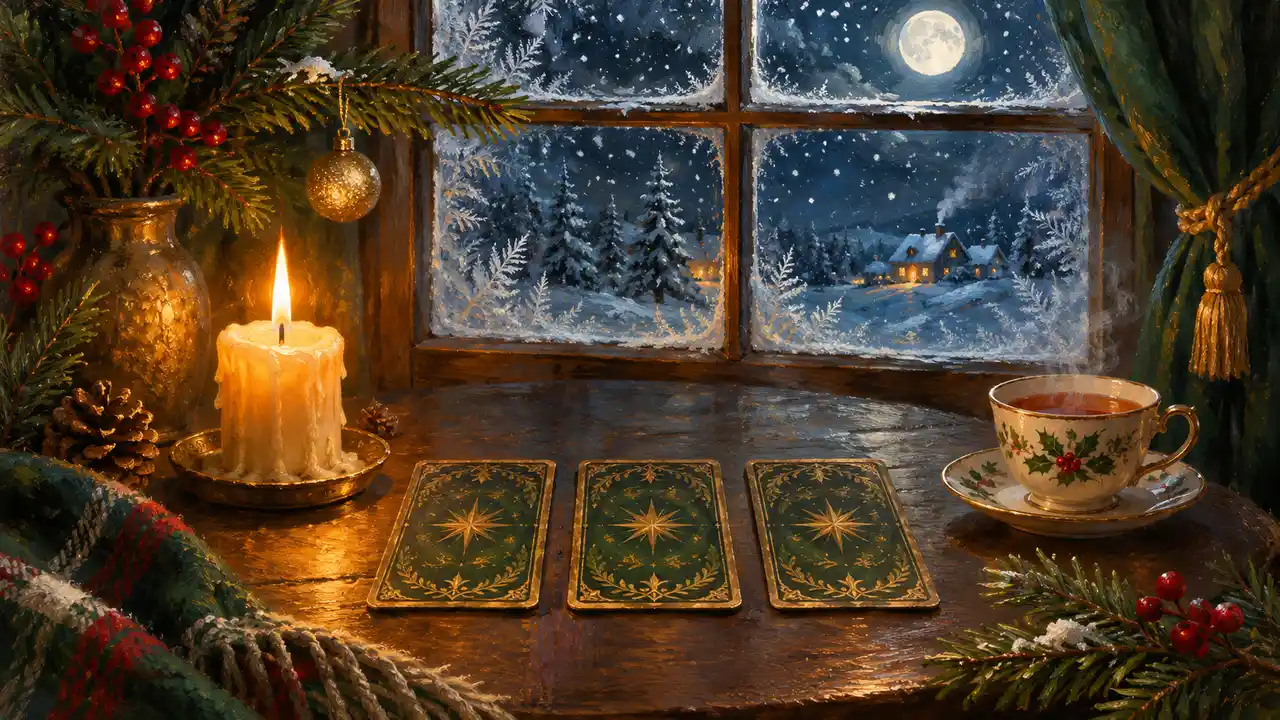
How do you approach a Christmas tarot reading? The simplest answer is to slow down first and ask second. Around Christmas, work tends to ease off, the lights and music in the streets remind you that the year is almost over, and there is finally a little room to sort through what you have been carrying. That reflective mood is exactly what a good reading needs. This year the timing has an extra layer: on December 24, 2026, Christmas Eve falls on a full moon, and a supermoon at that, so the moon will look bigger and brighter than usual. The next day, December 25, Christmas Day, lands on a Friday and runs straight into the weekend. For many people, those few days are a rare stretch at the end of the year when you can rest properly and think clearly at the same time. You do not need any special ritual to use them well; a quiet table, a deck and an honest question are enough to begin.
The questions that suit a Christmas tarot reading fall roughly into three groups: where a relationship stands right now, what you want to close out properly this year, and which direction you would like to head next year. Instead of asking “will it happen?”, it usually works better to ask “what is the situation now?” and “what can I do?”. If you want a simple structure, try the three-card Christmas spread: the gift you received this year, what to let go of, and what to carry into the new year. Once the cards are down, resist the urge to jump to a conclusion. Read the three positions side by side, notice how they speak to each other, and finish by choosing one small thing you can actually do over the Christmas holiday. In this kind of reading, tarot works more like a mirror than a crystal ball: it helps you see your own state of mind more clearly rather than deciding your future for you.
Why Christmas Is a Good Time to Pause and Draw Cards
Christmas is not a divination holiday, but it works a lot like a comma in the sentence of your year. After months of being busy, gaps start to appear in your calendar in late December. People around you are swapping gifts and planning dinners, and almost without meaning to, you start looking back: how did this year actually go? That backward-looking mood is exactly the state a tarot reading benefits from most. Tarot is not a prediction machine. What it does best is help you put vague feelings into clear words.
This year's timing is a little special too. Christmas Eve, December 24, falls on a full moon, and it is also a supermoon, so the moon will appear larger and brighter than usual. In common symbolism, a full moon is often linked with seeing clearly and with harvest, the moment when what has been quietly growing finally becomes visible. You do not need to believe in astrology to borrow that image. Treat it simply as a prompt: on the night the moonlight is brightest, look at what in your life you most want to take care of. Christmas Day, December 25, is a Friday followed by the weekend, which gives you more room to reflect slowly in daylight, with a clear head.
If you would like a sense of the month's overall mood first, read the December 2026 tarot monthly forecast, then come back and use the method here for your own Christmas tarot reading. The monthly forecast gives the broad direction, while a Christmas reading stays closer to your personal year. Looking at both together makes it easier to find the question you genuinely care about.
Good Question One: Where Does This Relationship Stand?
Christmas has a way of bringing relationships to mind. Couples everywhere, family gatherings, friends exchanging presents: it is hard not to wonder where you stand. What are we to each other right now? Is this friendship still alive? Has that unspoken knot with a family member loosened at all this year? All of these are good questions for a Christmas tarot reading, but how you phrase them matters.
Rather than asking “Will they come back?” or “Will we be together next year?”, try “Where has this relationship arrived this year?” That wording keeps the focus on the present instead of handing the outcome over to the cards. The cards you draw can help you sense the current temperature of the connection. For example, the suit of Cups is generally interpreted as relating to emotional exchange, while the suit of Swords is often linked with communication, thoughts and distance. If one suit shows up a lot, ask yourself whether what passes between you is mostly feeling, or mostly things that never get said.
You can also break the question into smaller pieces: “What did I give most to this relationship this year?” “What do I really want the other person to know?” The answers are often already inside you; the cards simply help you say them out loud.
A relationship involves two people, and tarot can only reflect your side of it. The other person's feelings still need to be confirmed through real conversation. Christmas happens to be a natural reason to reach out, and a simple greeting or message may help more than another round of guessing.
Good Question Two: What Do You Want to Wrap Up This Year?
The second kind of question that suits Christmas is about closing out the year. Everyone's year has things left halfway: unfinished plans, thank-yous never said, clearing out that has been postponed for months, a thought you keep wanting to drop but cannot quite let go of. The end-of-year atmosphere tends to bring these to the surface on their own. Instead of letting them circle in your head, it helps to look at them properly once.
Useful ways to ask include: “What do I want to wrap up properly this year?” “Which one thing, if I dealt with it before the year ends, would make me feel lighter?” “What explanation do I still owe myself about this year?” These questions are not about finishing everything during the holiday. They help you tell apart what is worth closing and what can honestly be left as it is.
Wrapping up does not always mean ending. Sometimes it means completing something, sometimes saying goodbye, and sometimes simply admitting, “I could not do this this year, and I am setting it down for now.” The cards can hint at which kind you are facing. The suit of Wands is generally interpreted as relating to action and passion, while Pentacles are often linked with practical life, work and resources. If many Pentacles appear in a wrap-up question, what needs closing may be concrete, everyday matters rather than emotions.
For a fuller look back over the whole year, pair this with the 2026 year-end tarot review: trace the year's overall arc first, then use the three Christmas cards to focus on the one thing you most want to close.
Good Question Three: Where Do You Want to Go Next Year?
The third kind of question is about direction for the new year. Christmas sits close to New Year's Eve, and many people start thinking about next year's goals during these days. When you draw cards now, the point is not to predict what will happen next year but to clarify where you yourself want to go.
Helpful phrasings include: “Which direction do I want to move in next year?” “Where do I want to put more of my energy?” “What do I want more of, or less of, next year?” These questions keep the steering wheel in your hands. The cards offer a way in. If cards associated with beginnings or setting out appear, consider whether you already have a direction you quietly want to try. If cards associated with waiting or introspection appear, perhaps the start of next year is better spent strengthening your foundations than rushing ahead.
One reminder matters here: cards about next year's direction are not a promise and not a verdict. Even a card that looks smooth reflects your present state and possibilities; a card that looks harder simply points to places that deserve more care. The future still depends on what you choose and do next.
A Christmas reading is best for catching a general sense of direction. If you want to plan next year in more detail, wait until the holiday is over and your mood has settled, then use the 2027 yearly tarot spread guide for a more complete annual spread. Used together, one handles the feeling and the other handles the planning.
What Not to Force on Christmas Eve
Christmas Eve can be beautiful, but not every question is suited to being pushed alone on that night. The most common trap is pressing late at night, while your mood is low, about a relationship that no longer has an answer. Watching everyone else celebrate while you sit by yourself, it is easy to ask “Do they still love me?” or “Is there still a chance for us?” again and again. In that state, you tend to read whatever card appears in the bleakest or the most wishful light, and the reading leaves you more unsettled than before.
Another trap is asking the same question over and over until you get the answer you want. That is not really asking the cards; it is looking for permission. If the first draw makes you uneasy, that unease is itself worth looking at. Redrawing again and again only drains every result of meaning.
Why is the urge to draw cards so strong at night? Late at night, emotions tend to feel amplified, and thoughts you pushed down during the day come back up. You can read more in why you always want to draw tarot at midnight. If you notice yourself in that state on Christmas Eve, write your question down and promise yourself you will ask it the next morning. After some sleep and breakfast, the same question often looks quite different.
If you have been sleeping badly or feeling physically exhausted lately, look after your body first. If you feel unwell, please see a doctor; tarot speaks to your state of mind and is not a substitute for medical advice. When emotions feel heavy, talking to a trusted friend or family member can come first. The cards can wait.
How to Lay Out the Christmas Three-Card Spread
If you want a simple structure for your Christmas tarot reading, try the Christmas three-card spread. The three positions are: the gift you received this year, what to let go of, and what to carry into the new year. The design is intuitive, a bit like sorting the boxes under the Christmas tree: see what you received, take out what you no longer need, and choose what you want to keep.
The layout is easy. Before shuffling, sit quietly for a few minutes and let a rough picture of your year come to mind; it does not need to be detailed. When you feel ready, lay out three cards from left to right. The left card is the gift you received this year, the middle card is what to let go of, and the right card is what to carry into the new year. You can do this on the night of the Christmas Eve full moon, or during the day on Christmas when you feel calmer. What matters is choosing a time when you will not be interrupted or rushed.
After turning the cards over, do not rush to look up meanings. Give yourself a moment to take in the images and notice the first feeling that comes up: who or what does this card remind you of? Write those impressions down, then compare them with common card meanings. Sometimes your intuition and the usual meaning agree, sometimes they differ, and both are worth recording.
Reading these three cards works much like any three-card spread. If you are not yet comfortable with that, start with how to read a three-card tarot spread to learn the basics of how three cards relate, then come back and apply them to the three Christmas positions.
Position One: The Gift You Received This Year
The first position is the gift you received this year. A gift here does not only mean good news or achievements. It also includes experiences that felt uncomfortable at the time but helped you grow when you look back. This position invites you to view the year through the lens of gratitude.
If this position shows a card that looks warm or abundant, think about which people or opportunities made you feel supported this year. The suit of Cups is generally interpreted as relating to emotions and connection, so here the gift may have come through a relationship. Pentacles are often linked with stability and practical progress, which may suggest you laid some real foundations in your work or daily life this year.
If a heavier-looking card appears here, such as an image of loss, conflict or pressure, there is no need to panic. It may be saying that this year's biggest gift was an experience that showed you yourself more clearly. Perhaps a relationship that ended helped you understand what you truly want, or a setback taught you how to ask for help. Reading it this way keeps you from seeing the whole year as negative.
When interpreting this position, ask yourself: “Have I actually accepted this gift yet?” Some gifts we have not properly acknowledged, such as being stronger than we thought, or having someone by our side all along. Saying it out loud or writing it down is where accepting it begins.
Position Two: What to Let Go Of
The second position is what to let go of, and it is usually the one that takes the most courage to face. It does not necessarily point to something bad. It may be a habit, a role or an expectation that once mattered a great deal but no longer fits who you are.
When reading this position, consider a few angles. Is there a thought you have turned over all year without getting anywhere? Is there a responsibility you have been carrying that was never really yours? Is there an expectation in a relationship that you have been holding up on your own? The suit of Swords is generally interpreted as relating to thoughts, anxiety and words, so when it appears here, what needs releasing may be excessive worry or self-criticism. Wands are often linked with action and responsibility, which may point to things you have taken on far too much of.
Letting go is not the same as rejecting. You can thank that thing for walking part of the road with you, and then leave it in this year. You also do not have to release it all at once. You can let go of part of it first, for example by no longer thinking about it every day, or no longer checking on it.
If the card in this position makes you resist strongly, that resistance deserves attention. It might mean this matter is still important to you and now is not the time to let go. Or it might mean you already know the answer and simply need a bit more time. Neither is wrong; being honest with your own feelings is enough.
Position Three: What to Carry Into the New Year
The third position is what to carry into the new year. The first two positions look back, while this one turns your gaze forward. It might be an attitude, a habit you want to continue, a relationship you want to nurture, or an idea that sprouted this year and that you would like to see grow next year.
When reading this position, the point is not to predict whether next year will go smoothly but to ask: “What do I want to bring with me into the new year?” If a card associated with beginnings, energy or action appears, think about something you started this year that is worth continuing. If a card associated with stability, care or patience appears, perhaps what you most need to bring along is a slower, steadier rhythm.
This card often echoes the first position. The gift you received this year is frequently the very thing you can carry forward. If you learned to ask for help this year, for example, you can take that ability into more areas of life next year. Sometimes the two cards seem completely unrelated, which may mean you want to develop an entirely new side of yourself next year.
Keep in mind that this position describes direction and resources, not a declaration of outcomes. A smooth-looking card does not mean everything will go your way next year, and a harder-looking card does not mean things will go badly. It is simply saying: carry this with you, and you will walk forward with more confidence.
How to Read the Three Cards Together
Once you have read each card on its own, the most interesting part is looking at them together. The three positions of the Christmas spread actually form a line: from what you received this year, to what you need to let go of, to what you want to take into next year. You can compare them from three angles.
First, look at the link between the gift and what you are letting go. Sometimes this year's gift is exactly the strength that allows you to release something. If you gained a circle of friends this year who truly listen, for instance, you may find the courage to step away from a relationship that kept leaving you hurt. If these two cards seem to contradict each other, ask whether a gift might also contain a part that needs to be released.
Second, check whether letting go creates space for what you carry forward. Whatever you release leaves an empty spot in your life, and what you bring into the new year can fill it. Letting go of excessive demands on yourself, for example, frees up energy for what you genuinely want to do.
Third, notice the overall mood of the three cards. If they share a suit or similar colors, this year's theme may have been quite focused. If they differ widely, perhaps you moved back and forth between many areas of life. None of this is good or bad; it simply helps you understand the shape of your year.
After comparing them, try summing it up in one sentence: “This year I received ___, I want to let go of ___, and I will carry ___ into the new year.” Writing that sentence down is the most practical takeaway from your Christmas tarot reading.
Turn the Cards Into One Small Holiday Action
After drawing and reading the cards, many people stay with the feeling that something rang true, and then forget about it a few days later. The most worthwhile final step in a Christmas tarot reading is to turn what the cards suggested into one small thing you can do during the Christmas holiday.
The method is simple: go back to each of the three cards and ask, “What could I do in the next few days?” The gift you received this year can become an act of thanks, such as sending a message to someone who helped you this year or writing a few grateful lines on a card. What to let go of can become a concrete bit of clearing out, like deleting a chat thread that keeps upsetting you, leaving a group you stopped taking part in long ago, or dealing with that box of old things in the corner of your room. What to carry into the new year can become a small beginning, such as buying a book you have wanted to read for ages, signing up for a trial class, or writing the first thing you want to do next year in your calendar.
If you want to do all three, wonderful, but if you can pick only one, choose the one you feel most strongly about. The action does not need to be big; it needs to be doable. Christmas Day, December 25, is a Friday, and the weekend that follows is a good time to get it done. Once it is done, you may find the cards' message is no longer just a feeling but a small change that actually shows up in your life.
If you want to carry these small actions through the rest of the month, revisit the December 2026 tarot monthly forecast and plan the final weeks of the year at a gentler pace.
References
Bring the one thing you most want to sort out this year and draw your cards. Let three cards on Christmas Eve help you settle your feelings before you step into the new year.
Get a Tarot Reading