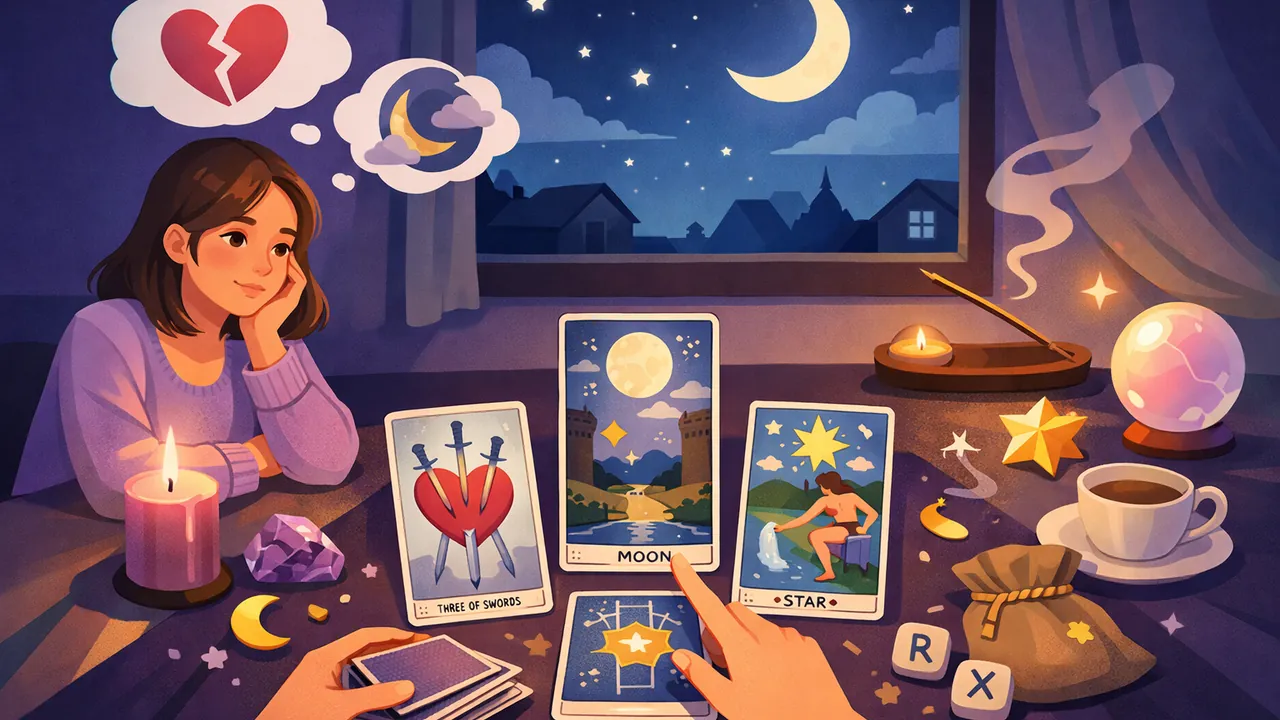
Yes. A card drawn at night is just as random as a card drawn during the day, and the hour doesn't make a reading more or less accurate. What matters is the state you're in. When you're tired or upset late at night, the same card often reads much darker than it would in daylight.
So before a late-night tarot reading, take one minute to ask yourself: do I want to sort out my thoughts, or do I just want an answer that makes me feel safe? If it's the first, go ahead and draw. If it's the second, sleep first. Things usually look a lot clearer in the morning.
Morning, Daytime, Evening, Late Night: What Each Is Good For
Time | Better for | Watch out for
Morning | One card as a reminder for the day; specific things you need to handle today | Don't ask big questions when you're rushing, or you'll only remember one line
Daytime | Work questions and decisions; anything you need to check facts on | If it's noisy and you keep getting interrupted, write the question down before drawing
Evening after work | Looking back on the day; taking stock of a relationship or situation | If you're worn out from the day, eat and rest before you ask
Late night | Quiet, good for writing down what's on your mind and asking “what am I feeling right now?” | Emotions are easiest to amplify; don't make major decisions late at night, and don't keep redrawing
As you can see, the difference isn't the time itself. It's the state you're usually in at that time.
A Self-Check Before a Late-Night Reading
Late at night is when the urge to read tarot hits hardest: you're alone in bed scrolling your phone, and the question in your head keeps getting bigger. Before you draw, run through this list:
- Am I already exhausted, with my eyes about to close?
- Have I just been crying, just had a fight, or been drinking?
- Do I only want to hear “it'll be fine,” and plan to redraw if I hear anything else?
- Have I already drawn several times about the same thing?
If any answer is yes, it's better to write the question down and draw tomorrow during the day, or note tonight's cards and read the interpretation the next day. The cards won't go anywhere, and your judgment will be clearer.
On the other hand, a night reading can be just as helpful when you're in these states: you've already thought through what happened instead of just pouring your feelings in; you're willing to let the cards point out a blind spot rather than just wanting comfort; and once you're done, you're ready to go back to real life and watch or adjust.
Why the Urge to Draw Cards Hits in the Middle of the Night
The urge to draw cards late at night rarely comes out of nowhere. It usually has one of three sources. They look alike, but each wants something different. Recognizing which one you're dealing with tonight helps you know what to ask and when to stop.
- You were too busy to think all day: commuting, meetings, replying to messages, chores. You spent the whole day handling things. The things that need slow thought, like whether this relationship still works or whether you still want this job, all got pushed back. Once you've showered and turned off the light and there's nothing left on your to-do list, it's finally their turn. Wanting to draw cards then often isn't about knowing the future; it's about finally opening up worries that have been piling up. Pick the one thing you care about most tonight and write the rest on paper for tomorrow. During the day, you can also set aside ten minutes without your phone just to think about your own life, so you don't have to carry the whole day's load at midnight.
- Emotions get louder at night: there's no noise around you and no one to answer, just you and your thoughts. A comment you'd normally laugh off can replay in your head over and over at midnight. Still, nighttime feelings are also more honest. The hurt and longing you brushed off with “I'm fine” during the day often speak the truth late at night. These feelings are worth listening to, but don't act on them yet. Use the cards as a way to listen to yourself and notice which part of you got touched.
- You want an answer so you can sleep: the same thing has looped in your head so many times that you're no longer thinking, just going in circles, so you badly want someone to just say “do this” so your mind can stop. But the cards are more like a mirror; they won't make the decision for you. If you expect to hand off the responsibility once you draw, an answer that's unclear or not what you wanted to hear will keep you up even longer. Try changing the question to “What can I do tonight to feel a little more at ease?” Then you're not looking for a final verdict, just a reason to set things down for now.
Questions for the Night, and Questions to Save for Daytime
Good to ask at night | Wait until daytime
What am I most worried about right now? | Should I break up?
What exactly upset me about what happened today? | Should I quit my job?
What can I do to feel a bit better? | Has he stopped loving me?
When I talk to him tomorrow, what do I want to make clear first? | Did I do everything wrong?
The questions on the left help you sort yourself out. The ones on the right involve major decisions, or are easily read as the worst-case version late at night.
Two Common Situations
After work, wondering about someone you're seeing
Hypothetical: it's 10 p.m., your message has been read with no reply, and you want to ask “has he lost interest in me?” A better approach is to rephrase it first: “Where are our recent interactions getting stuck? How could I respond?” After you draw, write down the interpretation and don't rush to send a message that night. Look at it again the next morning. If you still feel the same way, then decide how to reply.
Anxious at bedtime and wanting to keep redrawing
Hypothetical: it's 1 a.m., you asked about work, drew the Nine of Swords, and the more you look at it the more panicked you get, so you want to draw again to see if it gets better. The Nine of Swords is generally read as anxiety and sleeplessness, and often it's describing the state you're in right now, not how things will end.
What helps most here isn't another draw. Stop, write down the outcome you fear most, then see which parts you can actually deal with tomorrow. Once it's written down, go to sleep and read the interpretation again tomorrow during the day.
Asking for Someone Else? Hold the Boundary First
What keeps you up at night often isn't only your own business: a friend has been down lately, a family member isn't well, your partner has been quieter than usual. The longer you lie in bed thinking, the more worried you get, and the more you want to ask the cards on their behalf. That care is a good thing. You just need to adjust the direction of the question first.
When you ask for someone else, the question easily becomes “What is he thinking right now?” or “Is she hiding something from me?” That person isn't there and didn't ask you to ask for them, so what you read is easily your own worry projected onto them. The next time you see them, you might interpret their every move through that guess and create misunderstandings.
A better way is to bring the focus back to what you can do:
- How can I be there for him without making him feel pressured?
- Within my worry about this, which parts can I actually do something about?
- Next time we meet, what attitude do I want to bring to the conversation?
Answers to these questions are usable as soon as you wake up, like sending a caring message that doesn't pry, or inviting them to dinner on the weekend. For more on what to keep in mind, see reading tarot for someone else.
A Three-Card Bedtime Spread: Setting Worries Down
If you still want to draw before bed, try this small spread. It isn't for answering “how will this turn out.” It helps you sort your worries, set them down, and deal with them tomorrow:
1. What is keeping me from letting go today?
2. What part of it can I set down tonight?
3. What is one small thing I can do when I wake up tomorrow?
Hypothetical: you can't sleep because a proposal got sent back, and you draw the Five of Cups upright, the Four of Swords upright and the Page of Pentacles upright. The Five of Cups suggests your eyes are stuck on what was lost, forgetting the cups still standing, the resources you still have. The Four of Swords suggests what you need most tonight is rest; you don't have to find the answer now. The Page of Pentacles suggests starting tomorrow with one practical task, like listing your manager's comments point by point and revising them one at a time. Draw, write it down, then go to sleep.
You can also change the third position: swap “one small thing I can do tomorrow” for “one sentence that can help me feel at ease tonight.” Pick one; you don't need both.
- If you can't sleep because the problem isn't handled yet and you keep planning what to do tomorrow, use “one small thing for tomorrow.” Turn the plan into one concrete action, write it on a sticky note and put it where you'll see it on your way out, so your mind can rest.
- If you've already done your best and what's holding you is self-blame, hurt or a loss you can't put into words, use “one comforting sentence.” Look at the cards, imagine a friend who really gets you sitting next to you, think about what they'd say, and write it down for yourself, like “I did my best” or “No rush, I can take it slowly.”
Whichever you choose, put the cards away when you're done, keep your phone out of reach, stop asking follow-up questions and don't go online looking for more meanings. These three cards are for closing out today, not opening a new topic.
When Tarot Helps, and When to Hold Off
Good for sorting out with tarot | Hold off for now
Before a decision, laying out the pros and cons of a few options | Right after a fight, while emotions are still running high
A relationship feels stuck and you want to see what you really care about | You've already drawn several times about the same thing tonight
Your mind is a mess and you want to untangle your feelings first | Matters that need a medical, legal or financial professional's judgment
Tarot can help you organize your thoughts, but it can't carry the decision for you. For serious health, legal or money matters, please see a doctor, lawyer or qualified professional.
Why the Same Question Asked Twice Gives Different Results
Every draw is random from scratch, so getting different cards when you ask the same question twice is normal, and it doesn't mean the first reading was wrong. Late at night it's especially easy to fall into “if I don't like it, draw again,” until you get the answer you wanted. What you end up with is no longer a reading but your own expectation. If you want to ask about the same thing again, wait until something has actually changed. See how often you should read tarot.
Mistaking Anxiety for the Cards' Answer
There's another late-night trap that's hard to notice: you think the cards are speaking, but it's actually your anxiety. When you're feeling low, a card with heavier imagery sends your mind straight to the worst ending. Even a fairly neutral card can get forced into a bad reading because you feel uneasy. That doesn't mean you can't read cards. When people are tired or worried, they naturally notice unsettling signals more.
The way to tell is simple. After looking at the cards, ask yourself: “If it were daytime, and I were well fed, well rested and calm, how would I read this spread?” Often you'll find the same image can be read several ways. Card meanings usually have several layers and rarely point to just one outcome.
Then take a sheet of paper and split it into two columns:
- Left column: the cards themselves, what's in the image and what this position is asking.
- Right column: the thoughts that popped up when you saw the cards. Lines like “It's over” or “I knew it, it's my fault again” go here.
Read it back afterward and you'll often find the right column is much longer than the left. What keeps you awake is worry magnified by the night, not something the cards actually said. If you drew three cards, remember to read all three together instead of fixating on the one image that scares you most.
The Vicious Cycle of Late-Night Readings
You meant to take a quick look before bed, and suddenly it's 2 or 3 a.m. The next day you're foggy and make mistakes at work, you feel worse that night, and you want to draw cards even more to check whether you've messed up, so you stay up late again. Once or twice is fine, but if it becomes a habit, late-night tarot stops keeping you company and starts wearing you down.
This cycle is hard to break because every night seems to have a reason why you “have to ask tonight.” But most things won't change because you asked about them at 3 a.m. Lack of sleep actually makes your daytime judgment worse, and things you could have handled get harder. A good night's sleep is preparation for whatever you have to face tomorrow.
A few things you can start doing right away:
- Set a time to put the cards away, like before midnight. When time's up, stop, even if you still want to ask.
- Put the cards back in their box after you draw, not next to your pillow. Cards within arm's reach are the easiest to flip again.
- If you read on your phone, close the screen when you're done. Don't drift over to social media or search for more card meanings.
- Treat “I won't ask tonight” as a real option, not as losing to yourself.
Choosing to sleep when you really want to ask is a practical way of taking care of yourself. The issue will still be there tomorrow, and you'll have more energy to deal with it.
Moon Phases, Candles and Small Night Rituals
Some people believe readings on a full moon or new moon are especially accurate. Card draws are random, and the moon phase doesn't make them more accurate. If you feel more emotional on a full-moon night, that's your own mood. You can use it to observe yourself, but it doesn't need to be a condition for reading.
If you like a bit of ritual at night, dim the lights, turn off notifications and take a few deep breaths before you start. If you want to light a candle or incense, put it in a stable holder, away from the cards, curtains and bed, and always put it out before you get sleepy. Honestly, a small desk lamp is enough. If you're drawing online, a quiet corner is all you need.
When You Feel Very Low Late at Night
If you keep going over the same thing late at night, are too upset to sleep, or have thoughts of hurting yourself, what you need more than a tarot reading is someone to listen. Contact a local crisis hotline or emergency services; many crisis lines are available around the clock.
Lots of people have the occasional sleepless night and want to talk things through with the cards. The thing to watch for is when it becomes the norm, for example:
- For weeks you've been sleeping badly through the night, or waking very early and not getting back to sleep.
- You have no energy during the day, can't eat, and find it hard to focus at work or school.
- You've lost interest in things you used to enjoy and see friends and family less.
When these show up, it's no longer just overthinking at night; your body and mind are telling you that you need more care. If you're unwell, please see a doctor. Tarot speaks to your state of mind and doesn't replace medical judgment. Insomnia and emotional struggles are common, and both can be treated. You can start with your family doctor or a mental health professional, or use counseling resources from your school or workplace. On nights when you really can't cope, don't stay alone. Call a friend or family member you trust, or a crisis line. Being unable to sleep isn't some special gift; you deserve a peaceful night.
If you're still fairly clear-headed, turn the thing you most want to understand into one specific question and draw once. If you're already exhausted or hurting, sleep first. It's not too late to come back tomorrow.
Draw cards for your question