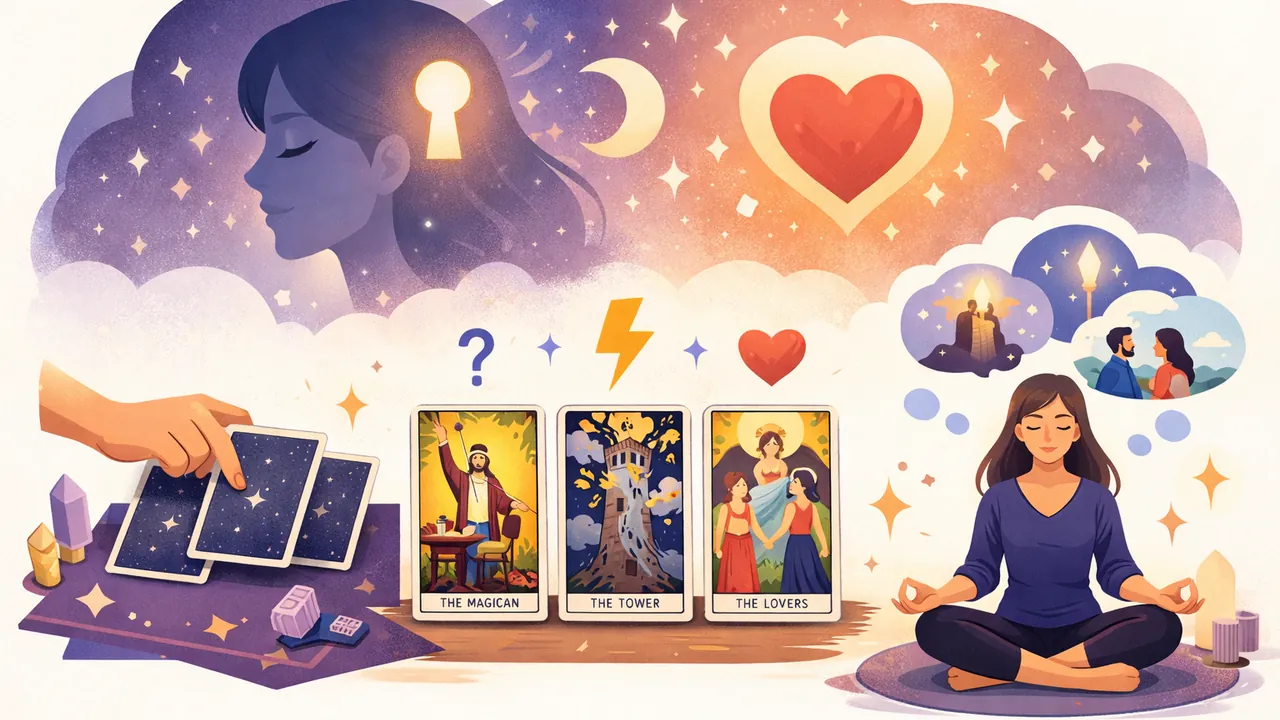
A three card tarot reading doesn't depend on memorizing what each card means. It depends on two things: deciding what the three positions stand for before you draw, and linking the three cards into one sentence afterward. The three most common structures are Past / Present / Future, Situation / Challenge / Advice, and Surface Issue / What's Really Blocking You / What You Can Do.
Many people draw three cards, look up every meaning, and still can't put them together, so they end up with three unrelated explanations. Below, a table helps you pick a structure, then four steps show how to link the cards, and three full examples show the same method applied to different questions.
Key points: 1) Set the positions first, then read the cards, and don't change what a position means after drawing. 2) Link the three cards into one sentence: what caused it, where you're stuck, what you can do next. 3) The Future card shows where your current direction tends to lead. It isn't fixed, so always finish with an action.
Choose a Structure: Five Common Three Card Layouts
Structure | Three positions | Good for questions like
Timeline | Past / Present / Future | How did this get here, and where is it heading if nothing changes?
Situation-Challenge-Advice | Situation / Challenge / Advice | I'm stuck and want to know what the problem is and what to do
Inner layers | Surface issue / What's really blocking you / What you can do | I know what I should do but keep not doing it, and want to see myself clearly
Two-person relationship | Your mindset / Their mindset / Where the relationship is heading | Love or social dynamics, comparing two people's states
Either-or | Option A / Option B / Advice | Quickly comparing two choices
Beginners do best with the first two: the timeline shows you the backstory, and situation-challenge-advice points straight to action. To see how past, present and future cards reveal the turning points of a situation, read how to read a past, present, future timeline spread. If you want to lay three cards in a triangle, the layout and reading method are in how to lay out the holy triangle spread.
Four Steps to Link the Three Cards
1. Read the position first, then the card: take only the meaning that fits that position. The same Two of Swords in the Challenge spot means you're stuck and afraid to decide; in the Advice spot it means pause and don't rush to choose.
2. Look at how the three cards relate: many Major Arcana suggest a bigger life theme; a repeated suit shows where the problem centers, such as Cups for emotions and Pentacles for practical conditions; wherever the reversals cluster is usually where things are most stuck.
3. Make one sentence: for a timeline, try 'Because..., now..., if this continues...'; for situation-challenge-advice, try 'Right now..., I'm stuck on..., I can start by...'. If you can't say it as one sentence, you're probably still translating card by card.
4. End with one action: ask yourself what small thing you can do this week, and what you'll watch for afterward.
Full Example 1: Timeline (Past / Present / Future)
This is an illustrative scenario. Say things with your roommate have gone sour lately, and you ask: 'Where is my relationship with my roommate heading over the next month?' You draw:
- Past: Three of Cups (upright). Three people raising cups in celebration, friendship and sharing. When you first moved in together, you got along well.
- Present: Five of Wands (upright). A group clashing with raised staffs, friction and competition. Lately you keep arguing over small things like chores and schedules.
- Future: Six of Swords (upright). A ferryman carrying people away from rough water, transition and leaving a hard place. On the current path, the relationship is more likely to move toward distance and cooling off, such as redividing space or talking about living apart.
As one sentence: 'Because we were once close, the friction now hurts more; if this continues, distance is more likely than going back to how things were.' Action: if you want to keep the relationship, talk through chores and schedules while the friction is still small. The Future card shows where the current direction tends to lead; if you change your approach, the outcome may change too.
Full Example 2: Situation / Challenge / Advice
This is an illustrative scenario. Say you were laid off two months ago and can't find the energy to job hunt, and you ask: 'How do I start looking for work again?' You draw:
- Situation: Five of Cups (upright). A cloaked figure stares at three spilled cups while two still stand behind them. You're still processing the loss and focused on what's gone, overlooking the skills and connections you still have.
- Challenge: Two of Swords (upright). Blindfolded, arms crossed holding swords, stalemate and avoidance. You're stuck between changing careers and finding a similar job, so you do neither.
- Advice: Ace of Wands (upright). A hand from the clouds holds a sprouting staff, inspiration and a fresh start. Try something small and let action bring the spark back.
As one sentence: 'The loss isn't fully processed, which keeps you frozen between two paths; instead of waiting to have it all figured out, use one small action to restart your momentum.' Action: this week, send three applications for similar roles and sign up for one intro class in the field you're curious about. Take one small step down each path, then see which one feels more alive.
Full Example 3: Inner Layers (With One Reversed Card)
This is an illustrative scenario. Say your thesis has stalled for a whole semester, and you ask: 'Why do I keep procrastinating, and how can I start writing?' You draw:
- Surface issue: Eight of Pentacles (reversed). Upright, it's focused craftsmanship; reversed, it's generally read as burnout, slipping quality or perfectionism. You think you're lazy, but it looks more like fear of not writing well enough, so you never start.
- What's really blocking you: Nine of Swords (upright). A figure sitting up in bed at night, face in hands, anxiety and self-blame. What really stops you is the worry that floods in whenever you think of the thesis.
- What you can do: The Star (upright). Pouring water back into a pool under the stars, hope and healing. Write one imperfect draft section and let the feeling of 'I can do this' return bit by bit.
As one sentence: 'Behind the procrastination is perfectionism, and what really holds you back is anxiety; let yourself write an imperfect version first, and hope will slowly return.' Action: write for twenty minutes every day, aiming to finish, not to be good, and revise after a week.
The Most Common Mistakes in Three Card Readings
- Each card speaks on its own: you look up three meanings and stop, without building one story. Try the sentence patterns above.
- Deciding positions after drawing: saying 'let's call this one the advice' after seeing the card is picking the answer you want to hear. Write down the positions before you draw.
- Treating the Future as fixed: the Future card is the trend of your current direction, not a verdict; its value is prompting you to consider adjusting.
- Redrawing when a heavy card appears: when cards like the Nine of Swords or The Tower show up, first check their position. In the Challenge spot, it's a problem to deal with; in the Advice spot, it's a reminder to adjust first. Neither is a sentence passed on you.
Three cards suit clearly scoped questions. If a situation involves many people and factors, such as whether to start a business or where a long-term relationship is going, three cards won't be enough; try a five card spread or the Celtic Cross. For decisions about health, legal matters or large sums of money, rely on professional advice and use the cards only to sort out your thoughts.
References
Want to practice a three card reading? Write the question you most want to clarify as one sentence and draw three cards. Link them yourself with the four steps above, then compare with the AI reading to see what you already picked up and what you missed.
Draw for your question