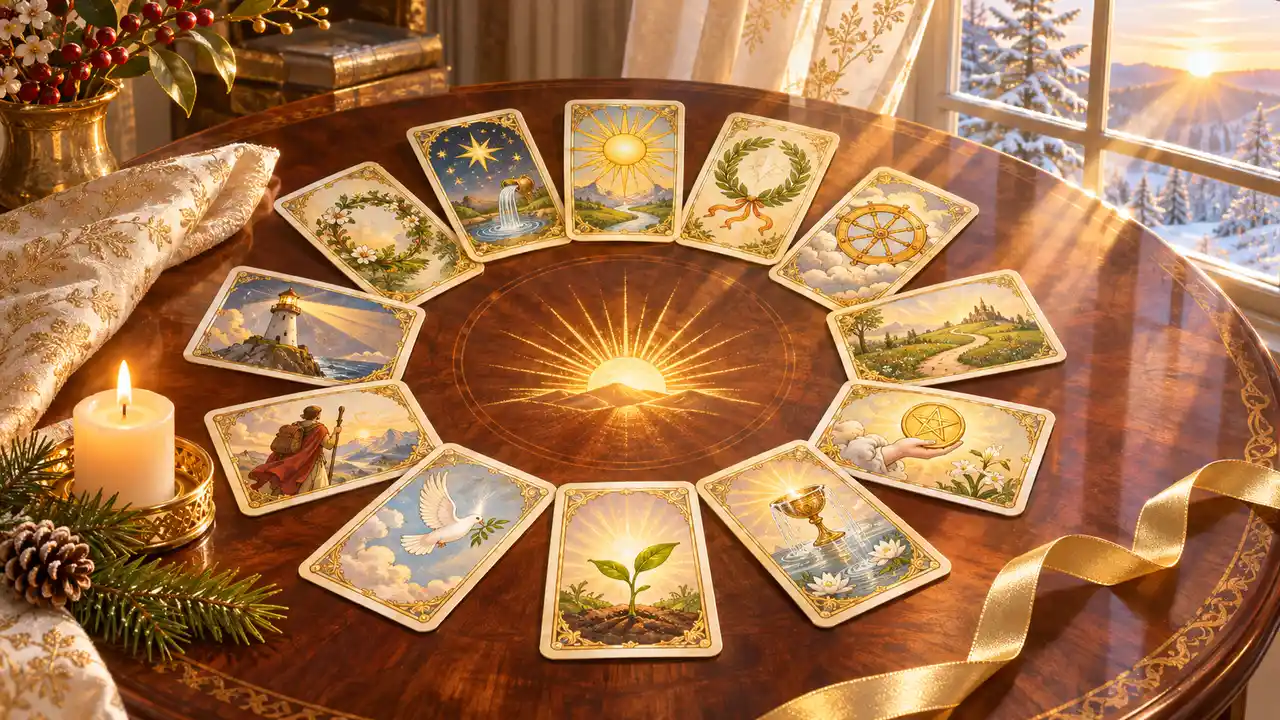
If you want to know what 2027 holds, the most grounded approach is not to wait for someone else's one-size-fits-all forecast. Instead, lay out a yearly tarot spread for yourself. The structure is simple: draw one card for the overall mood of the year, then place twelve more cards in order, one for each month from January to December. The result relates only to your own situation, and you always know exactly which question each card is answering. In this kind of reading, tarot works more like a mirror. It helps you see where you want to put your energy this year and which areas need extra care, rather than deciding for you what will happen. Think of the spread as a planning companion for the year: something you return to each month, not a verdict you receive once and file away.
Most people get stuck on two things the first time they try a yearly spread. There are so many cards that they don't know where to start, and a card that looks bad makes them anxious. In fact, once you decide what each position is asking and read every card in the same order, thirteen cards become surprisingly manageable. The guide below walks through how to draw and interpret the yearly theme card, how to lay out the twelve month positions, where to look for love, work and money, and how to turn a difficult card into a useful reminder. It finishes with the best time to draw, how often to repeat the spread, and why it is worth keeping a written record of your results. None of it requires advanced knowledge. If you can read a three-card spread, you already have the skills you need, and the rest comes with practice and patience.
What a yearly tarot spread is and who it suits
A yearly tarot spread is a set of cards laid in fixed positions so you can take stock of the whole year ahead in one sitting. It works differently from an everyday reading. A regular reading usually zooms in on one question. A yearly spread breaks the year into stages you can actually observe, so you see the overall direction and the focus of each period at the same time.
The most common layout uses one yearly theme card plus twelve month cards, thirteen cards in total. The theme card answers “What is this year asking me to pay attention to overall?” and each month card answers “Where is my attention best placed this month?” If thirteen cards feel like too many, start with a simple three-card or five-card layout. For example, use one card for the first half of the year, one for the second half and one for overall advice, then expand once you feel comfortable. You can find these basic layouts in five easy tarot spreads for beginners.
A yearly spread suits people who like to sort through their thoughts at the end of the year. It also suits people in a period of transition who want to set a direction for the new one. It is not a good tool for confirming whether a particular event will or will not happen, because a year holds too many variables. What the cards offer is tendencies and reminders. Before you draw, think about which area of your life you most want to take care of this year. Coming to the cards with “How do I want to live this year?” usually gives a clearer reading than “What is going to happen to me?”
How to draw your yearly theme card
Before drawing the yearly theme card, spend a few minutes getting the question clear. Questions that work well are “What does 2027 want me to pay attention to overall?” or “What attitude do I most need to build this year?” rather than “Will 2027 go smoothly?” The first kind gives you something you can act on. The second just keeps you going back and forth between good and bad.
In practice, shuffle the full 78-card deck, cut it, and take one card from the top. Place it face down at the top or in the center of the layout. Then turn it over together with the twelve month cards once they are all in place. Some readers prefer to reveal the theme card first and use it to set the tone for the whole year before looking at the months. Either order works. What matters is staying consistent.
A common question is whether to draw the theme card from the Major Arcana only. Using just the 22 Major Arcana cards tilts the answer toward life lessons and mindset. Using the whole deck means you might draw a Minor Arcana card, and the answer will sit closer to everyday matters. Both approaches make sense. For your first yearly spread, the full deck is a good choice, because it keeps you from quietly hand-picking cards on the idea that a Major card “feels more important.”
If the card's meaning is not obvious once you have drawn it, resist the urge to draw again. Note it down, wait until all the month cards are revealed, and then come back to it. The theme card often echoes something in the months, and then its meaning becomes clear.
How to interpret your yearly theme card
It helps to read the yearly theme card in three layers. The first layer is the card's core meaning. The Chariot, for example, is generally interpreted as momentum and taking control of your direction. The Hermit usually stands for slowing down and looking inward, and the Four of Pentacles is often read as holding on to what you have and a need for security. The second layer is whether the card is upright or reversed. A widely shared view is that a reversed card is not simply “bad.” It points to energy that is blocked, overdone or not yet mature. The third layer is your own situation, where you translate the card's meaning into concrete, everyday language.
Say your theme card is The Hermit. There is no need to read it as “I will be lonely this year.” It can instead mean this is a year to slow down and spend more time working out what you actually want. If you draw the Ace of Wands, a common interpretation is fresh drive and new beginnings. You might ask yourself: is there something I have wanted to start for a long time but never got moving on?
The theme card's biggest job is to act as a reference point for the whole year. Each time you turn over a month card, come back and ask whether this month moves in the same direction as the yearly theme or pulls against it. Months that align are good times to push forward. Months that pull against it are better for pausing and adjusting.
Finally, boil the theme card down to a single written reminder, such as “Build a solid foundation first.” A sentence is easier to remember than a card name, and you can check yourself against it all year.
How to lay out the 12 month cards
There is no single correct way to lay out the month cards, but three layouts are common. The first is three rows of four cards, with each row covering four months. You can also use four rows of three to match the seasons, which suits anyone who likes to review by quarter. The second is a circle that runs like a clock from January to December, with the theme card in the center. This layout makes the flow of the year easiest to see. The third is a single straight line, which saves the most space on a small table.
Whichever you choose, follow three rules. First, decide which position stands for which month before you draw, not afterward. Second, draw and place the cards one at a time, in order, so the sequence does not get mixed up. Third, once everything is laid out, look over the whole spread before reading card by card. Notice whether one season holds a cluster of the same suit or several Major Arcana cards.
That overall view is genuinely useful. If one quarter shows several Swords in a row, a common reading is that thinking, communication or decisions will take up more space during that stretch. If Cups gather in the second half of the year, emotional and relationship themes may stand out more then. This does not predict events. It hints at where your attention could go during that period.
If you want to practice reading how several cards relate before tackling thirteen, start with three. Once you are used to how cards complement each other, the full yearly spread becomes much easier. For how to read three-card combinations, see how to read a three-card tarot spread.
What to look for in each month card
Each month card reads best with the same question: “What do I most need to watch for or make the most of this month?” With one fixed question, you can compare the answers with each other instead of asking about love one month and work the next.
For a single month, try three steps. Start with the card's core meaning, then look at how it relates to the yearly theme, and finally come up with one small, concrete action. Suppose March brings the Eight of Pentacles. This card is generally linked with focused practice and building skills. Paired with a yearly theme of “build a solid foundation first,” it could make March the month to learn a new skill or tidy up your work routine.
You can also give the months a natural sense of timing. January and February tend to be a period for starting out and planning. The middle of the year often calls for a mid-point check, and November and December lend themselves to wrapping up and looking back. Placing each card's meaning in that rhythm makes the reading feel closer to real life.
One caution: month cards describe tendencies, not a calendar of appointments. A card linked with love in the July position does not mean you will meet someone in July. It suggests that during that stretch you may feel more drawn to relationship questions, or that it may be a good time to deal with something in a relationship. When the month actually arrives, compare the card with what is really going on. That tends to help far more than treating every card as settled from day one.
Where to look for love, career and money
A yearly spread has no dedicated love position or career position, but there are two ways to bring these three themes in.
The first is to look for clues by suit across all thirteen cards. The usual associations are Cups for feelings and relationships, Wands for action, passion and career growth, Pentacles for money, work results and practical resources, and Swords for thinking, communication and stress. After drawing, circle the months that share a suit. This gives you a rough idea of which months carry more relationship themes this year and which bring a busier pace at work.
The second is to draw three extra theme cards beside the main spread. Ask “What should I pay attention to in love this year?”, “What should I make the most of at work?” and “What should I adjust with money?” These three cards do not belong to any month. They add detail to the yearly theme, much like a general three-card spread.
If you want to go deeper on one topic, read the related guide first and then return to your own cards. For relationships, see how to ask tarot about your 2027 love life. For work, see how to ask tarot about your 2027 career, and for money, how to ask tarot about your 2027 finances. Those guides offer ways of thinking about each area, but the cards you draw yourself are the answer that belongs to you.
Whichever method you use, read one theme thoroughly before moving on to the next, so the meanings do not blur together.
What to do when you draw a difficult card
When The Tower, the Ten of Swords, The Moon or The Devil turns up in a yearly spread, many people's first reaction is worry. But tarot cards are not good or bad in themselves. These cards are better understood as pointing to areas that need extra care.
The Tower is generally interpreted as sudden change or a structure coming loose. You could read it as “during that stretch, don't tie everything to a single plan.” The Ten of Swords is often seen as something reaching its end, a reminder to let go of approaches that no longer fit. The Moon is associated with uncertainty and unclear information, which suggests checking the facts before big decisions. The Devil is often read as attachment or habitual dependence, so it is a good moment to look at what is holding you back.
The most practical way to handle a difficult card is to turn it into a question. If The Tower lands in September, ask yourself: “Which of my current plans is so rigid that any change would knock it over?” Once the question is written down, prepare a little in advance by building in some flexibility or setting up a backup plan. The hard card then becomes an early reminder.
There is also no need to redraw just because a difficult card appeared. When you redraw, you tend to see only the answers you wanted, and the spread loses its value. If one card leaves you especially uneasy, do a small three-card reading on it before that month arrives. Ask “What can I prepare in advance?” and bring your attention back to the things within your control.
When is the best time to draw
The best window for a yearly spread runs from late November to early January. As the year winds down, people naturally look back and take stock, and their hopes for the new year come into sharper focus. Drawing in that frame of mind makes the question easier to pin down.
Some people like to draw on the winter solstice, New Year's Eve or New Year's Day. Others choose the days around Lunar New Year. None of these dates is more accurate than another, so pick a moment that means something to you and lets you sit quietly. Your state of mind matters more than the date. Set aside at least half an hour, make sure no one is rushing you, silence your phone, and write your question on paper before you start shuffling.
Missing the start of the year does not mean you cannot draw. If you lay a yearly spread mid-year, change the positions to “the next twelve months” and start from the month you draw in. Or draw only the remaining months, together with one theme card for the second half of the year. A spread is a tool, and you can adapt it to your own timing.
Before drawing, it also helps to spend a few minutes reviewing the year that is ending: what went well, and what you would like to change. That review gives you excellent material for your question. You will have something clear to compare against when you read your 2027 cards, and the yearly spread won't turn into a vague verdict of good or bad.
How often to draw and whether to keep a record
Once a year is enough for a yearly spread. When you draw the same question again and again, it tends to turn into chasing a better answer, until the meanings contradict each other and nothing is clear. A better approach is to lay one full spread at the start of the year. After that, do small check-ins each quarter or at mid-year rather than throwing it out and starting over.
A quarterly check-in can look like this. At the start of each quarter, bring out that quarter's three month cards from your original spread and compare them with how the previous quarter actually went. Then draw one new card and ask “How can I adjust this quarter?” That keeps the year's overall direction while letting you change course as life changes.
Keeping a record is highly recommended. Note the date, your question, the card and its orientation in each position, how you interpreted it at the time and how you were feeling. You can photograph the spread or write it in a notebook. At the end of each month, take five minutes to add what actually happened and whether the card's message helped.
Over a year, that record becomes valuable material for self-reflection. You will see when you tend to get stuck and which reminders were there all along. If you also like drawing cards for single questions during the year, you can use AI tarot reading alongside your spread and add each result to the same record.
References
No need to wait for New Year's Eve. Draw your yearly theme card now and see what is most worth preparing for in 2027.
Draw your 2027 theme card