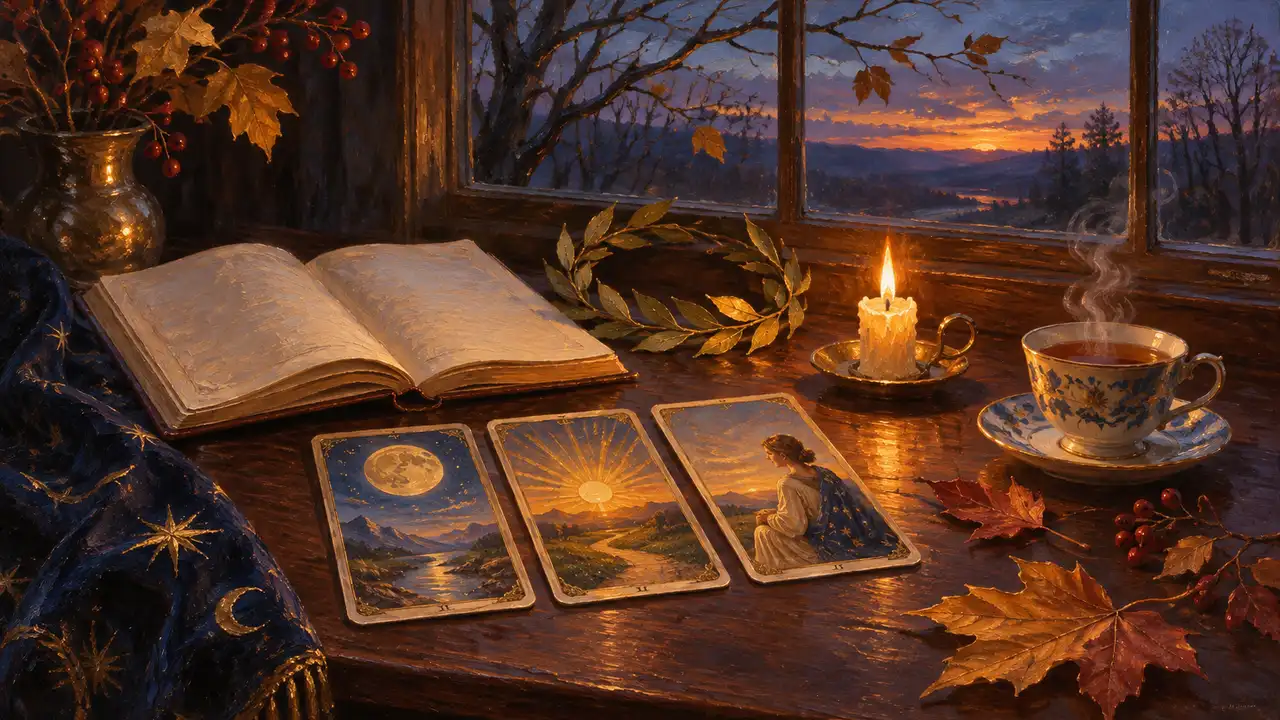
How do you do a year end tarot review for 2026? The simplest answer is this: before rushing to ask what next year holds, use tarot to take an honest look at the road you have walked this year. It is now mid-November 2026, the calendar is down to its last few pages, and many people start worrying about unfinished plans or hurrying to set goals for 2027. Yet pausing to sort through the year before charging ahead often makes the next step steadier. With the World card, the card of completion, as this month's ruling card, November is a fitting time to close the loop. A review reading is not about grading the year. It helps you see clearly which experiences are worth keeping, which weights you can set down, and what you want to carry forward. Think of it as a year-in-review for yourself, not a forecast of what is coming.
The method itself is not complicated. Prepare a few questions that are specific enough, then draw three cards for this year's gains, this year's lessons, and what you can bring into 2027. Place the three cards side by side and notice how they speak to one another. Finally, and this is the step people most often skip, write down what you saw and turn it into one small action you can take this month. The whole process is a bit like tidying a room with yourself for company: you pick things up one at a time, look at them, and decide whether to keep them, thank them, or let them go. You do not need to be an expert card reader. You only need to be willing to meet the person you were this year with honesty and a little kindness. Even a beginner can finish this review in one quiet evening.
Why the End of the Year Is Made for Reflection
Every November, many people notice a quiet, hard-to-name feeling: the year is almost over, yet a lot inside still feels unsorted. That feeling is actually a good starting point for a review. In the Major Arcana, the World card comes last, and it is generally interpreted as the completion of a cycle, a sense of wholeness for one chapter, and the moment just before a new journey begins. That is why it makes a natural ruling card for November 2026. It is not an ending so much as a circle: you walk the full loop, arrive back where you started, and find that you are no longer quite the same person.
The mood of November echoes the World card. The end of the year is more than a change of numbers on a calendar; it is a natural pause point that invites a simple question: what did I actually live through this year? Without that pause, one year is easily buried under the next. Good experiences go unacknowledged, painful ones go undigested, and both quietly pile up inside.
A common reading of the World card also includes integration. It reminds us that for a cycle to truly close, the scattered pieces need to be gathered so you can see the picture they form. That is exactly what a year end tarot review sets out to do: not rush to turn the page, but finish reading this one first. When you take the time to close well, a new beginning feels lighter, because you are not setting off with a pile of unopened boxes. A year-end review is a gentle full stop for this lap of the circle.
How a Review Reading Differs from a Forecast
When people think about tarot at the end of the year, the first instinct is often to ask what next year will bring. Forecast questions are perfectly valid, but a review reading points the other way: it looks at what has already happened and at where you stood within it.
Forecast questions tend to put the focus outside yourself: will a good opportunity show up next year, will I change jobs. Review questions bring the focus back to you: what did I learn this year, where did I get stuck, what did I get right. The first kind often comes loaded with hope or worry. The second feels more like a conversation with yourself, and its answers are easier to turn into concrete action.
Another difference is that cards in a review are less likely to be read as a verdict of good or bad. A card with heavy imagery might feel alarming in a forecast, yet in a review it often just names something you already knew but had not admitted. Perhaps you already sensed that you pushed yourself too hard this year, and the card simply lets that feeling be seen.
So when you sit down for your year-end review, it helps to set your curiosity about the future aside for a while. Not because looking ahead is unimportant, but because once you understand the road behind you, thinking about how to walk through 2027 gains direction and is less driven by anxiety. Reflection is the foundation; planning is the house you build on top of it later.
Three Good Questions for Your Review
Much of the quality of a review reading depends on the questions themselves. Here are three that work well, each matching one side of the year: acknowledging, releasing and carrying forward.
The first question: what deserves the most credit this year? Many of us fixate on what we did not get done and forget how many moments we got through and how much effort we put in. This question invites you to look at what has already grown, whether that is a skill, a relationship, a brave decision, or simply finally learning how to rest properly.
The second question: what is most worth letting go of this year? Letting go here does not mean denial or regret. It means recognizing habits, beliefs or expectations that no longer fit you. Some of them once protected you, but now they are only extra weight. Seeing them clearly is what gives you the chance to set them down gently.
The third question: what do I want to carry with me into the new year? This is not about predicting what 2027 will bring. It asks you which of the things you built up this year deserve more care. It might be a habit you want to keep, a mindset you want to hold onto, or a relationship you want to invest in.
You can ask all three together, or start with the one that stirs something in you most. What matters is that each question connects to your real life rather than staying at an abstract level.
Tips for Making Your Questions Specific
Even with the same question about what deserves credit this year, the more specific you make it, the more easily the cards line up with your actual life. If a question is too broad, such as 'Was this a good year for me?', the cards can be read in so many ways that you end up unsure where to begin.
The first tip is to add a scope. Limit the question to one area, for example 'At work, what deserves the most credit this year?' or 'When it comes to looking after myself, what should I let go of this year?' A clear scope keeps the reading from wandering.
The second tip is to make yourself the subject. Instead of asking 'How do other people see my performance this year?', ask 'In my relationships this year, what do I most want to acknowledge in myself?' Self-understanding sits at the heart of a review, and putting yourself back at the center gives the answer something you can act on.
The third tip is to avoid yes-or-no questions. A question like 'Did I fail this year?' easily slides into self-blame. Rephrasing it as 'What did the experiences that frustrated me this year teach me?' moves the focus from judgment to learning.
The fourth tip is to call up a few concrete scenes before you draw. Spend a minute or two recalling moments from the year: a late night at work, an important conversation, a trip. Reading the cards with those images in mind makes it easier for the symbols to connect with your memories.
How to Start the Three-Card Review
Once your questions are ready, you can begin the three-card review. The method is simple: three positions, standing for this year's gains, this year's lessons, and what you can carry into 2027. Lay the cards out from left to right, like a small path leading from the past toward the future.
Before you begin, find a stretch of time when you will not be interrupted and give yourself a few quiet minutes. While shuffling, silently repeat the meaning of the three positions, or simply hold the specific questions you prepared in mind. There is no need to hurry when you draw; let intuition choose.
If you are not yet comfortable reading three cards, start with the basic approach in how to read a three-card spread: look at each card's meaning on its own first, then see what story they tell together. A review works the same way, except that each position's theme is set in advance, which gives the reading a clearer direction.
When interpreting, begin with your first impression. What does the image bring to mind? Is there a color, a figure or a gesture that immediately reminds you of something from this year? Intuitive links like these are often closer to your real situation than memorized meanings. After that, consult the generally accepted card meanings to fill in angles you had not considered.
Finally, do not try to read everything in one sitting. Take a photo of the three cards or note them down, then come back a day or two later. A second look often brings something new. Reflection is a slow process of digestion, and you do not need every answer within a few minutes.
Card One: What You Gained This Year
The first card represents what you gained this year. It is trying to answer one question: what did you truly receive over these twelve months? A gain here does not have to be a visible result. It can be inner growth, such as understanding your boundaries better, being more willing to express your feelings, or finally making peace with something.
When reading this position, treat the card like a mirror. If a card associated with abundance or stability appears, such as the Ten of Pentacles or the Empress, it is commonly read as a sign that you built something up this year in the foundations of your life, in caring for yourself, or in caring for others. If a Wands card shows up, it may point to gains in drive, passion or trying new things.
If a card that looks less easy lands here, there is no need to worry. Swords cards, for example, are often linked to thinking, conflict or difficult choices. In the gains position, one may be reminding you that although this year involved plenty of tug-of-war, it also made you clearer about what you want. Difficulty itself is not the gain, but what you learned from it is.
As you read this card, try listing two or three concrete things that match it, such as 'This year I learned to voice disagreement in meetings' or 'This year I started exercising regularly.' Linking an abstract meaning to real life makes the gain tangible and easier to acknowledge. This step matters, because what many people lack most at the end of a year is a single sentence of recognition for themselves.
Card Two: This Year's Lesson
The second card represents this year's lesson. It corresponds to the question of what is most worth letting go of, or put another way, where you kept getting stuck this year and what deserves an honest look before the year ends.
The word lesson can sound heavy, but it is not meant as blame. Every tarot card is generally interpreted as having both a bright side and a shadow side, and a card in the lesson position usually just points to the direction that most needs adjusting right now. If the Eight of Swords appears, for example, a common reading is feeling trapped by your own thoughts, as if there were no options, when the ties holding you are looser than you imagine. The Six of Cups may be hinting that looking back at the past too often makes it harder to step fully into the present.
When reading this card, ask yourself three small questions. Did the state this card describes show up in my life this year? Under what circumstances does it usually appear? If I set it down, how much more room would my life have?
This position calls for the most gentleness. Seeing your lesson does not mean the year was a failure; it means you have reached a place where you are able to see it. It is like finding a coat you have not worn in ages while tidying a room. You do not need to scold yourself for keeping it so long; you only need to decide whether it is time to let it go. Some lessons cannot be released in one go, and that is fine. Being willing to see them is already a beginning.
Card Three: What to Carry into 2027
The third card represents what you can carry into 2027. It is worth being clear: this card is not predicting what will happen next year. It is asking which parts of this year's experience are worth bringing along with you.
This position can be read as a resource, an attitude or a direction you want to continue. If the Star appears, it is commonly read as hope and healing, perhaps reminding you that the confidence you slowly rebuilt this year deserves protecting. The Three of Wands may mean you have already laid groundwork in some area and can keep building on it with patience. The Hermit might be saying that the solitude and stillness you learned this year will be an important strength going forward.
As you read this card, connect it to your own life. If you carried this card into the new year as a gift, what exactly would it be? A regular block of time alone each week, a friendship you want to nurture, or a skill you want to keep practicing? The more specific it is, the easier it will be to remember in the days ahead.
If you later want to plan 2027 more systematically, you can turn to the 2027 yearly spread guide. At the review stage, though, you only need to find the one thing you want to take with you. Knowing what you already hold means you will not plan the new year from zero, but build upward from the foundation this year has given you.
Reading the Three Cards Together
Once you have read each card on its own, the most interesting step is to look at them side by side. The three cards are not three separate answers but one continuous story: what you gained, what you are learning, and what you want to keep.
The first way to compare is to look at how the gain and the lesson relate. Sometimes these two cards describe two sides of the same thing. Say the gains position shows a card of drive and action, while the lesson position shows a card of exhaustion or overload. That may be saying you pushed hard this year and gained a lot because of it, but you also built up too much pressure. Seeing that connection reminds you not only to celebrate the results but also to care for the cost of the effort.
The second way is to look at how the third card responds to the first two. The card you carry into 2027 often acts as an integration of the other two: keeping the gain, transforming the lesson, and turning both into a new attitude. If the third card's energy differs sharply from the second, for instance moving from feeling trapped to feeling open, you can read it as an invitation: you already have a chance to step out of the place where you were stuck.
The third way is to look at the overall mood. Do the three cards lean toward the same suit? Did any Major Arcana appear? It is generally interpreted that more Major Arcana cards point to deeper changes over the year. None of these are hard rules; they simply give you another angle for understanding the year.
After the Review: Turn It into One Small Action
The most important step of a review reading is not finishing the interpretation but what comes after it. If the insight from the cards stays at the level of feeling moved, everyday life will wash it away within days. What gives a review real meaning is turning what you saw into a small action.
The action should be small enough to do right now. Suppose the first card showed that what deserves the most credit this year is learning to care for yourself; a small action could be treating yourself to a proper, unhurried dinner this week. If the second card showed that you need to let go of saying yes to everyone, a small action could be answering the next request with 'Let me think about it and get back to you.' If the third card showed that you want to carry forward a love of learning, a small action could be finishing a book you have been meaning to read this month.
Why so small? Big goals make it easy to back off before you even begin, while small actions let you feel the texture of change straight away. One achievable step carries more power than a beautifully written plan that never gets carried out.
You can pair each card with its own small action, but avoid handing yourself too many tasks at once. If you can only choose one, pick the one that makes your heart stir the most. The point of a review is not to add more homework, but to let this year's experience actually be put to use and become strength for moving forward.
Write It Down, and Don't Wait for January 1
After your review reading, it is well worth writing down the results. A notebook works, and so does a note on your phone. It does not need to be long: which three cards you drew, your intuitive associations, the story the three cards tell together, and the small action you decided on.
Writing it down turns a vague feeling into something clear. Many insights only flash through your mind, and it is when they become words that you notice what you truly care about. More importantly, this record becomes your own reference. When you do another review at the same time next year and pull out this year's notes, you will see clearly how far you have come.
Also, there is no need to wait until January 1 to begin. Many people save change for the new year, as if they need a perfect starting line. But from mid-November to the end of the year there are still several weeks, which is exactly enough time to try out your small action. By the time the year actually turns, you will not be starting from zero; you will enter the new year with a few weeks of practice behind you. If life lately feels as though it is shifting from stuck to loosened, the ideas in starting fresh after Mercury and Venus go direct may help you treat every small turning point as a chance to begin again.
As for how often to review, see how often you can ask tarot. A year-end review does not need repeated draws on the same question; giving yourself time to digest reveals more change than asking again and again.
References
Bring your questions about this year and use three cards to look back on 2026: what deserves credit, what to let go of, and what you want to take with you.
Start Your Year-End Tarot Review