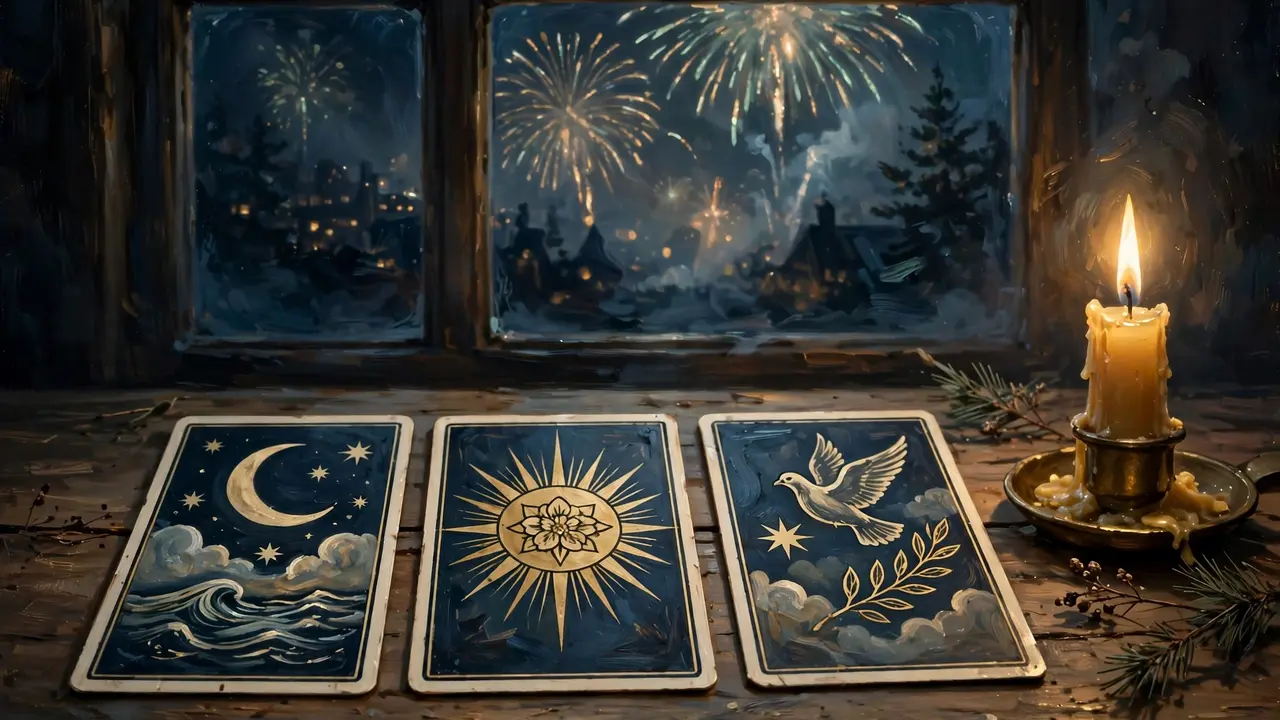
How do you do a New Year Eve tarot reading? The simplest way is to set aside some quiet time on the night of December 31, before the countdown begins. Shuffle your deck and draw three cards: the first says goodbye to 2026, the second welcomes 2027, and the third shows the first step of the new year. Once the countdown is over, turn the meaning of the welcome card into one New Year wish you can actually act on. If you are not sure yet what you want to ask, you can start with a tarot reading. Before you shuffle, write down the one thing weighing on your mind the most, then decide which direction your three cards should face. That small step gives the whole ritual a clear focus. It also keeps a lively, noisy night from turning your reading into a few cards flipped over without much thought. A few honest lines on paper are often all it takes to make the spread feel like your own.
A New Year Eve spread is not the same as a year-end review. A year-end review lays the whole year out on the table so you can look at what you gained and what you learned. New Year Eve is a ritual for one night. The point is not to add everything up. The point is to put a full stop at the end of one chapter and open a door to the next. That is why these three cards do not need a complete, detailed interpretation, and they do not need to predict what will happen in 2027. They work more like three reminders: what you can set down, what intention you want to carry with you, and which small thing you can do when you wake up tomorrow. If a card looks heavy, there is no need to panic. When Death or The Tower lands in the farewell position, it is generally read as something that is ending, not as bad luck.
How New Year Eve Tarot Differs From a Year-End Review
Many people mix up a New Year Eve tarot reading with a year-end review, but the two move at completely different speeds. A year-end review fits best on a quiet weekend in mid to late December. You can slowly look back through the year's photos, calendar entries and notes, then use three cards to sort out what you gained, what you learned and what you want to bring into 2027. You can follow the steps in the three-card year-end review. That review covers the whole year. It takes time, and it needs a little distance.
New Year Eve is a ritual for one night. It happens at a very clear moment: the old year has only a few hours left, and the new one is waiting just outside the door. You do not need to walk back through the entire year again. You only ask three things: what am I letting go of, what am I welcoming, and what can I do first tomorrow? The simpler the questions, the easier the cards are to read, and the easier it is for your mind to settle.
If you already drew cards on Christmas Eve, you do not need to repeat the same questions now. A Christmas tarot reading leans toward gratitude and sharing, while New Year Eve leans toward handing over and setting out. If you want a sense of the month's overall mood first, read the December tarot monthly forecast and treat it as background, not as an answer.
Put simply, a year-end review is like sorting out a drawer, taking every item out to look at it clearly. New Year Eve is like closing that drawer, picking up your keys and walking out the door. The first asks what happened this year. The second asks what mood you want to carry into the next one. Both are worth doing, but try not to squeeze them into the same night. Otherwise New Year Eve can easily turn into a summary that is too long and too tiring.
How to Prepare Before the Countdown
New Year Eve is usually busy. Some people watch the broadcast at home, some gather with friends, and some spend the night quietly on their own. Whichever describes you, you can still carve out a short stretch of undisturbed time before the countdown. You do not need to pick an exact hour or minute, and no moment of the night makes a draw more accurate than another. What matters is whether you can slow down and bring your attention back to yourself.
What you need is simple: a deck you know well, a notebook or the notes app on your phone, and a pen. Clear a small space on the table and silence any notifications you do not need. If you like, light a small lamp or make a cup of hot tea, so your body knows it is time to shift into a different rhythm. None of this is a rule. These are just small habits that help you focus.
Before you shuffle, take a few minutes to write three lines in your notebook: the one thing you most want to let go of this year, the one feeling you want more of next year, and one action you can take when you wake up tomorrow. You do not need to edit what you write. This is simply a way to pour out what is already in your heart, so you can compare it with the cards later. Quite often the cards echo those three lines, which helps you see more clearly what you really care about.
If you feel especially tired or unwell that evening, rest first. There is no need to force yourself to finish the ritual that night. If you are physically unwell, please see a doctor. Tarot speaks to how you are feeling and does not replace medical judgment. This ritual is a gift to yourself, not homework you must finish, so doing it a little later, or the next morning, is completely fine.
The Three Positions and How to Ask
For a New Year Eve spread, lay the three cards out from left to right: on the left, farewell to 2026; in the middle, welcome to 2027; on the right, the first step of the new year. Together the three positions form a line from the past toward the future, and you read them in that order, one card leading into the next. For the basic method, see how to read a three-card spread.
Make the question for each position a little more specific. For the farewell position you might ask: What from 2026 can I gently let go of? For the welcome position: What do I want to invite more of into my life in 2027? For the first step: What small thing can I do in the first week of the new year? All three questions are open-ended. They do not ask whether something will or will not happen. They ask what, and how.
Why not ask whether next year will be better? Yes-or-no questions like that make you stare only at whether a card looks good or bad, and one unwelcome card can sour your whole evening. When you change the question to what you can do, the cards become a mirror rather than a verdict. For more ways to reshape your questions, read how to ask tarot questions.
While shuffling, you can repeat the three positions silently, or write the three questions on a slip of paper and leave it at the edge of the table. Draw the cards the way you usually do. Cutting the deck, fanning the cards out or turning over the top of the pile all work, and none is more correct than another. Once all three cards are face up, do not rush to look up their meanings. Spend a minute taking in the whole picture: are the colors warm or cool, and are the figures moving or standing still? These first impressions are often where your reading begins.
Card One: Reading Your Farewell to 2026
The first card sits in the farewell position, and it speaks about what is wrapping up in 2026. It could be a certain way of relating to someone, a habit at work, or a demand you have been placing on yourself. As you read it, start by asking: which moment of this year does this image remind me of?
If you draw a gentler card, such as the Six of Cups or the Four of Pentacles, it is generally interpreted as pointing to something you held on to tightly this year: perhaps nostalgia for the past, perhaps a need for security. Saying goodbye does not mean throwing everything away. It means admitting that these things once protected you, and that you can now loosen your grip a little.
If you draw a card that looks very positive, such as The Sun or the Six of Wands, you can still read it in the farewell position. It may mean that one of this year's high points is already complete, and you do not have to force yourself to repeat the same achievement in the new year. Celebrate it properly, then let it become the past tense, so the new year has room to grow something different.
When you finish reading, write one sentence in your notebook: In 2026, I am grateful for ___, and I am willing to let go of ___. In the first blank, write the gift this card reminds you of. In the second, write what you are ready to release. The sentence does not need to be beautiful, only honest. Often the power of a farewell lies not in throwing something out but in saying it aloud. Once it is spoken, that thing is no longer a weight pressing quietly on your chest. It becomes a memory that has been properly seen and can now be put away.
When Death or The Tower Appears in the Farewell Position
The moment that makes people most nervous on New Year Eve is turning over a heavy-looking card such as Death, The Tower or the Ten of Swords in the farewell position. Take a breath first. In this position, the common reading of these cards actually fits very well. They do not speak of bad luck. They speak of something coming to an end, and ending thoroughly.
Death is generally interpreted as transformation and closure, like the turning of the seasons: the old leaves fall so the new buds have space to grow. In the farewell-to-2026 position, it may be reminding you that one stage really is complete and does not need to be patched up again. The Tower is often understood as a sudden loosening. Perhaps a structure you thought was solid cracked this year and showed you something you had not seen before. The Ten of Swords is like the end of a hard stretch: the most difficult part is already behind you, and dawn is close.
When these cards appear, you can ask yourself three questions. What this year felt like it was pushed to an end? Once it ended, what new space did I gain? How much longer do I need to grieve it before I can let it go? You do not need answers tonight. Writing the questions down is enough.
If a heavy card stirs up strong emotions, that is completely normal. It does not mean you did anything wrong, and it certainly does not mean the new year will go badly. You can set the card aside, drink some water, step out onto the balcony for some air, and come back when you feel steadier. Saying goodbye properly is part of what New Year Eve is for, and sometimes a goodbye brings tears. That is a kind of sorting out too. Placing this card in the farewell position is itself a way of telling yourself: this can stay in 2026.
Card Two: Reading Your Welcome to 2027
The second card sits in the welcome position, and it speaks about the energy you want to invite into 2027. Notice the wording: want to invite, not will definitely happen. This card is not previewing the plot of next year. It is helping you see the direction you truly long for.
Begin with how the image feels. Is it warm, fresh, fiery or quiet? If you draw The Star, the common reading is hope and healing, which may mean you want a year where you can breathe and recover at your own pace. The Ace of Wands is generally interpreted as carrying new passion and new beginnings; perhaps there is something you have been wanting to try. The Empress may point to wanting to care for yourself more and to notice the richness and beauty in everyday life.
If a card that looks less easy shows up here, such as the Two of Swords or the Five of Pentacles, there is no need to read it as bad news. It may be telling you that what you want to welcome in 2027 is the courage to face a hesitation, or learning to look after yourself when resources are limited. Cards like these often point to a real need, and a real need deserves to be seen even more than a pretty wish does.
After reading this card, do not rush to turn it into a wish yet. Instead, write down three key words, such as rest, healing and slow, or try, passion and set out. Once the countdown is over, these words will become the raw material for your New Year wish. They do not have to match the meanings in a book exactly. Writing them in your own words is what makes this welcome truly yours.
Card Three: Reading the First Step of the New Year
The third card sits in the first-step position. It is the most practical card in the spread, and also the one most easily overlooked. Many people make a big wish on New Year Eve and then have no idea what to do when they wake up on January 1. This card has one job: to turn a direction into a small action.
As you read it, ask: what is the figure in this card doing? The Magician, for example, is often understood as picking up the resources already at hand, so your first step might be to organize the tools you already have. The Page of Pentacles looks like a focused beginner, so your first step might be signing up for a class or reading the first chapter of a book. The Three of Cups shows friends gathering, so your first step could be sending a message to someone you have not talked to in a long time.
If the third card is a still, quiet card such as The Hermit or the Four of Swords, the first step may not be doing more but pausing first. The first week of the year does not have to be a sprint. Sometimes catching up on sleep or tidying your room is the most fitting start. This is also where a New Year Eve tarot ritual differs from ordinary goal setting: it allows your first step to be small and slow.
When you are done, write the first step as an action you can finish within a week and tick off afterwards, such as clear my desk before January 3, or go for two twenty-minute walks this week. The more specific, the better. The first step does not have to match the welcome card exactly, but the two usually echo each other. The welcome card is the direction, and the first-step card is the path under your feet.
After the Countdown: Turning the Cards Into a Wish
After the countdown ends and everyone has wished each other a happy New Year, return to your notebook and spend ten minutes turning the welcome card into one New Year wish. The key is to write the card meaning as a sentence you can actually do, not as a vague hope.
A vague wish sounds like this: I hope everything goes well in 2027, or I hope next year is better. There is nothing wrong with those words, but they cannot tell you what to do tomorrow. A wish you can act on includes an action and a scope. If you drew The Star, with the key words healing and hope, you might write: In 2027, I will keep one evening a week free from overtime and rest properly. With the Ace of Wands, you might write: In the first half of 2027, I will start that small project I have been thinking about for so long and move it forward a little every month. With The Empress, you might write: In 2027, I will set aside time once a month to enjoy a proper meal.
Three small reminders as you write. First, begin with I will or I am willing to rather than I hope, so you are back at the center of the sentence. Second, write actions instead of outcomes: rather than I will save a lot of money, write I will review my spending once a month to see where my money goes. Keep money wishes about mindset and habits; tarot does not replace investment decisions. Third, one sentence is enough. Too many wishes scatter your energy.
When you finish, copy the sentence onto a sticky note and put it somewhere you see every day, such as above your desk or on the fridge door. The cards from New Year Eve will be put away, but this sentence will walk with you into the new year. Each time you see it, it is a small reminder of a promise you made to yourself on New Year Eve, and one you are able to keep.
Drawing Alone or With Friends
You do not have to spend New Year Eve alone; you can also draw cards with family, friends or a partner. When you draw together, it works best if each person shuffles and draws their own three cards, rather than using one set of cards to answer everyone's questions. That way, each person's cards belong only to them.
When you take turns reading, agree on a simple rule: speak only about your own feelings, and do not draw conclusions for anyone else. If a friend draws The Tower, you might say this card makes me think of change, rather than telling them something bad will happen next year. Tarot is a tool for opening up conversation, not for judging someone else's life. If someone does not want to share, please respect that, and let them keep their cards and notes to themselves.
When drawing with a partner, each of you can draw your three cards first and then talk about whether your welcome cards point in a shared direction. If they do, you can write one wish together that you can both act on, such as taking a walk together once a month in 2027. If your directions are different, that is fine too. It simply means each of you has something you want to take care of, and you can support each other instead of asking the other person to fit your plans.
Drawing alone has its own benefits. You do not need to worry about anyone else reacting, you can read and write at your own pace, and if you want to stop and stare into space for a while, that is fine. Whoever you spend the night with, the three cards of New Year Eve are only a gentle reminder: even on a loud, festive night, leave a little time for yourself and listen to what your heart is saying.
Three Small Things for the First Week of January
The New Year Eve ritual ends after the countdown, but whether your wish takes root depends on the week that follows. Here are three small things to do. None of them is difficult, and none needs special preparation.
First, on January 1 or 2, look at your three cards and your notes again. Once the excitement of the countdown has passed, you may see one of the cards in a new light. If so, add a line or two beside your notes. This is not about changing your answers. It is about letting the cards keep talking with your life.
Second, complete the first step linked to your third card. However small it is, tick it off when it is done. That tick matters, because it helps you remember that the new year has already begun for you. If that week turns out to be too busy and you do not get to it, do not blame yourself. Move it back three days and try again.
Third, on the first weekend of the year, spend a little time thinking about the rhythm of the whole year. The three cards of New Year Eve are a starting point. If you want to map out a longer direction for 2027, this is a good moment to look at the 2027 tarot spread guide and use the key words from your welcome card as its central theme. That way, your plan for the year stays connected to the intention you set on New Year Eve.
Together these three things take only an hour or two. They are not meant to turn you into a different person overnight. They simply give your New Year Eve wish somewhere to land during the very first week. The true start of a new year is often not the final second of the countdown, but the first day you act on your own words.
References
Bring what you want to say goodbye to and what you want to welcome, do a tarot reading, and find your own first step into 2027.
Get a Tarot Reading