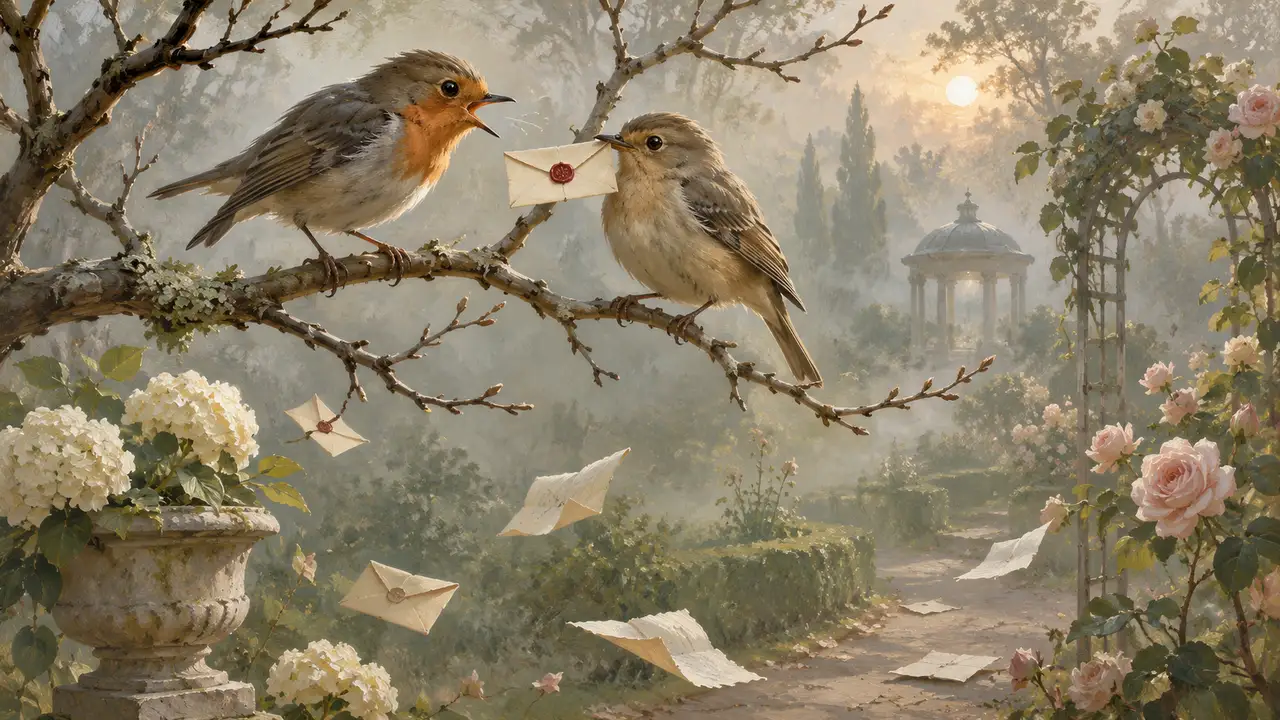
When the Lenormand Birds card turns up, it is usually saying one thing: someone is talking, and they are talking fast. Birds is card 12 of the 36-card Lenormand deck, and it is generally interpreted as messages, conversations, gossip, short bursts of nervousness and mental chatter that will not switch off. The deck has many slower, steadier cards. Next to them, Birds has a very short sense of time. Readers often take it to describe something unfolding within minutes or days, such as a phone call, a text that pops up or a discussion you get pulled into. Things arrive quickly and they change quickly. If you already have a question about a message or a conversation and want to see how the cards respond, you can start with a Lenormand reading. Keep that question in mind as you read on. Birds makes the most sense when it is tied to something specific you are waiting to hear or trying to say.
The most common mistake with the Birds card is to treat it as automatically good news or automatically bad news. On its own, Birds is neutral. It only tells you that there is sound here. Whether that sound is happy news, a complaint, small talk or an argument has to be judged from the cards around it. Lenormand does not use reversals, so Birds has no reversed meaning either, and all of its direction comes from combinations. Hold on to three words: fast, noisy and plentiful. Then check whether the neighboring cards are quick or slow, and whether they build something up, hold something steady or wear something down. Do that and Birds becomes one of the easier cards to read. The sections below take it apart step by step: the card image, three everyday situations, the most common pairings, and how Birds compares with slower cards in the deck. The goal is to read it with confidence rather than guesswork.
The Core of the Birds Card: Fast, Noisy, Plentiful
If you had to sum up the Lenormand Birds card in three words, a common answer would be fast, noisy and plentiful.
Fast refers to its short sense of time. The Birds card is generally interpreted as describing events that play out within minutes to days, like a phone that suddenly rings, a message that has just popped up or a discussion you get pulled into at the last minute. It is not about something that builds slowly. It is about something that appears all at once and may vanish just as quickly.
Noisy refers to the number of voices. The card usually shows not one bird but two, or even a flock, so it rarely describes a quiet one-to-one exchange. More often several voices are present at once. Someone is speaking, someone is listening and someone else is chiming in from the side. As the message travels, it may get exaggerated or misunderstood.
Plentiful refers to volume. Birds is often linked with frequent contact, repeated checking in and thinking about the same thing over and over. It can be a work group chat that buzzes all day, or a thought you have circled a dozen times and still cannot put down.
Keep these three qualities in mind and you will know where to start whenever the card appears. First ask what sound is present here. Then ask how fast it is coming, how many voices are involved and how much of it there is. For a compact summary of the card, see the full Birds card meaning. The rest of this guide looks at how fast, noisy and plentiful show up in real questions, and how the surrounding cards reveal what the voices are actually saying.
Reading the Card Image: Two Birds on a Branch
The most familiar Birds image shows two birds perched on the same branch, facing each other as if deep in conversation. When you read the card, it helps to split the picture into three parts.
The first bird is the speaker. It stands for whoever sends the message: the person texting you, the colleague who speaks up in a meeting or the one who brings the news. If your question is who will contact me, this is the bird that speaks first.
The second bird is the listener. A conversation needs someone on the receiving end, so this bird stands for response, attention and the reaction that follows once the message lands. Readers generally see the pair as a reminder that Birds describes a two-way exchange rather than a one-way broadcast. So besides asking whether anyone is talking, also ask whether anyone is listening.
The branch is the setting where the talk takes place. It might be a chat thread, a dinner table, a meeting room or the two ends of a phone line. A bird can leave a branch at any moment, which echoes the card's short time frame: the conversation happens here, but it does not stay here for long.
Some versions also show a flock in the background, often read as a crowded, chattering atmosphere. When your question involves a group, a community or rumors, pay attention to this layer. The news is not passing between two people only. It is moving among many people, faster and more easily distorted.
Looking at the three parts separately shows that Birds means more than just news is coming. It describes the speaker, the listener and the setting all at once. Work out which bird you are in the picture, and you are often halfway to your answer.
Why the Birds Card Has No Reversed Meaning
Many people who come to Lenormand from tarot ask the same first question: what does the Birds card mean reversed? The answer is that Lenormand does not use reversals, so Birds has no reversed meaning. Whether the card lands upright or upside down, you read it the same way. There is no separate set of opposite meanings to learn.
So how do you tell whether Birds is positive or negative? Through the cards beside it. Lenormand reading is built on combinations, and the cards around each card shape its meaning, add to it or change its direction. Birds only tells you that there is conversation, news or noise here. The cards next to it decide whether that conversation brings good or bad news, and whether it is relaxed small talk or a tense argument.
For example, if Birds sits beside a bright, sociable card, the exchange usually leans pleasant. If it sits beside a card with a sense of cutting or conflict, the talk may turn sharp. If it sits beside a steady, reliable card, the conversation may bring practical support. The same pair of birds sings a different tune depending on which cards they sit next to.
That is why reading Birds on its own is not recommended. Linking it with the cards before and after it into a single sentence keeps you much closer to your question than memorizing keywords. If you are not yet comfortable linking cards together, start with how to read three Lenormand cards and practice placing Birds at the beginning, middle and end of a sentence.
Remember one principle: Birds has no upright and reversed sides, only different voices in different combinations. If you come across a source that splits the card into two opposite meanings, know that this is not the usual Lenormand approach, and go back to the combination in front of you.
Situation One: Waiting for a Message
The question Birds appears in most often is some version of I am waiting to hear back. It might be a job interview result, a reply from someone, a quote, or whether a person you have not spoken to in a while will reach out. In this kind of question, Birds is usually read as a sign that the message is on its way and will not be slow.
Because the card's time frame is generally interpreted as minutes to days, a common reading is that something will move soon when Birds answers a question like will I hear anything. That might be a call, a text or news you hear secondhand. This is not a card that asks you to wait for months.
But hearing news is not the same as hearing the news you want. This is where the neighboring cards matter. If Birds sits next to a card with a formal or written feel, the message may arrive as an official notice. If it sits next to a card that suggests obstacles or delay, the message may come but be incomplete, or you may need to follow up.
As for the fear of being ignored, Birds itself rarely means silence. What usually holds a message back are the slow, stuck cards around it. So if you ask why have I not heard back and draw Birds, try looking at it from another angle. Perhaps people are discussing the matter or talking it over with others, and simply have not reached you yet. The noise of the flock can mean the news is going around somewhere else first.
If what you are waiting for is written or official, read this alongside the Lenormand Letter card meaning. Letter leans toward written, formal messages, while Birds leans toward spoken, immediate ones. Side by side, the form and speed of the message become clearer. That makes it easier to decide whether to follow up or keep waiting patiently.
Situation Two: Conversations and Communication
The second situation is the conversation itself: an upcoming negotiation, a talk you need to start, or a topic that has stalled between you and a partner or family member. Here Birds describes the mood and rhythm of the conversation rather than its final outcome.
When Birds appears, it is commonly read as a busy exchange, with lots of back and forth, topics jumping around and maybe some raised voices. The two birds face to face are a reminder that this is not a setting where one person speaks and that is the end of it. The other side will talk too, possibly quite a lot. Being ready to listen matters just as much as being ready to speak.
The outcome depends on the neighboring cards. If a card with a sense of stability or commitment follows Birds, the talk may reach common ground. If a card that suggests separation or cutting follows it, the conversation may end badly or break off suddenly. The card before Birds often shows how the talk began: whether it started over something good or because a problem could no longer be avoided.
Birds also points to something easy to overlook. In a group, the person who talks most is not necessarily the one who decides. When you ask about a work meeting or a family discussion, the chattering flock can bury what really matters. Rather than trying to persuade everyone, find the bird that is actually listening and speak to them.
If your question is will this conversation go well, try making it more specific. You might ask what should I pay most attention to in this talk, or how should I bring it up. That lets the cards speak to what you can do rather than simply predicting a win or a loss. What Birds does best is describe the voices along the way.
Situation Three: Anxious Chatter in Your Head
The third situation is mentioned less often but comes up all the time: Birds can also stand for the voices in your own head. Worries that will not stop, a conversation that replays as you try to fall asleep, an argument you keep having with yourself. They all look a lot like a flock of birds chattering on a branch.
When Birds appears in a question about mood, stress or why do I feel so uneasy, it is generally interpreted as a fast, scattered, repetitive kind of anxiety. It is not necessarily about anything big, but because it keeps ringing in your ears, it is hard to settle. Like birdsong, one chirp is nothing, but a whole day of it is exhausting.
Reading Birds here is not about finding what will go wrong. It is about finding where the noise comes from. Is it something someone said that you cannot shake off? An unanswered message that is weighing on you? Or have you rehearsed too many versions of a conversation that has not happened yet? The two birds can be read as two voices inside you, one worrying and one arguing back, and the branch is your attention. As long as they stay perched there, you keep hearing them.
The neighboring cards show where the noise is heading. If Birds sits beside a calm, restful card, the chatter may settle over time. If it sits beside a card that drains energy, these thoughts may be slowly eating away at you. You may need to stop on purpose and sort them out, for example by writing the worries down or talking them through with someone you trust.
To be clear, Lenormand can help you see a state of mind, but it cannot treat physical or mental symptoms. If you feel unwell, please see a doctor. The cards describe a situation and do not replace medical judgment. If anxiety is affecting your sleep or daily life, please reach out to a qualified professional. The cards can keep you company while you sort through your thoughts, but they cannot replace the practical steps of looking after yourself.
Five Common Birds Combinations
Combinations are what make Lenormand so engaging, and that is especially true of Birds. Here are five common pairings. Each reading below is only a general direction, so always bring it back to your own question.
Birds + Letter (card 27): spoken plus written. This pair is often read as a busy flow of messages, such as back-and-forth texts, notifications or a string of emails. Letter puts the birds' voices in writing, so the news tends to be more concrete and may need a reply or a signature from you.
Birds + Garden (card 20): Garden stands for public settings and social circles. With Birds, a common reading is talk in a crowd, chatter at a gathering or a topic spreading through a community. On the bright side, people are talking freely and new connections come easily. The thing to watch is that news travels far, and private matters can become public talk.
Birds + Scythe (card 10): Scythe means suddenness and cutting off. Paired with Birds, it is often read as unexpected news, a conversation that ends abruptly, or sharp, hurtful words. This combination is a reminder to think before speaking, and not to hit back the moment you hear something harsh. For the Scythe card itself, see the Lenormand Scythe meaning.
Birds + Moon (card 32): Moon relates to emotions, feelings and reputation. With Birds it can mean an emotionally charged conversation, a long late-night talk or people discussing your reputation. In questions about mood, this pair often describes an emotional conversation with yourself.
Birds + Dog (card 18): Dog represents friends and people you trust. With Birds, it is commonly read as chatting with a friend, news from someone close or someone willing to listen. Compared with the other pairings, the tone here is usually gentle.
Order and position also shift the emphasis. The first card often sets the topic and the second describes it, so it is worth reading each pair both ways.
Birds Compared with Tree, Bear and Mice
In Lenormand, judgments get much clearer once you sort out what is fast and what is slow. Birds is one of the fastest-moving cards in the deck, and comparing it with others makes its nature easier to see.
Birds is fast noise. It speaks of now, of the next few days, of voices you can hear at this moment. It comes quickly and goes quickly. What Birds describes rarely lingers, and what is loud today may be quiet in a few days.
Tree (card 5) is slow accumulation. Tree concerns roots, growth and physical wellbeing, and its time frame is long. Things grow layer by layer. When Birds and Tree appear together, they may point to a long-running situation that keeps being talked about, or a slowly building issue that finally gets said out loud. For more on this card, see the Lenormand Tree meaning.
Bear (card 15) is steady strength. Bear is often linked with resources, protection and people with influence. It is unhurried but hard to ignore. Birds with Bear is often read as a conversation with someone influential, or talk that involves money and resources. Here, the weight of what is said matters more than its speed.
Mice (card 23) is gradual wear. Mice is not a sudden blow but something nibbled away bit by bit. Birds with Mice is commonly read as tiring gossip, worries you keep chewing over or a conversation that is slowly wearing down your patience.
Looking at these four cards together suggests a practical order of questions. First, is this fast or slow? Then, is it building up, holding steady or wearing down? Once that is clear, it becomes easier to tell whether the voice of Birds is a brief interruption or part of a longer issue, and you are less likely to be thrown off by a passing burst of noise.
Five Steps to Reading the Birds Card
To finish, here is an order you can follow whenever Birds shows up in a draw.
Step one: check whether your question involves sound. If you are asking about a message, contact, a conversation, a rumor or your own worries, Birds speaks to it directly. If you are asking about something else, Birds may be hinting that the matter will be discussed, or that it needs communication to move forward.
Step two: look at its position. In a three-card line, Birds in the first position is often the starting point: everything begins with a message or a conversation. In the middle, it is often the heart of the matter, meaning communication itself is the key. In the last position, it often shows how things develop, meaning news is coming or you will need to speak up.
Step three: see what the neighboring cards change. Next to bright cards, the voices lean toward good news. Next to cards of cutting or conflict, they may turn into an argument. Next to slow cards, the speed of Birds stretches out. Next to draining cards, the noise becomes a burden.
Step four: separate fast from slow. Ask yourself whether this is chatter that will pass in a few days, or a long-term issue finally being voiced. This step keeps you from taking a passing rumor too seriously, and from brushing off something that really needs attention as idle talk.
Step five: come back to action. Birds often points to a balance between speaking and listening. Ask what needs asking, answer the messages that need answering, and set aside the thoughts that need a rest. The cards offer direction, and the decision stays with you.
Read this way, Birds is no longer just a vague sense that news is coming. It becomes a clue that helps you answer a concrete question. With practice, you may find Birds is a very honest card: it simply turns up the volume on what is already being said.
References
Bring the message you are waiting for, the conversation you want to clear up or the worry that will not stop running through your head, and draw your cards to see how Birds and the cards around it form an answer that is yours.
Try a Lenormand reading