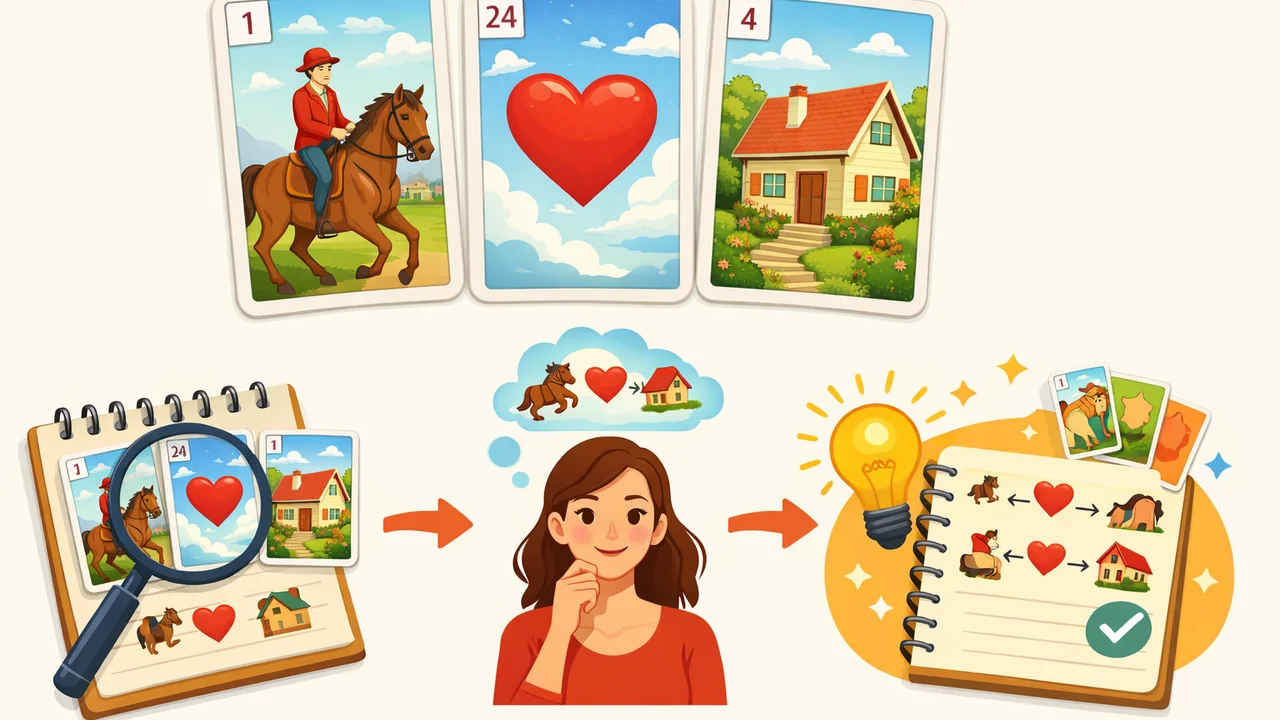
Learning to read three Lenormand cards takes three steps: set your question and time frame, read the left, middle and right cards as background, core and direction, then turn the result into concrete signs to watch for. If you want to practice as you read, bring a recent situation to a Lenormand reading online and place the cards back into your own context.
Many beginners read Lenormand cards the way they read tarot: the Bouquet means good news, the Coffin means an ending, the Snake means a rival. That quickly turns a reading one-sided. Lenormand works more like stringing keywords together, so the three cards need to be judged as one unit. Check whether the middle card is the subject, whether the side cards act as modifiers, and whether the event has a clear direction.
What follows walks through the three-card line spread: how to phrase the question, what each position means, how to combine the cards, worked examples for love and work questions, and the situations where three cards alone are not enough.
Key takeaway: reading three Lenormand cards is not about reciting what each card means on its own. It is about reading the links, direction, modifiers and event context between them. You will get a working framework for the three-card line, question phrasing, love and work examples, common mistakes, and reading steps a beginner can practice right away.
The Core Method: Read Three Lenormand Cards as One Event Sentence
The most direct answer to how to read three Lenormand cards is this: do not split them into three separate predictions. Combine them into one event sentence with a subject, modifiers and an outcome. A common line reading treats the left card as background, cause or precondition, the middle card as the focus or the real core of the question, and the right card as the direction, outcome or the state most likely to show up next. This works well for everyday questions such as “Where is this situationship heading?”, “Is this job worth more of my effort?” or “What should I watch for today?”
Lenormand and tarot are quite different. In most common tarot systems, readers interpret inner states through imagery, figures' postures and the life lessons of the Major Arcana. Lenormand reads more like an event language: the Bouquet, Letter, Ship, Key, Clouds and Scythe usually point to concrete people, things or clear situations. If you already know tarot, you can compare the two with the complete guide to all 78 tarot card meanings, but avoid applying tarot-style psychological analysis directly to a three-card Lenormand line.
Three cards are quick, precise and good at short-term, specific questions. Their limit is that they cannot carry very complex life questions. Ask “Will my life be successful?” and three cards can hardly give the full picture. Ask “What do I most need to watch for in my job search over the next month?” and three cards can give a far more usable signal.
The basic one-sentence formula
Start with “the left card causes or describes the middle card, and the middle card develops toward the right card.” Say you draw Clouds, Letter and Sun. A first reading is “unclear news gradually becomes clear.” Then adjust for the question: in love, a vague message or conversation turns more positive; at work, a confusing notice or document ends up with a better outcome.
Don't rush to judge good or bad
Three cards are not automatically good because a positive card appears, or bad because a negative one does. A Bouquet followed by the Scythe may mean a pleasant surprise gets cut short; a Coffin followed by the Key may mean an ending actually opens a new opportunity. The point is the relationship, not each card's emotional label.
- The left card usually shows background, cause or conditions.
- The middle card usually shows the main focus and is the center of gravity.
- The right card usually shows what follows, the outcome or visible developments.
Reading the Positions: Left, Middle and Right Are Not a Rigid Timeline
Many beginners fix left, middle and right as past, present and future. That can work, but it is not the only way. Three Lenormand cards are more often read with line grammar: the left card modifies the middle, the middle connects both sides, and the right card adds direction. If the question already has time built in, such as “How will this develop between now and next week?”, you can read the line as a time flow. If the question is “How does this person feel about me?”, the three cards are better read as layers of signal rather than a mechanical past-present-future.
Before assigning positions, check whether you are asking about an event, a person, feelings, options or advice. For events, read cause, core and direction. For a person, the middle card often represents them or the main focus, while the side cards show what influences them and how they act. For advice, the three cards can read as the state to avoid, the current priority and the next step. Positions are not rules in themselves; they are a way of reading that serves the question.
Event questions: follow the chain of events
Say you ask “Will I hear back about the resume I sent?” and draw Letter, Mountain and Rider. The Letter matches the resume and messages, the Mountain shows a block, and the Rider shows news arriving. Overall it is not “no reply,” but progress stalls first and things move later. The Rider on the right matters here: the matter doesn't stop at the Mountain, and a response comes after the obstacle is passed.
Person questions: focus and outward behavior
Say you ask “How does this person see me right now?” and draw Dog, Woman and Clouds. If the querent is a woman, the Woman in the middle may represent her. The Dog on the left suggests familiarity, trust or friendship; the Clouds on the right suggest uncertainty, unclear views or wavering. This may not mean dislike, but that they place you somewhere safe and familiar while the next step still feels foggy to them.
Advice questions: the order of action
If you ask “How should I handle this relationship now?” and draw Birds, Key and Garden, one reading is: clarify the main points through talking or messages first, the key is opening a line of communication, and the next step can move into public, social or more formal settings, or involve mutual friends. It isn't simply telling you to chat; it turns the conversation into the entrance that unlocks the relationship.
- A timeline reading works, but only when it fits the question.
- The middle card is usually the most important, but it is not always the outcome.
- Set position meanings before drawing so you can't change them on a whim later.
Combining Three Lenormand Cards: Read Pairs First, Then the Whole
The heart of the three-card technique is combination: read the first and second cards together, then the second and third, and finally merge all three into one meaning. This is steadier than adding up single meanings. Ship plus Letter can be news from afar, long-distance contact or an invitation from out of town; Letter plus Ring can be a contract, a commitment or an official notice. If the line is Ship, Letter and Ring, it can read as “news from far away or an outside channel about a commitment, partnership or contract.”
The key is knowing which card modifies which. Lenormand symbols are usually concrete: the Tree can mean health, the long term, stability or growth; the Moon can mean emotions, reputation, night or feelings; the Lily can mean maturity, peace, an older person, purity or intimacy. When three cards appear together, don't cram every meaning of every card into the reading. Pick the layer most relevant to the question.
Step one: left card plus middle card
The left and middle cards usually explain why the current core took shape. With Snake, Letter and Sun, Snake plus Letter can be a roundabout message, contact with a hidden motive, or a notice that isn't entirely straightforward. That tells you the question isn't simply whether news comes, but that the news may involve detours, things held back or self-interest.
Step two: middle card plus right card
In the same Snake, Letter and Sun line, Letter plus Sun means news becomes clear, communication has a positive result, and information comes to light. Put the pairs together and the reading isn't “there's a bad person, so it's bad.” It becomes “at first the message seems unclear or raises doubts, but it can be clarified later and the outcome leans positive.” Neighboring cards correct exaggerated single-card judgments.
Step three: build the full sentence
Finally, condense the three cards into one clear sentence, ideally with a condition and a direction. For example: “This news feels opaque to you at first, and someone may not have told the whole story, but a clearer answer is coming. The point is to ask them to spell out the details.” If you can say it as a concrete sentence, you have actually finished the reading.
- Read cards one and two, then two and three, then merge them into one sentence.
- Neighboring cards shape the direction more than single meanings do.
- The same card takes a different layer in love, work or money questions.
Your Question Shapes the Reading: The Clearer It Is, the More Grounded the Cards
Drawing is only the second half of reading three Lenormand cards; the first half is the question. Three cards suit clear, short-term, observable questions, not ones too vague to ever check. Instead of “Will I be happy?”, ask “What change is most likely in this relationship over the next month?” Instead of “Is this person my destiny?”, ask “What is their current attitude toward moving things forward?” The more specific the question, the more easily the meanings turn into real action.
When phrasing, add a time frame, a relationship scope and an action scope. A time frame makes the right card's near-term direction easier to judge; a relationship scope keeps different people from blurring together; an action scope makes advice practical. If you want to ask about a situationship, read Can Lenormand cards answer love questions, and which ones first to see how Lenormand handles love topics, then use three cards to read the signals.
Three marks of a good question
First, a clear subject: a particular person you're seeing, a particular job, a particular interview. Second, an observable time frame: the next seven days, a month, this project cycle. Third, a specific focus: their attitude, the chance of a reply, partnership risks, the next step. These three pull the cards from vague feelings back into reality.
Questions to avoid
Avoid questions like “Will we be together forever?” that span too long and hold too many variables, and avoid re-asking the same thing until you get the card you want. Three cards can give you the current signal for an event, but they can't replace communication, judgment or owning your choices. If you're only trying to relieve anxiety, repeated draws will distort the reading.
- Narrow the question to one matter, one period and one focus.
- Skip fate-style questions; ask about observable attitudes and developments.
- Set position meanings before drawing so the reading stays consistent.
Three-Card Examples for Love, Work and Everyday Questions
The three-card method needs examples most, because Lenormand meanings shift with the question. The examples below are not fixed answers; they show how a judgment is built from the cards. When you practice, don't just memorize the conclusion; follow how each step comes from the neighboring pairs. If you also use tarot, the beginner's complete guide to learning tarot helps with spread setup and framing the question before you return to Lenormand's concrete event language.
For a love question, say you ask “Will they reach out in the next two weeks?” and draw Birds, Heart and Rider. Birds stand for conversation, messages, nerves or scattered exchanges; the Heart stands for feelings, liking and emotional motive; the Rider stands for news, a visit or taking the initiative. Birds plus Heart reads as wanting to talk out of feeling; Heart plus Rider reads as a message sent with feeling. Overall it leans toward contact, and not just out of politeness, but the Birds hint that communication may be scattered and tentative, and may not go deep at first.
Love example: Clouds, Heart, Key
Question: “What is the real sticking point in this situationship?” Clouds plus Heart means unclear feelings, liking mixed with doubt, or someone unsure of their own emotions. Heart plus Key means the feelings themselves are what unlocks things: the issue isn't a lack of feeling, but whether both are willing to be honest. Together: the connection isn't empty, it's hidden by uncertainty, and moving forward means saying clearly what you like, what you hope for and where your boundaries are.
Work example: Mountain, Fox, Letter
Question: “What should I watch for in this job offer?” Mountain plus Fox suggests obstacles may hide self-interest, unclear duties or a need to stay alert; Fox plus Letter suggests documents, messages or contract terms may be dressed up. Together, it doesn't say you must decline. It reminds you to check the terms, pay, hours and scope of duties carefully, rather than relying on verbal promises.
Everyday example: Book, Key, Sun
Question: “Where should I put my focus today?” The Book stands for study, information and what hasn't been revealed; the Key for the crux, a solution or a breakthrough; the Sun for results, clarity and confidence. This line reads: today suits organizing information and finding the heart of a problem, and the more you're willing to look things up, the clearer your results. For exams or research, it's also a good day to review key points.
- The examples are about reasoning, not memorizing fixed answers.
- Adjust the same cards to each question; don't force one reading across topics.
- A conclusion works best when it becomes one sentence of advice.
Common Beginner Mistakes: Reading Lenormand Like Tarot and Overweighting Single Cards
The most common mistake with three Lenormand cards is reading them like tarot. In the tarot tradition, the imagery of common decks is well suited to digging into psychological layers through visual detail, figures' postures, elements and symbols, and the occult background of the Golden Dawn shaped many tarot correspondence systems. Lenormand's core isn't long psychological symbolism, though; it is combinations of concrete signals.
Another mistake is treating single meanings as absolute: the Snake must be a third party, the Coffin must be a breakup, the Ring must be marriage. Readings like this can easily frighten the querent and miss what the line is actually saying. The Snake can be complexity, detours, temptation or competition, or a woman who needs careful handling; the Ring can be commitment, a cycle, a contract or an agreement, and doesn't necessarily mean marriage.
Don't over-psychologize
If you draw Moon, Fish and Garden, a tarot-style reading might talk at length about the subconscious and emotional flow, but Lenormand more likely points to links between reputation, money and social or networking settings. In a work question, this line may mean your performance ties into social events and the flow of resources; only in a love question does it lean more toward emotional attraction and public interaction.
Don't cherry-pick the meanings you want
The Bouquet can mean affection, an invitation or a gift, but next to the Scythe and Coffin the whole line may read as a brief happy moment that ends suddenly. The Sun is usually positive, but next to the Clouds it can mean uncertainty remains before things clear up. Let the three cards balance each other instead of grabbing the one meaning that fits your hopes.
- Lenormand leans toward event language and tarot toward symbols and psychology; don't blend them all the way.
- Single meanings are raw material; the real answer comes from the combination.
- A negative card isn't necessarily a disaster, and a positive one doesn't guarantee perfection.
The Limits of Three Cards: Questions You Shouldn't Force
Three cards are concise and powerful, but not every question fits. When a question involves many people, long-term life plans, legal or medical judgments, or major financial decisions, three cards can usually only offer a reminder, never the sole basis. For questions like “Should I quit, move, get married or invest all my savings?”, three cards can at most help you see current signals and blind spots. They can't replace professional assessment or real-world information.
Knowing the limits is part of reading well. When Clouds, Moon, Book or Mountain appear, signals of unclear or missing information, it doesn't necessarily mean there's no answer; it may mean information is missing right now. The most responsible reading then isn't forcing an outcome, but pointing out “what you still need to find out” and “which part can't be judged by feel.” When three Lenormand cards are used to move real action forward, they're worth more than simply guessing results.
When three cards alone aren't enough
If a question spans a long time, such as “Will I be financially free in ten years?”, three cards oversimplify. If it involves a third party's privacy, such as “Who is this person with right now and what exactly did they do?”, it easily crosses a line. A reading can help you understand the parts you can handle, but it shouldn't become a tool for spying on or controlling others.
Should you add a card? First check whether information is really missing
Many beginners add cards the moment they feel lost, and the reading gets messier with each one. Before adding, ask: was the original question too big? Were the positions clearly set? Have the three cards already given a direction you just don't like? Add one card only when a specific card truly needs clarifying, and decide in advance whether it adds a cause, advice or a hidden condition.
- Three cards suit short-term, specific, observable questions.
- Major decisions can't rest on divination alone; they need real data and professional advice.
- Adding a card isn't a way to dodge the answer; first identify what is missing.
A Practice Routine for Three-Card Readings: From One Sentence to Actionable Advice
To really learn how to read three Lenormand cards, practice with a fixed routine. Step one: write down the question and time frame. Step two: set the left, middle and right positions. Step three: after drawing, don't look up long meanings yet; write two or three gut keywords for each card. Step four: read left plus middle, then middle plus right. Step five: merge the three cards into one complete event sentence. Step six: rewrite that sentence as advice. This works better than memorizing all 36 cards in one go.
Say the question is “What should I watch for in this week's partnership project?” and you draw Bear, Letter and Mice. The Bear can stand for power, resources, a manager or control; the Letter for documents, messages or notices; the Mice for wear, gaps, anxiety or loss. Left plus middle is a document about power or resources; middle plus right is a document losing value, details eroding or a message causing worry. The sentence: this week the project hinges on documents about resource allocation or a manager's input, and you should watch for gaps in the details and lost information. The advice: confirm written records, division of responsibilities, deadlines and who holds decision-making power.
How to keep a practice log
Record at least five things each time: the question, when you drew, the three cards, your reading at the time, and what happened later. Checking afterward isn't about proving you're always right; it's about seeing where you over-read, missed a neighboring pair or projected wishes onto the cards. After ten to twenty entries, you'll see more clearly which meanings you tend to misuse.
Turn the reading into a next step
A good three-card reading doesn't stop at “yes” or “no”; it points to what you can do. If the line shows Clouds and Letter, the next step may be asking the other person to be clear. If it shows Mountain and Key, the next step may be finding the real crux of the obstacle. If it shows Garden and Birds, the next step may be bringing the matter into an open conversation or a group discussion.
- Write the question first, then draw; don't edit the question while looking at the cards.
- Pick only the meaning most relevant to the question for each card; don't stuff them all in.
- Always finish with one sentence of actionable advice.
References
Want to ask your own question? Bring the love, work or everyday issue you're most stuck on, draw five cards, and see which key point the cards are pointing to together.
Start a Lenormand Reading