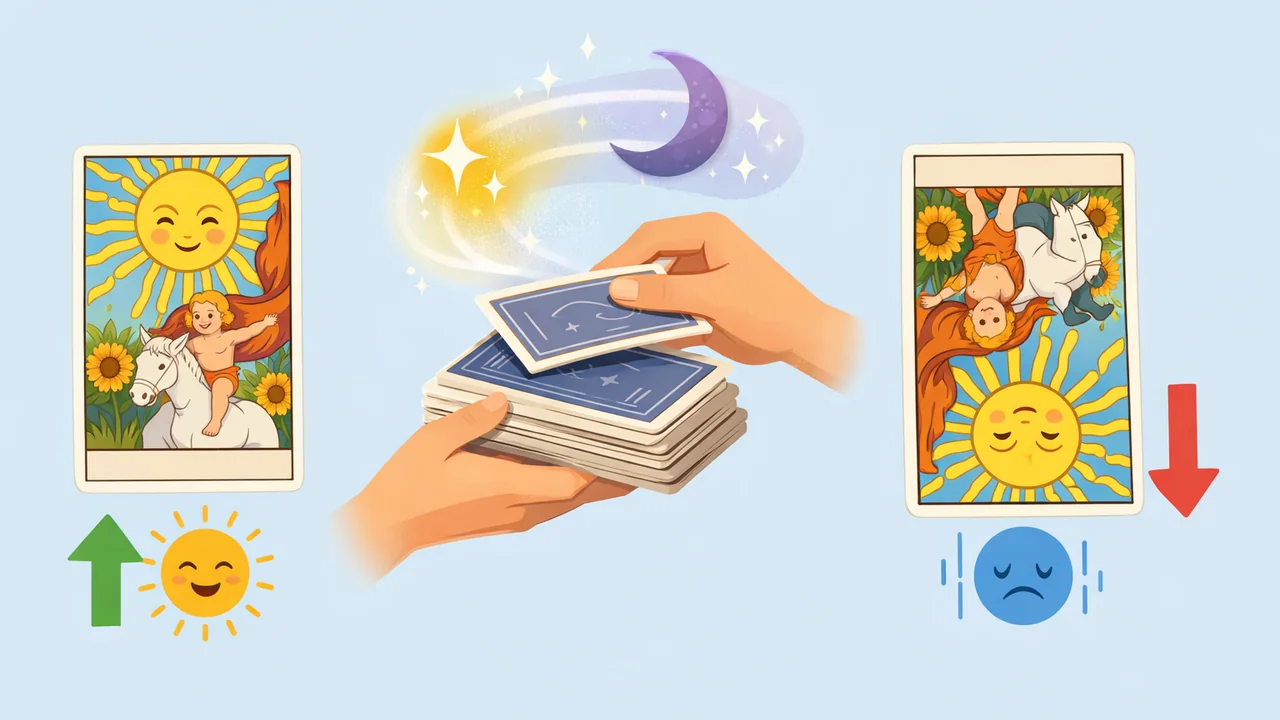
How do you read upright and reversed tarot cards? The short answer: an upright card generally suggests its energy is flowing, visible or easy to recognize. A reversed card may point to energy that is blocked, turned inward, overdone, delayed or expressed in the opposite way, or it may ask you to work with the card's shadow side. A reversal isn't a bad outcome, and an upright card doesn't guarantee things will go smoothly. To read either one, you have to go back to the question and the card's position in the spread.
Many beginners get stuck on reversals because they split every card into two lists to memorize, one upright and one reversed. Contradictions show up fast. Does the Lovers reversed always mean a breakup? Is Death upright always bad? Does the Eight of Wands reversed mean nothing will move? A steadier approach is to learn each card's core energy first, then ask whether that energy is flowing, stuck, excessive, lacking or turned inward.
The explanations below draw mainly on the widely used Rider-Waite tradition, with some symbolic language often discussed in the Golden Dawn lineage. The aim is to turn upright and reversed meanings from a memory exercise into a framework you can use to read cards in practice.
Key takeaway: reading upright and reversed tarot cards isn't about memorizing two sets of meanings. It's about seeing which way a card's energy moves in context. Core meanings, spread positions, love and career questions, common mistakes with reversals and a step-by-step method all build toward one usable way of judging a card.
The Core Idea: Upright and Reversed Describe Energy, Not Good or Bad Luck
The first step in reading upright and reversed cards isn't checking a chart. It's asking what the card's core energy is. Every card has its own theme. The Sun is generally tied to clarity, joy and being seen. The Moon is tied to unease, intuition and fog. The Two of Swords is tied to stalemate, avoidance and an internal tug-of-war. Upright and reversed only describe how that energy is working right now. They don't sort cards into good and bad. If you don't know the full meanings yet, start with the 78 tarot card meanings to learn each card's main thread, then practice reversals.
In the popular Rider-Waite deck, the images give you a lot of clues. A figure's posture, gaze, background and the direction of objects all shape the reading. The Hanged Man upright isn't only about being stuck. It can mean choosing to pause and see the world from a new angle. Reversed, it may become resisting a necessary sacrifice, staying stuck too long, or claiming to have let go while refusing to change. This is closer to what the card shows than 'upright good, reversed bad'.
The most practical way to think about it: upright leans toward energy that is visible, usable and flowing naturally. Reversed leans toward energy that isn't coming out smoothly. It may be stuck inside, suppressed, misused, or not yet ready to show itself. The same reversed card will look different in a question about love, work, money or friendships, so you can't pull it out of context and apply a fixed answer.
Upright and reversed aren't two cards but two ways one card works
It's easier to think of upright and reversed as two states of the same energy. Strength upright may be gentle but firm control of emotions. Strength reversed may be low confidence, trouble holding back impulses, or patience that has turned into resentment. The core is still 'strength' and taming instinct. Only the expression changes. Reading from this angle keeps you from getting trapped by keywords and helps you give advice that fits real life.
Figure out the level of the question before the direction of the card
The same card shifts its focus with the question. If you ask 'Is this person willing to talk?' and draw the Page of Cups reversed, it may mean immature emotional expression or fear of speaking up. If you ask 'How should I adjust?' and draw the same card, it may warn you not to people-please to get a response. A card meaning isn't a single answer. The question, the position, the image and your intuition shape it together.
- Upright isn't automatically good, and reversed isn't automatically bad.
- Learn the card's core theme first, then see whether its energy is flowing, stuck, excessive or turned inward.
- Always go back to the question and the spread position. Direction alone isn't enough.
Reading Upright Cards: Energy That Flows, Shows and Can Be Used
An upright card usually means its main energy is easier to express and closer to the card's most direct symbolism. The Ace of Wands upright often points to a new urge to act, a burst of passion or a creative spark. The Ace of Pentacles upright often points to a concrete opportunity, resources taking shape, or a base you can start building on. The Two of Cups upright often points to exchange, mutual attraction and emotional connection. None of this means the result will be perfect. It means the force the card stands for is currently easier to use.
The key with upright cards is not to stop at keywords but to ask how that energy can play out. If you draw the Chariot upright, don't just say 'you'll succeed'. Look at whether success comes from a clear goal, self-control, pulling resources together and disciplined action. The High Priestess upright doesn't mean doing nothing. It suggests watching first, letting information surface and not rushing to a public judgment. Upright means the energy is available, but it still matters whether it's used wisely.
In the Major Arcana, upright cards often show the main road of a life lesson. The Fool upright isn't reckless jumping. It's stepping into the unknown with openness. The Emperor upright isn't a control freak. It's setting boundaries, rules and responsibility. Upright Minor Arcana cards land more often on daily events, mindsets and concrete actions. The Six of Swords upright, for example, can mean leaving chaos for a calmer, more rational plan. To tell the two levels apart, see the 22 Major Arcana meanings and a quick guide to the 56 Minor Arcana.
With an upright card, ask where the energy is working well
When you see an upright card, ask three questions. What is the card's core theme? How does that theme show up in the person's situation? What can this energy be used for? If you ask about career direction and draw the Star upright, it doesn't promise a promotion. It suggests vision, healing and long-term belief are being rebuilt, so it's a good time to focus on professional positioning, building a body of work and long-term visibility.
Upright cards have a shadow side too, so don't sugarcoat
Upright cards usually flow more easily, but they can still carry a cost. The Lovers upright may mean attraction and choice, and it may also mean facing a split in values. The King of Wands upright may show leadership, and it may also show overconfidence that ignores others' feelings. If you only pick the pleasant parts, the reading loses its value as a warning. The real worth of an upright card is that it shows which strengths are available now and where responsibility lies.
- Upright means the card's energy shows more easily, but it doesn't guarantee success.
- Add the conditions for action to an upright reading instead of offering vague praise.
- Upright Major Arcana lean toward life lessons. Upright Minor Arcana lean toward daily events and practical details.
Reading Reversed Cards: Blocked, Internalized, Excessive, Lacking or Inverted
Reversals are easily misread as 'bad', but it's more accurate to say the card's energy isn't showing up in its usual smooth way. It may be blocked. The Eight of Wands reversed can mean delayed news or stalled momentum. It may be internalized. The Hermit reversed doesn't necessarily mean a lack of wisdom. It can mean withdrawing too far and refusing to engage with the world. Or it may be excessive. The Emperor reversed can slide from order into rigid control. A reversal is about distorted energy, not a verdict of failure.
You can make a first judgment of a reversal with five directions: blocked, lacking, excessive, internalized and inverted. Blocked means wanting to move but being unable to. Lacking means the related ability is missing. Excessive means the card's meaning has tipped out of balance. Internalized means the issue lives in the mind. Inverted means behavior opposite to the upright meaning. Take the Queen of Cups reversed. It may mean the capacity to care for others is drained, or being flooded by other people's feelings, or hiding vulnerability and refusing to ask for help.
Traditional tarot books give many short, blunt descriptions of reversals, but modern readers usually don't apply the wording at face value. They reason it through with the image and the situation. The Tower reversed is sometimes not a softened disaster but knowing a structure is broken and putting off tearing it down. Other times it means the shock has already happened and the person is cleaning up afterward. A good reversed reading comes from working through the possibilities, not from reciting one answer.
The five-way method: blocked, lacking, excessive, internalized, inverted
In practice you can treat a reversal like a checklist. If you draw Justice reversed, first ask whether information is unclear or a judgment is unfair. That's blocked. Then ask whether the person lacks an objective standard. That's lacking. If they chase perfect fairness until they lose all flexibility, that's excessive. If the real issue is guilt or self-judgment, that's internalized. If there's dodging responsibility or twisting facts, that's inverted.
A reversal isn't always weaker than upright, and sometimes it needs more attention
Some reversals are like energy pressed underground. It doesn't erupt in the short term but wears you down over time. The Devil reversed may mean starting to break free from dependence, or believing you're free while still being ruled by desire or fear. Temperance reversed may not be a big event but a slow, ongoing imbalance in daily life. A reversal points you to where things aren't flowing and asks you to focus on fixing it, not to rush into calling it a failure.
- Common directions for reversals are blocked, lacking, excessive, internalized and inverted.
- One reversed card can mean several things. Narrow it down with the question and the position.
- The point of a reversal is to find where energy is stuck and whether it can be adjusted.
Spreads Make It Clearer: Refine Reversals With the Question, Position and Nearby Cards
A single card can give you a direction, but upright and reversed meanings usually become clear only inside a spread. The position tells you whether the card is describing a cause, the present, an obstacle, advice, the other person's mindset or a likely path. Take the Seven of Swords reversed. In an obstacle position, it may mean a secret has come out or a strategy has failed. In an advice position, it may ask you to be honest and stop taking detours. In a position about the other person, it may suggest they're debating whether to come clean.
Nearby cards also change how you read a reversal. In a love question, if the Three of Cups reversed sits next to the Devil upright, watch for a love triangle, dependence or an unhealthy social circle. If it sits next to the Hermit upright, it may just mean stepping back from a group for a while to sort out your feelings. Don't fixate on one reversed card. Read the tone of the whole spread: is it about pressure, repair, delay or a warning?
The clearer the question, the easier upright and reversed cards are to ground. A vague question like 'What's going on with him?' scatters the meaning. 'What will this person's main attitude be in our interactions over the next month?' lets you tell whether a card describes feelings, actions or the rhythm of the relationship. If you often use online tarot tools, be careful with how you phrase questions. Without background, a reversed card is easily read too vaguely.
Position comes before direction: first see which question the card answers
The position is like a sentence's grammar, and the direction is like its tone. Read only the tone without the grammar and you'll misunderstand. The Magician reversed in a present position may mean resources aren't pulled together. In an advice position, it may mean stop relying on clever talk and build real skill first. In an outcome position, it may mean the plan hasn't taken shape. Confirm what the position is for, then apply the direction, and the reading becomes much steadier.
Nearby cards show whether a reversal is a temporary delay or a deeper imbalance
If the Eight of Wands reversed appears next to Temperance upright, it often looks like a slower pace that needs coordination. Next to the Tower upright, it may be an interruption caused by sudden change. Next to the Four of Swords upright, it may just mean you need rest and a pause. Don't decide there's no hope the moment you see a reversal. Check whether the surrounding cards support repair or magnify the problem.
- Read the position first, then the direction, then the nearby cards.
- One reversed card means different things in cause, obstacle, advice and outcome positions.
- The more specific the question, the more useful the upright or reversed reading.
Love, Career and Money: How to Read Upright and Reversed Cards in Real Situations
In love questions, the most important thing is not to turn a card straight into 'likes you' or 'doesn't like you'. The Two of Cups upright usually shows connection, willingness to get closer or emotional exchange, but you still need to see whether cards like the Eight of Swords, the Moon or the Devil sit nearby before judging whether the bond is clear and healthy. The Two of Cups reversed doesn't necessarily mean no love either. It may mean you're out of sync in how you communicate, expectations are unbalanced, or you haven't agreed on what the relationship is. If you're in a 'situationship', see does my crush like me? Common love signals in tarot to read feelings, actions and commitment separately.
In career questions, upright and reversed often map to resources, skills, pace and decisions. The Eight of Pentacles upright means building skill, steady practice and results earned through detail. Reversed, it may mean effort in the wrong direction, repetitive work without growth, or losing patience with quality. The Three of Wands upright often means expansion, waiting for returns and planning the next step. Reversed, it may mean limited vision, delayed plans, or counting too much on outside opportunities while ignoring what you can control.
In money questions, avoid treating every upright Pentacle as income and every reversal as a loss. The Four of Pentacles upright may mean protecting resources, or being too cautious. Reversed, it may mean spending getting out of hand, or loosening an anxious grip on security. If you ask about an investment and draw the Ace of Pentacles reversed, it doesn't necessarily mean 'don't do it'. It may suggest the opportunity isn't concrete yet, conditions aren't ready, and costs and risks need another look.
Love: separate feelings, actions and commitment
In love readings, the worst thing is to mix everything together. Whether someone has feelings, whether they'll make a move and whether you're a good match are three different questions. The Knight of Wands upright may bring passion and impulse but not necessarily long-term commitment. The Hierophant upright may value stability and a defined relationship but isn't necessarily romantic. If you draw the Lovers reversed, check whether it's a clash of values, avoiding a choice, or a relationship that hasn't been clearly defined.
Career: is the skill usable, and does the environment support it?
A career reading isn't only about what the person wants. It also looks at skills, resources, management and team dynamics. The Emperor upright may mean clear systems and management you can rely on. The Emperor reversed may mean muddled roles or a boss who controls too much. The Knight of Pentacles upright usually supports steady progress. Reversed, it warns of procrastination, rigidity, or building security on repetition instead of results.
- In love questions, read feelings, actions, commitment and the definition of the relationship separately.
- In career questions, look at both personal ability and outside conditions.
- In money questions, judge whether resources are concrete and whether risks are visible.
The Most Common Beginner Mistakes: Don't Treat Reversals as Omens of Disaster
The first common mistake is panicking at reversals and reading every one as failure, a breakup, a financial loss or no hope. That turns a reading into a scare instead of an assessment. Often a reversal just points out that something isn't sorted out yet. The Sun reversed may mean joy is clouded over, confidence is low, or good news hasn't fully come out. It doesn't necessarily mean there's no good outcome at all. Once you see reversals as reminders, you can find what in the cards can be adjusted.
The second mistake is only saying nice things about upright cards. The Tower upright doesn't become comfortable just because it's upright. It still means structures collapsing, a sudden awakening and no more pretending everything is fine. The force is just open and clear. The Devil upright doesn't become lucky either. It may point clearly to dependence, temptation, control and habit. Upright isn't a blessing and reversed isn't a curse. Both have to go back to what the card is.
The third mistake is reading every reversal as the opposite of upright. That works now and then, but not as a rule. Strength upright is gentle control. Reversed, it isn't just 'not gentle'. It may mean low confidence, bottled-up anger, too much endurance, or toughness covering vulnerability. If you only flip the meaning, you lose subtle emotional signals. A more reliable way is to list the core energy first, then decide what kind of imbalance you're seeing.
What not to do: jump to a conclusion the moment you see a reversal
Say you ask 'Does this job still have room to grow?' and draw the Three of Wands reversed. Saying 'no growth' is too hasty. A fuller reading would be: expansion is slow right now, outside response is weak, or the person's plan doesn't look far enough ahead. If the Star upright is nearby, it may still be worth building over the long run. Only with the Ten of Swords upright nearby does it look more like a chapter has ended.
What to do: turn the reversal into questions you can check
When a reversal appears, turn it into questions. Where is it stuck? Where is it too much? Where is it lacking? What's staying in my head instead of becoming action? Where is it the opposite of the card's meaning? For the Empress reversed, you might ask: am I caring for others so much that I neglect myself? Is my creativity being held back? Is the relationship missing nourishment? That's far more useful than 'the Empress reversed is bad'.
- A reversal isn't an omen of disaster. It's a reminder of imbalance or of energy that isn't ready yet.
- Upright cards can point to serious lessons too, so don't only pick the pleasant meanings.
- Don't read every reversal as the opposite of upright. Look at the type of imbalance.
Putting It Into Practice: A Seven-Step Method for Upright and Reversed Cards
When you actually draw, a fixed routine keeps you from getting flustered. Step one: name the card's core theme. Step two: confirm whether the question is about love, work, money, personal growth or relationships. Step three: see what the position is answering. Step four: decide whether upright or reversed shows energy that is flowing, blocked, excessive, lacking, internalized or inverted. Step five: check whether nearby cards support it, weaken it or rewrite it. Step six: put your judgment into one plain sentence about real life. Step seven: name the next action. If you can't remember a card's core theme, look up its upright and reversed keywords in the tarot card meanings library, then come back to these seven steps.
For example, the question is 'How will things go with someone I'm talking to over the next month?' The position is 'their actions', and you draw the Page of Wands reversed. One: the Page of Wands is about curiosity, testing the waters, messages and budding passion. Two: in a love context, it relates to reaching out. Three: it sits in the position for the other person's actions. Four: reversed, it may mean unsteady enthusiasm, testing the waters clumsily, or on-and-off messages. If the Moon upright is nearby, uncertainty may be growing. If the Two of Cups upright is nearby, it looks more like real interest expressed awkwardly.
Now a career example. The question is 'Should I take on this new project?' and the Ace of Pentacles upright lands in the advice position. Its core is concrete resources, a new opportunity and a practical start. In the advice position, it suggests the offer is worth considering, as long as the terms are spelled out. If the Seven of Swords reversed appears nearby, watch for transparency and contract details. If the Eight of Pentacles upright is nearby, the project may help you build skills. Upright and reversed aren't just answers. They help you list what to check next.
Translate the card into real-life language
Many people get stuck because they stay at the level of symbols. If you only say 'Temperance reversed means imbalance', the person still doesn't know what to do. In real-life language, it could be a chaotic routine, mismatched communication pace, uneven sharing of resources, poor emotional regulation, or partners with no shared standard. A reading is only finished once it lands on behavior, timing, relationship dynamics and conditions that can change.
Leave checkpoints you can verify after every reading
A reading shouldn't leave only a vague feeling. When you draw a reversal, write down three things to watch. For example: will replies be delayed over the next two weeks? Is the other person avoiding defining the relationship? Am I pressing too hard out of anxiety? These checkpoints help you calibrate the meaning and keep you from forcing every event back onto the cards. For long-term practice, keep a record of the cards, the question, your reading at the time and a later review.
- Seven steps: core meaning, question context, position, direction, nearby cards, real-life language, next action.
- Translate every card into observable behavior or conditions.
- Review your readings afterward to build your own experience with upright and reversed cards.
Where Reversals Stop: When You Can Skip Them and When to Be Careful
Not every tarot reader uses reversals. Some traditions and personal systems read only upright cards and find the shadow side through position, nearby cards, the balance of elements and details in the image. That isn't unprofessional. It's a different reading system. Some Marseille Tarot readers also focus more on numbers, suits, layout and the direction figures face than on a fixed reversed meaning for every card. What matters isn't whether you use reversals but whether your method is consistent, clear and traceable.
If you're just starting out, you can leave reversals off at first. Get comfortable with upright meanings, the four elements and the Major and Minor Arcana levels, then add reversals. If you try to memorize 78 upright plus 78 reversed meanings from day one, it easily turns into looking things up instead of reading. Once you can name each card's core energy, using the five-way method to judge imbalance is steadier than rote memory. If you're still building the basics, see the ultimate tarot guide for beginners.
There are also times to use reversals with extra care: when the person is very anxious, when the question involves major medical or legal decisions, or when the cards are likely to be taken as absolute orders. Tarot can help clarify your mindset and options, but it isn't a substitute for professional advice. Reversals in particular can magnify fear, so turn them into reminders the person can act on instead of using harsh words that add pressure.
You can still read the shadow side without reversals
Even with every card upright, the spread positions can still show obstacles. The Sun upright in an obstacle position may not be good news. It may mean needing too much approval, wanting to go public too soon, or overlooking details. The Lovers upright in a fear position may mean fear of choosing or fear of intimacy. Direction isn't the only clue. The position itself can flip the focus of a card.
Set your own rules before you use reversals
If you decide to use reversals, set rules first. Do you let cards turn naturally while shuffling? Do you always read reversals? Are there spreads where you skip them? When many cards come up reversed, do you treat it as an overall blockage or read each one? The clearer your rules, the less your readings drift with your mood, and the more steadily your experience builds.
- Without reversals, you can still read the shadow side through positions and nearby cards.
- Beginners can learn upright core meanings first, then add reversals.
- When someone is very anxious or facing a major decision, turn reversals into reminders, not scare tactics.
References
If you now have a feel for reading upright and reversed cards, bring a question that's been on your mind and draw. See whether the cards show your situation flowing, blocked or in need of adjustment.
Start a Tarot Reading