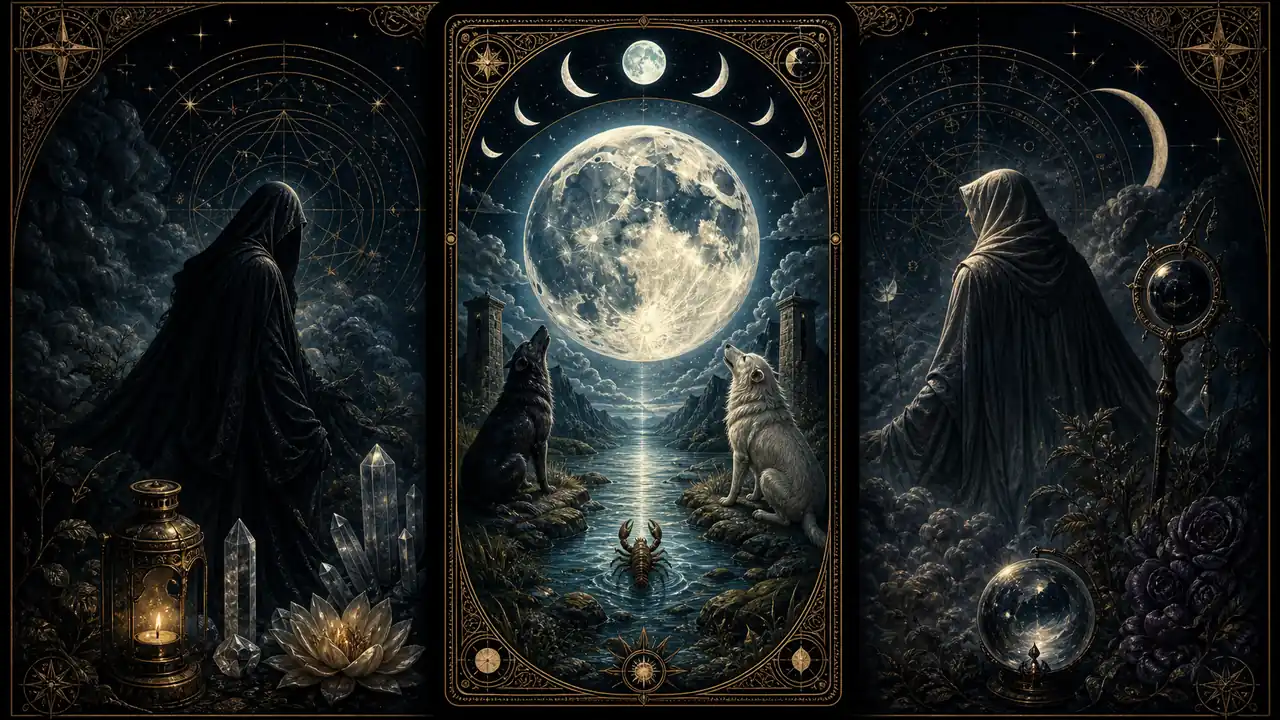
When the Moon appears, its most direct message is usually not “things are definitely bad.” It is closer to “the information you have is incomplete, and emotion and imagination are magnifying your judgment.” It asks you to pause instead of concluding from guesses, fear or a single remark from the other person. This matters most in love, situationships, job changes and murky social situations, where the Moon often points to haze, hidden conditions, inner anxiety and a truth that still needs checking.
The Moon is card XVIII of the Major Arcana. Its imagery usually shows moonlight, a dog, a wolf, a crayfish and a distant path. Together these point to instinct, the subconscious, an unknown journey and blurred boundaries. The most common beginner mistake is to read it straight as deception, a third party, a curse or certain failure. A more accurate approach is to treat it as a card about telling the truth apart from emotional noise.
If you are asking about someone's feelings, where a situationship is heading, whether a job will work out or whether to trust a promise, the Moon will not encourage you to act on impulse. It asks you to sharpen the question, separate evidence from imagination and watch whether more concrete cards show up next. For quick upright and reversed keywords, see the Moon card meaning page. To understand how the whole deck fits together first, read it alongside the 78 tarot card meanings.
Key takeaway: the Moon means information is incomplete and your emotions and imagination are magnifying your judgment. It does not mean someone is lying to you. Upright, the fog is still there. Reversed, the truth may be surfacing or anxiety may be spiraling, depending on the surrounding cards and on what actually happens. When you draw it, separate facts, feelings and guesses first, then plan one next step you can verify.
The Core Meaning of the Moon: Hidden Information, the Subconscious and Intuition That Needs Checking
The first step in reading the Moon is to stop treating it as a “scary card” and treat it as a card about finding your way through fog. Its core is not a single event but a state: the information is unclear, emotions rise and fall easily, intuition is strong but not necessarily accurate, and the person asking may be filling the gaps with imagination. It is not bright and direct like the Sun, and it does not carry a clear call like Judgement. The Moon is more like a night road: there is a path ahead, but you cannot see far, and you cannot tell whether the shadow beside it is a threat or just a tree.
In the image, the Moon hangs high. The dog and the wolf stand for tamed and wild instinct, and the crayfish rising from the water is like a raw impulse surfacing from the subconscious. These elements remind the reader that your reaction may come not only from outside events but also from past experience and from the fear of rejection, of losing control or of being deceived. If you only memorize “the Moon equals deception,” you miss the more important signal: what you really need to handle now is how to confirm the facts and how to avoid being led by anxiety.
As a Major Arcana card, the Moon usually goes deeper than everyday matters. It may point to insecurity that has built up over time, or to unspoken understandings and avoidance inside a relationship. If you are still building a sense of the Major Arcana as a whole, read the 22 Major Arcana meanings and the Fool's Journey and place the Moon within that journey: it is not the destination but a dark night before clarity.
Core reading: seeing fog is not seeing disaster
The most practical one-line reading of the Moon is: do not judge by appearances right now. The card may mean the other person has not been clear, you do not have all the information, some variables have not surfaced yet, or you are treating unproven thoughts as facts. It asks you to hold off on a final verdict and first clarify the question, the time frame and the clues you can check. In love questions it often means ambiguity. In work questions it often means an opaque process. In questions about yourself it often means anxiety and intuition tangled together.
Beginner trap: do not start building stories the moment you see the Moon
The Moon easily sets off overthinking because it is tied to the unknown. Beginners often draw it and immediately wonder whether someone is lying, whether there is a third party, whether they are bound to fail. That reaction is exactly the lesson the Moon asks you to face. Treat it as a prompt: write down the known facts, then your guesses, then the actions that could verify them. Once facts and guesses are separated, the Moon stops being a threat and becomes a tool for sorting out confusion.
- The Moon is about hidden information and emotional projection, not simply bad news.
- It asks you to verify your intuition, neither dismissing it nor trusting it blindly.
- Within the Major Arcana, the Moon is the dark night before clarity.
The Moon Upright: Not Necessarily Deception, but Murky Information and Emotions
Upright, the Moon usually means the situation has not fully surfaced yet. You may feel uneasy without being able to say what is wrong. You may also be dealing with vague or shifting explanations, promises without details, a relationship with no definition, or a job arrangement that lacks transparency. The upright Moon is “there seems to be a road, but the road conditions are unknown.” So it should not be read as a flat no. It is a reminder that the priority now is not to decide success or failure, but to find out what information is missing, which emotions are being amplified and which conditions are still unconfirmed.
In practice, the upright Moon shifts focus depending on the question. If you ask “Does he like me?”, it may mean his feelings are unclear and you are also unclear about your own expectations, with both of you testing the waters and holding back. If you ask “Is this job right for me?”, it may mean the role, the manager's style, the pay or the company's situation is still unclear. If you ask “Should I trust this person?”, it does not necessarily say they mean harm. It reminds you not to rely on smooth talk but to look at actions, records, contracts and specific commitments.
The upright Moon also points to the subconscious. The card is not just a mysterious night scene: it puts instinct, fear and an unknown path in one picture. When reading it, ask whether this unease comes from a real outside risk or from past hurt. If it is outside risk, the next step is verification. If it is old pain, the next step is grounding and awareness, not dumping all the pressure on the other person or the situation.
Upright signals in different questions
In love questions, the upright Moon often points to ambiguity, hidden feelings, fear of getting hurt and an undefined relationship. In work questions, it often means an information gap, unclear internal rules and promises not yet delivered. In money questions, it may warn that investment terms are vague, risks are dressed up, or the numbers look good but lack detail. In personal growth questions, it usually points to anxiety, dreams, intuition and heightened sensitivity. The same card should not be forced into one answer regardless of the question.
A practical checklist for the upright Moon
When you see the Moon upright, go through these three questions in order:
Ask yourself | If the answer is | Next step
Am I working with facts or assumptions? | Few facts, many assumptions | Hold off and fill in the missing information first
Are there outside clues I can check? | Yes | Arrange to confirm: ask directly, get it in writing, check records
Are my emotions stronger than the event itself? | Yes | Steady yourself first, then decide
Used well, the Moon breaks chaos down into things you can actually handle.
- The upright Moon often shows up in ambiguous, vague, undisclosed or poorly defined situations.
- It does not mean someone is definitely deceiving you, but you cannot rely on one side's story.
- Check both the outside information and your inner anxiety.
The Moon Reversed: The Fog Lifts and the Truth Surfaces, or Anxiety Spirals
The reversed Moon needs more care than the upright one, because it can go two ways. In the first, the fog gradually lifts, hidden matters start to surface and you slowly understand what confused you. In the second, emotion and fear get out of control, and it becomes even harder to tell intuition from fantasy, sometimes leading to repeated checking, repeated guessing and repeated self-doubt. Which one applies depends on the question, the position in the spread and the surrounding cards, not on a simple “reversed means the opposite.”
If the reversed Moon appears in the outcome position next to clear cards such as the Sun, Justice or the Ace of Swords, it often means the truth will become clear, a misunderstanding may be talked through, or the person finally stops being led by fear. If instead it sits next to the Nine of Swords, Seven of Swords, the Devil or the Hanged Man, the reversed Moon may mean anxiety piling up, avoiding reality, a lie coming out and causing even more chaos, or sensing something is wrong yet refusing to face it. That is why you cannot memorize one line for the reversal.
For beginners, the most useful key for the reversed Moon is not good or bad but “the fog is changing.” It may be thinning, or it may be thickening. Watch whether the person can now say more clearly what they want, whether there is more concrete evidence, and whether they are willing to face an uncomfortable truth. If yes, the reversal leans toward clarity. If no, it leans toward losing control and avoidance. To get comfortable with reversals in general, see reading reversed tarot cards for beginners.
Reversed is not automatically better, or worse
Many people assume a reversal is simply the opposite of the upright meaning: upright Moon is confusion, so reversed must be clarity. That is only half right. A reversal can mean unease receding, truth emerging and misunderstandings clearing up. It can also mean a fear held down too long starts erupting in messier ways. In love questions especially, the reversed Moon may mean you finally see the other person clearly, or that anxiety pushes you to dig up old arguments, track their whereabouts or demand answers.
Three clues for reading the direction of the reversal
First, see whether the surrounding cards bring clear structure, such as Justice, the Emperor or the Ace of Swords; these tilt the reversed Moon toward clarity. Second, see whether the person's actions are becoming steadier; if they are still chaotic, the reversal is not necessarily an improvement. Third, see whether things have entered a disclosure stage: the other person is finally willing to talk, the company finally puts terms in writing, or you finally admit what you are afraid of. Without these clues, do not rush to declare that the truth is out.
- The reversed Moon can mean the truth surfacing, or anxiety becoming harder to manage.
- Judge the direction from surrounding cards, position and the person's actions.
- A reversal is not a simple opposite but a shift or turn in the Moon's energy.
Here is how upright and reversed compare across common questions:
Question | Upright | Reversed
Love | Ambiguity, unclear feelings, attraction and unease at the same time | Real feelings about to show, or insecurity erupting into suspicion and checking
Work | Role, reviews or promises still unclear | Terms finally laid out, or internal chaos coming to the surface
Money | Returns sound great, risks are not spelled out | Risks get exposed, or anxiety creates a stronger urge for a quick win
Personal state | Anxiety, vivid dreams, strong intuition mixed with fear | Unease fading and self-understanding, or emotions harder to control
The Moon in Love: Ambiguity, Insecurity, Projection and Unspoken Feelings
Love questions are one of the most common places the Moon shows up, because intimate relationships naturally stir up security, expectations and guesswork. If you ask “Does this person like me?” and draw the Moon, you cannot simply answer “no” or “they must be hiding something.” A more accurate reading is that the connection is currently vague and uncertain: they may not have made their feelings clear, and you may be magnifying small signs because you care. The Moon asks you to tell apart what they actually do from the script your fears are writing.
In a situationship, the Moon often points to hot-and-cold messages, no clear definition, both people testing the waters, or someone holding back until the last moment. It can also mean they do have feelings but do not dare admit them, do not know how to move forward, or are very guarded because of past experience. This is where beginners often slip: seeing the Moon and inventing a hundred excuses for the other person while ignoring whether they actually show up consistently. The Moon can mean unclear feelings; it does not mean you must wait forever.
If you are asking where a relationship is heading, read the Moon together with real interactions. Do they make time to meet? Do they follow through on what they say? Do they dodge important topics? Do they only come close when they need emotional support? If the Moon sits next to the Two of Cups, the Lovers or the Star, there may still be a tender connection that simply lacks security. If it sits next to the Seven of Swords, the Devil or the Seven of Wands, watch for concealment, defensiveness and push-pull dynamics. If your question is about a situationship, read does my situationship like me? Common love signals in tarot.
Love upright: attraction and insecurity can coexist
In love, the upright Moon is often not a simple lack of feeling but feeling mixed with fear. They may be drawn to you yet afraid of commitment. You may really like them yet keep decoding every reply because you are unsure. The card reminds you not to treat a situationship as a stable relationship, and not to automatically read silence as rejection. The best approach is to watch whether their actions are consistent over time, not how high or low the emotions run.
Love reversed: the truth draws near, or insecurity explodes
In love, the reversed Moon often means hidden feelings are about to be seen. They may finally reveal how they feel, or you may finally realize you have been rationalizing their neglect. With cards of clear communication, the relationship may get talked through. With cards of anxiety or avoidance, checking up, suspicion, cold wars and emotional pressure may increase. At that point, make the question specific, such as “How should I communicate over the next two weeks?”, rather than asking “Does he love me or not?” again and again.
Action tips for love
After drawing the Moon, it is better not to interrogate, test or play it cool to see how they react. A more effective way is to check where things stand with a low-pressure but clear question, such as “Things between us have felt a bit unsteady lately. How do you see it?” or “Where do you hope this is going?” If they answer concretely, the Moon's fog thins. If they keep dodging, the card reminds you not to keep hope alive on imagination alone.
- In love, the Moon often means ambiguity, projection, fear of getting hurt and an undefined relationship.
- Do not equate the Moon with a third party, but do not ignore the risk of concealment either.
- What really matters is whether their actions are steady and their words specific.
The Moon in Work and Money: Unclear Processes, Undisclosed Risks and Delayed Judgment
When the Moon appears in a work question, it usually means information is not transparent, not that the job is necessarily bad. You may be facing a vague job description, a manager who has not stated expectations, team dynamics that are hard to read, a project that keeps changing direction, or terms that look good on the surface but have not been confirmed in detail. If you ask “Should I accept this job?”, the Moon reminds you not to be won over only by the title, salary or verbal promises, and to confirm the actual duties, boundaries of responsibility, how performance is reviewed and how much overtime is involved.
In money and investment questions, the Moon calls for extra caution. It may mean returns are described too attractively, risks are not fully disclosed, contract wording is vague, or you are rushing toward a seemingly perfect fix because you feel anxious. The Moon does not tell you never to invest or partner with anyone; it tells you to slow down and verify. Any line like “act now or miss out,” “zero risk” or “just trust me” sits very close to the Moon's warning.
At work, the Moon can also point to inner career confusion. You may not have a bad employer; you may simply not have worked out what you want most: stability, growth, income, freedom or building expertise. If the question itself is vague, like “Will my work go well?”, the Moon will just mirror your confusion. Better questions are: “If I stay in my current role for three months, what risk should I watch most?” or “What conditions of the new role I interviewed for still need confirming?”
Work: turn promises into things you can confirm
When the Moon shows up in a work question, turn every vague promise into a checklist. If they say there is great growth, ask what the growth path is. If they say it is flexible, ask how flexibility is measured. If they say bonuses are high, ask how they are calculated and when they are paid. The Moon's biggest danger is nodding along on feeling alone. Once information is in writing, specific and trackable, much of the card's risk goes away.
Money: do not make financial decisions out of anxiety
In money questions, the Moon often reminds you that anxiety inflates hope and hides risk. If you want a quick turnaround because you are short of money, or you are jumping in out of fear of missing out, the Moon is a clear signal to pause. Check the contract, the source, the fees and the exit terms first, and get help from a qualified professional when needed. Tarot can point out blind spots, but it should not replace legal, financial or risk assessment.
- At work, the Moon mostly means unclear terms, opaque processes and missing internal information.
- With money, the Moon warns against being pushed by polished pitches or by anxiety.
- The most useful action is to verify contracts, responsibilities, deadlines, risks and exit terms.
Common Beginner Mistakes with the Moon: Don't Mistake Fear for the Card's Meaning
The most common misunderstanding is seeing the Moon as guaranteed lies, betrayal, infidelity, supernatural interference or a bad outcome. That reading may be dramatic, but it is not precise, and it can easily hurt the person asking. The Moon can involve concealment, but concealment covers a lot of ground: some people hide their real feelings, some hide their fears, some hide their uncertainty, and some cannot even see their own motives. Declaring bad intent outright makes the reader more anxious and misses a more constructive reading.
The second mistake is turning intuition into something infallible. Many people see the Moon and say “trust your gut,” but in this card intuition and fear are often stuck together. You may feel something is off because there really is a risk, or because past hurt has made you extra sensitive to similar situations. The right approach is not to deny the feeling but to let it be tested. Write your intuition down as a checkable hypothesis, such as “I feel he is avoiding defining the relationship,” then watch whether he keeps changing the subject.
The third mistake is making a major decision from a single card. The Moon itself emphasizes uncertainty, so it is even less suited to being read in isolation. If you are deciding whether to break up, quit, put in a large sum of money, move or get married, deciding on one Moon card goes against what the card is telling you. It asks you to gather more information, observe for longer and ask more specific questions, rather than putting all the weight on one card. Beginners will find the Moon easier to read once they know the overall structure of the card meanings.
Myth one: the Moon always means someone is lying to you
The Moon can mean deception, but not every time. More often it means “you cannot confirm this yet.” If someone does not reply, they may be deliberately cold, genuinely busy, or unsure how to respond. The Moon does not let you pick the scariest answer; it asks you to look for patterns. Are they inconsistent over a long period? Do they only come close when they need you? Do they avoid every important question? A pattern is what allows a judgment.
Myth two: the Moon means your intuition is spot on, so no need to check
The Moon is linked to intuition, but it is not a pass to skip verification. Mature intuition is willing to be tested against reality; immature fear resists any contrary evidence. If you draw the Moon, treat the feeling as a prompt, not a verdict. You can say “I need more information” instead of “I must be right.” That respects your intuition while protecting you from being run by anxiety.
Myth three: the reversed Moon always means the truth is out
The reversed Moon is sometimes clarity and sometimes deeper confusion. If you keep doing readings while emotionally unsteady and draw the reversed Moon, it may not be an answer arriving but a sign you are getting more muddled the more you ask. To decide whether the truth is really out, look for concrete information: a conversation, documents, clear actions, confirmed dates. Without real-world support, do not read the reversal as everything becoming clear.
- The Moon is not a card of threats but a card of reminders.
- Intuition deserves respect, and it also deserves to be tested.
- Major decisions should not rest on a single Moon card.
How to Actually Read the Moon: Question, Position, Surrounding Cards and Next Steps
To read the Moon well, the first step is not memorizing more keywords but asking a clear question. A vague question makes the Moon even vaguer. “What will happen with us?” usually gets a very emotional answer. A better question is “Over the next month, what blind spot should I watch most in how we interact?” or “What is the key reason I cannot judge this job clearly right now?” The Moon needs a defined scope: it already stands for uncertainty, so the looser the question, the harder the answer is to apply.
The second step is the position. In the present position, the Moon means you are currently in an unclear situation. In the obstacle position, fear, concealment or misunderstanding is blocking progress. In the advice position, it does not necessarily tell you to suspect everyone; it tells you to slow down, gather information and listen to inner signals. In the outcome position, things may stay unclear in the short term, or the truth may need time to surface. The same card has a completely different tone in different positions, a detail beginners often miss.
The third step is the surrounding cards. With the High Priestess, intuition and unspoken information grow stronger. With the Seven of Swords, pay closer attention to concealment, strategy and lack of honesty. With the Seven of Cups, it points to fantasy, too many options and projection. With the Sun, the fog may gradually clear. The Moon's symbolism carries mystery, dreams and the trials of the road, but in practice the reading should return to the question itself rather than piling symbols onto the reader.
Step one: rewrite the question so it can be answered
Instead of “Is something wrong with him?”, try “Which signal in our interactions most needs confirming?” Instead of “Am I going to fail?”, try “What is throwing off my judgment right now?” Instead of “Will this company take advantage of me?”, try “What three kinds of terms should I confirm before accepting this job?” The Moon is good for finding blind spots, not for feeding fear.
Step two: separate facts, feelings and guesses
When reading the Moon, draw three columns on paper: facts, feelings, guesses. Facts are what the other person did, what they said, what the document says. Feelings are your unease, hope or disappointment. Guesses are what you infer they might be thinking. This method suits the Moon perfectly because it untangles what has been mixed together. Once you see that you do not actually have many facts, you know the next step is not to conclude but to gather more information.
Step three: turn the meaning into a next action
The Moon's advice usually comes down to slow, check, ask, wait. Slow means pausing impulsive decisions. Check means confirming data, records, promises and terms. Ask means raising questions clearly and without attacking. Wait means giving the truth time to surface, but not waiting indefinitely. Set an observation window, for example two weeks to see whether they are willing to talk about the relationship, or asking for a written job description after an interview. The Moon dislikes idle speculation; it needs concrete verification.
- Rewrite the question before reading the Moon, and the answer gets much clearer.
- The position decides whether the Moon is the present, an obstacle, advice or a short-term outcome.
- Surrounding cards help show whether the fog comes from outside concealment or inner anxiety.
The Limits of the Moon: Questions One Card Should Not Settle
The Moon is very good at showing blind spots, emotional noise and unresolved factors, but it is not suited to carrying a major decision alone. If the question involves law, health, finances, contracts, investments, a major career change or personal safety, the Moon can only tell you there is uncertainty and risk here; it cannot replace professional judgment. Especially when you already feel strong anxiety, asking the same question over and over tends to make the Moon's energy heavier, because you are no longer looking for information but for reassurance.
Another limit is that the Moon is easily colored by the reader's own state. If you have slept badly, are in an emotional low, just had a fight or were just left on read, drawing the Moon may reflect both outside uncertainty and inner unease. That does not mean the card is wrong; it is pointing to the filter through which you are seeing things. Rather than pressing “What is the truth?”, ask first “What part of me most needs steadying so I can judge more clearly?”
The Moon also reminds tarot readers to be responsible. Do not use a threatening tone that deepens the person's unease, do not say someone has definitely betrayed them without evidence, and do not dress up every ambiguity as mystical insight. A better line is: “There is something unclear here; let's see where it comes from.” The Moon shows its real value when a reading helps someone tell facts, emotions and actions apart. If you are new, practice with the basic card meanings and spreads rather than memorizing single-card keywords.
Questions not to settle in one reading
Whether to divorce, quit, commit a large sum of money or trust a high-risk promise should not be decided by one Moon card. You can use the Moon to find the source of uncertainty, then use a more specific spread to break down risks, resources, alternatives and timing. Where a professional field is involved, consult the relevant expert. Tarot's strength lies in prompting and organizing, not in letting you skip a real-world assessment.
The safest next step after the Moon appears
The safest next step is to set one action you can verify. In love, arrange one clear conversation and see whether they are willing to discuss what the relationship is. At work, ask for terms in writing and confirm responsibilities and pay. With money, pause any payment and review the contract and the risks. For your own state, keep a record of dreams, emotions and triggers. Once you verify, the Moon is no longer just fog; it becomes the road to the next card.
- The Moon is good at flagging uncertainty, not at replacing professional decisions.
- Asking the same question repeatedly can deepen anxiety instead of bringing clarity.
- The best way to close is not a verdict but a verifiable next step.
References
If you've just drawn the Moon, don't rush to a conclusion. Bringing your current question to the cards makes it easier to tell intuition from anxiety and to spot the clues that still need checking.
Start a Tarot Reading