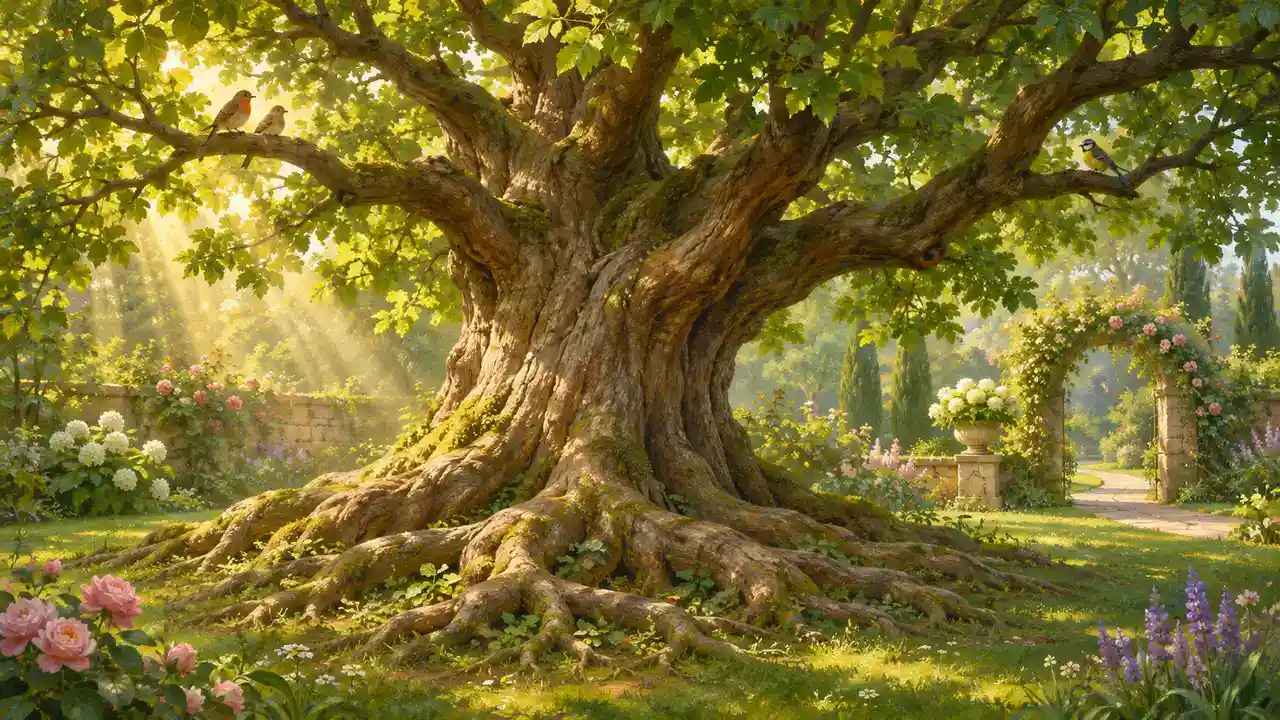
What does the Lenormand Tree mean? The Tree is card number 5 of the 36 Lenormand cards, and it is generally interpreted as a card of health, growth, roots and the long term. It does not describe something that happens overnight. It describes the whole life of a tree, from seed to shade: growing slowly, sending roots down and standing up to time. When the Tree appears, it reminds you to measure the matter in months and years rather than today or tomorrow. If you would like to try it yourself first and see where the Tree falls for your own question, you can start with a Lenormand reading.
Compared with other cards, the Tree has an especially clear sense of time. The Scythe is the instant of a single cut. The Mice are the slow wear of small losses. The Tree is just as slow as the Mice, but it moves in the opposite direction: it adds rather than subtracts. Because it is slow, the Tree can feel as if it gives no answer at all, yet its answer is simply that this takes time and that roots matter more than speed. Below, the Tree is unpacked step by step: the imagery on the card, why Lenormand ignores reversals, three situations (health, growth and long-term relationships), and its combinations with the Heart, Ring, Fish, Garden and Scythe.
The Core of the Tree: Slow, Deep and Lasting
The Tree is card number 5 in the Lenormand deck, and it is generally interpreted as a card of health, growth, roots and the long term. To sum it up in three words, try slow, deep and lasting. Slow describes how quickly things change. Deep describes the layer of life it touches. Lasting describes how much time it covers.
Start with slow. A tree does not grow faster because you hurry it, and a sapling usually needs years before it casts real shade. So when the Tree lands in the answer position, the common reading is that the matter will not be settled in a few days. It moves in months and years instead. If your question was about next week, the Tree is often gently pointing out that the time frame of the question may be wrong and that a longer view is needed.
Then deep. Much of a tree's strength sits underground, and the leaves you see are only the surface. The issues the Tree touches often work the same way. On the surface there is one argument, one job, or one small physical complaint. Underneath, it is connected to family background, long-standing habits and choices made a long time ago. The Tree asks you to look down instead of only dealing with the surface.
Finally, lasting. The Tree speaks about things that can endure: a relationship that goes the distance, a career that builds over time, a way of living you can keep up. It cares less about a short burst of excitement and more about staying power. That is why the Tree is often seen as a fairly stable and positive card. Its positivity, though, means growth once the roots settle, not instant good news. For the full basic meaning, see the complete Tree card meaning. Here the focus is on how to read time and roots.
Reading the Image: Roots, Trunk and Branches
Lenormand imagery is usually very direct, and the Tree card simply shows a large tree. Decks draw it in different ways, but almost all of them have three parts you can read: the roots, the trunk and the branches. Mapping these three parts onto a timeline is a very useful way to interpret the card.
The roots stand for foundations and the past. They grow underground where you cannot see them, yet they are the reason the whole tree can stand. In a reading, the roots point to the source of a matter: your family of origin, early experiences, the way a relationship began, or the first motivation behind a plan. When a question feels stuck, the Tree often suggests going back to the roots. The answer may not be in front of you but in something planted long ago.
The trunk stands for your present state. It connects roots and branches, and it is also where you can best see whether a tree is healthy: thick or thin, straight or leaning. In your situation, the trunk is your current energy, emotional reserves, resources and stability. When reading the Tree, it helps to ask yourself whether your trunk can carry the weight right now, or whether it is already too thin while you are still hoping to grow a huge canopy.
The branches and leaves stand for future development. They reach outward and upward, and they are the visible results, the part that changes with the seasons. Dense foliage suggests room to grow; sparse branches may mean the timing is not right yet or there is not enough nourishment. The key point is that the branches depend on the roots and trunk, not the other way around.
This approach turns the Tree from a simple label for health or growth into a storyline with a cause, a present and a direction. When you read it inside three cards, it also becomes much easier to connect it with its neighbors and form a complete sentence.
The Tree Has No Upright or Reversed Meaning
Many people come to Lenormand from tarot, and their first question is what the Tree means upside down. The answer is simple: Lenormand does not use reversals. If a card turns upside down while you shuffle, just turn it the right way up and read it as usual. The meaning does not change. This is worth stating clearly for the Tree in particular, because you will sometimes see tarot habits carried over, with an invented rule that a reversed Tree means illness or stagnation. That is not the traditional way Lenormand is read.
Why does Lenormand not need reversals? Because its whole logic is built on combinations. Each Lenormand card has a fairly simple meaning, much like a single word, and the real message comes from putting cards together into a sentence. The Tree itself names the theme of health, growth, the long term and roots. Whether that theme is going well or badly, growing or declining, is left to the cards beside it.
In other words, the Tree works like the noun tree in a sentence, while the neighboring cards act as adjectives and verbs. Next to bright cards such as the Sun or the Bouquet, the Tree reads as lush and flourishing. Next to heavier cards such as the Clouds, the Coffin or the Mice, it may read as undernourished and in need of care. It is still the same tree; what changes is the environment around it.
So when you read the Tree, do not ask whether it is upright or reversed. Ask what is next to it. This is also why practicing combinations matters more than memorizing single card meanings when you learn Lenormand. The guide on how to read three Lenormand cards walks through the full sentence-building process, and it pairs well with this article if you want to practice placing the Tree inside real sentences.
Thriving or Withering: Look at the Neighbors
Since the Tree has no reversed meaning, whether it is thriving or withering depends on the cards around it. Below are some common directions to help you judge quickly during a real reading. Keep in mind that these are only general tendencies, and the final reading should always return to your actual question.
Signs of thriving: when the Tree appears next to cards such as the Sun, the Bouquet, the Stars or the Anchor, a common reading is that the foundation is solid, growth is under way, or long-term effort is finally starting to show results. The Sun gives the tree light, the Bouquet is like blossoming, the Stars offer direction, and the Anchor makes the tree steadier. All of these strengthen the picture.
Signs of withering: when the Tree sits next to the Mice, the Clouds, the Coffin or the Cross, it is generally read as a tree that needs care. The Mice nearby suggest something slowly gnawing at the roots, perhaps long-term stress or a gradual loss of resources. The Clouds point to an unclear state that comes and goes. The Coffin is often read as a phase coming to an end, calling for rest or a transition. The Cross brings a sense of burden and responsibility.
There is also a neutral but changing direction. With the Stork beside the Tree, a common reading is that the way you grow needs to change, such as adopting a new habit or adjusting your course.
Position matters too. In a three-card line, the Tree in the middle is the core of the matter; on the left it acts more like the cause or background; on the right it reads more like the direction things are heading. Take the Tree and the Mice: with the Mice after the Tree, long-term wear may be happening right now; with the Mice first and the Tree after, it may mean that time is needed to recover after a period of loss. Different positions tell different stories, and that is what makes Lenormand so rewarding to read.
Health Readings: State of Being, Not Medical Advice
The Tree is most often associated with health. It is generally interpreted, in health-related questions, as speaking about your overall physical and mental state and the time that recovery needs. First, the most important principle: if you feel unwell, please see a doctor. Tarot and Lenormand speak about your state of being, and they do not replace medical judgment. Whatever card you draw, it should never be used to decide whether to seek care, whether to take medication, or to guess what condition you might have.
With that in mind, how can the Tree be read? First, it reminds you to care for yourself at the root level. A tree's health does not come from trimming its leaves but from soil, water and sunlight. In daily life, that means sleep, food, routine and stress. When the Tree appears, a common suggestion is to look back at these long-term habits instead of searching only for quick fixes.
Second, it speaks about the rhythm of recovery. If you are in a period of rest, the Tree's sense of time suggests that recovering is more like a tree growing new leaves: it takes patience, and thinking in weeks or months is more realistic. This is not bad news. It is an invitation to be gentler with yourself instead of worrying because you are not fully better today.
Third, it can also describe your emotional state. A tree's roots need settled soil, and people need a settled environment too. If the Clouds or the Mice sit beside the Tree, you can read it as a reminder that you have been using up a lot of energy lately and need to replenish it, for example by scheduling rest, talking with someone you trust, and seeking professional support when needed.
One final reminder: treat the Tree simply as a prompt to look after yourself. It can help you sort through your feelings and notice the rhythm of your life, but real judgments about your body always belong with a doctor.
Growth Readings: Direction Matters More Than Speed
The second common situation is growth, whether that means work, study, skills or personal maturity. Here the Tree is not about how fast you grow but whether you are growing in the right direction.
A tree grows slowly, but it rarely grows the wrong way. It sends roots down and reaches up toward the light, and each year its trunk becomes a little thicker than the year before. This is the Tree's most common message in questions about careers and learning: long-term effort does pay off, as long as you keep investing in the same direction. If you study design today, coding tomorrow and want to change fields again next month, the tree can hardly grow, because its roots keep being pulled up and replanted.
So if you ask whether your current effort is worth it and draw the Tree, the general reading tends to be yes, but it takes time and depends on direction. Use the neighboring cards to judge that direction. The Book beside it may point to ongoing study or further training. The Crossroads suggests a choice ahead, and you need to think carefully about which path lets you put down deep roots. The Anchor suggests your current direction is stable and worth continuing.
The Tree also reminds you not to judge only by the leaves. Many people feel they are not making progress because they cannot see obvious results, yet before a tree grows tall, it spends a long time growing roots underground. If you have recently been building foundations without visible breakthroughs, the Tree is often read as the stage where roots are growing and nothing shows above ground yet.
In workplace questions, the Tree can also point to a job you can stay in for the long run, a professional field that needs steady cultivation, or experience that builds through patience. It does not favor short-term moves. Instead, it encourages you to choose good soil and then give yourself enough time.
Long-Term Relationships: How Solid Are the Roots?
The third situation is long-term relationships, including romance, friendship, family and business partnerships. The question most often asked about the Tree here is whether the relationship can last.
It is generally interpreted that the Tree in a love reading shows a relationship with long-term potential, or one entering a steadier and deeper stage. It is not the spark of a new romance but the process of two people slowly growing their roots together. What you have been through together, your mutual trust and the small understandings of daily life are the roots of the relationship.
The Tree can also show you where the foundation is weak. If a relationship has only branches and leaves, for example a great match on paper and a lot of fun together, but you have never talked about values, future plans or money, it can easily shake when a storm comes. The Tree's reminder here is that instead of asking whether the other person loves you, it may be more useful to ask whether your roots are growing in the same soil.
If this is a relationship that ended and you are thinking about reconnecting, the reading again returns to the roots. Has the reason you separated been addressed? If the roots are still alive and only the leaves have fallen, starting over has a better chance. If the roots themselves are damaged, more time and sincerity are needed to repair them. The Tree does not make the decision for you; it simply reminds you that repairing a relationship, like a tree recovering, takes time and care.
Partnerships work the same way. When the Tree appears in a question about working together, a common reading is that the partnership suits the long term, provided both sides agree on the goal. If you want to explore the role of strength and protection in a relationship, you can also read about the Lenormand Bear card meaning. When the Bear and the Tree appear together, they are often read as one side providing steady support.
Five Common Tree Combinations
The heart of Lenormand is combination. Here are the Tree's pairings with five common cards, offered as general directions. The actual reading still depends on your question and the cards' positions.
Tree and Heart: the Heart stands for love and passion. Paired with the Tree, it is often read as a deeply rooted love, or a love that needs a long time to grow. It can also point to emotional stability. In love questions, this pair tends to suggest that the relationship has lasting potential, but its warmth builds slowly rather than arriving as love at first sight.
Tree and Ring: the Ring stands for commitment, contracts and cycles. A common reading of the Tree and Ring is a long-term commitment, such as a relationship that is settling down, a long contract or an ongoing partnership. The Ring gives the Tree's staying power a formal shape, so this pair is often linked with making things official.
Tree and Fish: the Fish stands for money, resources and flow. Together they can be read as wealth that builds slowly, or a business that brings in income over the long run. It does not lean toward quick profits; it is more like a fruit tree that needs years of care before it bears fruit. Some also read it as the link between health and resources, such as investing time and money in long-term self-care.
Tree and Garden: the Garden stands for groups, social life and public spaces. This pair is often read as working within a community over time and gradually building a reputation, or as the roots of a family or group. It can also point to opportunities that grow slowly through your network.
Tree and Scythe: this is the pair that deserves the most attention. The Scythe is card 10 and stands for sudden cuts and decisions, the exact opposite of the Tree's slowness. A common reading is a sudden change in a long-standing situation, such as an interrupted routine, or something long-term that needs pruning. Pruning is not necessarily bad; gardeners cut branches so the tree can grow better. For the full reading of the Scythe, see the Lenormand Scythe meaning. If this pair appears in a health question, treat it as a reminder to pay attention to your body's signals and to see a doctor if you feel unwell, rather than guessing on your own.
The Tree Compared with the Scythe, Mice and Bear
Several Lenormand cards also speak about time, and comparing their rhythms with the Tree can help you grasp the Tree's meaning more precisely.
The Scythe, card 10, has the timing of an instant. One stroke and things have changed, with no buffer. That is why the Scythe is often read as sudden news, quick decisions or unexpected cuts. The Tree stands at the opposite end. Its change is invisible and gradual; you may need to look back after several months before you notice how much you have grown.
The Mice, card 23, are also slow, but they move in the opposite direction to the Tree. The Mice stand for wear, loss and anxiety, as if something is being nibbled away a little every day. The Tree grows a little every day; the Mice take a little away every day. Both cards remind you to watch long-term accumulation, one adding and one subtracting. When they appear together, a common reading is that long-term stress or habits are slowly weakening the original foundation, and it is worth adjusting early.
The Bear, card 15, has the timing of strength that already exists. The Bear stands for power, protection and resources; it describes a present condition, while the Tree describes a process. Together, the Bear and the Tree are often read as steady backing that supports your long-term growth, or as strength you have built up yourself that is now laying the groundwork for future growth.
Seen side by side, these cards show that the Tree's most distinctive quality is its scale: it counts in months and years. When you draw the Tree, it is worth asking yourself whether you are looking at this matter too impatiently. Very often the Tree does not offer a specific date. It offers a reminder instead: stretch the timeline, and the answer becomes clearer.
References
Bring the health rhythm, long-term goal or relationship foundation you care about and draw your cards, then see how the Tree and the cards beside it form an answer that is truly yours.
Start a Lenormand reading