Drawing the Scythe in a Lenormand reading makes many people tense up, as if something is about to be taken away. The Scythe is card 10 of the 36-card Lenormand deck, and it is generally interpreted as a sudden, fast and clean turning point. At a certain moment something is cut, and the situation changes because of it. That turn can be an ending, but it can just as easily be a decision you have finally made, or the harvest that comes after a long stretch of effort. What defines the Scythe is the single stroke, not a slow process. It describes an instant rather than a long season, which is why it tends to feel so sharp when it appears. Once you see it as a card about timing and decisiveness, not doom, the Scythe becomes much easier to read and far less frightening to find on the table.
This is also what separates the Scythe from the other Lenormand cards that speak about loss. Being slowly worn down, or losing something bit by bit without noticing, belongs to a different rhythm. The Scythe's rhythm is immediate, clear and visible. So when this card shows up, the most useful thing is not to fear what it might cut. Look instead at where the blade points, whether it is clearing weeds or gathering a ripe crop, and whether you are ready to meet that turning point. Reading it well means paying attention to the image on the card, the direction of the blade, the combinations it commonly forms, and its quieter meaning as harvest. It also means knowing when a clean cut is the kindest choice, when it is wiser to hold the blade still, and how to stop circling back once the cut is made.
The Core of the Scythe: A Turning Point in an Instant
The Scythe is card 10 among the 36 Lenormand cards, and it is generally interpreted as sudden, fast and decisive change. Many cards need time to develop, but the Scythe usually appears when things do not drift slowly toward a result. Instead they swerve at a particular moment. A single sentence, one notification or one thought can be enough to change the whole picture.
This quality of the instant is the first key to the card. Many people see the Scythe and immediately assume loss, but a more accurate word for it is cutting. A cut can end a situation that no longer fits you, settle a choice you have been wrestling with for months, or bring ripe fruit down from the branch. The cut itself is neither good nor bad. What matters is where it lands and what it separates.
So when you read the Scythe, ask what in your life needs to be dealt with cleanly instead of asking whether something bad is coming. The card usually points to speed and resolve. Things left untouched for too long may eventually be forced into a fast resolution, while handling them yourself tends to feel calmer than waiting for them to happen to you.
If you want the basic keywords first, the full Scythe card meaning is a good starting point. Then come back and compare it with the two directions discussed here, cutting and harvesting. That makes it much easier to place the card inside your own situation instead of remembering it only as a frightening image.
How to Read the Card Image
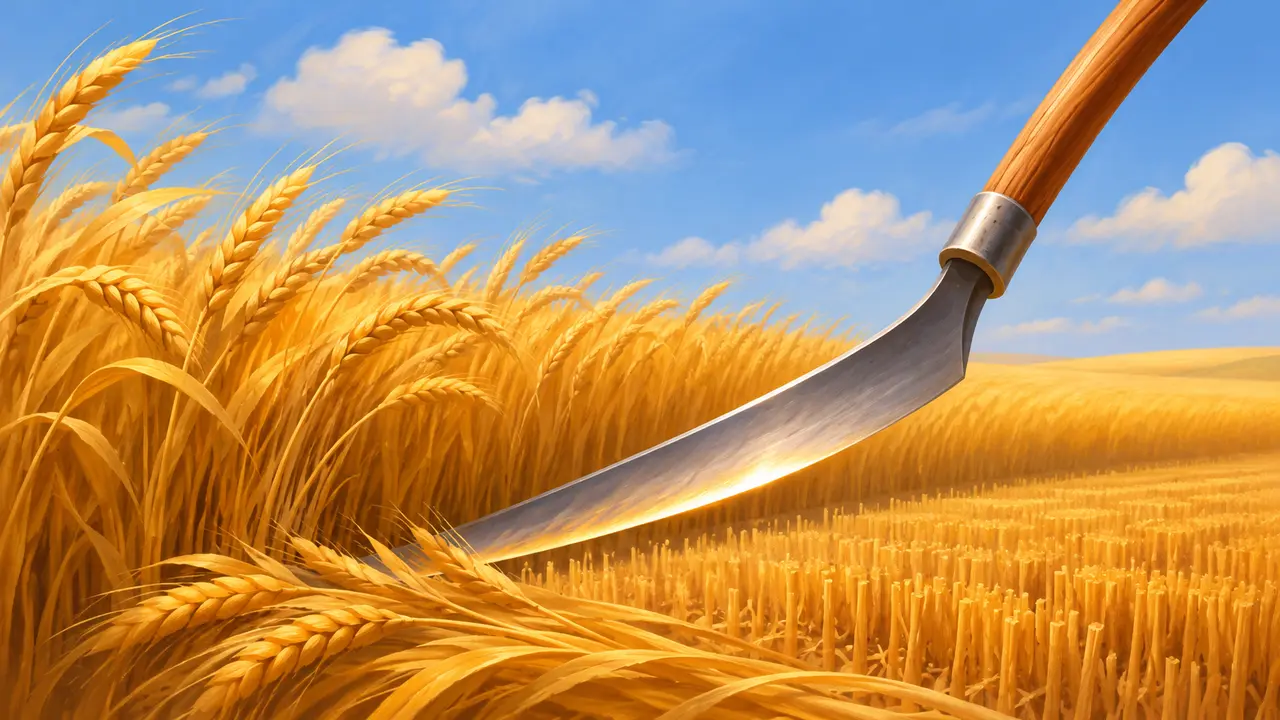
The picture on the Scythe card is usually simple: a long-handled scythe, sometimes beside a field of wheat or ripe grain. The image carries two layers of meaning. The first is the blade itself, sharp and clean, with a sense of speed: one swing and it is done. The second is the crop in the field, a reminder that the scythe was originally a tool for harvesting, not for destruction.
When you look at the card, a few details are worth noticing. The curve and direction of the blade are clues to where the cut is aimed, which the next section covers in more detail. If the image shows golden ears of wheat, a common reading leans more toward harvest and ripeness. If the artwork feels colder and shows only the blade with no field, you can give more weight to ending and interruption. Different decks have different styles, so there is no need to cling to one version. The point is to let the image guide your sense of the card's speed and direction.
Another thing to notice is the feeling of motion. A scythe does nothing while it simply rests there; it has to be swung. That is why many readers feel the card usually describes an action, a moment of decision, rather than an ongoing state. The question it asks is whether the moment to swing has come.
Once the image is familiar, the Scythe stops looking so menacing. It is more like a farmer standing at the edge of a field, judging whether the crop is ripe and whether the weeds need clearing. That judgment takes a good eye and some courage, and those are exactly the two things this card offers you.
Blade Direction: Which Card Is Being Cut
In a Lenormand layout, the position of the cards relative to one another shapes the reading, and the Scythe shows this more clearly than most. A common approach is that whichever card the blade points toward is the area being cut. The card in front of the blade is often what gets severed, rapidly changed or harvested. The cards on the handle side feel more like the source of the swing or the background to it.
For example, if the blade faces a card that represents love, the focus of the question lands on the relationship. If it faces a card tied to work or money, the change is more likely to show up in that area. This is not a rigid rule but a way of reading that helps you focus: first see where the blade swings, then look at what sits there.
If the Scythe sits at the very edge of a row with its blade facing outward, pointing at no card, some readers take this to mean the cutting force is aimed beyond the spread. The change may come from somewhere you cannot see yet, or its impact may not fall directly on the topic you asked about. There is no need to speculate too far here. Treat it as a reminder to stay alert.
In practice you can also read blade direction alongside the timeline. In a three-card line, a Scythe in the middle with its blade facing right is often understood as a turning point that will quickly shape what comes next. To practise this kind of positional reading, try reading three Lenormand cards with the Scythe placed in the line. Seeing it in an actual layout makes the idea click quickly.
Scythe and Mouse: The Quick Cut Versus the Slow Drain
The best way to understand the Scythe is to set it beside the Mouse. Both cards are linked to loss, but the way the loss happens is completely opposite. The Mouse describes being nibbled away: small, steady drains and losses you barely notice until a large piece is suddenly missing. The Scythe describes a single stroke that is quick, clear and visible the moment it happens.
This difference matters a great deal in a reading. Some questions sound like “why am I getting more and more tired?” or “why do my savings keep shrinking when I cannot say where the money goes?” That feeling sits closer to the Mouse and its chronic leak. If your question is whether something will change suddenly, or whether you should decide right now, you are closer to the rhythm of the Scythe. For the slow-drain side of the story, read the Lenormand Mouse card meaning.
The two cards also bring different lessons. With the Mouse, the work is to find the leaks and patch them patiently. With the Scythe, the work is to prepare and respond decisively. The Mouse asks you to watch the details, and the Scythe asks you to watch the timing. One is patient repair; the other is clear action.
Interestingly, the Scythe is sometimes exactly how a Mouse problem gets solved. When something has been worn down so far that it can hardly be saved, dragging it out only extends the loss, and a clean cut can make the draining stop. In other words, the suddenness of the Scythe is not always bad news. It can be the very turning point that ends a long, slow loss.
The Other Side of the Scythe: Harvest
When people think of the Scythe, many think only of cutting and forget that its original purpose is harvest. No farmer brings out a scythe during sowing season. The tool only comes out when the crop is ripe and ready to be brought into the barn. So the other face of this card simply says that the time has come.
Seen this way, the Scythe can stand for effort finally paying off. The results arrive for an exam you prepared for over a long time. A project you have nurtured for months can finally show what it has achieved. A long period of study starts to be useful in real life. These are all harvests, and harvests are fast too. Once something is ripe, it needs to be gathered at the right moment, or the crop may overripen and the best window may pass.
How can you tell whether the Scythe is cutting or harvesting? Two things help. The first is the question itself. If you are asking about something you have cultivated for a long time and hope to see results from, harvest becomes the more likely reading. The second is the surrounding cards. When the Scythe sits beside cards that carry a sense of results, reward or joy, a common view is that it leans toward harvest.
Harvest carries its own reminder as well. After the crop is gathered, the field lies empty, which means one stage is closing and another is getting ready to begin. So even when the harvest is a good one, the Scythe suggests enjoying the results while thinking about what to plant next season. Ripeness is not an ending but the completion of a cycle, and the empty field is waiting for new seed.
The Scythe in Love: Ring and Heart
In questions about love and relationships, the Scythe often appears together with the Ring or the Heart. In Lenormand the Ring is commonly seen as commitment, agreement or the relationship itself, so Scythe plus Ring is generally interpreted in two possible ways. It can point to a relationship or agreement that is suddenly cut off, or to a decisive choice made within the relationship.
These two readings look like opposites, but their core is the same: the state of the relationship gets settled in a short space of time. Sometimes that means separation. Sometimes it means a promise finally spoken aloud or a direction finally agreed. To tell which, go back to your question and the blade direction. When the blade points straight at the Ring, it is often understood as the agreement itself taking a hit. When the Scythe and Ring sit together beside cards suggesting results or happiness, it reads more like a decision has been made, and a reassuring one.
Scythe plus Heart is often described as cutting through emotional tangles in one stroke. The Heart stands for feelings and what you care about, and a Scythe aimed at it does not necessarily mean heartbreak. More often it means that emotional back-and-forth gets resolved all at once. Perhaps you stop endlessly guessing about an undefined situation, or perhaps you decide to let go of an attachment that has been draining you.
If the Scythe shows up in a love question, try not to jump straight to the worst outcome. What this card more often points to is that something you have agonised over for too long may need a clear answer. You can ask, check and clarify yourself rather than waiting for events to unfold. Facing things directly is usually gentler than simply enduring them.
Combinations for News, Health and Money
Scythe plus Letter is commonly read as news that arrives suddenly. The Letter represents messages, documents and notifications, and the Scythe adds speed, so together they look like an unexpected message landing out of nowhere. The content is not necessarily bad: it might be a job interview result, a notice or a very direct reply. What matters is that it arrives quickly and changes the situation straight away.
Scythe plus Tree is a combination to treat gently but seriously. In Lenormand the Tree is usually connected with the body, health and long-term wellbeing, so this pairing is generally interpreted as a reminder that a health signal may need attention and should be dealt with promptly rather than put off. To be clear, the cards can only serve as a reminder and cannot replace medical judgment. If you genuinely feel unwell, please see a qualified doctor, and let the card be nothing more than the nudge that says stop postponing it.
Scythe plus Fish is often read as a sudden cut in money flow. The Fish represents money, trade and circulation, and a Scythe pointed at it may suggest an expected income stopping or a source of finances changing. Rather than a cause for worry, this pairing works better as a prompt to review your financial arrangements. Are you relying too heavily on a single income, and have you kept some buffer? The cards are no substitute for professional financial advice, but they can encourage you to think ahead.
What these three combinations share is speed. The Scythe brings change forward and makes it happen faster, and that also gives you the chance to prepare early. When you see it, there is no need to panic. Start by handling whatever is already within your reach.
When to Make a Clean Cut
The most important lesson of the Scythe is not predicting what will happen. It is helping you judge when a decisive cut is the right move. In some situations, cutting something off is the kindest choice you can make for yourself.
The first situation is when you have already checked something again and again, the answer is clear, and you simply have not found the courage to act. It might be a relationship in which you have felt wronged for a long time, or an arrangement that stopped suiting you ages ago. You know it inside, yet you keep waiting for a better moment. When the Scythe appears here, it seems to say that the moment may be now.
The second situation is when delay itself is causing harm. Some things get harder the longer they wait, such as a misunderstanding that needs clearing up or a plan that should be stopped. Being decisive here is not impulsive. It prevents a bigger drain and stops the same issue from pulling you back and forth.
The third situation is when something ripe needs to be gathered. You have prepared long enough and built up enough, and waiting any longer may mean missing the window. Here the Scythe is about harvest rather than severing. It invites you to trust your own effort and reach out to collect what you have earned.
To work out whether you are in one of these situations, try making your question more specific. Instead of asking “should I leave?”, ask “if I make a decision now, what do I most need to watch for?” The way you phrase a question shapes how you read the cards, and you can find more ideas in this guide to questions for Lenormand.
When Not to Swing the Blade Yet
The Scythe stands for decisiveness, but decisiveness is not the same as impulse. Seeing this card does not mean you should make a major decision immediately. Sometimes the Scythe is actually reminding you not to rush the swing.
The first moment to pause is when your emotions are at their peak. When you are angry, hurt or anxious, it is easy to want one clean cut that makes you feel better right now. A decision made in that state may not be what you would choose once you are calm. A useful check is to ask yourself whether you would make the same decision if you looked at it again in three days.
The second is when things have not been fully clarified. Many misunderstandings are only one question away from being resolved, and the sudden news of a Scythe and Letter pairing may simply be incomplete information. Before you cut, ask what needs asking and listen to what needs hearing, then decide whether to act. Cutting is easy and reattaching is hard, so spending a little more time to confirm is worth it.
The third is when the crop is not ripe yet. Harvest needs good timing, and if you gather too early the fruit is still green. If your plan has only just begun, the Scythe may be reminding you to stay sharp and alert rather than asking you to end it or reap from it right away.
So when the Scythe turns up, you can run a small check. Have I clarified things? Am I calm? Is this matter ripe? Once you have thought through all three, swinging the blade is no longer impulsive. It becomes a decision with real thought behind it.
After the Cut, Stop Looking Back
The Scythe carries one more reminder that is often overlooked: once you have cut, try not to keep looking back. The motion of a scythe is completed in a single sweep; it does not hack at the same spot over and over. If you have already made your decision, constantly doubting it and returning to inspect the cut only makes the wound slower to heal.
This does not mean pushing your feelings down. Ending something or letting go of a relationship naturally brings sadness. But sadness and endless wavering are two different things. Sadness is allowing yourself to feel the loss. Wavering is pulling a decision you have already made back onto the table again and again, which leaves you stuck in the middle, unable to go back and unable to move forward.
A small ritual can help. You might write the decision down, spelling out clearly why you chose it, or tell a friend you trust so the decision has a witness. Later, if the urge to go back returns, reread the reasons you wrote and remind yourself that you made the choice after thinking it through.
The same applies to a harvest. Once the results are gathered, enjoy them properly instead of wondering whether you should have waited longer. A field needs rest after harvest, and it needs new seed too. Where the Scythe passes, it leaves space, and that space is where the next beginning takes root. If you treat the Scythe as a clean turning point rather than an omen to dread, you will be much better able to receive the message it brings.
References
If there is something on your mind that you are weighing whether to cut off, or a harvest you are waiting for, bring your question, draw the cards and see how they respond.
Try a Lenormand reading