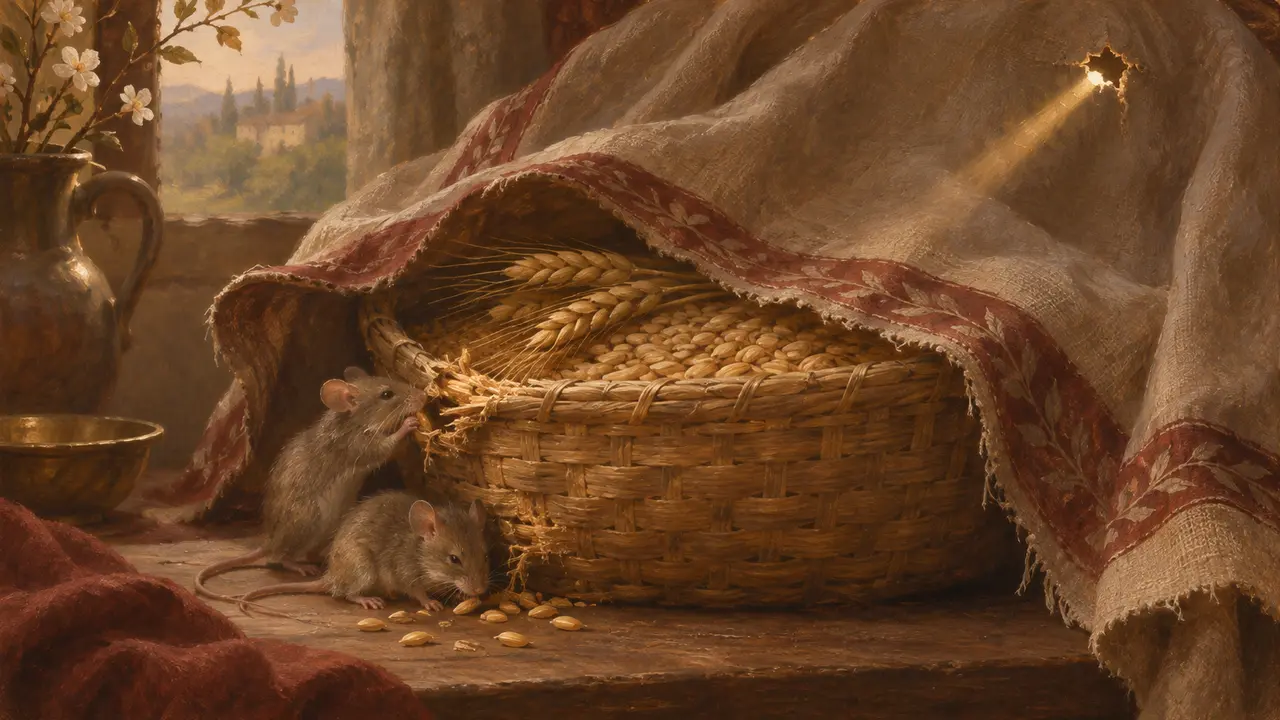
In Lenormand, the Mice is card 23 of the 36-card deck, and it is generally interpreted as wear, stress, worry and loss. Yet the most useful thing about the Mice card is not the loss itself but the way loss happens. Mice never carry off a whole sack of grain in one night. They nibble a little each day, quietly, and one morning you open the cupboard and find the sack half empty. So when the Mice shows up in your reading, it is usually not announcing a sudden disaster. It is pointing at something that is slowly leaking in your life, something you may not have noticed yet. That leak might be money, time, energy, trust in a relationship or simply your peace of mind. The card asks you to look more closely at the places you normally walk past without a second glance. Seen this way, the Mice is less a verdict and more a flashlight shining into a dim corner.,That is also why there is no need to treat the Mice as a curse card. Slow loss is uncomfortable, but it has one big advantage: it gives you time. Once you find where the leak is, most of the drain can still be stopped before it does lasting damage. Reading the Mice well means shifting your attention away from 'am I about to have bad luck?' and toward 'where are my energy, money, relationships or mood trickling away, a little at a time?' That shift turns vague stress into a practical question you can actually work on. Loss that is seen early is usually loss that can still be managed. The sections that follow move from the imagery on the card to its common combinations, then to realistic ways of stopping the loss, and finally to a side of the Mice that is mentioned less often: it also chews away the things you should have cleared out long ago. If you'd like to draw cards for a question of your own and see what message this card forms with the cards beside it, you can start with an online Lenormand reading.
How to Read the Mice Card's Imagery
Before you memorize keywords for the Mice card, try simply looking at the picture. Most decks show one or several mice gathered around food, grain or a pile of goods, gnawing away. Some versions place them in a dim storeroom or a forgotten corner, which gives the feeling that something is happening where nobody is paying attention. Those details already tell you most of what the card means.
The first detail is the act of gnawing. Gnawing is not grabbing and it is not smashing. It is bite after bite, repeated over and over. It describes a steady drain that is never dramatic but never really stops. The second detail is that things are shrinking. The food in the picture is usually already missing a corner, a reminder that the loss started some time ago and simply has not become obvious yet. The third detail is hiding in the dark. Mice like to work where they cannot be seen, which mirrors the leaks in daily life that are easy to miss: a subscription charge you forgot about, a hurt you never voiced, a body signal you keep postponing.
The core image of the Mice is generally interpreted as invisible, accumulating loss. If you want the fuller set of basic meanings, see the full Mice card meaning. Here the focus stays on that quality of slow wear: how it works in an actual reading, and how it can help you find direction in everyday life instead of simply making you nervous.
Loss That Builds Up Over Time
Many people tense up the first time they draw the Mice, assuming something big is about to go wrong. But the kind of loss this card describes is very different from a sudden blow. A sudden event is like a storm: fast, loud and impossible to miss. The loss that mice bring is more like a water tank that drops a little every day. You see no difference today, none tomorrow, and then one day you notice the level has fallen a long way.
This cumulative kind of loss has a few typical features. First, it is usually made of many small things, none of which looks serious on its own, so each one is easy to explain away: it is only a bit more spending, I am only tired today, I will just let it go this once. Second, it creates a vague tiredness that is hard to name, the sense that you have not done much and yet you always feel drained. Third, by the time you really notice it, it has often been building for a while, which is why it can bring a jolt of 'how did it get like this?'
Keeping this in mind makes the card far less frightening. When the Mice appears, a common reading is that the problem has existed for some time but is still within reach. Instead of asking 'will I lose something?', ask 'what am I already losing, and since when?' That question is the first step toward stopping the loss, and it moves you from passive worry to active observation.
Mice + Ring: A Relationship Being Worn Down
In Lenormand the Ring is often read as commitment, agreement and an ongoing bond. When the Mice sits next to the Ring, the pair is generally interpreted as a commitment that is slowly being worn away. The bond here is not necessarily romantic. It can be a partnership, a contract or even a promise you made to yourself.
Relationships that are worn down rarely break in one big fight. They erode through many small disappointments that never get addressed. The other person forgets the plan again, you swallow what you wanted to say again, and the conversation ends with another 'never mind.' None of these moments is serious by itself, but the scratches on the ring keep adding up. Mice plus Ring asks you to notice those scratches before they become the whole story.
When you meet this combination, you can gently ask yourself a few questions. Is there something in this relationship that keeps bothering me and that I have never brought up? Is our agreement still a version we both actually accept? Is any part of the commitment already empty in practice, kept only in name? These questions are not about finding someone to blame. They are about bringing an invisible drain into the light, where it can finally be talked about.
If you want to use Lenormand to look at love or the direction of a relationship, start with reading love with Lenormand, which explains how to ask more specific questions so the cards can respond in a way that fits real life.
Mice + Fish: Money Slipping Away
The Fish in Lenormand is usually linked to money, trade and the flow of resources. When the Mice meets the Fish, the most common reading is money draining away like water from a leaky pipe. This does not necessarily point to fraud or one large loss. More often it describes that feeling of not being able to say where the money went, while the end of the month still comes up short.
Slow money loss takes many shapes: auto-renewals you forgot to cancel, small purchases repeated to ease stress, habitual orders placed without comparing prices, money you lent and feel awkward asking for back, or a job where what you earn is out of proportion to what you give. Each item looks tiny on its own, yet together they can add up to a figure that genuinely surprises you.
The message of Mice plus Fish is to turn 'it feels like there is never enough' into 'I can see where it goes.' The most direct way is to pull up your recent statements or transaction history and go through them line by line. There is no need to judge yourself right away. Just mark the items you would not spend on if you could do it again. Often that single step is enough for the leaks to reveal themselves.
It is also worth saying clearly that the cards can help you organize your thinking, but they cannot replace real financial planning or professional advice. If debt, investments or major decisions are involved, talk with a qualified professional before choosing what is right for you.
Mice + Tree: Body and Mind Worn Down by Stress
The Tree in Lenormand is often connected with health, vitality and long-term growth. Placed together with the Mice, the pair is generally read as vitality being slowly eroded by stress. This combination is not about any particular illness. It describes a state: being tense for a long time, sleeping badly, resting and still feeling tired, as if somewhere inside you a battery keeps draining.
Trees grow slowly and root deeply, so the damage they take also tends to build up slowly. The mice in this picture are gnawing at the roots. Above ground everything looks normal, while underneath things are no longer quite steady. In everyday life that might look like long stretches of overtime, caring for family while nobody cares for you, or carrying a worry for so long that you can no longer relax. These pressures may not knock you down all at once, but they quietly thin out your reserves.
When you see this combination, rather than being afraid, treat it as a checklist. Have you been eating properly, sleeping enough and moving your body? Is there something that has made you anxious for a long time that you could set down for now, or share with someone else? Writing down the sources of stress often shows that they are more concrete than they felt, and easier to handle.
It also needs to be said plainly: Lenormand is not a medical tool, and the cards cannot be used to assess your health. If you feel unwell in any way, please go directly to a medical professional. The cards are simply one way to help you sort through how you feel.
Mice + Heart: Anxiety in Love
The Heart stands for love, feeling and inner warmth. When the Mice appears beside it, a common reading is that anxiety and insecurity are gnawing at the relationship. That anxiety might come from uncertainty about the other person, or from worries inside yourself: fear of not mattering, fear of not being good enough, fear that the relationship could suddenly disappear one day.
Anxiety behaves a lot like mice. It rarely erupts all at once. It circles in your head again and again. Your partner replies late and you think about it all night; a careless remark gets chewed over for days. These thoughts do not necessarily mean something is wrong with the relationship, but if you let them keep gnawing, the sense of safety between you can slowly be hollowed out, and small things can start to feel very heavy.
When you face Mice plus Heart, the first step is to tell the difference: is my unease coming from something that actually happened, or from something I am imagining? If it is something concrete, try to bring it up calmly and steadily. If it is imagination, take care of your own feelings first instead of rushing to look for proof in the other person's behavior.
When you ask about love, the way you phrase the question matters a great deal. Instead of 'does my partner not love me anymore?', try 'where does my insecurity in this relationship come from, and how can I care for it?' For more ideas on wording, see how to ask Lenormand questions.
Three Questions to Find the Leak
The most practical thing about the Mice card is that it pushes you to look for the leak. The trouble is that leaks are hard to find precisely because they hide inside ordinary routines. Three simple questions can help you narrow the search.
First question: what has recently left me feeling exhausted even though nothing much seems to be happening? That kind of unexplained fatigue is often a sign of slow drain. It might be a relationship where you always have to accommodate, a task that keeps getting extended, or a worry you have avoided looking at for a long time.
Second question: what have I kept telling myself I will deal with next time? Procrastination is the environment mice love most. Each delay lets the problem grow a little, and the longer you wait, the more awkward it becomes to fix. Listing all your 'later' items often produces a ready-made list of leaks.
Third question: if I turned this into a number, what would it be? Time, money, hours of sleep, or how many times a week the issue crosses your mind all count. The hardest part of invisible loss is that it has no shape. Once it has a number, it becomes something you can actually face.
If you want to read the Mice in context during a reading, take a look at how to interpret three Lenormand cards. Watching the cards before and after the Mice usually shows more quickly which area of life the leak belongs to.
Stopping the Loss: Fix One Small Hole at a Time
Once people find the leaks, many want to fix everything in one go: cancel every subscription today, have the big conversation tonight, start going to bed early tomorrow. That determination is admirable, but it often lasts only a few days and can leave you feeling more discouraged than before. The Mice card is a reminder that the loss built up little by little, so the repair can happen little by little too.
Fixing one small hole at a time is the most realistic approach. Pick the smallest, easiest item on your list and start there, such as cancelling one subscription you never use, or having one calm conversation about a minor issue this week. Once that hole is patched, you get something very concrete: proof that things can change. That feeling becomes the energy for the next repair.
The second principle is to make the loss visible. Spend a few minutes each week looking at your spending, your sleep or your mood. It does not need to be elaborate; it only needs to show you the trend. What you can see is much harder for the mice to steal quietly.
The third principle is not to wait until everything has been eaten. When the Mice appears, it usually means there is still some margin left, and that is exactly the best moment to act. The earlier you deal with a leak, the smaller the cost tends to be. Rather than fearing this card, you can thank it for speaking up while there is still time.
The Other Side of the Mice: Clearing Out the Old
So far the Mice may sound like it only talks about loss, but there is another side that is often overlooked: mice also chew through what is no longer needed. In a storeroom, the first things they go for are usually the items that have sat untouched for ages. Seen from that angle, the Mice can also be a reminder that some things were meant to be cleared out.
Those things might be old habits, such as scrolling your phone until midnight every night or apologizing first whenever there is conflict. They might be forms of hoarding: clutter you cannot bring yourself to throw away, files you never sort, or relationships that stopped fitting you long ago but that you keep holding up anyway. They take up space and attention without giving much real value in return.
When the Mice shows up while you are asking whether to let something go, it is generally interpreted as saying that the matter has already been mostly used up. Letting go in that case is not a loss so much as making room. When the old is cleared away, the new finally has somewhere to land.
So the Mice is not only asking you to stop the leak; it is also inviting you to tidy up. That tidying does not need to be dramatic. It can begin with one drawer, one habit or one draining conversation. Once the unneeded parts are gnawed away, what remains is what is truly worth protecting.
Bringing the Mice Card to Your Question
If the Mice has appeared in a recent reading, or you want to find out where something in your life is slipping away, try making your question more specific. Faced with a vague question, the Mice often just amplifies vague anxiety. Faced with a concrete one, it can point you in a useful direction.
Good questions usually share a few traits: they focus on what you can act on, they stay within one clear area of life, and they ask 'how' rather than 'will it happen.' For example, instead of asking 'am I going to lose money?', ask 'where is most of my money currently leaking?' Instead of 'will this relationship end?', ask 'what is being worn down between us right now?'
When you interpret, also notice the picture the Mice forms with the cards around it. If nearby cards carry a sense of stability or strength, that may suggest you have the resources to stop the loss. If the surrounding cards feel more changeable, the reading may be reminding you to steady yourself first. To practise more systematically, you can start with Lenormand reading, bringing a question you genuinely care about and seeing what the Mice wants to show you.
Finally, remember that the cards are a mirror that helps you see your situation, not a verdict. Seeing the loss is what gives you the chance to stop it, and being willing to clear things out is what leaves more room for yourself.
References
If you also sense that something in your life is quietly slipping away, bring your own question and draw the cards to see where the leak might be.
Try a Lenormand reading