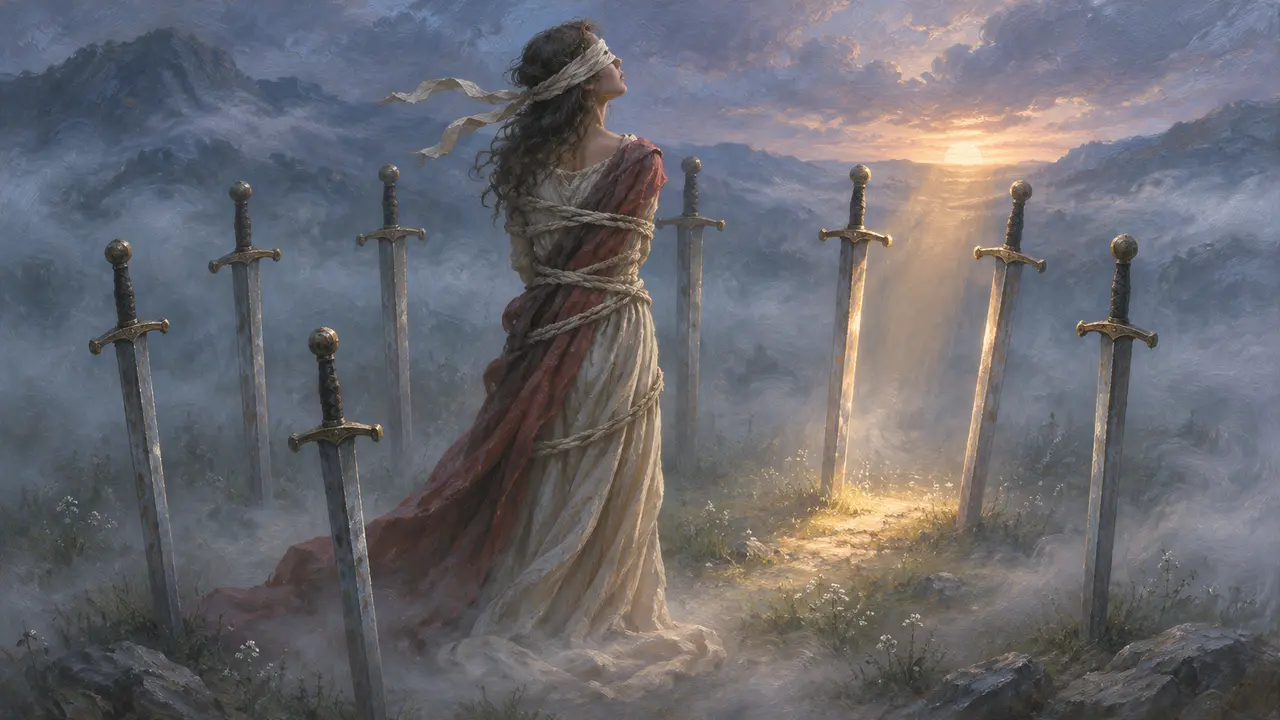
What does the Eight of Swords mean? In short, it pictures the feeling of being unable to move. A figure stands blindfolded, loosely wrapped in cloth, with eight swords planted in the ground around them, as if stuck in place with nowhere to go. Many people feel a jolt of anxiety when this card shows up and assume things have gone so wrong there is no way out. The general interpretation points somewhere else. The Eight of Swords is less about an outer prison and more about the mind. Thoughts like “I can't do this,” “it's bound to fail,” or “nothing I say will change anything now” are usually what truly block the road. The swords stand for worries that feel solid, but the card quietly asks whether those worries are facts or forecasts, and whether the trap is as complete as it looks from the inside.
So drawing the Eight of Swords is not a reason to brace for bad news. It works more like a mirror, inviting you to pause and ask: is it the situation itself that has me stuck, or the story I am telling myself about it? The image leaves clues. The swords do not fully surround the figure, there is open ground near their feet, and the binding around their arms is loose. Reading the card well means walking through it piece by piece: the imagery, the upright and reversed meanings, how it tends to look in love and at work, why staying still can sometimes protect you, and how to walk out. Along the way you will find four small steps you can start today and a simple three-card layout that turns a vague sense of dread into a next step you can see. None of it asks you to be fearless. It only asks you to look a little more closely.
What Kind of Card Is the Eight of Swords?
The Eight of Swords belongs to the Minor Arcana and is the eighth card of the Suit of Swords. Swords correspond to the element of air, and they are commonly linked with thinking, language, judgment and communication, all the things that keep running inside our heads. Air can clear away fog so we see more sharply, but it can also spin us in circles. Thoughts work the same way. They help us analyze a problem, and they can also narrow our view the longer we dwell on it. If you want to compare Swords with the other suits, see the complete guide to the four tarot suits.
Within the Minor Arcana, the number eight is often seen as a point deep into a process, where energy has built up and the situation has taken on a definite shape. In the Suit of Swords, what has built up is thought. One worry stacks on another, one assumption leads to the next, until it feels as though you are surrounded by your own mind. That is why the Eight of Swords usually describes not a sudden blow from outside, but pressure that has gathered quietly over time.
This context matters. The Eight of Swords is not a Major Arcana card about a sweeping life turning point. It speaks to something ordinary and specific: hesitation, self-doubt, the fear of getting it wrong. And because the trap is built from thoughts, it can also be loosened by changing how you think, which is the gentlest and most hopeful side of this card. For the core meaning at a glance, visit the full Eight of Swords meaning page.
How to Read the Card's Imagery
Start with the figure. Their eyes are covered with a blindfold, their body is wrapped in strips of cloth, and they stand on low, damp ground with eight swords planted beside and behind them. At first glance it is easy to conclude that this person is completely trapped: unable to see, unable to move, blades on every side. That picture is exactly why so many people feel uneasy when the card appears.
Look more closely and a few telling details emerge. First, the swords do not form a closed ring. There is open space in front of the figure and near their feet, and a few steps forward would take them clear. Second, the cloth around their upper body is loose, and their legs are not tied at all, so they are able to move. Third, the blindfold is what keeps them from seeing those gaps, which is why they believe there is no way out.
The general interpretation is that the real limit in this image is not the eight swords but the cloth over the eyes. The swords represent worries and concerns that genuinely exist, yet they are not packed tightly enough to seal anyone in. The blindfold represents the way we see our situation, letting us notice only danger and never the exit.
A castle often stands in the distance, commonly read as a place the figure belongs to and could return to. The core image is consistent: someone stands still, convinced they are stuck, while the path has been there all along. When you draw this card, ask yourself what your blindfold is right now.
There is no single right answer. For some it is fear of criticism, for others a belief that they are not good enough, and for some it is simple exhaustion, so deep they have no energy left to look around. Recognizing your blindfold is the first step toward loosening it.
Upright: Feeling You Have No Choice When You Do
The most common upright meaning of the Eight of Swords is self-imposed limitation. It is not that you truly have no options, but that worry about where each option might lead has frozen you, until it feels easier to believe you have no choice at all. The inner script often sounds like: “I'm not capable of changing jobs,” “if I say this, they'll definitely be angry,” or “it's too late to change now.” These lines sound like facts, but most of them are predictions.
Upright, the card is also tied to fear of making decisions. Every option seems risky, so you pick none of them. The longer you delay, the heavier the pressure, and the more trapped you feel. Sometimes a contradiction shows up: you say you badly want change while lining up a reason why each possible exit will not work. That is not weakness. It is often how people protect themselves when they are tired or unsettled.
There is another layer: a deadlock caused by missing information. The blindfolded figure cannot see the gaps, just as we fall back on imagination when we lack the full picture. What helps most here is not forcing a decision but gathering a little more information. Clarify the terms, check what the other person actually thinks, find out which options really exist. Many situations that seem impossible reveal paths you had not noticed once the gaps in your knowledge are filled.
So the upright Eight of Swords reminds you not to trust the worst version playing in your head before the facts have had a say. A useful check is to ask yourself: “Did I actually see this happen, or am I guessing?” Simply separating the two can turn many walls into doors.
How It Often Shows Up in Love and Work
In love, the upright Eight of Swords tends to appear in a few familiar forms. One is feeling suffocated in a relationship yet not daring to voice your needs, afraid that speaking up will cost you the other person. Another is already knowing the answer in your heart but avoiding it out of fear of loneliness or of what others will think. A third is the endless second-guessing of an undefined connection, replaying every message and never quite asking directly. What these share is that the thing holding you back is often an imagined consequence rather than the other person's real reaction. If love is weighing on you, you can bring a specific question to love tarot.
At work, the upright card might look like being unhappy in your role while believing you have no other skills, wanting to share an idea but fearing you will seem unprofessional, or drowning in a project without asking for help because you worry it will look like you cannot cope. It can also be the habit of waiting until conditions are perfect, waiting and waiting until the opportunity passes.
In both areas, the card invites you to test one sentence: “Do I really have no choice, or am I just not ready to choose yet?” The difference is large. The first breeds hopelessness; the second leaves room to move. If you are not ready, prepare slowly, starting with the smallest and least intimidating step, without demanding that every change happen at once.
Sometimes saying “I'm not ready yet” is an honest act in itself. Admitting you are stuck, rather than pretending everything is fine, often makes the next step easier to find.
Upright Stillness Can Also Protect You
When discussing the upright Eight of Swords, it is easy to see only its difficult side, but being held in place can also have a protective function. Imagine if the figure rushed forward while still blindfolded: they might walk straight into one of the swords. Staying put for a while, in a sense, keeps them from making a harmful move while they cannot see clearly.
Daily life works the same way. Sometimes we choose not to act because we are genuinely worn out, or because the situation is still shifting and deciding now would only create more confusion. This kind of pause is not the same as running away. It is a choice too: saving energy, observing, letting emotions settle. The general interpretation is that the upright Eight of Swords is not always urging immediate action; it can also be a reminder that it is all right to admit you need to stop for a moment.
The key is whether the pause is a conscious decision. If you know why you are stopping, roughly how long you plan to wait, and what you will do in the meantime, that time becomes a way of gathering strength for the next step. If it is only fear stretching into endless delay, it can easily turn into a real cage.
So there is no need to scold yourself with “why haven't I changed yet?” A gentler approach is to turn stopping into an active choice. Tell yourself: I'm not moving for now, and once I can see more clearly and have rested, I'll decide where to go. Then the pause is no longer being trapped but waiting for the right moment. Look after your sleep and daily routine, sort through the information you have, and let your footing be steadier when you stand up again.
Reversed: The Beginning of Release
Reversed, the Eight of Swords is commonly read as the start of getting free. The figure may slowly realize the cloth is not that tight and there are gaps between the swords, so they begin to move their hands and feet and lift a corner of the blindfold. In real life this might mean being willing to say what you have kept bottled up, starting to talk things through with someone, finally admitting “I actually do have other options,” or looking at the same situation from a new angle.
The reversed card is also often linked with seeing the exit. Where you once saw only obstacles, possibilities start to appear. Where there seemed to be just two paths, both bad, you notice a third and a fourth. This shift is not always dramatic. Sometimes you simply wake up one morning and the problem feels smaller than it did the night before.
It is worth being clear that reversed does not mean instant freedom. After the blindfold comes off, your eyes still need time to adjust to the light, and you still have to walk step by step out from among the swords. The reversal describes loosening that has begun, not a problem already solved. If you treat it as proof that everything is fine, the next small setback may make you feel you have been knocked right back to the start.
Readers approach reversals differently: some go by the card's orientation, others adjust based on the overall context. For a more structured look, read upright vs. reversed tarot cards alongside this card. Whichever approach you use, the heart of the reversed Eight of Swords is much the same: you are beginning to believe you can move.
Reversed Release Can Feel Unsettling Too
Many people assume a reversed Eight of Swords must be good news, but the process of breaking free can carry its own unease. When you have grown used to a stuck state, even an uncomfortable one, it is at least familiar and predictable. Once things start to loosen, you face new unknowns: how will the other person respond after you speak honestly? If you leave where you are, where do you go next? Questions like these can leave you feeling more anxious than before.
There is another possibility: the reversal can also point to a panicked scramble to escape. When people rush to get out of a difficult situation, they sometimes make impulsive decisions before thinking things through, such as quitting in a moment of anger or saying something irreversible at the height of an argument. That kind of escape can look like freedom, yet it may simply move you from one trap into another.
So when you read the reversed Eight of Swords, you can hold two understandings at once. On one hand, acknowledge that you are loosening up, which is a change worth valuing. On the other, allow yourself to feel afraid, to waver, or even to want to retreat along the way. Unease does not mean you are heading in the wrong direction; it is often a normal response to change.
The practical approach is to slow down. Release does not have to happen all at once. You can lift the blindfold and look around before deciding whether to move forward. You can take one step, make sure the ground holds, and then take the next. Breaking a big change into small actions makes the unease much easier to carry.
Four Small Steps to Find Your Way Out
Once you understand what the Eight of Swords is saying, the most important question is how to walk out. The four small steps below do not require great courage, and you can begin today.
First, write your worries down. Take a sheet of paper and list each thought that has you stuck, without polishing it. Then, next to each line, mark whether it is something that has already happened or a guess about the future. Often you will find only two or three real facts; the rest are scenes your mind has been rehearsing. Just separating them loosens the blindfold a little.
Second, ask a smaller question. “Should I quit my job?” is so big it freezes you. Try shrinking it to “Which one opening can I look into this week?” or “Who could I ask about their experience changing careers?” Small questions have concrete answers and are doable, and finishing one gives you a sense of moving forward.
Third, talk it through with someone. The blindfolded person cannot see the gaps, but someone standing nearby often can. Choose a friend or family member you trust, and seek professional support when you need it, then describe your situation out loud. Speaking is itself a way of organizing your thoughts, and a single question from the other person might reveal an exit you had missed.
Fourth, give yourself a time frame. This is not about forcing an immediate decision but setting a reasonable checkpoint, such as “I'll look at this again in two weeks.” A time frame turns waiting into a conscious choice and keeps delay from stretching on forever. Even if you have no answer when that day arrives, you will understand your own thinking more clearly than you do now.
A Three-Card Way to Read It
To look more concretely at a situation connected with the Eight of Swords, you can try a simple three-card layout with these positions: the current bind, the real limitation, and a first step you can take. The structure fits the card's theme closely and breaks a vague feeling of being trapped into three questions you can actually think about.
The first card is the current bind. It describes the situation as you feel it right now, a bit like seeing what your own eight swords look like. This card lets you acknowledge: yes, I really am stuck at the moment, and this is where.
The second card is the real limitation, and it is the heart of this layout. It answers the question: among all my worries, which one genuinely needs attention? It may also suggest that the true limit is not outside you but in a thought you have avoided looking at directly. When reading this card, ask yourself: if this limit disappeared, what would I do differently?
The third card is a first step you can take. It is not meant to deliver a complete solution, only to point toward a small direction. That might be a single conversation, one piece of information to look up, or simply giving yourself proper rest. What matters is that it is small enough to actually do.
The relationships among the three cards are often more interesting than each card on its own. Notice, for example, whether the second and third cards echo each other, or whether most of the cards come from the same suit. For more ways to connect three cards into one story, see how to read three tarot cards.
What to Ask Next After Drawing It
After drawing the Eight of Swords, many people's first impulse is to pull another card right away, hoping to check whether things are really that bad. That reaction is understandable, but when you keep re-asking out of anxiety, the answers tend to grow more confusing and the worry tends to deepen. For more on whether you can repeat the same question, read can you ask tarot the same question twice.
A better approach is to change how you ask rather than repeating the same question. The Eight of Swords is already reminding you to look at things from another angle, so instead of asking “Will this fail?”, try “What am I overlooking here?”, “What is one small thing I can do first?” or “Which belief is making me feel I have no choice?” These questions shift the focus from outcomes to what you can do, and they sit closer to what the card is trying to say.
You can also pay attention to the overall context when the Eight of Swords appears with other cards. If it is surrounded by cards associated with action, support or new beginnings, the common reading is that the conditions for change are already forming. If it sits among other heavy Swords cards, it may suggest that your thoughts are carrying a lot right now and that your emotions and rest need extra care.
Tarot can help you sort through your thoughts, but what actually moves you out of a hard place is the step you are willing to take. The Eight of Swords is not here to hold you captive. It is here to help you see that you are freer than you believed.
References
Bring the thing that has you stuck and ask the cards, and see what openings in your situation you may not have noticed yet.
See the full Eight of Swords meaning