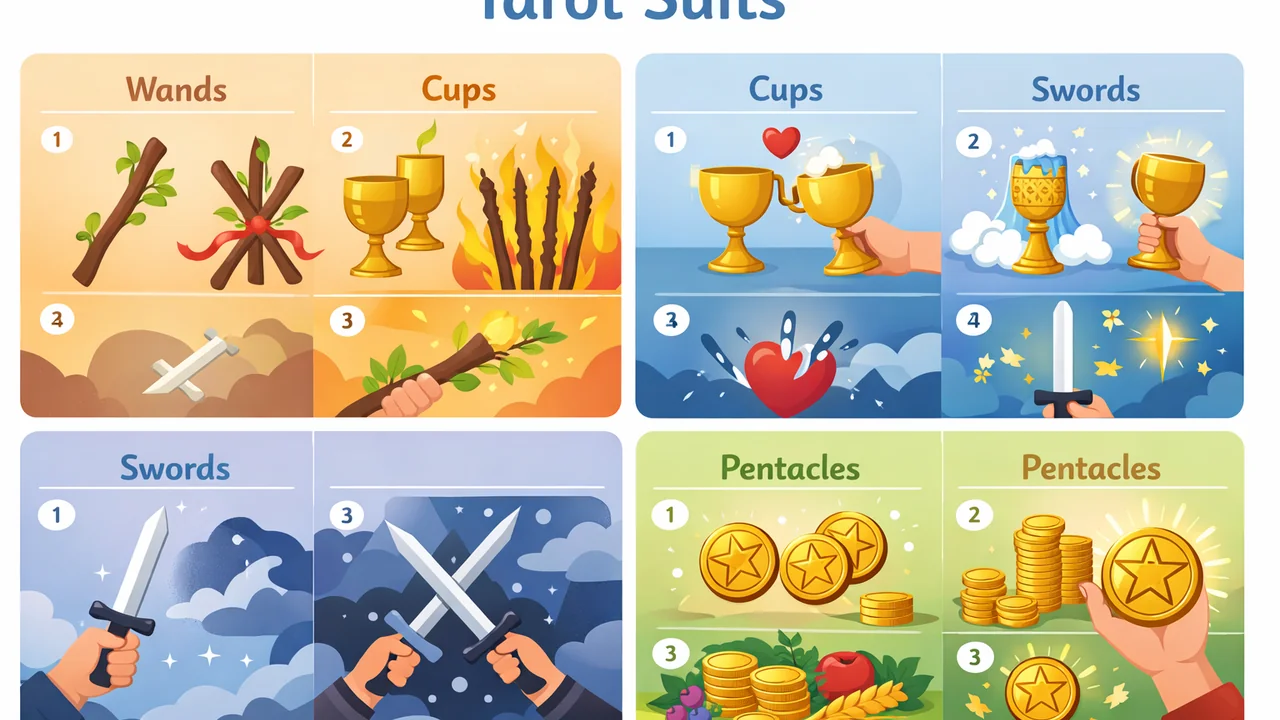
To read the four tarot suits quickly, you don't need to memorize every card first. Wands, Cups, Swords and Pentacles point to action, emotion, thought and practical conditions. Work out which layer your issue sits on first, then go back to the details on the card.
Key takeaways: identify the suit first to see whether the question is about action, emotion, thought or material reality. Then check which stage the number shows: 1 is a beginning, and 10 is completion or a load that has grown too heavy. Several cards from the same suit mean that area is driving the whole situation.
The core answer: what Wands, Cups, Swords and Pentacles each represent
The four suits are the map for reading the Minor Arcana. The most direct answer: Wands are about action and ambition, Cups about feelings and relationships, Swords about thinking and conflict, and Pentacles (also called Coins) about resources and practical reality. Whichever suit you draw, first ask yourself: is this card mainly telling me to get moving, to get clear on how I feel, to think it through, or to make things concrete?
When you read a suit, the real task is not reciting a single card's meaning. It is judging the core nature of the question. If you ask about work and draw a Cup, the point may be how the team feels rather than your ability. If you ask about love and a Pentacle appears, the card may be talking about commitment, time and how you share daily life.
One sentence for each suit
Wands correspond to fire: passion, creativity, drive and initiative. Cups correspond to water: love, intuition, the flow of emotion and connection. Swords correspond to air: reason, language, judgment, boundaries and pressure. Pentacles correspond to earth: money, the body, work results and measurable conditions. The figures' actions and the scene on the card also help turn the suit from an abstract idea into a concrete situation.
- For a quick read, don't rush to look up keywords. First say whether the card belongs to action, emotion, thought or reality.
- If one suit dominates a spread, that area is steering the whole matter. If a suit is missing entirely, it may be a layer you have been overlooking.
From elements to life areas: building your suit-reading framework
Build your framework in three steps: look at the elemental energy, then the life area, and finally what is happening on the card. Fire is not only passion; it can also be impatience. Water is not only love; it can also be clinging. Air is not only reason; it can also be overthinking. Earth is not only stability; it can also mean being stuck on security.
You can treat the suits as a sorter for real-life questions. When you ask whether you should change jobs, Wands show ambition and opportunity, Cups show satisfaction, Swords show judgment and communication, and Pentacles show salary, role and long-term costs. To fill in more Minor Arcana context, read the 56 Minor Arcana card meanings quick guide.
Calibrate with question, position and image
First, confirm whether you are asking about a choice, a state, a relationship or an outcome. Second, check where the card sits in the spread, such as present situation, obstacle, advice or possible development. Third, look at where the figures face, their posture, distance, objects and background. That way you won't read every Sword as bad news or every Cup as romance, and you can see the actual conditions the card describes.
- In practice, write four columns: element, life area, action on the card, and the next step you can take. This keeps the reading from stopping at abstract adjectives.
- A common limit: a suit only shows the layer of energy and can't decide the outcome on its own. You still need the layers of numbers, court cards and the Major Arcana.
Putting the suit back into the question: love, work, money and people
The same Wands card in a love question isn't necessarily passionate romance. It may show who is taking the initiative or who is rushing the relationship forward. In a work question it often points to ambition, project speed and follow-through. Before reading, refine the question: are you asking about the current state, the cause, advice on what to do, or the likely direction? The clearer the question, the less you will force a suit into a single answer.
For love, first see whether Cups respond to emotional needs, then whether Swords bring up communication, defensiveness or misunderstanding. For work, look at the drive of Wands and the decision pressure of Swords. For money, use Pentacles to check resources, costs and time. For relationships with other people, separate the closeness of Cups, the boundaries of Swords, the competition of Wands and the give-and-take of Pentacles.
Two examples. You ask about work and draw the Five of Cups. The suit is Cups, so the issue may be disappointment rather than ability: a rejected proposal or a trusted colleague leaving can keep your attention fixed on the three spilled cups. Yet two cups still stand behind the figure, a reminder that you still have support to draw on. You ask about love and draw the Two of Swords. The suit is Swords, so the focus is thoughts and communication, not whether feelings exist. The blindfold and crossed swords often describe someone who keeps avoiding the issue and won't decide; the next step is to name what is really stuck.
First rewrite the question so it can be read
Instead of asking only “Does he love me?” or “Will I succeed?”, ask “Which layer is this relationship mainly stuck on right now?” or “Should my next step strengthen action, communication, emotion or resources?”
- Love: check the emotional exchange first, then whether actions match.
- Work: look at goals and decisions first, then whether resources can support them.
- Money: don't just look at good or bad; look at cost, time and stability.
- People: work out where closeness, boundaries, competition and exchange of interests each sit.
The most common beginner mistakes with the four suits, and how to fix them
The most common beginner mistake is treating the suit as a fixed answer: Cups always mean love, Swords are always bad, Pentacles are always money, Wands are always action. In fact, each card's posture, distance and setting shift the focus of its meaning.
The fix is a three-step workflow. Step one, name the suit's area. Step two, describe what is happening in the image. Step three, return to the card's position in the question and draw your conclusion. For example, a Sword in the advice position isn't telling you to be pessimistic. It is reminding you to clarify the facts, set boundaries, or stop using feelings to make excuses for the other person.
Complete one reading with suit, image and position
Write down which suit it is and which area it points to: action, emotion, thought or reality. Note whether the figures are approaching, avoiding, waiting or exchanging. Finally, check whether it falls in the present, obstacle, advice or outcome position. This keeps you from simply reciting meanings and also shows the limit: a single card usually can't decide your life for you; it only points to the layer that most needs attention now.
- Mistake one: seeing Cups and concluding there is love. Fix: first check whether the feelings are mature, flowing or out of balance.
- Mistake two: fearing Swords. Fix: check communication, truth, boundaries and decision pressure.
- Mistake three: reading Pentacles only as money. Fix: also look at the body, time, commitment and usable resources.
- Next step: after each reading, record the suit, question type, your conclusion and what happened later.
Practice: get a feel for the suits with a daily card and a three-card spread
When practicing the four suits, don't aim for instant understanding the moment you draw. What you are building is a feel: does today's event look more like the push of Wands, the feelings of Cups, the judgment of Swords, or the practical conditions of Pentacles? A daily card is best for watching how the suits show up in everyday details, not for predicting whether the whole day will be good or bad.
Before drawing, set a small question, such as “What kind of energy should I watch for today?” After drawing, record only three things: the suit, the action on the card, and how it compared with the day.
How to do a daily card and a three-card spread
A daily card should be low-pressure and easy to review. In the morning, don't rush to ask “Will it go well?”; ask instead “How am I likely to react today?” In the evening, check whether the suit showed up in your behavior: did Wands make you agree too impulsively, did Cups let emotions pull you around, did Swords make you overthink, did Pentacles remind you to deal with time, money or your body? For a three-card spread, practice with present, obstacle and advice: look at the suit balance across the three cards first, then read each card.
- Daily card: record the suit, the day's events and your reaction, without rushing to judge good or bad luck.
- Three-card spread: see which suit appears most, then which is missing, and only then add number and image details.
- If the same suit keeps appearing, first ask which area of your life you keep neglecting, rather than reading it straight away as a sign of fate.
Limits of suit reading: when to add numbers, court cards and the Major Arcana
The four suits help you find the direction, but they can't complete a reading on their own. They tell you whether a message is about action, emotion, thought or reality, but not necessarily what stage the matter has reached, who plays a key role, or whether a larger life lesson is involved. That is when you add numbers, court cards and the Major Arcana.
If you only look at suits, it is easy to read every Cup as romance and every Sword as stress, missing the real layers on the card. Numbers fill in the progression, court cards point to personality, attitude or patterns of interaction, and the Major Arcana often signal that this isn't just an everyday choice but a matter of values, turning points or long-term learning.
Three checkpoints for going deeper
First, does the question need a sense of time? If so, look at how numbers one to ten show beginning, building, conflict, completion or exhaustion. Second, does a figure stand out on the card? If so, the court card or the figure's posture may matter more than the suit. Third, when you draw Major Arcana cards such as The Fool, The Lovers, Death or Temperance, slow down, because they often point to choice, transformation and life themes rather than a single event in one suit's area.
You can map numbers and court cards like this; it works for all four suits:
Number | Stage | Example
1 (Ace) | Starting point, seed | Ace of Wands: an idea you want to act on has just appeared
2 | Choice, pairing | Two of Cups: two people responding to each other
3 | First shape | Three of Pentacles: working with others to build a first version
4 | Stability, or standing still | Four of Pentacles: holding on to what you have, unwilling to change
5 | Conflict, loss | Five of Swords: winning the argument but hurting the relationship
6 | Adjustment, recovery | Six of Swords: leaving a hard place and moving toward calmer water
7 | Test, evaluation | Seven of Wands: holding your ground from higher up
8 | Momentum, focus | Eight of Pentacles: repeated practice, building craft
9 | Nearly done, and most tense | Nine of Wands: wounded but holding on to the last stage
10 | Completion, or overload | Ten of Wands: one person carrying too much responsibility
Court cards | People or attitudes: Pages learn, Knights act, Queens tend inward, Kings direct outward | Queen of Swords: speaks directly, clear boundaries
- When you only ask “What should I do?”, the suit gives enough initial direction; to judge the stage, add the number.
- When a court card appears, first decide whether it is you, the other person, someone around you, or an attitude you need to take.
- If Major Arcana cards keep appearing, the next step isn't drawing many more cards but checking whether the question has reached a deeper choice.
What to do next: keep a personal card journal and plan your learning path
At this point you can use the four suits to catch the first layer of the Minor Arcana. The next step isn't memorizing more keywords but turning each draw into a record you can check later. A personal card journal shows you how you understand Wands, Cups, Swords and Pentacles, and which situations you misread most easily.
Split the journal into three columns: card observations, the question at the time, and later verification. Under observations, write only the images and suit impressions you actually saw. Under the question, note whether you asked about a state, a cause or advice. Under verification, go back to real events and check which element fit best and which inference came too fast.
Strengthen your suit reading with a second layer
When the same suit keeps showing up, don't jump to conclusions. Ask yourself three questions: is this a recurring theme of mine, or the real core of this event? Is the figure acting, waiting, avoiding or carrying a load? Does this card need numbers, court cards or the Major Arcana to fill it out? For example, drawing Swords again and again isn't necessarily bad; it may mean you are using analysis in place of feeling. Repeated Pentacles aren't only about money either; they remind you to come back to time, resources, your body and what is actually doable.
- Each week, pick the card that struck you most, reread your notes, and add “what I missed then” and “how I would read it now”.
- A good learning order is number cards first, then court cards, and finally integrating the Major Arcana and the structural differences of other decks such as the Marseille Tarot.
- If a reading touches major medical, legal, investment or safety decisions, use tarot as a tool for sorting out your thoughts and seek the relevant professional advice.
References
Now that you know the four suits, the fastest way to practice is to draw cards for a question you really care about. See which suits come up first, then compare them with the reading to find what you can already read and what you hadn't thought of yet.
Draw cards for your question