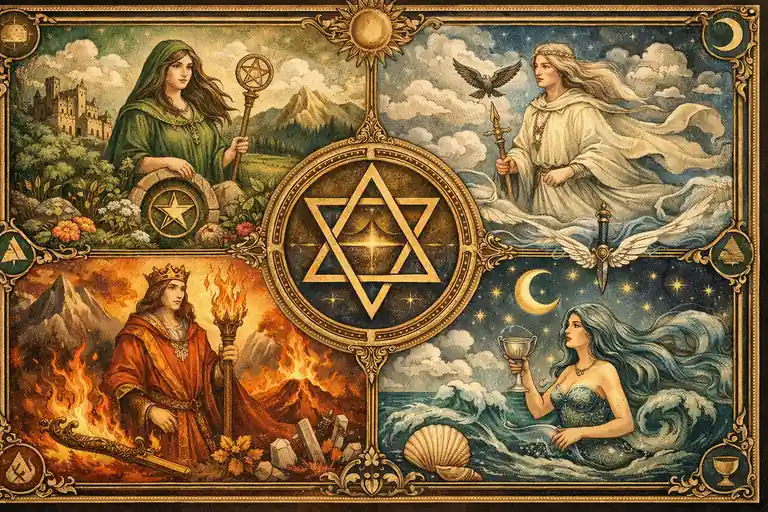
If you want more accurate tarot readings, start with the elements, not with memorized answers. Put simply, the four elements work like this: Fire is about action and willpower, Water is about feelings and connection, Air is about thinking and judgment, and Earth is about resources and making things real. Once you can spot the element first, you can quickly catch the core tone of a single card or even a whole spread.
This guide first explains how the four elements line up with the four suits, then breaks down the signals each element tends to give upright, reversed, in love, at work and under relationship pressure. It also covers which element combinations are easy to misread and when elements alone shouldn't decide your answer. If you already use the Minor Arcana 56-card meanings quick guide, treat this article as its elemental framework; if you want to connect the whole system at once, pair it with the complete guide to all 78 tarot card meanings.
If you often get stuck on questions like 'Is this card about emotions or about practical reality?' or 'Why do two reversed cards feel so different?', reading by element is the most useful first step.
Key takeaways: count the suit balance in your spread first, then read individual cards. No element is good or bad in itself; what matters is whether it is out of balance and whether it fits your question. With a reversal, first ask whether the energy is too much, too little or misdirected, rather than treating it as bad news.
What the tarot four elements mean: the core of each in one line
At their core, the four elements sort a card's message into four different languages: Fire is the force that pushes things forward, Water is the flow of emotion and feeling, Air is thought, language and judgment, and Earth is matter, time, the body and results. These four languages don't just correspond to the four suits of the Minor Arcana; they also shape whether you should read a card's 'momentum' or its 'state' first. In a love question, for example, Wands might be talking about pursuit and heat, Cups usually point to inner feelings and how the two people interact, Swords often describe clashing thoughts or communication strain, and Pentacles tend to speak to practical conditions, commitment and stability. That is why learning the elements often gets you reading faster than memorizing meanings by rote.
If you only memorize 'what each card stands for', it's easy to treat cards as fixed answers. The elemental view reminds you that a card isn't reciting a definition; it describes a type of energy. In the Rider-Waite deck, the meanings of Wands, Cups, Swords and Pentacles already form a stable symbolic structure, which is why elements matter so much for beginners. Once you grasp that structure, it becomes easier to see the difference between the complete guide to the 22 Major Arcana and the Minor Arcana: the Major Arcana leans toward life themes and stages, while the Minor Arcana generally uses the elements to break down everyday situations.
What each element looks at
Fire asks 'Should I act, do I dare, how fast?'; Water asks 'Is there feeling, how deep is it, is the relationship flowing?'; Air asks 'Are the thoughts clear, is the information enough, is communication working?'; Earth asks 'Are there enough resources, are conditions stable, can results take shape?' The four elements aren't a replacement for card meanings; they help you identify the card's focus first. Once you have that focus, your reading is far less likely to drift off topic.
For instance, if a love question brings up lots of Cups, the point usually isn't who has the upper hand but feelings, attachment, emotional projection and mutual response. If it brings up lots of Swords, the focus shifts toward words, misunderstandings, pressure and positions. Element first, card meaning second: that is the steadier way to read.
Why read the element before the details
The biggest benefit of reading the element first is that it stops you from over-extending a single card. Many beginners describe every detail of a card's image without actually answering the question. Identifying the element narrows things down fast: is this question more about emotions or practical reality? Action or thought? A short burst or long-term build-up? All of this directly shapes the direction of your reading.
Another benefit is that you don't have to rush to read a reversal as 'broken'. A reversed Fire card may mean blocked passion or charging ahead too fast; reversed Water may mean suppressed feelings or getting lost in them; reversed Air may mean confusion and overthinking; reversed Earth may mean stagnation, delay or not being grounded enough. Reading the element first turns a reversal into a state you can assess rather than a simple negative label.
Fire: what Wands mean, and when it's momentum versus impulse
Fire corresponds to Wands, and its core is action, motivation, ambition, creativity and heat. It is the drive in someone that 'wants to move forward', so Fire is often key in work, starting a business, pursuing someone, speaking up first and the early stages of a relationship. When you see many Wands and strong Fire, the spread is often talking about taking the initiative, bursts of inspiration and wanting to get started right away. But Fire carries a clear risk too: going too fast, being too impatient, trying too hard to prove yourself, so the effort fizzles halfway or you charge ahead before seeing the whole picture.
In practice, Fire doesn't only mean 'positive and proactive'. A Wands card that looks hot isn't automatically good; it can also mean restlessness, impulsiveness, lack of patience or action taken once emotions flare. In a love question, Fire often points to attraction, desire, pursuit and obvious initiative, but it can also mean a relationship heating up too fast or two people moving at different speeds. In a work question, Fire can be a strong start, or it can be lots on your plate, pressure arriving quickly and a need to focus your energy first.
Fire upright versus reversed
Upright, Fire usually shows up as clear intent, drive, breaking out of the status quo and willingness to take risks. Reversed, it commonly shows scattered passion, unclear direction, wanting to rush without staying power, or emotions running ahead of reason. This doesn't mean reversed Fire will fail; it's a prompt to ask: is this energy being used in the wrong place? Is restraint missing? Is there only drive and no strategy?
For example, when a Wands card appears reversed in a love question, it often isn't 'no feelings' but a pace that's too fast, a strong urge to control, or neither person willing to give ground. If you ignore the other elements and read only in Fire's language, it's easy to reduce the problem to 'is there love or not'. The real issue is often 'what is going wrong with how this relationship moves forward'.
Where Fire tends to appear
Fire shows up especially in new ventures, competition, performance, pitches, job interviews, creative work and short sprints. It suits questions like 'Should I go first?', 'Is there a chance to get ahead?' or 'Is now the right time to act?' But if you're asking about long-term maintenance, steady commitment or slow and lasting growth, Fire only offers part of the picture and can't be the sole conclusion, because it leans toward starting things rather than sustaining them.
In a spread, Fire together with Earth usually means there are ideas and the conditions to make them real. Fire with Water often means passion and emotion intertwined: attractive, but prone to mood swings. Fire with Air tends to mean quick minds, blunt words and a rushed decision-making pace. These combinations help you find the real issue better than a single card can.
- Fire keywords: action, will, heat, ambition, speed
- Common risks: rushing, needing to prove yourself, passion that doesn't last
- Best for reading: beginnings, initiative, breakthroughs, creativity, competition
Water: what Cups mean, and how to read emotional flow and depth
Water corresponds to Cups, and the most important point isn't as simple as 'love or no love'. It's about feelings, emotions, attachment, acceptance, resonance and inner needs. Water flows and seeps, so in tarot it often points to the unseen part of a relationship: Do I care? Does the other person feel something? Is there emotional exchange between us? Is it calm on the surface but turbulent underneath? The key with Water isn't just how much emotion there is, but whether that emotion is being received.
In relationship questions, Cups often reveal 'what the heart really wants' better than Wands do. If you're asking about a situationship, getting back together, attachment, family dynamics or empathy with others, Water almost always deserves a careful look. It can be tenderness, care, empathy and healing, but also escaping reality, heavy projection, getting lost in fantasy or emotional manipulation. Many people remember that Water means love but forget that it also means emotions spilling over or unclear boundaries. For a more specific love scenario, read Does my crush like me back? Common love signals in tarot to see the Water signals that often appear in the early, undefined stage.
How not to read Water as pure romance
Beginners most often read Water as 'if there's love, it's good', but its signals are more complex. Many Cups cards look gentle yet may be warning you: lots of feeling, but no clear action; a relationship that feels strong, but goes nowhere; two people who care, but stay stuck in imagination. In these cases, more Water isn't an advantage; what matters is whether it flows into reality.
So when reading Water, always ask: is this feeling mutually nourishing or a one-sided projection? Is it mature empathy or treating the other person as an emotional container? Some spreads look beautiful but are actually pointing to a boundary problem. Reading them only as romance means missing the real warning signs.
Water signals in relationships and inner needs
Water is very good at revealing whether someone truly feels safe, is willing to open up or fears rejection. When Water is too strong in a spread, the common issue isn't too much love but loose boundaries, being swept along by emotions and letting feelings change your judgment. On the other hand, too little Water may show a cold relationship, an emotional disconnect, or all logic and no heart.
In practice, Cups alongside Earth usually means the relationship needs not just feeling but stable commitment. Cups with Air often means emotions and thoughts are fighting, leading to overthinking. Cups with Fire often means passion rising quickly, but possibly running hot and cold. These cross-readings get closer to the truth than simply asking 'are there feelings?'
- Water keywords: feeling, attachment, resonance, emotion, healing
- Common risks: projection, getting lost in it, blurred boundaries, moodiness
- Best for reading: love, early dating, family, empathy, inner needs
Air: what Swords mean, and how to tell clear thinking from strain
Air corresponds to Swords, and its themes are thought, language, judgment, information, truth, conflict and decisions. Like a sword, it can cut through confusion but can also wound. Air shows up most in questions that involve analysis, negotiation, communication, choices, law, rules, pressure and boundaries. If Fire acts first and Water feels first, Air thinks it through before speaking. It is very practical in tarot, but it also easily stirs anxiety, because thinking itself can become a source of pressure.
Swords don't equal bad news; they show 'the mind at work'. Clear Air brings judgment, honesty and insight; excessive Air turns into anxiety, guessing, criticism, hurtful words and inner tug-of-war. Especially in relationship questions, many Air cards don't necessarily mean there are no feelings; they may mean 'things haven't been said', 'information is lopsided' or 'both people are filling in the blanks'. The thing to check then isn't who's right, but whether the message has actually been made clear.
Air versus stress and anxiety
Many people see Swords and assume the worst, because they're so often linked with stress, conflict and confusion. But Air's real function isn't to cause pain; it forces you to see clearly. If a situation is already murky, Air magnifies the murkiness; if it's actually simple and you just don't want to face it, Air cuts through that avoidance. That's why Air often feels uncomfortable yet is so necessary.
Upright, Air usually means reason, insight, precise expression and the ability to decide. Reversed, it may mean overthinking, distorted information, broken communication, misjudgment or excessive defensiveness. When reading Swords, first tell whether it's 'painful because you see clearly' or 'anxious before you see clearly'. Both are uncomfortable, but the way forward is completely different.
The key check when Air dominates a question
When a question is essentially about information, communication, boundaries or a choice, Air carries much more weight. If you're asking about a job change, contract negotiation, interview performance, exam strategy or whether someone is telling the truth, Swords are often more useful than Cups. These questions can't be solved by feeling alone; you need to see whether the information is consistent, the logic holds up and the message is clear.
But Air has a common trap: reading every worry as truth. Not every bout of anxiety is a prediction; often your information is simply incomplete. When Air appears, the best move isn't to judge right away but to check first: do I have facts or guesses? Did the other person actually say this, or am I assuming they'll do it? This distinction matters a lot.
- Air keywords: thinking, communication, judgment, truth, boundaries
- Common risks: anxiety, guessing, criticism, hurtful words
- Best for reading: decisions, communication, disputes, rules, information
Earth: what Pentacles mean, and how to read real-world conditions and results
Earth corresponds to Pentacles, and it focuses on reality, resources, the body, money, time, work, habits and results. It isn't as fast as Fire or as soft as Water; it cares most about whether something can truly exist, last and be seen. Earth cards are usually the slowest, steadiest and most practical group in tarot, reminding you that however good an ideal is, without resources, rhythm, structure and long-term upkeep it's hard to make real. That's also why Earth is so often linked with finances, health, work and daily order.
Many people assume Pentacles are only about money, but that's not all. Earth also covers bodily sensations, your living environment, practical skills, stamina and everyday management. In love, Earth looks at whether someone is willing to invest time, can commit, and whether both people's life circumstances fit together. In career, it looks at income structure, workflow, stability and sustainability. If Fire lights the flame, Earth puts it in the stove so it can burn for a long time.
What people most often get wrong about Earth
Earth is most often misread as 'slow means bad', but slow isn't necessarily worse. Many long-term results simply take time to build, especially in work, finances, habits and health. When Pentacles appear, they're often saying: what matters now isn't a quick burst but whether you can hold steady. That steadiness is Earth's value.
Another misreading is seeing Earth as conservative, boring and unchanging. In fact, Earth is about building results that are repeatable, sustainable and verifiable. It may not be dramatic, but it's often closest to reality. If you want to know whether something can actually work out, Earth is often more convincing than the other elements.
Using Earth in everyday questions
In an actual reading, Earth is best for looking at concrete conditions: are there resources, can things be coordinated, is there enough time, how heavy is the practical pressure. In a work question, Earth asks whether processes are clear, roles are fair and pay is stable. In a love question, it asks whether you're willing to meet, whether the relationship can fit into real life rather than staying as words.
Earth is very recognizable in combination. Fire plus Earth often means action that lands, though watch for burnout. Water plus Earth often means emotional security, but possibly too clingy or too slow. Air plus Earth often means turning ideas into rules and processes. Once you start seeing these combinations, tarot stops being single-card answers and becomes a description of the whole system.
- Earth keywords: resources, stability, time, body, results
- Common risks: too slow, stagnation, overly cautious, inflexible
- Best for reading: finances, work, health, commitment, long-term outlook
Reading the four elements together: cross-checks, common mistakes and an example
What really sharpens a reading isn't just recognizing the four elements but seeing how they interact. Once you cross-check them, they move from 'single keywords' to 'relationship structures': lots of Fire isn't necessarily good, it may be too rushed; lots of Water isn't necessarily gentle, it may be too clingy; lots of Air isn't necessarily rational, it may be chaotic; lots of Earth isn't necessarily stable, it may be too slow. The point isn't the element itself but whether they're out of balance. That's why the same deck can give completely different answers to different questions.
Say you ask 'Does this relationship have room to grow?' If the spread leans Fire and Water, there's usually attraction and feeling, but look for Earth to ground it and Air to handle communication. If it leans Air and Earth, the practical conditions may be there while feeling and heat are lacking. If Fire and Water are strong but Earth is weak, there's often plenty of emotion and desire but not enough real-life fit. This is closer to reality than reading single cards as lucky or unlucky. To place the elements within the full system of card meanings, check the complete guide to all 78 tarot card meanings and you'll see where each suit sits in the deck as a whole.
Mistake one: treating elements as fixed good or bad
No element is absolutely good or bad. Fire drives forward but can spin out of control; Water connects but can drown; Air clarifies but can make you anxious; Earth stabilizes but can stall. Many beginners treat the element they like as the good one and the one they don't know well as the bad one, which is a very common bias. The useful judgment is whether an element fits what the question needs.
For example, when asking about starting a business, Fire and Earth are usually more directly useful than Water; when asking about repairing a relationship, Water and Earth often matter more than Fire; when asking about a contract or an exam, Air and Earth are usually key. Good or bad should be relative to the question, not to your preferences.
Mistake two: drawing conclusions from one element only
Looking at only one element is the easiest way to read too narrowly. If a spread has lots of Fire, you might think it simply means charging ahead; but with Earth alongside, that drive may have practical footing; with Air, it may be thinking before acting; with Water, it's often emotionally driven. Elements don't exist in isolation; together they tell the story.
In practice, many accurate readings come from combining a 'main element plus supporting element'. The main element names the theme, the supporting one shows how it plays out. See both layers and your reading becomes richer and better at answering what the person actually wants to know.
Example: the same question, different element mixes
Suppose the question is 'Do the other person and I have a chance to keep going?' If the spread leans Fire, both may be willing and attracted, but moving fast. Leaning Water, there are feelings on both sides, but the relationship is easily swayed by emotion. Leaning Air, both have a lot on their minds and communication needs sorting out first. Leaning Earth, it's about life circumstances, commitment and long-term viability. Change the element and the focus of the answer changes too.
Now take an actual three-card draw: Knight of Wands, Two of Cups, Four of Pentacles. Count the elements first: one each of Fire, Water and Earth, and zero Air. The Knight of Wands shows someone taking initiative and wanting to push forward; the Two of Cups shows mutual feeling and response; the Four of Pentacles warns that, practically, someone is gripping the status quo and reluctant to adjust their life arrangements. With no Swords at all, the two rarely talk their thoughts through. Put together: there's room to grow, but the next step isn't waiting; it's each person spelling out how they see future plans.
Examples like this show how practical elemental reading is. It's not about memorizing answers but knowing what to ask, what to look at first, where the focus is and where to hold back. Once you can use elements to orient yourself and other cards to fill in detail, the whole reading becomes much clearer.
Beginners' most common questions on reading elements: practice, asking and avoiding misreads
The most effective way to actually use the four elements isn't memorizing them all at once but starting with how you frame the question. Ask yourself: is this mainly about action? Feelings? Thoughts? Or practical conditions? If the question already leans toward one element, you'll get into the reading faster. If it's too broad, vague or mixed, even strong elements will struggle to narrow the answer. Elements are a judgment tool, not a filter that fixes everything.
The most practical exercise is to take a spread and look only at the suit balance first, then at the scene on each card. Work out which element is most present, which is least and which is out of balance, then bring the focus back to the question. For a work question, if the spread leans Swords and Pentacles, start with strategy and practical conditions; if it leans Wands, check drive and direction; if it leans Cups, pay attention to the team atmosphere and sources of pressure. Practicing this way builds a steady reading routine. If you're still learning the basics, go back to The complete 2026 tarot beginner's guide: learn tarot reading from scratch to tie suits, questions and the reading process together.
How to ask so the elements answer clearly
The more specific the question, the more useful the elements. Instead of 'What does my future look like?', ask 'For this job over the next three months, what do I most need to strengthen: action, communication, emotions or resources?' This forces you to clarify what kind of question it is and makes the elements easier to match. Tarot isn't a substitute for thinking; it helps you slice your thinking more finely.
For relationship questions you can also ask directly, 'Which element is this relationship missing most right now?' That makes gaps easier to see: missing Fire means missing initiative, missing Water means missing feeling, missing Air means missing communication, missing Earth means missing follow-through. This gives you more actionable guidance than asking only about outcomes.
How to practice without getting more confused
The steadiest method is keeping an element journal. After each draw, note not just the card names but the suits, the type of question, the element you sensed at first glance and what actually happened later. Over time your feel for the elements gets sharper, and you're less likely to be led by a single image. This training pairs well with the bigger system, because it organizes scattered card meanings into a repeatable way of judging.
Once you've progressed further, you can also compare the Major and Minor Arcana: the former looks at life themes, the latter at how the elements operate. When you can separate these two layers, tarot shifts from 'memorizing cards' to 'reading structure'. That's the most important step for going further.
- Identify the question type first: action, feelings, thinking, practical reality
- Check the element balance first, then the details of each card
- Keep questions specific; don't cram in too many directions at once
- With reversals, look for imbalance before jumping to a negative conclusion
References
To practice reading with the four elements, bring a question you're facing and draw three cards: first note which element each card belongs to and which appears most, then compare that with the reading.
Start a Tarot Reading