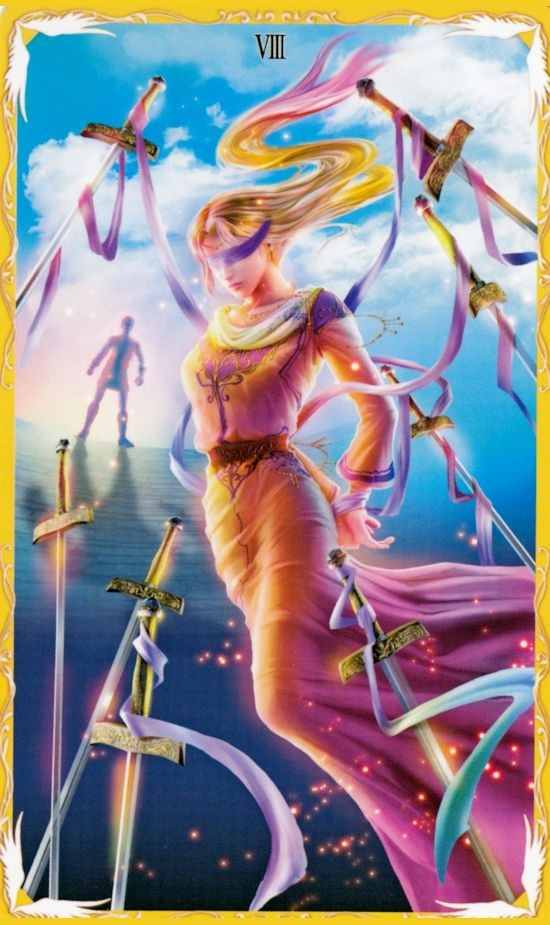
Eight of Swords meaning at a glance
Upright, the Eight of Swords shows feeling trapped, fear and self-imposed limits tangled together, a sense of having no options while you still need to tell which obstacles are real; reversed, it can mean seeing a way out and loosening those limits, or staying stuck through continued avoidance.
- Upright
- Restriction, fear, self-imposed limits
- Reversed
- Seeing a way out, breaking free, continued avoidance
- Love
- Tell outside control apart from your own fears, and seek support.
- Career & money
- List the work options you actually have and get clear on your real financial limits.
- Yes or no
- Leaning no. Work out where the limits come from, then try one small step.
The yes-or-no answer is based on the card's general upright meaning; read it together with your question and the other cards.
Eight of Swords Meaning Overview: You Are Freer Than You Think
The image of the Eight of Swords is striking in almost every tarot deck: a blindfolded, bound figure surrounded by eight swords, standing on muddy ground. At first glance it is a card full of oppression. Look closely, though, and you will notice that the swords do not actually pierce her, the ropes are not impossible to untie, and she could even remove the blindfold at any moment if she chose to. The core message of the Eight of Swords has never been that you are trapped, but that you believe you are trapped.
As a member of the Minor Arcana suit of Swords, the Eight of Swords belongs to the element of Air, which governs thought, language and mental activity. When this card appears, it often means the person is caught in a loop of thinking, repeatedly telling themselves there is no choice, no way out and no ability to change the situation. In tarot tradition this state of mind is called a victim mindset. It is not weakness but a self-protective mechanism people develop under heavy pressure; over time, however, it becomes the deepest chain of all.
- Core imagery: blindfold, bonds and a ring of swords, symbolizing the mental trap of self-imposed limits
- Element: Air, linked to thinking, perception and patterns of communication
- Key question: how much of your current limitation is real, and how much have you built yourself?
- The energy of eight: in numerology eight stands for strength and cycles, hinting at the potential for transformation even in a difficult situation
- Relation to other Swords cards: the Eight of Swords is the prelude to the Nine of Swords (anxiety) and the Ten of Swords (collapse), so noticing it early is a warning
Eight of Swords Upright: Trapped in a Cage of Your Own Making
When the Eight of Swords appears upright, its most direct message is that the limits you feel right now come largely from your own patterns of thought. This is not blaming you; it is pointing out an important fact. When we live for a long time under stress, fear or low self-esteem, the brain automatically narrows our sense of what is possible. You may feel you have no right to ask for better treatment, no ability to make a change, or that any action will only make things worse. These thoughts feel very real, but they are products of the mind, not objective reality.
The upright Eight of Swords may also reflect a concrete outside difficulty: being bound by a relationship, a job or social expectations and feeling unable to move. In that case the card's reminder is to stop first and look carefully at whether those swords are real obstacles or a projection of your fear of the consequences. Very often we are not truly without choices; it is that every choice frightens us, so we choose to stay still. The upright Eight of Swords invites you to ask yourself honestly: if you were not afraid, what would you do?
- Core themes: self-imposed limits, a victim mindset, fear of change
- Common situations: feeling trapped in a relationship or job, being unable to make decisions, relying too heavily on other people's judgment
- State of mind: anxiety, helplessness, thoughts going round in circles without leading to action
- The gift of the upright card: its appearance means you have already recognized the trap on some level, and awareness is where change begins
The Psychology of the Upright Card: How Fear Becomes the Most Effective Prison
Psychology has a concept called learned helplessness: when a person stays for a long time in a negative situation they cannot control, they keep acting powerless even after the situation changes. The upright Eight of Swords describes exactly this state. You may once have truly been trapped, and those experiences were real. But now that trap may no longer exist, or a way out may already be there, and your nervous system is simply still stuck in the old pattern, telling you that moving will only make things worse. Recognizing this pattern is the first step out.
Action Advice for the Upright Card: How to Start Loosening the Bonds
The upright Eight of Swords is not asking you to make a huge change right away. Its advice usually starts with the smallest step: take off the blindfold first, which means letting yourself see reality clearly. Try replacing the "I can't..." in your head with "I choose not to...". This small shift in language can help you feel your own agency again. Then find someone you trust and tell them about your situation, because an outside perspective often sees a way out that you cannot. Your action does not need to be perfect; it only needs to be real.
Eight of Swords Reversed: Breaking Free, or Deeper Avoidance
The reversed Eight of Swords has two very different readings, and you need the context of the question to tell which applies. The first is a positive breakthrough: the person finally starts to see their own thought patterns clearly, begins to loosen long-standing self-imposed limits, and regains the ability and will to act. This is a moment of awakening, showing you are ready to step out of the victim role and take back the direction of your life. This kind of reversal brings a sense of relief, like a stone that has long pressed on your chest finally being lifted away.
The second reading is a warning: the reversed Eight of Swords sometimes means avoiding the problem in a more extreme way, or walking straight into a new bind right after escaping an old one. Some people who feel free have actually just moved into a better-hidden cage, for example going from one controlling relationship into another, or quitting a stifling job only to sink into deeper self-doubt. The reversed Eight of Swords reminds you that real freedom is not escape but understanding.
- Positive reversal: breaking through self-imposed limits, regaining your agency, waking up from a victim mindset
- Warning reversal: running away instead of facing things, swapping one bind for a better-hidden one, an overly impulsive kind of freedom
- Key question for the reversal: is this change a real awakening, or another form of running away?
The Positive Sign of the Reversal: You Are Finding Your Voice Again
If you have recently started saying no to things that have weighed on you for a long time, begun setting boundaries for yourself, or finally found the courage to make a decision you had long been afraid to make, the reversed Eight of Swords confirms that you are on the right path. The process will not be smooth. Regaining your agency often comes with discomfort, because your nervous system is not yet used to this kind of freedom. Give yourself some time and let the new pattern settle in.
The Warning Sign of the Reversal: Trading One Cage for Another
If you feel you are finally free, yet the chaos in your life has not decreased or has even grown, the reversed Eight of Swords may be reminding you that you have not yet dealt with the underlying problem. A real breakthrough requires looking inward, not just running outward. Ask yourself: is the choice I am making now coming from clear intention, or from escaping a certain feeling? There is no standard answer to this question, but facing it honestly is what brings real release.
Eight of Swords in Love Readings: Where the Chains in Love Come From
In a love reading, the Eight of Swords is a card to take seriously. When it appears, it often means the person feels suffocated or trapped in love, or unable to make the choice that is truly good for them. This trap may come from outside: an unhealthy relationship, a controlling partner, or pressure from family and society. More often, though, it comes from within: fear of being alone, avoidance of conflict, and an unshakable belief that you do not deserve better.
When the Eight of Swords appears in a love spread, it is not asking you to make any decision right away. It invites you to stop and honestly look at the real state of the relationship. Do you truly love this person, or are you just afraid to leave? Are you staying because the relationship helps you grow, or because you do not believe you can stand on your own? These questions have no right or wrong answers, but their answers will show you which direction to go next.
Single: Why You Keep Attracting the Same Kind of Person
For singles, the Eight of Swords often points to a repeating pattern: you may keep entering relationships where you feel trapped or disrespected, or you may have set up all kinds of conditions and reasons that keep you from truly opening up to love. This card asks you: what do you believe about love? Do you believe you deserve to be treated well? If the answer is uncertain, then before looking for a new relationship, taking time to understand where that belief comes from will help more than any dating technique.
In a Relationship: A Real Trap, or a Lack of Communication
Drawing the Eight of Swords in a committed relationship may mean you feel you have lost yourself in the relationship, or that some things have never been said and some needs have never been met. This card's reminder is that many of the traps in love are really communication traps. You assume your partner will not understand even if you speak, or that speaking up will start a fight, so you choose silence. But the cost of accumulated silence is often far greater than one honest conversation. Try opening up, even if all you say is "Something has felt off lately."
Breakup or Relationship Crisis: Do You Really Have No Choice
When you draw the Eight of Swords during a breakup or relationship crisis, the card asks you directly: how much of the choice you are making now comes from what you truly want, and how much comes from fear? Whether you are too afraid of loneliness to leave or too afraid of conflict to try to save things, the Eight of Swords reminds you that fear is a terrible adviser. Try setting your fear aside and asking yourself: if the outcome did not matter, what would I really want? A choice that starts from that answer is the one that truly belongs to you.
Eight of Swords Career and Money: The Truth About Feeling Stuck at Work
In a career reading, the upright Eight of Swords usually means the person feels unable to move at work: perhaps trapped in an unfair environment, held down by a manager's or colleague's behavior, or never quite able to take the step toward changing jobs, getting promoted or starting a business. When this card appears, the question worth asking is: how much of your situation is a real outside limit, and how much is your expectation of failure making you give up before you start?
When it comes to money, the Eight of Swords often points to a sense of financial helplessness: feeling you will never manage to save, never improve your financial situation, or carrying deep fear and shame around money. This mindset itself shapes the financial decisions you make and becomes a self-fulfilling prophecy. When the Eight of Swords appears in a money spread, it invites you to examine your beliefs about money, not just the numbers in your account.
- Career upright: feeling stuck in an unsuitable job, unable to move important decisions forward, confused about your career direction
- Career reversed: starting to break through limits at work, being ready to make a change, rediscovering passion and direction in your work
- Money upright: financial helplessness, fear or shame around money, scarcity thinking shaping your decisions
- Money reversed: starting to improve financial habits, a healthier attitude toward money, a chance to break through a financial plateau
Stuck at Work: Who Set Your Ceiling
Many people's limits at work come from beliefs instilled since childhood: "I'm not good enough," "I'm not cut out for big things," "Stability matters more than growth." When the Eight of Swords appears in a career spread, it is often challenging these beliefs. Is your current position, salary and work environment something you truly chose, or what you think you can only get? The answer to this question will often guide your next step better than any career-planning tool.
Money Reading: From Scarcity Thinking to Abundance Thinking
When the Eight of Swords appears in the money position, the most important work is not finding more ways to earn but first understanding where your fear of money comes from. Is it because your family was always fighting about money while you were growing up? Is it because a major financial failure in the past has made you afraid to take risks again? What marks have these past experiences left on your financial decisions? Seeing these clearly is how you can truly begin to change your relationship with money.
Frequently Asked Questions
Does the Eight of Swords mean I am really trapped?
The Eight of Swords does not mean you truly have nowhere to go. It describes your current state of mind more than anything else: you feel trapped. The core message of this card is that a large part of the limitation you feel comes from your own patterns of thought, not from objective reality. This does not deny that the difficulties you face are real; it reminds you that before taking any action, you should first separate the real obstacles from the projections of your fear of the consequences, and that act of telling them apart is itself a breakthrough.
Does the Eight of Swords in a love reading mean the relationship has no future?
Not necessarily. In love, the Eight of Swords describes the person's current state of mind in the relationship more than it predicts how the relationship will turn out. It may mean you feel you have lost yourself in the relationship, or that some important things have never been said. This card is an invitation to honestly face your own feelings and needs in the relationship. Sometimes one sincere conversation can change everything; sometimes it helps you see more clearly whether this relationship is really right for you to continue.
Is the reversed Eight of Swords a good card or a bad card?
The reversed Eight of Swords is neither absolutely good nor bad; its meaning depends on your current situation and the context of your question. In a positive case, the reversal means you are breaking through self-imposed limits, stepping out of a victim mindset and regaining the ability to act. In some cases, though, it may mean you have replaced real confrontation with avoidance, or that after breaking free of one bind you have walked into another. The key to telling them apart is this: is the change you are making now coming from clear self-understanding, or from escaping a certain feeling?
When I draw the Eight of Swords, should I act immediately to change my situation?
The Eight of Swords usually advises not "act immediately" but "see clearly first." The first step with this card is to take off the blindfold: let yourself truly see your current situation instead of continuing to spin in fear and assumptions. You can start with small things: replace "I can't" in your head with "I choose not to," tell someone you trust about your situation, or write down the reasons you believe you have no choice and then check one by one whether they really hold. Action will grow naturally out of clear understanding, and you do not need to force yourself into a huge change right away.
How is the Eight of Swords related to the Nine of Swords and the Ten of Swords?
In the story of the suit of Swords, the Eight, Nine and Ten form a sequence in which a mental trap gradually deepens. The Eight of Swords is the beginning of the trap, representing self-imposed limits and a victim mindset; the Nine of Swords is the deepening of the trap, representing anxiety, nightmares and overthinking; the Ten of Swords is its extreme, representing collapse and endings. Seen this way, the Eight of Swords is an important warning: if you do not face these self-limiting thought patterns now, they may gradually turn into deeper anxiety and collapse. On the other hand, the Eight of Swords is also the easiest of the three to transform, because its chains have not yet fully tightened.