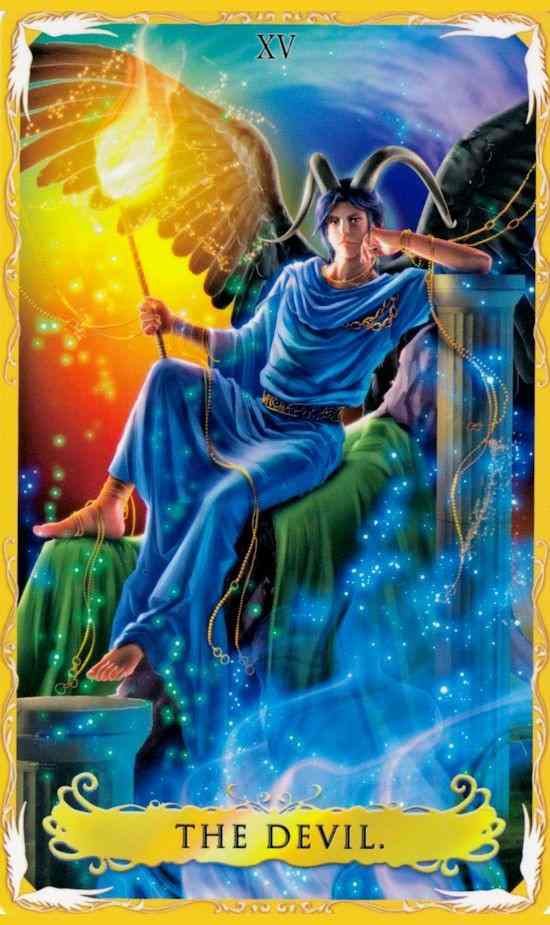
The Devil meaning at a glance
The Devil upright points to bondage formed by desire, dependence and material attachment, and asks you to see the patterns that cost you your freedom; reversed, it can mean gradually breaking free after waking up to them, or still denying the problem and sinking deeper into dependence.
- Upright
- Bondage, dependence, attachment
- Reversed
- Awareness, breaking free, denial
- Love
- Tell attraction apart from control, and face unhealthy dependence.
- Career & money
- Watch for power pressure and debt, and weigh the true cost.
- Yes or no
- Leans no. Sort out dependence and its cost before you commit.
The yes-or-no answer is based on the card's general upright meaning; read it together with your question and the other cards.
The Devil Card Overview: Looking Straight at Your Inner Chains
The Devil is the fifteenth card of the Major Arcana, linked to the element of Earth and the sign of Capricorn. It shows a winged devil seated on a high pedestal, with two figures below wearing loose chains around their necks. The most important detail in the image is that the chains are not tight: the two could slip free at any moment, yet they choose to stay where they are. The core message of The Devil is not an outside evil force, but the way we build our own cages with our own hands and then convince ourselves there is no way out.
In number, this card echoes The Lovers (VI): in both, two figures stand before a higher being, but in The Lovers it is an angel and in The Devil it is a devil. The contrast reveals a deep psychological truth: when our choices are driven by fear, desire or unconscious patterns rather than by our genuine will, love and connection twist into control and dependence. The Devil is not here to make you feel ashamed. It invites you to see, honestly, the attachments you have never wanted to admit.
- Number: XV (15), associated in numerology with “the darkness before transformation”
- Element: Earth, symbolizing the material world, the bodily senses and attachment to worldly things
- Sign: Capricorn, representing ambition and discipline, but also a possible overreach for status and material gain
- Key image: the loose chains, a bondage that is voluntary and can be undone voluntarily
- Related Major Arcana: a deep dialogue with The Lovers (VI) and Temperance (XIV)
The Devil Upright: What Has You Trapped?
When The Devil appears upright, it often points to a predicament you are already aware of but find hard to escape. It might be an unhealthy dependence on a relationship, a compulsive pursuit of money or status, a sense of powerlessness around an addictive substance or behavior, or long-suppressed shadow emotions such as anger, jealousy or sexual desire. This card is not judging you. It is saying that something is draining your life energy, and that you are more capable of facing it than you think.
The Devil upright also often points to “the trap of materialism.” You may be doing a job that suffocates you just to keep up a certain lifestyle or social image, or you may be unable to leave a relationship because you fear loneliness or depend on it financially. The appearance of this card is a sobering reminder: how much of your current situation is a genuine “I have no choice,” and how much is a lie you keep choosing to believe?
The Psychology of the Upright Devil: The Shadow Self Emerges
Jung's concept of “the shadow” fits The Devil closely. When The Devil appears upright, it often means a part of you that you have long suppressed is surfacing in a distorted way: perhaps jealousy you don't dare admit, a desire to control others, or shame about your own bodily desires. This card invites you to stop fighting these parts and instead try to understand, with curiosity, where they come from. Suppression only gives the shadow more power; seeing it is where real liberation begins.
Upright Action Advice
The Devil upright does not ask you to cut everything off at once. First, take an honest inventory: which habits, relationships or beliefs are draining you? Try writing down three areas of your life where you feel “stuck,” and ask yourself: if there were no fear, what would I choose? The answer to that question is often the first gap where the chains begin to loosen.
The Devil Reversed: The Moment You Break the Chains
The Devil reversed usually has two very different readings, and which one applies depends on the context of the question. The first is positive: you are waking up from some form of bondage, beginning to see the patterns that kept you stuck, and finding the courage to change. This might mean leaving a toxic relationship, quitting an addictive behavior, or refusing to keep living for outside approval. In this context, The Devil reversed is a card of liberation full of hope.
The second reading is more of a warning: sometimes the reversal means you recognize the problem but are still avoiding it, or even continuing the harmful patterns in more hidden ways. For example, you may leave one controlling relationship on the surface, only to jump straight into a similar one; or you may quit one addiction only to shift to another. Here The Devil reversed reminds you that true freedom is not swapping one cage for another, but understanding why you keep walking into cages.
- Positive reversal: waking up from addiction or a toxic relationship and regaining your autonomy
- Warning reversal: replacing an old attachment with a new one, so the pattern hasn't truly changed
- Deeper reversal: a suppressed shadow erupting more intensely, calling for professional support
- Spiritual reversal: beginning to integrate the shadow self and moving toward a fuller self-understanding
The Healing Message of the Reversal
The most important message The Devil reversed brings is this: you are more powerful than you think. The habits you believe you cannot change, the relationships you believe you cannot leave, the thought patterns you believe you cannot shake: their foundations are not as solid as they seem. When this card appears, the universe is telling you it is time to re-examine the stories that begin with “I have no choice.” Every place where you say “I have to” deserves to be asked again: is that really true?
The Devil in Love Readings: The Line Between Love and Control
In a love spread, The Devil is one of the cards that most demands honesty. It does not necessarily mean the relationship is “bad,” but it almost always points to some unhealthy dynamic: over-dependence, jealous control, physical attraction overshadowing genuine emotional connection, or two people staying in a relationship that stopped nourishing them long ago because both fear being alone. When The Devil appears in love, it invites you to ask yourself honestly: am I staying here out of love, or out of fear?
It is worth noting that The Devil is not always negative in love. It can also represent strong physical attraction, passion and desire, which are real and important parts of human relationships. The question is whether the relationship is built only on these, or whether deeper mutual respect and genuine connection hold it up.
Singles: What Pattern Are You Repeating?
For singles, The Devil often points to a question worth reflecting on: do you keep being drawn to the same type of person, only to get hurt in the same way each time? This card invites you to look inward rather than keep searching for “the right one.” Your attachment to a particular relationship dynamic, such as needing to rescue the other person, being drawn to domineering people, or seeking excitement in uncertainty: where do these patterns come from? Only by seeing them can you truly break the cycle.
In a Committed Relationship: Dependence or Real Love?
Drawing The Devil in a committed relationship calls for an honest look at the relationship's dynamics. Is one partner controlling the other's finances, social life or emotions? Has someone been suppressing their own needs for a long time because they fear conflict? This card isn't telling you to end the relationship right away. It invites both of you to talk openly and see clearly the fears and needs that have never been spoken, so you can decide whether the relationship has a real chance to transform.
Breakups or Affairs
If the question is whether to break up, The Devil upright is usually a sobering signal: you already know the answer, you just haven't found the courage to admit it yet. If the question involves an affair or a love triangle, this card usually points not to a moral judgment but to a deeper question: what need does this secret relationship meet that your main relationship does not? That need is the core that truly has to be faced.
The Devil in Career and Money: The Price of Ambition
In a career spread, The Devil often points to the dilemma of “selling yourself out for success.” You may be struggling in a well-paid job that suffocates you, or making compromises against your values for a promotion. Here Capricorn's energy shows its darker side: an attachment to status and achievement that makes you forget why you started working in the first place. When this card appears, it is worth asking: is what this job gives you really what you want?
On the money side, The Devil warns of impulse spending, a gambling mindset, or taking on too much debt to maintain a certain lifestyle image. It can also point to an unhealthy anxiety about money: not a real shortage, but never feeling secure no matter how much you have. This compulsive pursuit of material security is often rooted in a deeper emotional sense of lack, and needs to be addressed on a psychological level rather than a financial one.
Power Dynamics at Work
In a workplace context, The Devil also often points to unhealthy power relationships: a controlling boss, workplace bullying, or pressure that you yourself are unconsciously putting on subordinates or coworkers. This card reminds you that true leadership comes from empowering others, not from maintaining control through fear. If your work relationships are full of tension, manipulation or mistrust, The Devil's appearance is an invitation to re-examine those dynamics.
Money Advice: From a Scarcity Mindset to Real Abundance
The Devil reversed is a positive sign for finances, showing that you are waking up from impulse spending or financial anxiety and starting to build a healthier relationship with money. Upright, it asks you to check how much of your spending reflects real needs and how much is shopping to fill an emotional void. The first step to changing your financial situation is often not a money-management technique, but honestly facing the emotional relationship between you and money.
Frequently Asked Questions
Does drawing The Devil mean I have bad luck or am cursed?
Not at all. In the tarot system, The Devil represents psychological and behavioral patterns, not an outside curse or fate. It acts as a mirror, reflecting a dynamic in your life right now that leaves you feeling stuck: a relationship, a habit, or a deeply rooted belief. Tarot's purpose is to offer insight, not to predict doom. Drawing The Devil is actually a rare chance to see honestly the parts you usually avoid, and to find real freedom through them.
If The Devil shows up in a love reading, does the relationship have to end?
Not necessarily. The Devil in love means there is an unhealthy dynamic in the relationship that needs to be faced, but that doesn't mean the relationship must end. Some relationships can transform when both people are willing to communicate honestly and seek change. The key question is: are both of you willing to face the problems together, or does one of you refuse to admit the problem exists at all? The answer decides whether the relationship has real room to transform.
Is The Devil reversed better than upright?
The Devil reversed usually means you are waking up from some form of bondage, or that the patterns trapping you are loosening, which in many situations is indeed a positive sign. But a reversal doesn't automatically mean “good”: it can also mean you are avoiding the problem, or replacing an old attachment with a new one. Upright and reversed meanings need to be read within the context of the whole spread; the orientation of one card alone is rarely enough for a complete conclusion. What matters most is understanding the core message this card carries in your current situation.
What does it mean when The Devil appears with Temperance (XIV)?
Temperance (XIV) stands for balance, integration and the middle way, and The Devil (XV) comes right after it, symbolizing the extremes we fall into when we lose balance. When the two appear together, it is often a strong signal: some area of your life is badly out of balance, and deep down you know where the real point of balance lies. The pairing can also mean you are at a turning point: Temperance reminds you to return to the middle way, while The Devil reveals the direction you are currently drifting in. Read together, they pose a profound question about how to find your way back to yourself.
How can I use the wisdom of The Devil in everyday life?
The most practical everyday use of The Devil is as a tool for “honest inventory.” Whenever you feel trapped, powerless to change, or compulsively attached to something, ask yourself three questions: What fear lies behind this attachment? Without that fear, what would I choose? What am I willing to let go of for real freedom? These questions don't need immediate answers, but living with them over time often makes those unconscious chains gradually clearer, and clarity itself is the beginning of freedom.