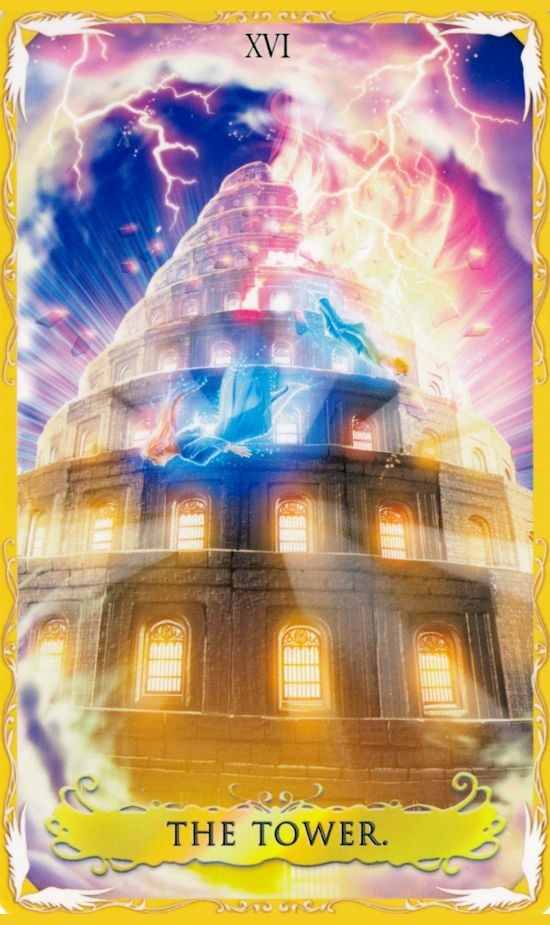
The Tower meaning at a glance
The Tower upright signals sudden change that exposes an unstable foundation, so old beliefs or structures need to be re-examined; reversed, it reflects resisting necessary adjustments, putting off a problem, or pushing the turmoil inward where it keeps wearing you down.
- Upright
- Sudden change, revelation, rebuilding
- Reversed
- Resisting change, delaying action, inner turmoil
- Love
- Face the problem that has been exposed, and steady your communication first.
- Career & money
- Check the weak spots in the organization and your finances, and keep resources in reserve.
- Yes or no
- Leans no. Deal with the shaky foundation before planning the next step.
The yes-or-no answer is based on the card's general upright meaning; read it together with your question and the other cards.
The Tower Card Overview: Truth in the Flames
The Tower, often referred to simply as the Tower card, is the sixteenth card of the Major Arcana and one of the cards people least want to see in a spread. In the image, a tall tower bursts into flames after being struck by lightning, people fall from the top, and a crown is blasted into the air. The scene is direct, shocking and makes no attempt to soften itself. The Tower's element is Fire and its ruling planet is Mars, representing an energy that cannot be held down and is bound to erupt. It is not a curse, but a forced reckoning.
The core message of The Tower is that some structure you depend on is built on an unstable foundation, and the universe is telling you so in the most direct way possible. It could be a relationship, a job, a belief system, or even a way you see yourself. The collapse itself is not the end; it is the precondition for rebuilding. When The Tower appears, it often means you have stayed too long inside a false sense of security.
- Number: XVI (16), which reduces to 7 in numerology, symbolizing deep inner transformation
- Element: Fire, the primal force of purification, destruction and rebirth
- Ruling planet: Mars, bringing conflict, action and unavoidable confrontation
- Core themes: sudden collapse, forced revelation, clearing away false foundations
- Related cards: The Moon (hidden fears), Judgement (awakening), The World (rebuilding complete)
The Tower Upright: When Everything Suddenly Falls Apart
The Tower upright represents violent change that arrives suddenly and can't be prevented. It might be an argument that makes you realize the relationship has been full of holes for a long time, a piece of news that instantly wrecks your plans, or a truth you have long avoided finally surfacing in the most forceful way. The “suddenness” of The Tower is not chance but the inevitable result of long accumulation; you simply chose not to look before.
The Tower upright also carries a sense of liberation. Yes, collapse is painful, but what falls is often what you should have let go of long ago. When The Tower appears, rather than asking “why is this happening to me,” ask “what is this collapse telling me?” The fire burns away what has rotted; what remains is what truly belongs to you.
Common Ways The Tower Upright Shows Up
In real life, The Tower upright often shows up in very concrete ways: a sudden layoff or a company going under, a major betrayal or a sudden breakup, a health emergency, an unexpected financial loss, or a long-maintained lie being exposed. What these events share is that they are “fast, high-impact and impossible to pretend didn't happen.” The Tower gives you no buffer time; it demands that you face reality right away.
The Psychology of The Tower Upright
On a psychological level, The Tower upright can represent the collapse of a belief: something you always thought was true is suddenly proven wrong. This kind of cognitive shock is sometimes harder to bear than an external event. When The Tower appears, it is necessary to let yourself feel the shock and loss, but don't linger in the ruins too long. Seeing clearly what has fallen is what lets you decide what to build next.
Is It the Surface or the Foundation That's Collapsing?
To judge how strong The Tower upright is, first work out what is actually falling. A delayed plan or renegotiated partnership terms are mostly surface adjustments; a concealment exposed, trust shattered, or an arrangement you have long been propping up finally becoming unsustainable is The Tower at full strength. In love, you can tell the difference this way: an ordinary argument is about a single incident, while a Tower-style crisis targets the structure of the relationship itself, such as repeated broken promises, a major secret, values that can't be reconciled, or one partner controlling the other over a long period. If you are only asking about a small everyday matter, The Tower usually means a limited setback or disrupted plans, and there's no need to blow it up into a life crisis.
The change The Tower brings usually passes through four stages: cracks building up, a trigger appearing, collapse, and reorganization. First work out which stage you are in, then decide what to do. After the collapse, you can sort your situation into three piles: what can be kept, what must be let go, and what needs to be rebuilt, rather than cutting everything off in one emotional stroke.
The Tower Reversed: A Delayed Collapse and Inner Turmoil
The Tower reversed does not mean the crisis has disappeared. It means the collapse is being drawn out, internalized, or deliberately held down by you. You may sense that something is about to give way, yet choose to keep up a stable surface. The Tower reversed can sometimes be more draining than upright, because the state of “about to collapse but not yet” keeps people anxious and exhausted for a long time.
The Tower reversed can also mean you are slowly recovering from a shock, or that you have already sensed the warning and are actively making changes to avoid a bigger collapse. In this sense, The Tower reversed gives you a choice: you can wait for the lightning, or you can take down the unstable structures yourself before it strikes.
- The Tower reversed may suggest that long-suppressed conflict is about to erupt
- It may also mean you are slowly healing from a past shock
- As a warning: don't assume a problem is solved just because the surface is calm
- On the positive side: you have a chance to make changes yourself before the collapse
Two Main Readings of The Tower Reversed
The first: the crisis is delayed but not resolved. You know the problem exists but choose to avoid it, which will only make the eventual eruption more violent. The second: you have already been through the shock and are in the rebuilding stage, and The Tower reversed reminds you not to rush into rebuilding old patterns, but to truly reflect on why that foundation fell. Both readings point to the same core: honestly face the problem you have not wanted to look at.
The Tower in Love Readings: What It Means for Your Relationship
In a love spread, The Tower is the hardest card to brush off lightly. It almost never brings “it's fine” news, but what it brings is often the truth you most need to hear. When The Tower appears in love, it means the relationship is going through, or is about to go through, a test that can't be avoided, and the outcome of that test will decide whether the relationship is worth continuing.
Importantly, The Tower does not equal a breakup. It means “the current pattern has to change.” If both people are willing to look at each other anew among the ruins, The Tower can actually become the turning point where a relationship gains real depth. But if one or both are unwilling to face the problem, The Tower may indeed foretell the end of the relationship.
Singles: What The Tower Says About Love
For singles, The Tower may mean you are coming out of a painful heartbreak, or that a deep-rooted belief you hold about love is being broken. Maybe you always thought you needed a certain type of partner, or you held a fixed picture of what love should be, and The Tower is tearing down those limiting frames. The process is uncomfortable, but it clears space for a relationship that truly suits you.
In a Committed Relationship: Warning and Opportunity
When The Tower appears in a committed relationship, it usually means a core issue the two of you have long avoided is about to surface. It may be a communication pattern, a fundamental difference in values, or one partner's long-suppressed dissatisfaction. The appearance of The Tower is an invitation: rather than waiting for the explosion, start that difficult conversation yourself. Whether the relationship survives the shock depends on whether both of you have the courage to be honest with each other.
Asking About Getting Back Together: The Tower's Direct Answer
If you draw The Tower while asking whether to get back together with an ex, the card's message is quite direct: that relationship ended because its foundation was flawed to begin with. Reconciling isn't impossible, but if neither of you truly changes the root cause of the collapse, all you'll rebuild is another tower destined to fall again. The Tower here is not a prohibition but a serious question: are you both ready to really change?
Drawing The Tower When Things Are Still Undefined
The Tower breaks the ambiguity of an undefined relationship: someone may suddenly declare their feelings, someone may suddenly pull back, or you may find out you are not the other person's only option. At this point, rather than continuing to guess, ask directly where the relationship stands. If your question is “do they still love me,” The Tower won't answer yes or no; instead it points out that some major shock is affecting how they express their feelings. If your question is “will they contact me,” The Tower could mean contact out of the blue or a sudden silence, so read it together with the other cards.
The Tower in Career and Money: Lessons for Your Working Life
In a career spread, The Tower represents dramatic change in your work environment. It could be a major company restructuring, sudden layoffs, a broken partnership, or a career advantage you've relied on suddenly losing its value. When The Tower appears in career matters, the most important thing is not to panic but to assess quickly: in this upheaval, which abilities and resources truly belong to you, and which are just external structures you've been leaning on.
On the money side, The Tower warns of possible financial losses or unexpected expenses, especially those tied to excessive risk-taking or investments built on unstable foundations. This isn't telling you never to act again; it's reminding you to make sure, before any major financial decision, that the foundation is genuinely solid and not just solid-looking.
- Stop: don't make irreversible decisions at the height of your emotions. Hold off on confrontations in the moment, impulsive resignations and revenge spending, and don't keep redrawing cards hoping to replace this one.
- Look: confirm the facts first, such as message records, contract terms, financial figures and the resources you actually have. At work, you can start by updating your résumé and keeping records of your work.
- Dismantle: actively remove arrangements that no longer make sense, such as a vague relationship, chronically excessive working hours or unbalanced spending. Financially, the worst move is trying to win back losses by taking even bigger risks.
The Tower for Entrepreneurs and Freelancers
For entrepreneurs or freelancers, The Tower may mean the sudden loss of a major client, a business model that stops working, or a drastic shift in the market. These shocks are painful, but The Tower is also asking: does your business depend too heavily on a single source? Is this collapse pushing you to build a more diverse, more resilient foundation?
The Tower for Employees
For employees, The Tower may foreshadow sudden changes at work, such as a new manager, a department reorganization, or a major policy change. It can also represent your own disillusionment with the job: you suddenly see clearly that this position or company is not what you thought it was. The role of The Tower here is to force you to re-evaluate: what career direction do you really want?
Stop, Look, Dismantle: Three Steps When The Tower Appears
When The Tower shows up in a work or money reading, you don't have to react to everything at once. Work through it in three steps: stop before making irreversible decisions, look at the facts and resources you actually have, then dismantle the arrangements that no longer hold up.
The Tower in Different Spread Positions
The same Tower card can sound very different depending on its position. As a general rule, the closer it sits to the outcome position, the closer things are to erupting; the closer it sits to the cause or past position, the more it shows the problem has been there for a long time.
Reversals depend on position too: The Tower reversed in the future position often means the problem is being held down rather than gone; in the present position, it may mean a recovery period after the shock.
- Cause / past position: the problem has been building for a long time, and the current situation continues an old crack.
- Present position: the upheaval is happening now, or the atmosphere is already so tense it's hard to pretend everything is fine.
- Future position: if the current pattern continues, you may be forced to change; this is a warning, not a verdict.
- Advice position: actively take down arrangements that aren't real, such as no longer pretending things are fine, re-checking a contract, or admitting a plan won't work.
- Outcome position: the original situation is hard to sustain, and the focus from here is how to rebuild.
- The Tower + Justice: the change involves contracts, rules or who is responsible; a good time to put responsibilities in writing.
- The Tower + The Lovers: the conflict comes from choices and values, not just passing emotions.
- The Tower + Wheel of Fortune or Judgement: the turn is hard to reverse; instead of resisting it, start planning your next step.
- The Tower + The Devil or Nine of Swords: the problem is magnified by delay, attachment or anxiety; first deal with the thing that keeps you from walking away.
- The Tower in the outcome position alongside the Ten of Swords, Three of Swords or Eight of Cups: separation or leaving is more likely.
- If the Four of Cups, Seven of Swords or Five of Pentacles come before it, the problem has been buried for a while; if The Star, The Sun or Temperance follow it, there is still room to rebuild after the shock.
The Tower with Other Cards
The cards around The Tower show what the upheaval is really about. Justice points to contracts, rules and responsibility; The Lovers to choices and values; Wheel of Fortune or Judgement to a turn that is hard to reverse; The Devil or Nine of Swords to a problem magnified by delay, attachment or anxiety. Cards that come before it can show how long the problem has been buried, while The Star, The Sun or Temperance after it leave room to rebuild.
Two Spread Examples
Asking about love over the next three months: Two of Cups, The Moon (obstacle), The Tower (future). There's an emotional bond between the two of you, but information isn't transparent; if it's never addressed, the vague parts will sooner or later be exposed. The better approach is to define the relationship clearly now rather than waiting for it to blow up on its own.
Asking whether to stay in or leave a job: Ten of Wands, The Emperor reversed, The Tower (advice). This combination isn't telling you to quit tomorrow; it's reminding you to stop getting by on endurance alone, to clarify roles and responsibilities, and to set your own stop-loss point.
To learn more about what to ask next and how to limit the damage after drawing The Tower, read: Is The Tower a Bad Card? Complete FAQ on The Tower Upright and Reversed.
Frequently Asked Questions
Does drawing The Tower always mean something bad?
Not necessarily. The Tower represents “a necessary collapse,” not pure bad luck. Often we stay too long in a situation that stopped suiting us because the cost of change looks too high. The appearance of The Tower is often the universe making the decision you have kept putting off. The collapse is genuinely painful, but what falls is usually what you should have let go of long ago. The real question isn't whether The Tower is good or bad, but “what is this collapse telling me, and am I willing to face it honestly?”
If The Tower appears in a love spread, does it mean we will definitely break up?
The Tower is not a breakup verdict. It means “the relationship's current pattern can't be sustained,” but that change can go two ways: the relationship ends, or it reaches a deeper level after an honest conflict. The key is whether both people are willing to face the core issue that has long been avoided. If both are willing to rebuild from the ruins, The Tower may actually be the point where the relationship truly matures. But if one or both are unwilling to change, separation is indeed the more likely outcome.
Is The Tower reversed better than The Tower upright?
There's no simple yes-or-no answer. The Tower reversed sometimes means the crisis is postponed, giving you a chance to change on your own terms, which in a sense is better than passively taking the hit. But The Tower reversed can also mean you're delaying a necessary collapse, letting the “barely holding on” state keep draining you. Living in that unresolved tension for a long time can hurt more than one clean collapse. So The Tower reversed isn't “the safer Tower”; it's simply asking you the same question in a different way.
What should I do when The Tower appears?
First, don't make hasty decisions in a panic. The shock The Tower brings often makes people want to act immediately to regain a sense of control, but decisions made in the moment of shock may simply rebuild the same old structure on the ruins. Give yourself some time to see clearly what has fallen and why. Then ask yourself: if I rebuild, what do I want to build? The most valuable function of The Tower is forcing you to rethink, from the ground up, the foundations you have always taken for granted.
The Tower and Death both mean endings. What's the difference?
Death (XIII) represents a natural, cyclical ending and transformation, like the changing of the seasons, with its own rhythm and inevitability, and it is usually gradual. The ending The Tower brings is sudden and forced, often accompanied by shock and chaos. Death gives you time to prepare and say goodbye; The Tower doesn't. Another key difference: the transformation of Death is usually holistic, while The Tower targets a specific structure built on a false foundation. Death is metamorphosis; The Tower is a reckoning.
If The Tower is in the advice position, is it telling me to end things myself?
It doesn't mean you have to break up or quit right away. The Tower in the advice position asks you to stop maintaining a false stability: make vague commitments clear, renegotiate responsibilities, and admit that a certain arrangement no longer works. Ending things is one option, but the first thing to take down is the part that isn't real.
What should I ask first when I draw The Tower?
Ask first “where is it least stable?”: is this change coming from outside or from within? What most urgently needs to be stopped from getting worse right now? Is there a backup plan you can prepare? This helps far more than repeatedly asking “is something bad going to happen?”
When will The Tower happen?
The Tower itself doesn't predict a specific point in time, and it doesn't mean something will happen tomorrow. It describes a structure that is already unstable; timing depends on how the spread is designed and on the other cards. If the matter involves legal issues, medical concerns, workplace bullying or intimate partner violence, please seek professional help first and don't rely on a reading alone.