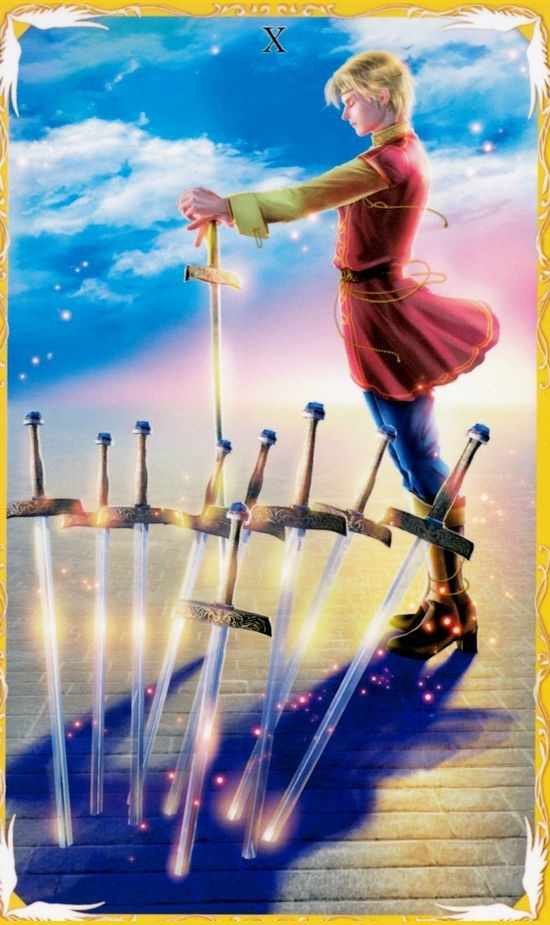
Ten of Swords meaning at a glance
Upright, the Ten of Swords represents a painful ending, a heavy blow and exhaustion, a reminder to admit that one way of doing things can no longer be kept going; reversed, it can mean slow recovery and getting ready to rebuild, or delaying the facts by refusing to say goodbye.
- Upright
- Final ending, heavy blow, exhaustion
- Reversed
- Recovery, rebuilding, resisting goodbye
- Love
- Face the hurt in the relationship and where it has ended, and leave room to recover.
- Career & money
- Stop pushing on with what is not working, and take stock of your work and financial losses.
- Yes or no
- No. Stop the drain first, then plan your recovery and rebuilding.
The yes-or-no answer is based on the card's general upright meaning; read it together with your question and the other cards.
Ten of Swords Meaning Overview: The Weight of an Ending
The image of the Ten of Swords leaves almost no room for ambiguity: a person lies face down on the ground with ten swords in their back, and the distant sky is heavy with dark clouds, yet a thin line of dawn is breaking through. In the whole tarot deck, this card is the most direct symbol of an ending. It means something has gone as far as it can go and cannot continue. It is not a gradual decline but a clear breaking point.
The suit of Swords corresponds to the element of Air and governs thought, language and conflict. As the final chapter of the suit, the Ten of Swords carries the most extreme expression of all Swords energy: overthinking, hurtful words, betrayal between people, and the feeling of being completely defeated on a mental level. At the same time, the card is an important reminder: ten is the end of the count and also the start of the next cycle. Hitting rock bottom means the only way left is up.
- Number ten: completion, endings, the last step of a cycle
- Air element: extreme conflict in thought and communication
- Ten swords: the hurt has peaked and cannot grow any more
- Dawn on the horizon: after the darkness, a turning point always comes
- Face-down posture: complete surrender and release
The Symbolism of the Card Image
The ten swords in the back symbolize hurt that has reached its limit and cannot possibly increase. The figure lying face down represents complete surrender and giving up resistance. The golden light on the distant horizon is the most important detail of this card: even in the darkest moment, dawn still exists. The cloud-covered sky contrasts with the calm water, hinting that the storm within will eventually settle.
Ten of Swords Upright: When Everything Reaches Its End
The upright Ten of Swords usually appears when a relationship, a job, a plan or a chapter of life has truly come to an end. That end is often not a peaceful goodbye but one that comes with pain, betrayal or sudden collapse. You may be going through the shock of being betrayed, the defeat of a plan failing completely, or the sudden crumbling of something you once believed in without question. These feelings are real and do not need to be played down.
However, the upright Ten of Swords is not predicting your future; it describes something that has already happened or is happening now. When this card appears, it is often telling you: yes, this really is over, and you do not need to keep struggling to hold it together. Accepting this ending is the first step toward recovery. The pain is real, but it is not permanent, and the line of dawn on the card has never been mere decoration.
- A relationship or partnership has reached a point of no return
- The shock of betrayal, deception or sudden collapse
- Long-accumulated problems have finally erupted in full
- A moment to accept reality and stop struggling
- After hitting bottom, the possibility of recovery begins to appear
The Core Message of the Upright Card
The core of the upright Ten of Swords is not "you will fail" but "this is already over." It asks you to face reality honestly and stop spending energy on keeping alive something that has already died. Admitting an ending takes courage, but that courage is where real recovery begins.
Common Situations for the Upright Card
In a reading, the upright Ten of Swords may correspond to a friendship or partnership breaking apart through betrayal, long-accumulated pressure finally exploding at some point, a plan you poured your heart into being declared a failure, or finally realizing that a relationship has long existed in name only. What these situations share is that the outcome is settled and cannot be reversed, and precisely because of that, you can truly let go.
Ten of Swords Reversed: Rising from the Ruins
The reversed Ten of Swords brings a subtle shift. It may mean you are slowly recovering from a painful experience: the wound is still there, but you have started trying to stand up. It may also mean you are avoiding an ending you must face, knowing something is over yet still refusing to admit it and finding all kinds of ways to put off that unavoidable goodbye.
Another reading of the reversal is that past trauma is surfacing and needs to be acknowledged and dealt with. You may think you have already come through a certain pain, but it is still buried deep inside, shaping your current decisions and feelings. The reversed Ten of Swords reminds you that real healing is not forgetting, but carrying your scars forward and understanding how they have shaped who you are now.
- Slowly recovering from the lowest point, with rebuilding already underway
- Refusing to accept the ending and putting off a necessary goodbye
- Past trauma resurfacing and needing to be faced
- Learning from failure to avoid repeating the same mistakes
- Letting go of a victim mentality and taking back control of your direction
The Two Main Directions of the Reversed Card
The reversed Ten of Swords has two very different directions to tell apart. One is recovery: the worst moment has passed and you are slowly rebuilding. The other is avoidance: you know something has to end, but you are not ready to face that reality yet. In a reading, use the background of the question and the other cards to judge which state applies.
Ten of Swords in Love Readings: Endings and Rebirth in Love
In a love spread, the Ten of Swords is one of the hardest cards to accept, because it often points directly to the end of a relationship. But an ending does not necessarily mean failure. Some relationships reach their end because they have completed their purpose, and both people need to continue on their own journeys. When this card appears, the most important thing is to ask yourself honestly: does this relationship still have real life in it, or are you only keeping up an empty shell?
In love, the Ten of Swords may also represent the hurt of betrayal, whether it is an affair, lies, or a sense of betrayal built up through long-term emotional neglect. This hurt is real and needs to be acknowledged, not rationalized or suppressed. Whether you ultimately choose to stay or leave, facing the truth of the hurt is a necessary first step.
- The relationship has reached a point of no return and needs to be faced honestly
- Deep hurt caused by betrayal or lies
- Old wounds that have not healed affect your current love life
- A crisis can also be a turning point for rebuilding the relationship
- Allow yourself to grieve, but do not stay trapped in the pain
Single: Old Wounds and New Beginnings
For singles, the Ten of Swords may be reminding you that the wounds left by a past relationship have not truly healed. Without realizing it, you may be carrying those wounds into new connections, responding to the person in front of you with defensiveness or excessive expectations. This card is not saying you cannot begin a new relationship; it is saying that once you properly tend to those old wounds, you can truly love someone as your whole self.
In a Relationship: Crisis or Turning Point
When the Ten of Swords appears in a committed relationship, it may mean the relationship is facing a major crisis point: a serious conflict, an exposed lie, or long-accumulated resentment finally boiling over. This moment is painful, but it is also an opportunity: are you both willing to face the problem honestly, or will you keep avoiding it? Some relationships can be rebuilt after hitting bottom, but only if both people are truly willing to face reality.
Breakup or Divorce
If you are considering a breakup or have already been through one, the Ten of Swords is a kind of confirmation: this ending is painful, but it is real. This card does not encourage you to go back; it invites you to admit that this relationship has run its course. Grief is normal, so allow yourself to mourn, but do not let mourning turn into endless self-punishment.
Ten of Swords Career and Money: Collapse and Rebuilding at Work
In a career spread, the Ten of Swords may represent the complete failure of a project, betrayal at work (being sold out by a colleague or sacrificed by a manager), or a job that has reached its end. This kind of ending is sometimes sudden and sometimes the inevitable explosion after a long build-up. Either way, the card is saying that pushing on any further no longer makes sense, and acknowledging the situation is how you find a way forward.
When it comes to money, the Ten of Swords may point to a major financial loss or a failed investment. This is not encouraging you to give up but reminding you to figure out the root cause of the failure before you start over. Rushing to cover old wounds with new actions will only make the problem more complicated.
- A project fails or a work plan collapses entirely
- Being betrayed or sold out by a colleague or manager
- A job or partnership reaching its end
- A major financial loss that calls for an honest assessment of where you stand
- Rebuilding after hitting bottom takes clear-headed planning, not impulsive action
Betrayal and Conflict at Work
In a work setting, the theme of betrayal is especially strong for the Ten of Swords. A colleague you trusted may turn against you at a critical moment, someone else may take credit for your efforts, or internal politics may make you the one who gets sacrificed. Such experiences can leave you deeply doubtful of relationships at work, but they are also a chance to see more clearly who is truly worth trusting.
Hitting Financial Bottom and the Way to Rebuild
Financially, the Ten of Swords marks a clear low point: perhaps investment losses, a failed business or a sudden financial crisis. What this moment calls for is not finding a solution immediately but stopping first and honestly assessing where you stand. Impulsive attempts to fix things often only make the situation worse. Stabilize first, then plan: that is this card's core advice on money.
Frequently Asked Questions
Does the Ten of Swords always mean the worst outcome?
Not necessarily. The Ten of Swords is indeed one of the heaviest cards in tarot, but it describes a state of ending, not a curse that cannot be changed. When it appears, it is often telling you that something has reached its end and that further struggle will only add to the pain. Accepting this reality is actually the starting point for change. The line of dawn on the horizon is not an accidental design; it reminds you that after the night, dawn always comes. The point of a reading is to help you see your situation clearly, not to fix your fate.
The Ten of Swords came up in my love reading. Can the relationship still be saved?
There is no one-size-fits-all answer to this question, because it depends on the real state of the relationship right now and on whether both people are willing to face the problems honestly. The upright Ten of Swords usually represents some degree of ending or a serious crisis, while the reversal may represent the beginning of recovery. More importantly, this card is asking you: have the relationship's problems ever truly been faced, or have they always been avoided? If both of you are willing to communicate honestly and make changes, a turnaround is possible; but if only one person is making the effort, this card may be reminding you to face the answer you already know.
The Ten of Swords and Death both mean endings. What is the difference?
The Death card (Major Arcana) represents a natural, necessary transformation and metamorphosis; its ending carries a broad sense of inevitability and usually points to a deeper change in life. The Ten of Swords is more specific and more immediate: it describes the collapse of a particular event or situation, with a stronger sense of pain and impact. Death's ending is often calm and far-reaching, while the Ten of Swords' ending is more like a sudden explosion. Both point to an ending, but Death is more like the turning of the seasons, and the Ten of Swords is more like the peak of a storm.
If I draw the Ten of Swords reversed, does it mean I am out of the low point?
The reversed Ten of Swords has two main readings, and you need the background of the question to judge between them. The first is recovery: the worst moment really has passed, and you are rebuilding slowly but truly. The second is the opposite: you are not yet ready to face an ending, and you are using all kinds of ways to avoid that necessary goodbye. If you feel you are getting better, the reversal may be a confirmation; but if you feel you are still going in circles, it may be reminding you that real recovery first requires honestly facing the reality you have been avoiding.
The Ten of Swords appeared in my career spread. Should I quit my job?
The Ten of Swords is not a direct instruction to act; it is more like a mirror that lets you see your current situation clearly. If it appears in the position for the present, it may be saying that this job or work environment has already done you real harm, and the cost of staying needs to be weighed seriously. But the decision to quit involves many factors, including your finances and how ready your other options are. What this card advises is to stop deceiving yourself, honestly assess the real impact this job has on you, and then make a clear-headed decision rather than acting on impulse or fear.