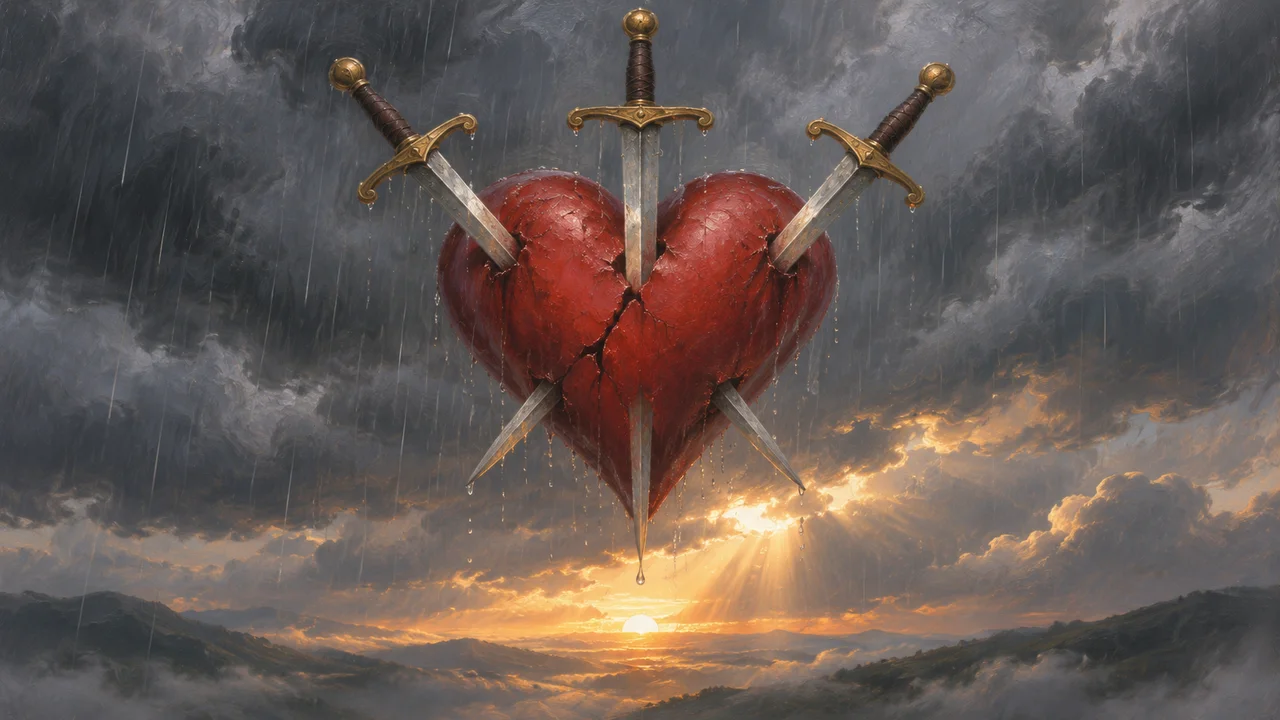
When the Three of Swords turns up, a lot of people feel their stomach drop. Is this a breakup? Is the project about to fail? In most readings, though, this card is generally interpreted not as a sentence handed down but as an honest signal. Three blades pierce a single heart, and the image is blunt on purpose: it wants you to see where it hurts and why. Pain itself is information. It tells you an expectation has collapsed, or that a relationship or plan has run into trouble, but it does not announce that your story is over. The Three of Swords meaning is less about doom and more about clarity, even when that clarity stings. If you are stuck in a situation that keeps aching and you want to understand what the hurt is trying to tell you, a tarot reading is a gentle place to start. Bring the question that sits heaviest on your mind, and let the cards help you name it before you decide what to do next.
Upright, the Three of Swords commonly points to heartbreak, disappointment and the truth coming out. Reversed, it can mean the wound is beginning to heal, or that you are still stuck in the pain and avoiding it. The card is not limited to love questions. Setbacks at work, harsh criticism, a plan that falls through, a habit of beating yourself up, or an old wound that suddenly reopens can all bring it into a spread. The most useful way to read it is to treat the pain as a clue: which expectation fell apart, which fact has finally become visible, and which thought is quietly doing the damage. The sections below begin with the imagery on the card, then move through the upright and reversed meanings, the three main areas where it shows up (relationships, career and your relationship with yourself), how neighbouring cards shift its tone, and finally some concrete steps for working through the hurt and asking a better next question.
Reading the Card: Swords, Heart and Rain
The Three of Swords has one of the least ambiguous images in the whole tarot deck. A red heart hangs in the air, three swords drive through it from different angles, and behind it sit heavy storm clouds with rain slanting down. There are no people, no faces and nowhere to hide. A common view is that this empty, figure-free composition is deliberate: it keeps your attention on the feeling itself rather than on rushing to blame someone.
The three blades can be read as three sources of hurt: words someone else said out loud, the outcome of events themselves, and the things you keep telling yourself in your own head. The suit of Swords is associated with thought, language and judgement, so the pain of this card usually has to do with knowing something. You might have heard a cutting remark, seen a fact you did not want to face, or finally admitted something you had half-sensed for a long time.
The clouds and rain describe emotional weather. Rain stops and clouds clear, and that is the side of this card people most often miss: it pictures a period of time, not a permanent condition. Notice, too, that the heart is not tucked away. It sits right in the centre, facing you, which suggests the pain here is direct and honest. It does not soften anything, which is why it hurts, but precisely because nothing is disguised you get a real chance to see where the problem actually lies. For a closer look at individual symbols and keywords, see the Three of Swords card meaning.
Three of Swords Upright: Admit That It Hurts
The most common keywords for the Three of Swords upright are heartbreak, disappointment, grief and truth coming to light. It can point to something that has already happened, such as a rejection, a piece of harsh feedback or discovering that something was kept from you. It can also describe the moment you finally admit something you have been refusing to admit. In general, the upright card is interpreted less as “something bad happened” and more as “now you know.” Knowing hurts, but only after you know can you actually deal with it.
Many people draw this card and immediately want to flip it back over, pretend they did not see it, or tell themselves it is not that bad. The card suggests the opposite: do not pretend you are fine. Feelings that get pushed down do not disappear; they come back in other forms, like poor sleep, irritability, impatience with the people around you, or the same reaction repeating in your next relationship or your next job.
When you read the upright Three of Swords, try asking yourself three questions. What exactly am I hurting about right now? Does this pain come from the facts, or from my interpretation of the facts? Am I avoiding an answer that is actually already clear? You do not need perfect answers straight away, but writing them down or saying them aloud turns a vague cloud of hurt into a specific problem you can work with.
The upright card also often speaks to the cost of honesty. Sometimes the truth surfaces because someone finally told it to you straight. It was unpleasant to hear, yet it spared you from investing more time in a wrong assumption. Seeing the pain as information rather than punishment is the single most important step in understanding this card.
Three of Swords Reversed: Healing or Stuck
There are two common ways to read the Three of Swords reversed, and they point in opposite directions, so you need the question you asked and the surrounding cards to decide which one fits.
The first reading is that the wound is starting to heal. The swords are slowly being drawn out of the heart, the rain is easing, and you notice you can talk about what happened without your voice catching, or that you have gone a while without thinking about that person or that failure. In this sense the reversed card shows letting go in progress. You are not fully better yet, but you are moving in the right direction. There is no need to force yourself to recover overnight; simply notice whether you can breathe a little more easily than you could last month.
The second reading is that you are still stuck in the pain, or even refusing to look at it. Reversed swords can describe hurt that has been pushed inward: saying you are fine while replaying the scene again and again, or filling every hour with something new so you never have to stop and feel it. Another version is getting trapped in self-blame, stretching one disappointment into the conclusion that you are simply not good enough. Here the card reminds you that a wound that is never seen cannot truly heal.
How do you tell which one applies? Look at your daily life. Are your sleep and routines coming back, are you willing to talk about what happened, do you feel even a flicker of curiosity about the future? If so, you are closer to healing. If you notice that you change the subject whenever it comes up, or that your reactions are far bigger than the event itself, you may still be stuck. Neither reading is good or bad; both simply show where you are on the path right now.
Love: When Expectations Fall Apart
In relationship questions, the Three of Swords upright is often linked with a breakup, betrayal, growing coldness or hopes that did not come true. Your partner may have said the very thing you feared hearing, or you may have finally admitted to yourself that this relationship stopped looking like what you wanted some time ago. A common view is that the card does not necessarily mean the relationship is over, but it does mean a hurt has already happened and needs to be faced.
The first step with this card in a love reading is to separate what happened from what you think it means. They replied to your message late: that is a fact. “They do not care about me”: that is an interpretation. They said they want to separate: that is a fact. “I am not worth loving”: that is a conclusion you added. The pain of the Three of Swords is real, but it is often mixed with a great deal of imagination. Pulling the two apart makes it much clearer which part you actually need to make a decision about.
Reversed, the card may suggest that the damage in the relationship is slowly being repaired and both people are becoming willing to speak honestly. It may also suggest that you are still standing in the same place, checking over and over where things went wrong. If you are hoping to win someone back, you may feel the urge to keep asking the cards about the outcome. Before you do, it can help to read about whether tarot can help when you want to reconcile so you can frame the question more clearly.
Love is only one side of this card. For a deeper look at breakups and heartbreak specifically, see the Three of Swords in love. What matters here is that however the relationship turns out, your feelings deserve proper care, not just to be used as a gauge for whether the other person will come back.
Career: Setbacks and Self-Doubt
When the Three of Swords shows up in a work question, common situations include a proposal being turned down, a performance review that falls short of what you hoped, being criticised in front of colleagues, a long-running project being cancelled, or an interview or promotion that goes nowhere. The sting of these experiences is surprisingly similar to romantic heartbreak: you invested hope, and the result let you down.
Upright in a career reading, the card asks you to first admit that this really was discouraging, rather than rushing to cover it with “never mind, next time will be better.” Then break the criticism you received into two parts: specific feedback on the work itself, and the tone, mood or pressure the other person was carrying. The first part deserves careful attention, because it may point exactly to something you can adjust. The second part you do not have to swallow whole.
For many people, the deepest wound after a work setback is not the event but the self-doubt that follows: maybe I am just not cut out for this. The Three of Swords reminds you that a failed plan is not the same as a failed person. Try listing which factors were within your control and which were not. Market shifts, budget cuts and reorganisations are beyond any one person. How you prepared, when you communicated and how complete your information was are things you can improve next time.
Reversed, the card may show that you are recovering from the blow and starting to reorganise your direction, or that you have been avoiding that failure and never reviewing it, so similar problems keep repeating. If work stress is already affecting your sleep or your body, please see a doctor; tarot describes a situation and does not replace medical judgement.
Self: Harsh Self-Talk and Old Wounds
The most underrated side of the Three of Swords is what it says about your relationship with yourself. Sometimes those three blades were not thrust in by anyone else. They are yours: being far too strict with yourself, replaying every mistake on a loop, calling yourself names you would never use on another person. This kind of pain has no outside event to point to, which makes it much harder to notice.
When the upright card speaks to the self, a common interpretation is that an old wound has been triggered. A careless comment or a familiar scene suddenly brings back a loss or an embarrassment from long ago, and your emotional reaction is far larger than what is happening in front of you. This does not mean you are too sensitive. It means that old wound has not finished being dealt with. The Three of Swords lays it out in the open, almost as if to say: perhaps now is a time you can look at it.
When reading this angle, pay attention to your inner voice. If you said the same words to a close friend, could you actually say them? If not, that is one sword you can slowly begin to set down. Getting to know yourself again is not about erasing every flaw; it is about telling the difference between criticism that is a useful reminder and criticism that is just a habit of attacking yourself.
Reversed, the card may show that you are becoming a little kinder to yourself, willing to accept that you did your best with what you had at the time. It may also show that the pain is buried so deep that even you barely notice it. If it is the latter, you do not need to dig it all up at once. Simply noting which situations tend to hurt you most is already a very practical first step.
Reading It With the Surrounding Cards
Focusing on the Three of Swords alone makes it easy to read it too heavily. In general, its meaning is shaped by the cards around it. If it is followed by cards associated with rest, reflection or support, it is often read as relief and repair arriving after the hurt. If it sits beside Swords cards that suggest ongoing conflict or anxiety, it may be a reminder that the situation is still unfolding and needs more time and firmer boundaries.
In a three-card reading, try placing the Three of Swords in the present position. The card before it explains how the pain came about, and the card after it hints at where you could go next. Read this way, the Three of Swords stops being an isolated piece of bad news and becomes a turning point in the middle of a story. For position layouts and how to link the cards together, see how to read a three-card spread.
If you are new to tarot, the imagery of this card can be genuinely startling. A good habit is to return to the question itself: what did you ask, and which part of that question is this card answering? Reading from the question outward, instead of from the heaviness of the picture, makes interpretations far steadier. For more groundwork, see tarot reading tips for beginners.
It also helps to remember that tarot reflects present conditions and trends, not a fixed fate. The pain the Three of Swords describes will shift with your choices and with time. If you are wondering how far into the future this kind of reading can reasonably look, read how far ahead tarot can predict.
Five Practical Steps for Moving Through It
Step one: acknowledge the feeling. Give the emotion a name. Is it disappointment, a sense of being wronged, anger or embarrassment? Write it on paper or in a notes app. It does not need to be eloquent, only honest. Naming it alone shifts the feeling from chaos into something you can hold.
Step two: separate facts from imagination. Split the situation into two columns. On the left, write what definitely happened. On the right, write your interpretations and worries about it. Very often the right-hand column turns out to be much longer than the left, and what really keeps you awake at night usually lives on the right.
Step three: talk to someone. Choose a person you trust who will not rush to give advice, and tell them how you feel right now. Saying it out loud is not about getting a solution; it is about letting the pain stop circling only inside your own head. If there is no one suitable around you, or the feelings have become strong enough to disrupt daily life, reaching out to a counsellor or other professional support is a very good choice.
Step four: give yourself time. The rain in the Three of Swords does stop, but not on your schedule. Set a looser expectation, such as getting your sleep and routines steady over the next two weeks, rather than demanding that you be completely over it by next week.
Step five: bring your attention back to what you can manage. Tidy a room, eat regular meals, finish a small task at work, or go back and pick out one detail from this setback that you could handle differently next time. Small, manageable things add up, and they gradually pull you out of the feeling that nothing is within your control.
What to Ask Next After Drawing It
After drawing the Three of Swords, many people want to pull another card immediately to check whether things will get better or whether someone will come back. That impulse is completely understandable, but asking the same question again and again tends to make the answers more and more confusing. A better approach is to absorb what this card has already shown you, then ask the next question from a different angle.
For example, change “Did I fail?” into “What do I most need to see in this setback?” Change “Do they still love me?” into “What actually hurt me in this relationship, and what do I need in order to move forward?” Change “Am I a terrible person?” into “What is the harshest thing I usually tell myself, and where does it come from?” Each of these puts the focus back on you, so tarot becomes a tool for sorting your thoughts rather than a place to wait for a verdict.
The message of this card is actually gentle, even though the picture is anything but: the pain is real, but the pain is not all of you. It points to where something went wrong, which also points to where care can begin. When you are willing to admit it, look at it clearly and give yourself time, this card slowly shifts from heartbreak to understanding.
When you ask about next steps, the more specific the question, the clearer the direction. Instead of one huge question, break the next step down: what small thing can I do this week to look after myself; what is the one sentence I most need to say clearly in this relationship; which work habit could I change first so I stop feeling so drained. Writing questions down helps too. The act of writing is a way of sorting, and halfway through you may realise that what looked like someone else's problem partly comes from a need of your own you have been overlooking.
If emotions are running high when you draw, there is no need to interpret right away. Leave the card where it is, go for a walk, drink some water, sleep on it, and come back when you feel steadier. The cards are not going anywhere, and the answer will not vanish because you looked later. When the Three of Swords appears, the most important thing is not finding a way out immediately but admitting that you are hurting and choosing to treat yourself more gently. Starting from there, your next step can be a real one rather than an answer grabbed just to escape the pain.
References
Bring the thing you can't stop thinking about to a tarot reading and see what this pain is trying to tell you.
Get a Tarot Reading