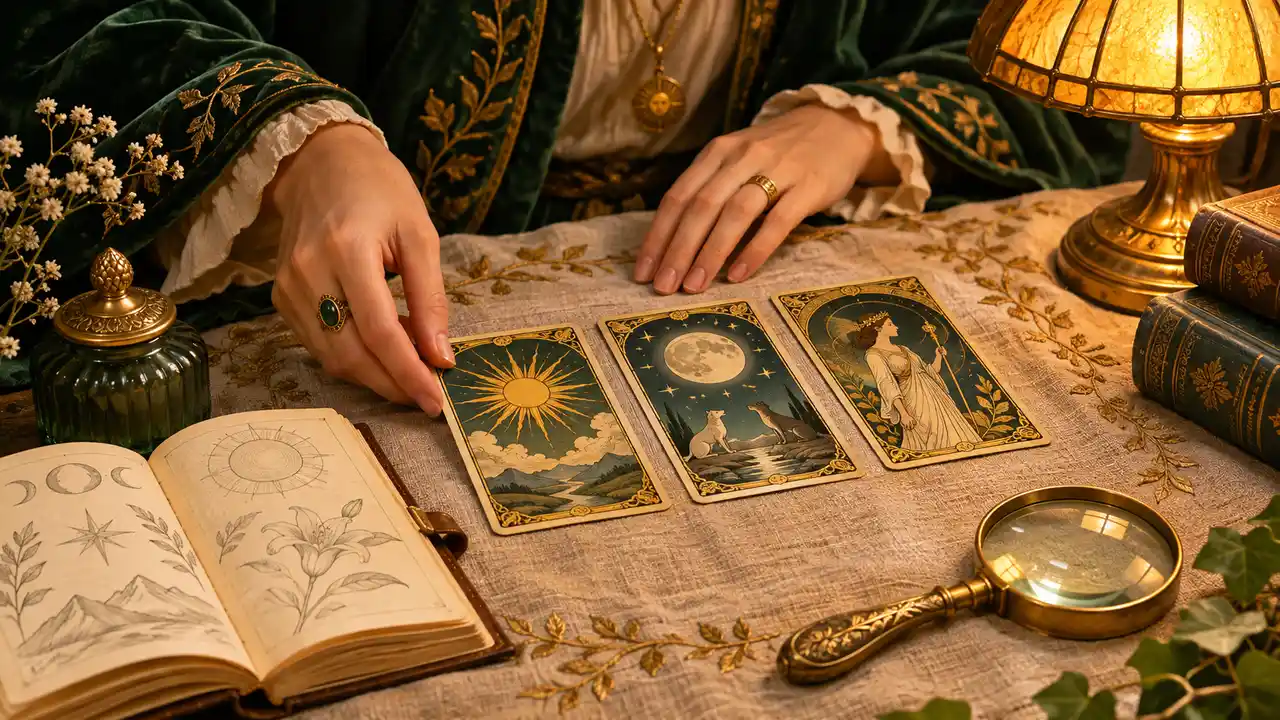
Many people who start learning tarot get stuck in the same place. They buy a deck and open the little guidebook. Inside are 78 cards, each with upright and reversed meanings and several sets of keywords. After two weeks of memorizing, they draw a card and still go blank. The good news is that reading tarot cards does not have to start with memorizing. Every card is a picture. What the figures are doing, which way they face and whether the sky behind them is bright or stormy are all clues. Then look at where the card lands in the spread and how it interacts with the cards around it. That gives you enough to offer a reasonable reading that speaks directly to your question. For beginners, this shift from recalling definitions to observing and reasoning is usually what turns a blank stare into a first real interpretation.
The method comes down to three steps: read the image, read the position, then link the cards into a story. Reading the image lets you catch a card's mood without rote memory. Reading the position gives the same card a different emphasis in different questions. Linking the cards into a story turns scattered meanings into one sentence that answers what you asked. The walkthrough below uses the Six of Cups and the Seven of Swords to show how to read a picture. It then uses three spread positions to show how a meaning shifts, and puts a real three-card draw together from start to finish. It closes with the three mistakes beginners make most often, so you know what to watch for when you practice. You don't need any special talent for this. You only need to look closely and say what you see before you reach for the book.
Why You Don't Need to Memorize Card Meanings First
Memorizing card meanings isn't useless. The problem is the order. Beginners often treat the guidebook like a dictionary. They draw a card, look it up and find three words such as “nostalgia, childhood, innocence.” Then they have no idea how those words relate to the work question they just asked. Keywords are a compressed summary of what someone else concluded after studying the image and building up experience. If you take the conclusion without working through the reasoning, it's hard to connect it to your own situation.
Flip the order and start with the image instead. You will notice for yourself that “someone in this card is handing something to another person” or “this figure is sneaking away.” Those observations come from you, and they map straight onto your question. Later, when you open a complete guide to tarot card meanings, you will find that the book's explanation matches what you already saw. The meaning sticks because you know where it came from. Next time a new question comes up, you can reason your way to a fitting interpretation instead of hunting for a stock phrase.
If you are curious how intuition and established meanings work together, read does tarot reading rely on intuition alongside this guide. If you are still unsure how many cards a deck has or how the Major and Minor Arcana are divided, start with learning tarot from zero. Build that foundation first, then come back and practice the three steps here. The basics make every later step easier to follow.
Step One: What Is the Image Telling You?
When you read the image, don't rush to a conclusion. First describe the card the way you would describe a photograph, naming what you can actually see one item at a time. Four angles help you work through it in order: figures, action, color and symbols.
Figures: how many people are in the picture? Are they adults or children? Are they alone or interacting? A lone person at the edge of a cliff sends a very different signal from a group gathered to celebrate. Action: what are the figures doing? Are they walking forward, turning away, looking down in thought or reaching out to give something? Action usually shows which way a situation is moving. Color: is the background a bright yellow sky or a heavy layer of gray cloud? Are the clothes warm reds and oranges or cool tones? Color often reflects the emotional temperature of the card. Symbols: are there flowers, castles, boats, a moon or something broken? These objects often add another layer of meaning.
Once you have described the scene, ask yourself one more question: “If this were a frame from a movie, what happened a second ago, and what might happen a second later?” That question sets a still picture in motion, and you start to sense what is happening in the card rather than only its parts.
A simple daily drill works well here. Draw one card a day and do only this step. Describe the picture in three to five sentences without opening the book. After a few weeks your descriptions will get sharper, and you'll start spotting details you used to skip.
Image Example One: The Six of Cups
The Six of Cups is the sixth card of the Cups suit and belongs to the Minor Arcana. Here is what most common versions show, using the four angles. Figures: two children, one taller and one shorter. Action: the taller child is handing the shorter one a cup filled with flowers. Color: the palette is warm overall, with a yellow sky and soft tones. Symbols: white flowers in bloom, buildings that look like an old village or courtyard, and six cups holding flowers.
From the picture alone you can probably feel that this is a warm, safe, low-pressure scene. One child gives and the other receives, and the backdrop looks like a familiar place from childhood memory. Now ask the movie question. A second ago, the two children might have been playing in the yard. A second later, they might carry the flowers home together. There is no conflict anywhere in the card, only simple goodwill.
Now compare your notes with common interpretations. The Six of Cups is generally interpreted as nostalgia, childhood memories, innocent feelings, old friends or a return to a familiar place. It can also suggest giving without expecting anything back. Every one of those keywords can be traced back to something in the picture, so there is nothing you need to cram.
The image also hints at a downside. Getting lost in a lovely past can make it harder to deal with the present. That shadow side becomes important when the card lands in a difficult position, which is exactly what step two covers.
Image Example Two: The Seven of Swords
The Seven of Swords is the seventh card of the Swords suit. It is also part of the Minor Arcana, and its mood is almost the opposite of the Six of Cups. Common versions show only one figure, with several tents in the background that suggest a camp. Action: the figure is carrying five swords and tiptoeing away while glancing back over one shoulder. Color: the background is mostly yellow, but the figure looks sneaky. Symbols: the detail that matters most is the two swords left behind, still stuck in the ground.
Put the scene into words. Someone waits until no one in the camp is paying attention, quietly takes most of the swords and keeps looking back to check whether anyone has noticed. A second ago, they may have been waiting for the right moment. A second later, they might get away, or someone might call out to them. The two swords left behind raise a question of their own: why not take them all? Were they too heavy to carry, or left there on purpose?
From these observations, the Seven of Swords is generally interpreted as being about strategy, concealment, avoiding direct confrontation and acting alone. It can also point to a lack of honesty from yourself or from others. The backward glance is the key detail. It reveals guilt or unease, which suggests the action is not entirely honest.
Still, the Seven of Swords is not automatically bad news. It can also mean finding a clever way around an obstacle, or seeing that not every battle has to be fought head-on. Which side applies depends on the question and on where the card falls.
Step Two: How Position Changes the Focus
Every position in a spread is really a small question. The “present” position asks what the situation looks like right now. The “obstacle” position asks what is holding you back. The “advice” position asks what you can do about it. If you put the same card in different positions, the same picture answers different questions, so the focus of the answer shifts.
Beginners often wonder why a “good” card showed up in the obstacle position. In fact, no card is simply good or bad. The position tells you which angle to read it from. A card about passion in the obstacle position might mean there is too much enthusiasm, or that you are rushing. A card that looks heavy in the advice position might be reminding you to stop and face something you have been avoiding. For more on cards that look negative, see how to read negative tarot cards.
In practice, write down what each position means before you draw. After drawing, read each position's question aloud before you answer it with the card. For example: “What is the present situation? The Six of Cups: I really miss how things used to be.” This question-and-answer habit stops you from reading every card the same generic way, and it makes each card answer the question its position asks. Over time it also helps you notice when a card fits a position awkwardly. That awkward fit is often where the most useful insight lies.
One Card in Three Positions
Suppose the question is “How should I handle a collaboration problem with a coworker?” Let's put the Seven of Swords in each of three positions and see what changes.
In the present position, the focus is on the figure sneaking away. This may describe a collaboration where someone isn't being fully open, or where you yourself are avoiding conflict and handling things privately. On the surface everything looks calm, but underneath everyone is doing their own thing. A useful question here: who is the one carrying the swords out of the camp right now?
In the obstacle position, the focus moves to the backward glance and the two swords left behind. The obstacle might be mutual distrust. It might also be a wish to carry everything yourself, only to find you can't hold it all. Here the Seven of Swords seems to say that what blocks you is not the task itself. It is the guardedness that keeps everyone from talking openly.
In the advice position, the focus becomes strategy and avoiding a head-on clash. The card may suggest that you don't need to fight it out in a meeting. Instead, find a private moment and a smarter way to communicate. It may also remind you to protect your own work first, then discuss how to divide the work. In this position the card is not telling you to deceive anyone. It's telling you to think it through instead of forcing your way.
All three positions use the same picture, but each picks out different details. The present reads the posture, the obstacle reads the guilt and the swords left behind, and the advice reads the strategy.
Step Three: Linking Three Cards Into One Sentence
After the first two steps, you will have three interpretations that each make sense on their own. If you read them out one after another, though, they often sound like this: “The first card says you are nostalgic, the second says someone is hiding something, the third says you should boldly move forward.” That sounds like three unrelated horoscopes. Step three ties them together into a story where one card leads to the next.
The simplest way to link the cards is with connecting words: “Because... so... but... so you could...” Between the present and the obstacle, the link is usually “because things are like this now, you are stuck here.” Between the obstacle and the advice, it is usually “to get past this, you could try this.”
Another technique is to look for shared elements. Are the figures in the three cards facing the same direction, or turned away from one another? Does the color move from dark to light, or from light to dark? Does a suit repeat? If all three cards are Swords, for instance, the matter is mostly mental, and thinking and communication are the focus. If the cards move from Cups to Wands, the story may be shifting from feeling to action. These patterns give you a thread to follow when the individual meanings seem to pull in different directions.
For more ways to combine three cards, how to interpret a three-card tarot spread collects common spreads and ways to link the cards. It works well as extra practice for this step.
Putting the Story Together: A Full Example
Suppose the question is “Should I consider changing jobs?” The three cards drawn are the Six of Cups in the present position, the Seven of Swords as the obstacle and the Three of Wands as the advice.
First, run steps one and two on each card. Present, Six of Cups: the picture is warm and nostalgic. In this position it suggests you feel attached to your current job or to a certain period of the past, which makes it hard to let go. Obstacle, Seven of Swords: here the emphasis is on sneaking and looking back. Perhaps you are quietly looking at other options but afraid to let anyone know, and that leaves you uneasy. Or perhaps you aren't being fully honest with yourself: you say you want a new job, but you haven't really thought it through. Advice, Three of Wands: common versions show a figure standing on high ground, back to the viewer, watching ships out at sea. The card is generally interpreted as being about vision, broadening your horizons and waiting for plans to pay off.
Now link them into one sentence: “You care about where you are now, which is why you haven't openly faced the urge to leave. The cards suggest looking further ahead and planning your next step properly, instead of quietly searching while still looking back.”
That sentence explains why you are stuck and where to go next, so it answers the question far better than three separate card meanings. It doesn't say you must change jobs or must stay. It describes how you are feeling right now and what you could change, and it leaves the decision with you.
Common Mistake One: Looking at Only One Card
The first common mistake is treating each card as a standalone answer. After drawing three cards, beginners often fixate on the most striking one. If you draw a card that looks grim, for example, it pulls all your attention. You end up ignoring the two cards next to it, which may well be offering a way out.
Take the Seven of Swords in the obstacle position. Suppose the advice card beside it is one associated with honesty and communication. Then the overall story becomes “talking it through can resolve this.” If the advice card is one associated with pausing and rest, the story becomes “don't rush to fix this; let emotions settle first.” The Seven of Swords hasn't changed at all, but the whole reading points somewhere completely different. Look at only one card and you miss that difference.
The fix is simple. Before you read anything, lay out all the cards and look at them together without interpreting any single one. Which card is brightest, and which is darkest? Do the figures' gazes meet? Are any suits or numbers repeated? Form an overall impression first, then move into the details of each card.
You can also make yourself end every reading by saying, in one sentence, what the whole spread is telling you. If you can explain one card but can't sum up the whole spread, you have slipped back into the single-card trap. Go back to step three and link the story again. With practice, this summary sentence becomes the most useful part of the reading.
Common Mistake Two: Forcing Keywords Onto the Question
The second mistake is using keywords as formulas. You draw the Six of Cups and say “nostalgia,” or draw the Seven of Swords and say “deception,” whatever the question is. The trouble is that keywords are abstract. Forced onto a concrete question, they often make no sense, and the person hearing the reading has no idea what to do with it.
Say the question is “Have I prepared enough for this exam?” and the Seven of Swords appears. Forcing the word “deception” onto it sounds odd. Is it saying you will cheat? Go back to the image instead. You see someone quietly carrying swords away, with two swords left behind. That can be read as: “You may have studied only part of the material, hoping a shortcut will get you through, and you've missed some key topics.” That reading is much more specific, and it points straight to an action: go back and pick up those two swords.
To break the keyword habit, practice translating keywords. After drawing a card, write down the keyword from the book. Then ask yourself: “For my question, what specific thing does this word point to?” Translate an abstract “nostalgia” into “you are still comparing your current job with the one you had three years ago.” Translate “strategy” into “you could talk to your manager privately first instead of raising it in a meeting.” The more concrete the translation, the more useful the reading. It also becomes easier to check later whether the reading actually helped.
Common Mistake Three: Asking a Question That Is Too Vague
The third mistake happens before you draw a single card: the question is too big or too fuzzy. Questions like “What will my future be like?” or “How is my love life?” are so broad that any card could mean anything. Beginners get lost even faster, and the reading ends up as vague statements that could apply to anyone.
Good questions usually have three things in common: a specific subject, a time frame and a focus on what you can do. Compare these two. “How is my love life?” is far too broad. “Over the next three months, what can I do to help things grow with the person I'm getting close to?” is much clearer. The spread positions also fit more easily: the present is where things stand between you now, the obstacle is what is holding things back, and the advice is a step you can take.
Also try to avoid questions that can only be answered yes or no, such as “Will they come back?” Questions like that focus on someone else. Tarot tends to help most when it helps you see your own situation and choices more clearly. Rephrase it as “What do I most need to see clearly about this relationship right now?” The reading then has a clearer direction and is less likely to feed anxiety.
Asking a good question takes practice too. Before you draw, spend two minutes writing your question down, then cross out any vague words. If it still feels hazy, narrow the time frame or the subject until it's clear.
References
Once you know the three steps, the best practice is a draw of your own. Bring one specific question, then read the images, read the positions and link the cards into a story.
Try the three steps with your own draw