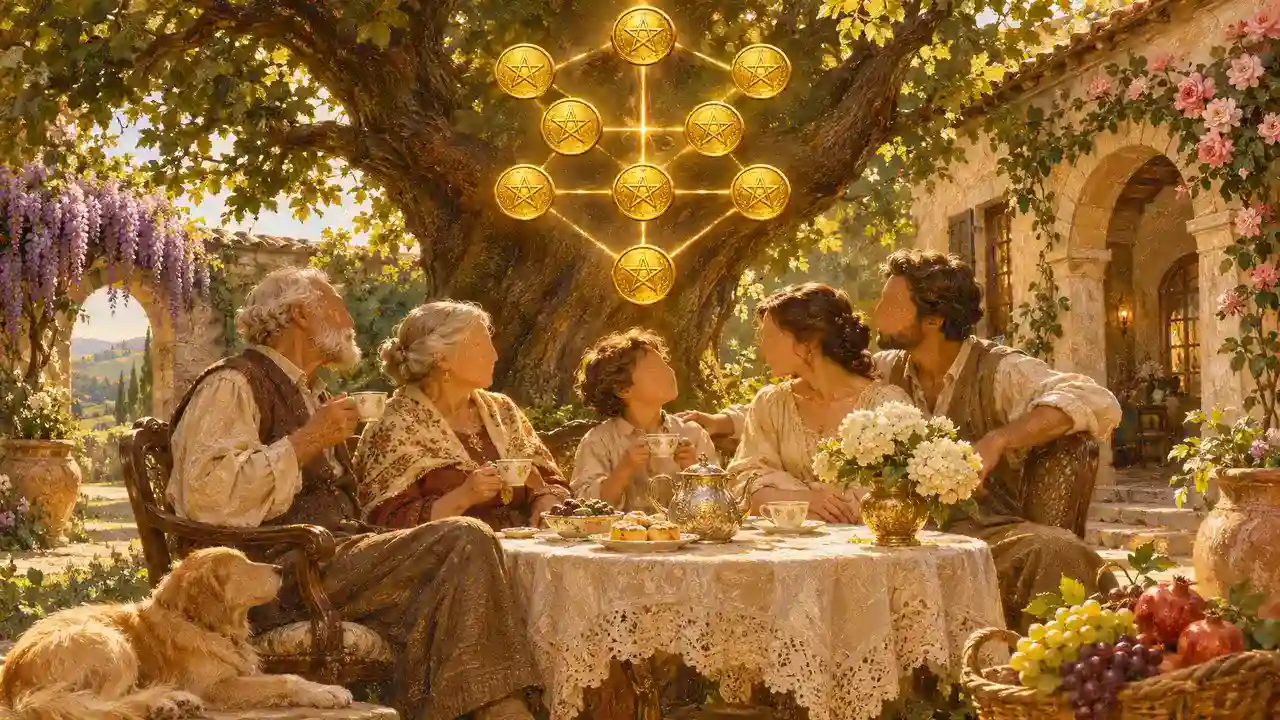
What does the Ten of Pentacles mean? It is generally interpreted as the most complete card in the Pentacles suit, symbolizing family harmony, long-term wealth and the legacy passed between generations. This kind of fulfillment has nothing to do with getting rich overnight, though. It describes the stability a family slowly builds over many years: a house lived in for decades, a daily rhythm everyone knows by heart, and a foundation that can be handed to the next generation. Drawing the Ten of Pentacles is usually a nudge to look further ahead, to ask what your present efforts will eventually turn into, and who else will benefit from them alongside you. The card speaks in years and generations rather than weeks, so it rewards patience more than urgency. It also tends to show money as something shared within a household rather than a private score. Upright or reversed, its core theme stays the same: what lasts.
Because it is about the long term, the most useful question to bring to the Ten of Pentacles is often not “Will I have money?” but “What do I want to leave for the people around me?” Legacy here is not only financial; it also includes values, habits and relationships. The security of the upright card is precious, but it can gradually harden into complacency and a fear of change. The family friction of the reversed card is uncomfortable, yet it can also be a chance to finally talk things through. The sections below cover the card's imagery and its upright and reversed meanings, then what it suggests for love, work and money, and how to break a distant goal into concrete steps you can start today. Throughout, the focus is on reflection rather than prediction. The card works as a mirror for your choices, not a verdict on your future, and it is most helpful when you pair it with honest questions about your own situation.
The Pentacles Suit Reaches Ten
Among the four suits of the tarot's Minor Arcana, Pentacles correspond to the element of earth. They deal with the tangible side of life: the body, money, work and the place you call home. If you are still getting to know how the four suits divide their roles, read the complete guide to the four tarot suits first and then come back to the Ten of Pentacles; its focus will be much easier to see.
The numbered cards run from Ace to Ten, and a common reading treats the Ace as a seed and the Ten as the completion of a cycle. The Pentacles story begins with a single coin held in an open hand. Along the way it moves through learning a craft, gathering resources, holding on tightly, learning to give and receive, and waiting patiently for a harvest. By the Nine of Pentacles, one person has earned comfort and independence through their own effort. The Ten takes one more step: abundance no longer belongs to a single person but spreads across a whole household and a whole family line.
That is the biggest difference between the Nine and the Ten. The garden of the Nine is beautiful, yet usually only one figure stands in it. The Ten is full of people. Its question is not “Am I doing well?” but “Can all of us live steadily together?”
Ten is also both an ending and the start of the next round. After the Ten, the suit hands its story to the court cards, which suggests that fulfillment is never a finish line. It is a platform others can keep building on. When you read this card, keep the idea of a very long stretch of time in mind, and many of its details fall into place.
The Imagery: Three Generations and a Family Home
In many common versions of the Ten of Pentacles, an elderly man sits at one side of the scene, wrapped in a richly patterned robe, with two dogs leaning against him. In the middle stand an adult couple, and a child stays close beside them. Behind them rises an archway, and beyond it lies a town or an estate. Grandparents, parents and a child all appear at once, and that is the heart of the card: three generations under one roof, with life and wealth flowing between family members.
Look closely and you may notice that the figures are not all looking at each other. It is a telling detail. Living in the same house does not mean everyone is on the same wavelength. The fulfillment of the Ten is structural stability, and the warmth inside the relationships still has to be looked after by each person.
The archway is another key symbol. It separates the household from the wider world and also connects the two. Inside is the security a family has built up over time; outside is society at large. The child stands near the gate, as if hinting that the next generation will eventually walk through it, carrying what home has given them into a life of their own.
The two dogs are generally interpreted as symbols of loyalty and protection, and of the unspoken understanding that holds a family together. Read as a whole, the card looks like a family portrait: everyone in their place, with coins scattered around each of them. It is a reminder that wealth never exists on its own. It is always tied to people and relationships.
Ten Coins Arranged as the Tree of Life
What makes the Ten of Pentacles distinctive is the way its ten coins are laid out. Many versions arrange them in a fixed pattern that mirrors the Tree of Life from the Kabbalistic tradition. It starts from a single point at the top, branches out symmetrically to the left and right, and settles into one final point at the bottom.
The Tree of Life describes a movement from the abstract to the concrete, from spirit into matter. The top stands for the first spark of intention, and the bottom for reality taking solid form. The Ten of Pentacles is the last card of its suit, which places it at the very base of that tree. A common reading is that this card shows ideals finally landing in everyday life: beliefs become habits, habits become a family culture, and that culture becomes something you can see, such as a home, savings and a certain quality of life.
The pattern is also a reminder that wealth has structure. The ten coins are not piled carelessly in a corner. They sit above and below, left and right, linked to one another. A household's long-term stability works the same way. Income, spending, saving, caring for elders, raising children and keeping relationships healthy all pull on each other. Take away any one coin and the whole tree loses its balance.
One more detail deserves attention: the coins float among the figures and even over them, like a layer laid on top of the scene. You can think of them as the invisible things that run through a family. They never appear in a ledger, yet they outlast any figure written there and shape the next generation far more deeply.
Upright: Family Harmony and Long-Term Wealth
The upright Ten of Pentacles is generally read in terms of family harmony, long-term wealth, legacy and a solid foundation. It often shows up after you have been quietly building something for a while, as if to say that what you have gathered carries real weight and can become something you and the people around you lean on together.
In family matters, the upright card is often seen as a sign of stable, supportive relationships at home. That does not mean a flawless family. It means a family where, when something happens, people are willing to sit down and face it together. It can also point to good news connected with family, such as moving into a new home, a family gathering, elders in steady health, or a long-running household issue finally being settled.
In money matters, the Ten is about the long term. It does not encourage chasing quick wealth. Instead it affirms the kind of growth that looks unremarkable from day to day: money set aside regularly, credit built slowly, relationships and expertise developed over years. In the short run these things barely seem to make a difference. Over a long enough time, they become a foundation no one can take from you.
When it comes to legacy, the upright card invites you to notice what you received from the generation before you. It may be a practical resource, or it may be a habit of hard work or a sense of how to treat people well. For the core meanings across different kinds of questions, see the full Ten of Pentacles card meaning. The point here is that the upright card helps you see you are part of a story larger and longer than your own.
In Love: A Sign of Building a Family
When the upright Ten of Pentacles appears in a love reading, it is commonly taken to mean the relationship is moving in a more lasting, concrete direction. It speaks less about butterflies and romance and more about commitment and daily life: whether two people plan to build a life together, and whether each is willing to bring the other into their family.
If you have been together for a while, the Ten may echo steps like meeting the parents, talking about marriage, looking at homes together, or starting to treat each other's relatives as your own. It can also remind you that once a relationship reaches this stage, it is no longer only about the two of you. Each family's habits and expectations come along too. At that point you need more than affection; you also need patience for communication and compromise.
If you are single, the Ten does not necessarily mean a particular person is about to appear. It is more likely asking you what your ideal home looks like and what kind of person you want to build a lasting life with. This card is well suited to clarifying your own values, for example whether you care most about financial security, a similar family background, or simply having daily habits that fit well together.
Of course, the upright Ten does not mean everything will follow a script. It describes a possible direction and the conditions that direction needs. If you want to ask your love question more clearly, try a love tarot reading. Bring the current state of things between you and the other person, and see what each of you may still be holding back about the idea of building a family.
Work and Money: Building Slowly
In questions about work and money, the upright Ten of Pentacles is often interpreted as steady accumulation and sound, gradual growth. It rarely signals a chance to double your money overnight. Instead it supports choices whose results only show over time: deepening your skills in one field, earning trust within an organization, and making your income more stable step by step.
If you are deciding whether to stay in a job or leave, the Ten may be asking you to look clearly at the long-term value of your current position. Does this role offer a stable path to grow? Is it helping you build skills you can take anywhere? Can it support the life you want? The card is also often linked to family businesses, working alongside relatives, or career choices made to care for family, which is a reminder to include your family's needs in the decision.
With money, the Ten's emphasis is on structure rather than numbers. It encourages you to think about how income and spending relate, whether you have an emergency cushion, what your plans for the future are, and how responsibilities are shared within the family. These are prompts about direction. Specific financial and investment decisions should still be based on your actual circumstances, with a qualified professional consulted where needed. A card draw is not a basis for buying or selling anything.
If you want your career questions to have more direction, read how to ask tarot about your career. Rather than asking “Will I get promoted?”, try “What will the work I am doing now add up to in five years?” A question like that is closer to the spirit of the Ten and more likely to give you clues you can act on.
The Other Side of Upright: When Comfort Becomes Complacency
The upright Ten of Pentacles looks like a deeply reassuring card, but reassurance has two sides. When a home, a job or a way of living has been stable for a long time, it becomes easy to fear change and to feel that keeping things exactly as they are is enough. At that point, the security of the upright card can quietly turn into complacency, or even into a frame that keeps you from moving at all.
You might, for instance, follow a way of life simply because your family has always lived that way, without ever asking whether you actually like it. You might keep postponing something you have wanted to try because your job is stable enough. On the surface everything is harmonious, yet underneath some voices are being held down.
Go back to the image: the archway is always there. The household offers safety, but there is still a world beyond the gate. The upright Ten is not asking you to cling to everything you have. It is telling you that you have a solid base behind you, which means you can try new things with more confidence. Truly healthy stability should make people braver, not more timid.
So when you draw the card upright, ask yourself one more question: is this stability something I chose, or am I simply afraid to leave? If it is the first, cherish it. If you suspect it is the second, perhaps you can leave yourself a little room to experiment without damaging the foundation. The upright Ten's message has never been “don't change anything.” It is closer to “from a firm place, you can travel further.”
Reversed: Friction Over Family and Money
The reversed Ten of Pentacles is commonly read in terms of family money conflicts, the pressure of inheritance, and trading long-term security for short-term gain. The most important point comes first: reversed does not mean bankruptcy, and it does not mean a family is falling apart. It is more like a prompt to check what price has been paid for that word “stability.”
Friction over family finances is the most common face of the reversed card. Family members may see money differently, with one wanting to save and another wanting to spend. The division of who covers household costs or who looks after aging parents may feel unfair. Or loans and shared property may never have been talked through clearly, so that over time they turn into quiet resentment. None of these issues has to be large, but left alone for years they slowly wear away trust.
The pressure of legacy is another side. When the older generation places heavy expectations on you, such as taking over the family business, holding on to the house or protecting the family's reputation, what was meant as a gift can become a burden. The reversed card lets you feel that weight and asks which parts you genuinely want to carry forward, and which you are accepting only because saying no feels awkward.
Short-term gain here means giving up part of the long-term foundation for something immediate, such as overspending to keep up appearances, or damaging a long partnership for a quick profit. For practical matters like dividing assets or handling an inheritance, which involve law and tax, please consult a lawyer, accountant or other qualified professional. What tarot can do is help you see your own emotions and blind spots in these situations.
The Other Side of Reversed: Saying What Needs to Be Said
The reversed card is uncomfortable, but discomfort is not always a bad thing. Many family problems drag on for years because everyone is keeping the surface peaceful and nobody wants to be the one who breaks the mood. When the reversed Ten of Pentacles appears, it often means that whatever has been held down can no longer stay hidden, and that can be a chance to finally talk things through.
For example, you may have been quietly covering most of the household expenses for a long time without ever saying so. Or you may see the path your family expects of you differently, but never have known how to raise it. The conflict in the reversed card is sometimes exactly what brings these things into the open.
This lesson sits close to the one in the Four of Pentacles reversed: holding on and letting go. The Four is about how one person deals with what they grip too tightly. The reversed Ten scales that lesson up to an entire household. Is the whole family clinging to some idea of how things “should” be? Are there old rules or old divisions of labor that no longer fit the people you are today?
Talking things through takes some skill. Start with facts rather than blame. Share your own feelings and needs before judging anyone else. Begin with one small, concrete issue and work up to the larger ones gradually. The reversed Ten is not telling you your family is broken. It is telling you the household needs some reorganizing, so that its stability rests on a more honest foundation.
The Real Question: What Do You Want to Leave Behind?
Many people who draw the Ten of Pentacles first wonder, “Does this mean I'll be rich?” It is a natural question, but the card is really asking something else: what do you want to leave for the people around you? That question shifts the focus from getting to giving and from “me” to “us,” and it stretches the timeline from today to many years from now.
What you leave can certainly include money and resources, but the Ten reminds us that legacy reaches much further. Beliefs are a kind of inheritance: how you view work, how you treat failure, how you handle money anxiety. Habits are an inheritance too, like tracking your spending, being on time, eating at regular hours, or chatting with family before bed. Relationships may be the deepest inheritance of all. The people around you see how you treat a partner, elders and friends, and they learn from it without even noticing.
Seen this way, the Ten of Pentacles is not just a card about wealthy families. Even if money is tight right now, you are passing something on every single day. A household that keeps caring for one another through lean times may be leaving the next generation something more valuable than any savings account.
So when you meet the Ten, try making three lists. The first is what you received from the generation before you and want to keep. The second is what you received but want to change in your own generation. The third is what you hope your family or the people close to you will remember about you someday. Those three lists will tell you far more clearly than “Will I be rich?” where to put your effort next.
Turning Long-Term Goals Into Today's Steps
The Ten of Pentacles speaks in long stretches of time, but even the longest stretch is made of single days. If you stay at the level of “I want to give my family a secure future,” the goal can feel so distant that nothing actually happens. A more practical approach is to break the long-term goal into things you can do now.
Step one is to make a vague wish more specific. What does a “secure future” mean for you? A settled place to live, not having to panic when someone in the family gets sick, children free to choose their own path? The more concrete it is, the easier it becomes to find the next step.
Step two is to pick one small thing you can start this month. If financial stability matters most, begin by going through the household's income and spending once. If relationships matter most, set a regular time to share a meal or call your family. If passing on values matters most, think of the one thing you most want to teach the next generation, then show it in how you live each day.
Step three is to look back regularly. The Tree of Life in this card reminds us that every part affects the others, so check from time to time whether your arrangements still feel balanced. A tarot draw can be one tool for that check. For example, try a three-card reading with positions for “my current foundation,” “what needs adjusting” and “a next step I can take.” When you want to revisit the details, you can also return to the Ten of Pentacles card meaning. Lasting fulfillment is built from small things done consistently, even when they seem minor.
References
Bring your real questions about family, love or long-term finances to the cards, and see what the Ten of Pentacles may be pointing out in your situation.
Read the full Ten of Pentacles meaning