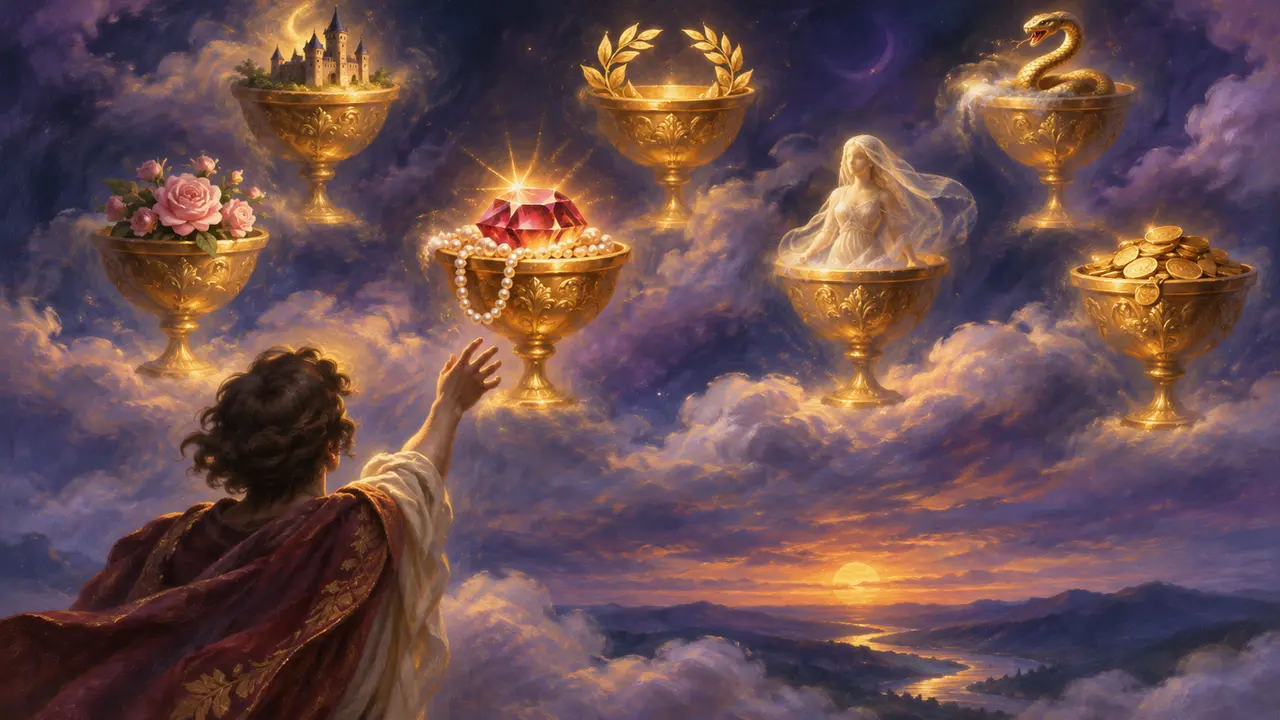
What does the Seven of Cups mean? The Seven of Cups is generally interpreted as a card about having too many choices, each one beautiful, and no clear way to tell which one is real. Many people draw it not because life has run out of options, but because there are too many. Every job posting has something tempting about it, several people in your love life make your heart race, and even planning a weekend turns into a long debate. The problem is rarely that the options are bad. It is that each one still lives only in your imagination and has never been tested against real life, so you hesitate to reach for any of them, afraid that choosing one means losing all the others. That hesitation can feel like being stuck, yet the card usually points somewhere more hopeful: you are seeing possibilities, and what you need now is a calm way to sort through them.
The Seven of Cups is a numbered card in the Cups suit of the Minor Arcana. Cups are linked to the element of water and speak of emotion, longing and imagination, while the number seven is often seen as a stage of pausing to examine things and facing the fog within. Taken together, the card seems to ask a simple question: are you looking at genuine options, or at what you wish they were? It is not scolding you for daydreaming, and it is not a warning that something bad is about to happen. It is a gentle reminder that dreams need ground beneath them and that choosing always involves letting something go. The guide below moves from the imagery on the card to the upright and reversed meanings, then to practical ways of narrowing your options and a three-card layout for seeing the choice in front of you more clearly.
How to Read the Imagery on the Seven of Cups
The most familiar version of the Seven of Cups shows a figure standing with their back to the viewer, facing a bank of cloud. Seven cups float on that cloud, and each one holds something different: a face, a castle, jewels, a laurel wreath, a snake, a dragon, and a shrouded figure that seems to glow from beneath its cover. Everything shimmers, yet all of it hovers in the air. Nothing rests on the ground, and nothing is within easy reach.
The cloud is the most important clue on this card. Clouds stand for imagination, wishes and ideas that have not yet taken shape. They are lovely to look at and almost impossible to hold. The contents of the cups carry their own symbolism too. The castle suggests security and achievement, the jewels suggest wealth, the laurel wreath suggests recognition, while the snake and the dragon carry a note of temptation or fear. The covered figure is often read as a longing you cannot yet see clearly, even in yourself. In other words, the seven options mix things you want with things you dread, and at first glance they are hard to tell apart.
Now look at the person in front of the cloud. They are only looking. They have not reached out. A common reading is that this posture captures the heart of the card: the choice is still at the watching stage, none of the possibilities has been tested, so every one of them looks perfect and every one feels too precious to give up. For the symbolism of each cup in more depth, see the full Seven of Cups meaning.
Seven of Cups Upright: Too Many Options and Bright Fantasies
When the Seven of Cups appears upright, it is generally interpreted as a card of option overload, a moment when fantasy outweighs reality. You may be holding several paths at once. Each has an appealing reason behind it and each carries a doubt you have not quite put into words, so you compare them in your head day after day without taking a first step down any of them.
The most typical pattern looks like this: lots of plans, very little action. You spend hours imagining how life would look if you picked this one, and the more detail you add, the harder it becomes to let go of the others. Over time, deciding itself becomes exhausting, so you put it off, telling yourself to wait a little longer and that the answer will arrive on its own one day.
The upright Seven of Cups also often suggests that some options look flawless only because you are seeing them in the clouds. Their costs, trade-offs and the time they would demand have not been honestly counted yet. That does not make the option fake. It simply means it is still a wish rather than a plan.
So if you draw this card upright, there is no need to panic about daydreaming again. Treat it as a signal that now is a good time to write down the options in your head and bring them back to earth one at a time for inspection. Upright and reversed are not simply good and bad, and if you want to understand the logic behind them, read how to read upright and reversed cards.
Seven of Cups Upright in Love: Drawn to Too Many People
In love readings, the upright Seven of Cups tends to show up in two situations. The first is having feelings for several people at once. Each of them has something that draws you in: one is easy to talk to, one feels steady, one brings excitement. What you actually want is someone who combines all of those qualities, but such a person rarely exists, so you drift between a few undefined connections, unwilling to let any of them go and not truly getting close to any of them.
The second is idealizing the other person. What you love may not be entirely the person in front of you, but the picture of them you have already painted in your mind. When they are slow to reply, you make excuses for them. When they say one tender thing, you imagine a whole future. This kind of projection is natural in the early days of attraction, but if it stays in the imagination for too long, it becomes hard to see what being together is really like, and easy to feel suddenly let down when reality does not match.
Here the card is not asking you to dismiss your feelings. It invites a question: do I love this person, or the life this person lets me imagine? If the romantic Knight of Cups appears in the same reading, the Knight of Cups love meaning explores the difference between romance and idealization.
When you are willing to invite someone down from the clouds and get to know them through time spent together rather than through fantasy, the relationship often becomes steadier and has a better chance of lasting.
Seven of Cups Upright in Career: Wanting a Change but Afraid to Choose Wrong
Work and career are areas where the Seven of Cups appears often. You may be tired of your current job while several other paths keep floating through your mind: switching to work you love, going back to study, freelancing, joining a different company, or even taking a break for a while. Each direction is attractive, yet the moment you think about choosing the wrong one, you pull back.
In a career reading, the upright Seven of Cups is generally interpreted as a reminder that your hesitation may not come from a lack of ability, but from a lack of information. Many options feel frightening because they are still vague. You do not know what the work actually involves, how long it would take to get good at it, or whether your income would change. In that fog, the mind tends to magnify only the upsides or only the risks, and neither is the whole truth.
A more practical approach is to test each option in a small way. If you are thinking of changing fields, talk to someone already working in that field. If you are considering more study, take a short course first. If freelancing appeals to you, try one small project. None of these steps requires quitting tomorrow, yet each one lifts a cup down from the cloud so you can see what is really inside.
The card is not asking you to decide right now. It is pointing out that options you never touch stay imaginary forever. Once you start gathering real information, fear usually shrinks and a direction slowly begins to emerge.
The Upside of Fantasy in the Upright Seven of Cups
Many people hear the word fantasy and assume it is negative, but the upright Seven of Cups is not only a warning. It brings a gift as well. Imagination is where seeing possibilities begins. If you never dared to picture a different life, you would not know that part of you longs for change. Without those seven cups in your mind, you might not even notice that you have other choices at all.
Seen this way, the upright card can also mean that your heart is opening. Where you once believed life could only go on as it was, you are now noticing other roads, and that in itself is a step forward. Many important decisions begin as nothing more than a hazy picture in the mind and only later, step by step, become real plans.
The key is telling fantasy apart from avoidance. Fantasy helps you see a direction. Avoidance lets you stay in your imagination so you never have to face real challenges. If you notice that you are always thinking and never moving, you may be closer to the second. If, after imagining, you are willing to look things up, ask questions and try something, then fantasy has become an excellent starting point.
So when you draw the Seven of Cups upright, you do not need to rush to blame yourself for being unrealistic. Let yourself dream properly, then gently ask: of all these dreams, which one am I willing to put real effort into? That answer is often your next step.
Seven of Cups Reversed: Starting to See Reality Clearly
When the Seven of Cups appears reversed, a common reading is that the fog is beginning to lift. Options that were once blurred together slowly show their real shapes. Some turn out to be less appealing than they seemed, some cost more than you imagined, and one, after a careful look, is still something you want. The meaning of the reversed card often lies in being willing to choose one: to set down the other possibilities and put your energy into a single path.
It is worth being clear, though, that reversed does not mean everything instantly becomes obvious. It is more of a turning point. You are starting to face reality and starting to accept that you cannot have it all. The process may still involve hesitation and second thoughts, but the direction has shifted from endless looking to actually walking, and that is an important change.
In love, the reversed Seven of Cups might mean you finally admit who you truly care about, or you see the other person as they really are and stop loving only an image. At work, it might mean you have gathered enough information to realize an option does not suit you, and you feel relieved rather than disappointed. It could also mean you have finally made up your mind and begun preparing for one path.
Disillusionment sounds like a bad thing, but very often it brings a sense of solid ground. You are no longer pulled in too many directions. Your feet are on the floor and you know what to do next, and that clarity is a strength of its own.
Clarity in the Reversed Seven of Cups Can Bring a Sense of Loss
Calling the reversed card a moment of clarity does not mean it is always easy. When you choose one path, you have to put the others down, and letting go almost always comes with some reluctance. The possibilities that once excited you kept you company while you imagined the future, even if you knew they were not realistic.
Sometimes seeing reality clearly also means discovering that an option you were really looking forward to is not as wonderful as you pictured. The dream job turns out to be very stressful once you learn more about it. The person you projected so many hopes onto turns out, after spending time together, not to be a good fit. That sense of loss is real. You do not have to pretend you do not care, and you do not have to hurry to convince yourself that it is all for the best.
The loss in the reversed Seven of Cups is generally interpreted as part of growing up rather than a punishment. It brings you back from the dream into your life. Allow yourself to feel sad for a while, then look at what is still in your hands. You may find that although you have fewer dreams, you now hold a choice you can actually keep.
If the Six of Cups appears in the same reading, it may also relate to looking back and missing earlier times, and the Six of Cups meaning explores that nostalgic mood. Upright or reversed, the Seven of Cups is not judging whether you are right or wrong. It keeps you company while you find a balance between imagination and reality.
Why More Choices Make Deciding Harder
Psychology has a widely discussed idea often called choice overload. The gist is that when there are too many options, people can find it harder to decide and are more likely to second-guess the decision afterwards. The reason is not complicated. The more options you have, the more angles you need to compare, so the mental load grows and it becomes tempting not to choose at all. Even once you do choose, you may keep wondering whether another option would have been better and feel less satisfied with what you picked.
The seven cups on this card look very much like that state. Every cup is glowing and every one feels like a waste to miss. It is not that you lack judgment. You are being held by too many possibilities at once, your attention is split in every direction, and in the end you go nowhere.
Understanding this can help you be kinder to yourself. Struggling to decide does not necessarily mean you are indecisive or lacking courage. It may simply mean that there really are too many options and the information really is too vague. What helps at that point is not forcing yourself to choose correctly right away, but first reducing the options to a number you can compare properly.
You can also practise shifting your goal from choosing the best option to choosing one that is good enough. Chasing the perfect answer tends to keep people comparing forever, while accepting a choice that is good enough, and that you are willing to commit to, lets life move forward. That shift from endless possibility back to concrete action is exactly what the Seven of Cups points toward.
Three Questions to Narrow Down Your Options
When you feel stuck in the Seven of Cups state, take out a pen and paper, write down every option you have, and ask three questions about each one.
First: which option would be worth trying even if it failed? This question helps you separate real desire from passing appeal. Some paths make you think it would be a terrible waste if things went wrong. Others make you think that even if it does not work out, you want to know you tried. The second kind usually holds something you genuinely care about, because its value lies not only in the outcome but in the process too.
Second: which option is the one other people expect of you? Honestly speaking, some options are on your list because your family hopes for them, your friends think they sound good, or society treats them as the sensible path. Those expectations are not necessarily wrong, but if an option mainly exists to satisfy someone else, it deserves a question mark. At the very least, you should know clearly who you are choosing for.
Third: which option do you truly want? It sounds like the simplest question, yet it is often the hardest to answer. Try imagining that nobody would ever judge your choice. Which way would you go? When you picture that direction, does your body relax or tense up?
After working through all three questions, a few options usually fall away on their own. The two or three that remain are the ones worth comparing seriously. With fewer options, the fog thins, and you may find that making a decision is not as frightening as it seemed.
A Three-Card Layout to See the Choice in Front of You
If you want to use tarot to sort through your thoughts, try this three-card layout designed for the kind of confusion the Seven of Cups brings. First, get clear in your mind about the decision you keep going back and forth on, and phrase the question as specifically as you can. Then draw the cards in order.
Position one: the option that attracts you most right now. This card shows which possibility is pulling at you most strongly and why it appeals to you. It may point to the feeling you actually long for, such as security, recognition or freedom.
Position two: the truth behind that option. This is the part the Seven of Cups cares about most, the moment of lifting the cup down from the cloud to look inside. This position may reveal a cost you had not noticed, expectations you have projected onto the option, or areas where you are not yet ready.
Position three: what you would face after choosing it. This position is not a prediction of the outcome. It is a reminder of what you would need to prepare for and which lessons might come up if you took this path. Once you know what lies ahead, the choice is no longer just a fantasy.
When interpreting, try to link the three cards into one story instead of reading them separately. For techniques on connecting cards, see how to read three tarot cards together. To understand how the suits shape the overall mood of a reading, for example how a reading heavy in Cups leans toward emotion, explore the four tarot suits guide.
References
Bring the choice you keep going back and forth on, draw a card, and see which possibilities are worth bringing down from the clouds and looking at in the light of real life.
Read the full Seven of Cups meaning