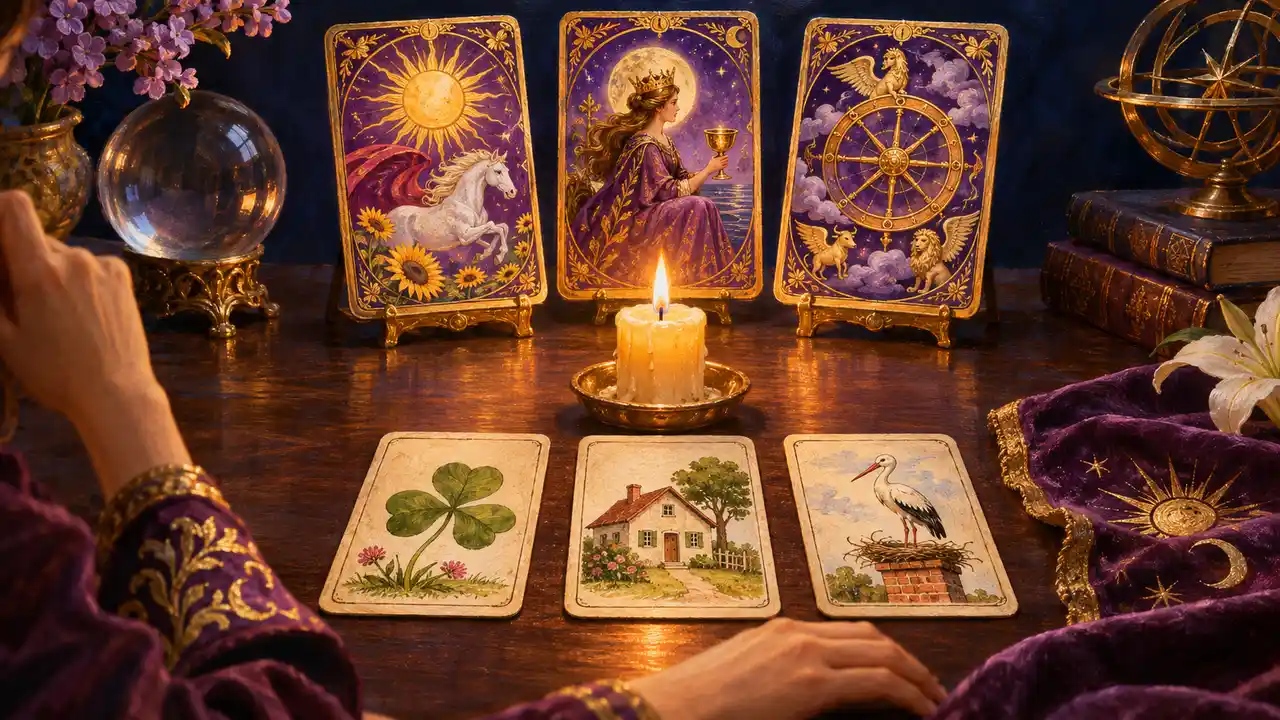
Lenormand vs tarot comes down to one difference you notice as soon as you lay out three cards: Lenormand builds a sentence, and tarot tells a story. In a Lenormand three-card reading, each card works like a plain word, such as Rider, Letter, House or Dog. Set three of them side by side and they combine into one concrete statement about where a situation is heading. In a three-card tarot reading, each card is a full picture loaded with symbolism. Placed in positions such as past, present and future, the images echo one another and add up to a narrative about your circumstances and your inner state. One gives you a description; the other gives you a scene. Neither is better. They answer in different languages, and most of the skill lies in knowing which language fits your question. If you have ever drawn three cards and felt the answer missed the point, the mismatch often lay between the question and the deck rather than in the cards. If this is your first time with Lenormand, start with the Lenormand reading introduction to learn how to ask questions and combine the cards.
That core difference leads to two more. First, each deck suits different questions. Lenormand is strong on concrete matters you can check against reality later: will I hear back, will this plan move forward, will the move go smoothly. Tarot is strong on states, relationships and inner lessons: why do I feel stuck, what is really going on between us, how should I face what comes next. Second, you focus on different things when you interpret. Lenormand reading centers on combinations and direction, meaning how one card modifies the next. Tarot reading centers on the depth of each card's meaning and the role of its position. Below, the same job-hunting question is read both ways so you can compare them side by side. After that come a simple way to choose, whether it makes sense to draw both, and the mix-ups beginners most often run into when they learn Lenormand and tarot at the same time.
Lenormand Builds a Sentence: Cards Link Into One Statement
The heart of a Lenormand three-card reading is treating the three cards as a single sentence. Each Lenormand card carries a fairly direct meaning. The Rider is commonly read as news or a visit, the Letter as written communication, the House as family or a stable space, and the Dog as a friend or someone dependable. On their own, these cards are just words in a vocabulary. Their real message only appears once they are lined up together.
There are two common ways to do this. One is to read straight from left to right, taking the first card as the subject, the second as the action or condition, and the third as the outcome. The other is to treat the middle card as the theme and let the cards on either side describe or modify it. Say you draw Ship, Key and Sun. A typical reading would be: a journey or change opens a crucial way forward, and the result is clear and successful. Whichever method you use, the spirit is the same. The cards have direction, the earlier card colors the later one, and if you swap the order, the meaning of the sentence shifts too.
That is why Lenormand readers rarely stop to meditate on the deep symbolism of a single card. The question they ask is simpler: put these three words together, and what is the most natural sentence they make? For more practice breaking down combinations, see how to read three Lenormand cards, which goes deeper into linking methods and common pairings.
Tarot Tells a Story: Symbols and Positions Build a Scene
Reading three tarot cards feels more like telling a story. Every tarot card is a complete image in its own right: the posture of the figure, the objects in their hands, the sky and landscape behind them all carry symbolism. A reader does not only note the card's name but also takes in the mood and energy of the picture, and from that draws out a sense of the person's state of mind or situation.
Position plays a major role in tarot. The most familiar three-card layout is past, present and future, but it can also be situation, obstacle and advice, or you, the other person and the relationship itself. The same card reads differently depending on where it lands. The Eight of Swords in the past position is generally interpreted as having once been trapped by your own thoughts. In the advice position, it may instead be a nudge to notice which limits are really self-imposed.
So a three-card tarot spread seldom collapses into a single sentence. Instead, three images each stand in their own place, respond to one another, and together form a narrative with highs and lows. The depth of each card's meaning, whether it appears upright or reversed, and the balance between Major and Minor Arcana all shape the tone of that story. A spread heavy with Major Arcana tends to feel like a turning point, while a mostly Minor Arcana draw often speaks to everyday circumstances. For a fuller look at position-based reading, see how to read a three-card tarot spread.
Lenormand Works Best for Concrete, Checkable Questions
Because the language of Lenormand sits close to everyday nouns and actions, it is best at answering concrete questions you can verify in real life. Will I get an interview call this week? Is the move likely to go smoothly in the near term? Is there a chance the money I lent will come back? Each of these has a clear person, event and scope, so the sentence a Lenormand combination forms can map directly onto an answer.
The more specific the question, the clearer the Lenormand response. If you only ask “What will happen with my job?”, three cards can point in several directions at once, which makes the reading hard to pin down. Rephrase it as “How will the transfer request I submitted this month progress?” and cards such as the Letter, Rider, Scythe or Anchor quickly line up with a notice, movement, a sharp decision or things staying put.
Another key habit is giving the question a time frame. Lenormand sentences usually describe the near-term direction of events. When your question includes a window such as the next two weeks or this month, you are less likely to blend distant possibilities into the reading, and it becomes much easier to look back afterward and compare the reading with what actually happened. That feedback loop is one of the fastest ways to build confidence with the deck. For help turning vague worries into questions Lenormand can actually answer, see how to ask Lenormand questions.
Tarot Works Best for States, Relationships and Inner Life
Tarot's strength lies in states of being, relationships and inner lessons. When the answer you want is not an event but an understanding, the symbolic depth of tarot comes into its own. Why am I losing motivation for this job? Where exactly are things stuck between us? What is the main lesson I need to face right now? Questions like these have no single correct answer. What helps is an image that lets you see yourself more clearly.
The Major Arcana are often seen as stages of life and psychological archetypes. The Hermit is commonly linked with looking inward, the Empress with nurturing and abundance, and Strength with gentle but steady perseverance. These archetypes are especially powerful when you are asking what is going on with me or what can I do, because they do not hand you an instruction. They offer a symbol you can return to, turn over and slowly digest.
This is also why asking tarot “Will he call me next week?” often brings up messages about expectation, anxiety or the momentum of the relationship rather than a clean yes or no. That does not mean tarot is dodging the question. It is simply better suited to why something is happening and how to face it than to whether something will happen on a particular day. Adjust the direction of the question to match what tarot does well, and the picture it offers becomes much clearer and more useful.
What to Focus On: Combinations Versus Card Depth
The differences in reading style and question type end up shaping what you pay attention to during interpretation. Lenormand puts the weight on combinations and direction. The same card takes on different meanings in different pairings. The Heart next to the Bouquet is often read as a happy expression of affection, while the Heart next to the Coffin may point to a relationship ending or cooling off. Left and right placement matters too. Some readers watch which way a person card is facing and treat that as where attention is going or the direction in which events are moving.
Tarot puts the weight on the depth of each card and the meaning of its position. When reading tarot, you consider a card's element, its number, the details of its imagery and whether it is upright or reversed, then fit all of that back into the position it occupies. The Three of Wands in the present position may suggest looking ahead and waiting for results. In the advice position, it may encourage you to widen your view instead of fixating on short-term progress.
Put simply, Lenormand skill runs horizontally: you train an ear for stringing cards together into fluent sentences. Tarot skill runs vertically: you train the ability to read each card deeply and layer its meanings. For a broader comparison of deck size, structure and everyday use, read the difference between Lenormand and tarot cards.
Example: Reading One Question With Lenormand
Take one question: what will happen next with the job I applied for last week? First, read it with three Lenormand cards. Suppose the draw is Rider, Letter and Clouds.
Using the sentence method, the Rider stands for news or someone reaching out, the Letter for a written notice, and the Clouds for uncertainty or open variables. Linked from left to right, this is generally read as: you will receive a written reply soon, but its content may not be fully clear yet, or there may be further steps still to be confirmed. If you use the middle-card-as-theme method instead, with the Letter at the center and the Rider and Clouds as modifiers, the meaning is much the same: a notice that arrives quickly but still carries some vagueness.
This answer is concrete. There is news, it comes in writing, and it is not entirely clear. The person asking can check it against the days ahead. Perhaps the email asks for additional documents, or a next-round interview is scheduled while the final outcome stays open. Here Lenormand delivers a sentence describing how things are likely to move, and once you have read it, the next practical step is obvious as well: keep an eye on your inbox and messages, and get any supporting materials ready in advance so the next stage does not catch you off guard. Notice how little of this reading depends on the emotional weight of any single card; the meaning lives in the combination.
Example: Reading the Same Question With Tarot
Now take the same question to tarot and read it across past, present and future. Suppose the draw is the Eight of Swords in the past, the Three of Wands in the present and the Star in the future.
The Eight of Swords in the past position is generally interpreted as being held back by your own doubts. Perhaps you hesitated for a long time before sending your application, worried you were not qualified enough. The Three of Wands in the present shows a figure standing on high ground, gazing into the distance. A common reading is that you have already sent your ships out and are waiting for word, while your horizon is also beginning to open up. The Star in the future position symbolizes renewed hope and a calm kind of confidence.
Strung together as a story, it reads roughly like this: you stepped out of a self-limiting mindset, found the courage to apply, are now in a phase of waiting and looking ahead, and will gradually rebuild faith in yourself. Notice that tarot barely touches on whether a notice will arrive. It speaks about the path this situation has traced inside you and the attitude you can carry forward. Both readings respond to the same question. One follows the direction of outer events; the other follows the inner journey. Put side by side, they show clearly why the choice of deck shapes the kind of answer you receive.
How to Choose: Look at the Question and the Answer You Want
After seeing both examples, choosing becomes fairly intuitive. Step one is to look at the nature of the question. If it involves a clear person, event and scope, and the answer can be verified in real life, such as will it happen, when, or how will it turn out, Lenormand is usually the better fit. If the question is about feelings, the state of a relationship, why you feel stuck or how to grow, tarot's symbolism will give you more material to reflect on.
Step two is to ask yourself what kind of answer you are hoping for. The same situation can often be approached from either side. If you want to know about concrete next steps in a relationship, such as whether the other person will reach out or whether you two will meet soon, Lenormand works well, and can Lenormand cards read love covers how to make love questions specific. If you want to understand why you keep feeling insecure in that relationship, tarot is the better match.
If you still cannot decide, try writing the question down and looking at the words you used. Is it full of nouns and events, or adjectives and feelings? The first leans toward Lenormand, the second toward tarot. This small habit does more than help you pick a deck. It also sharpens the question itself, which saves a lot of confusion once the cards are on the table and you start interpreting what they show.
Can You Draw Both Lenormand and Tarot?
Yes, and using both can sometimes give you a fuller view of a situation. The smoothest approach is to split the work. Use three Lenormand cards to see the concrete direction of events, then three tarot cards to look at your own mindset and the lesson in front of you. In the job example above, Lenormand says the news will come but will not be fully clear, while tarot suggests that this waiting period is part of rebuilding your confidence. The two complement each other rather than compete.
What to avoid is switching decks to ask the same question again just because you did not like the first result. That habit tends to leave you bouncing between different answers, comparing them over and over, growing more anxious with each draw and finding it harder to hear what the cards are actually saying. A better rule of thumb: one question, one deck. When you do use both, split the question into two angles, outer direction and inner state, and ask each deck its own part.
Also, there is no need to force the two readings into a single conclusion. A Lenormand sentence and a tarot story are information on different levels. Recording them separately and comparing them after some time has passed often shows more clearly which layer each one spoke to, and it steadily builds your feel for both card languages. Over a few months, those notes become a personal reference that grows with your practice.
Common Mix-Ups When Learning Both at Once
Beginners who study Lenormand and tarot side by side tend to stumble in three places. The first is cards with similar names. Lenormand has the Stars, Sun, Moon and Tower, and tarot has cards with the same or similar names, but their meanings do not line up exactly. The Lenormand Tower is often read as an institution, authority or a sense of distance, while the tarot Tower points to sudden collapse and awakening. The Lenormand Moon leans toward reputation, recognition and emotion, while the tarot Moon is more often read as confusion and unease. Mix the two sets of meanings together and your three cards end up making sense in neither system.
The second is blending reading styles. New readers often carry tarot's habit of deep reading into Lenormand, spending a long time analyzing each card's individual symbolism and forgetting to link the three into a sentence. In the other direction, reading tarot with the Lenormand sentence method can squeeze a rich image down into a short instruction and lose the layers that make tarot useful.
The third is reversals. Most Lenormand approaches do not use reversed cards; whether a card leans positive or negative depends on its combination and neighbors. Tarot, by contrast, often includes upright and reversed meanings in the interpretation. A practical suggestion is to get comfortable with one deck first, then learn the other, keeping separate notes as you practice. Once both languages feel steady, you can start combining them with confidence.
References
Turn the specific thing on your mind into one clear question, bring it to a Lenormand reading, and see what sentence your three cards form.
Try a Lenormand reading