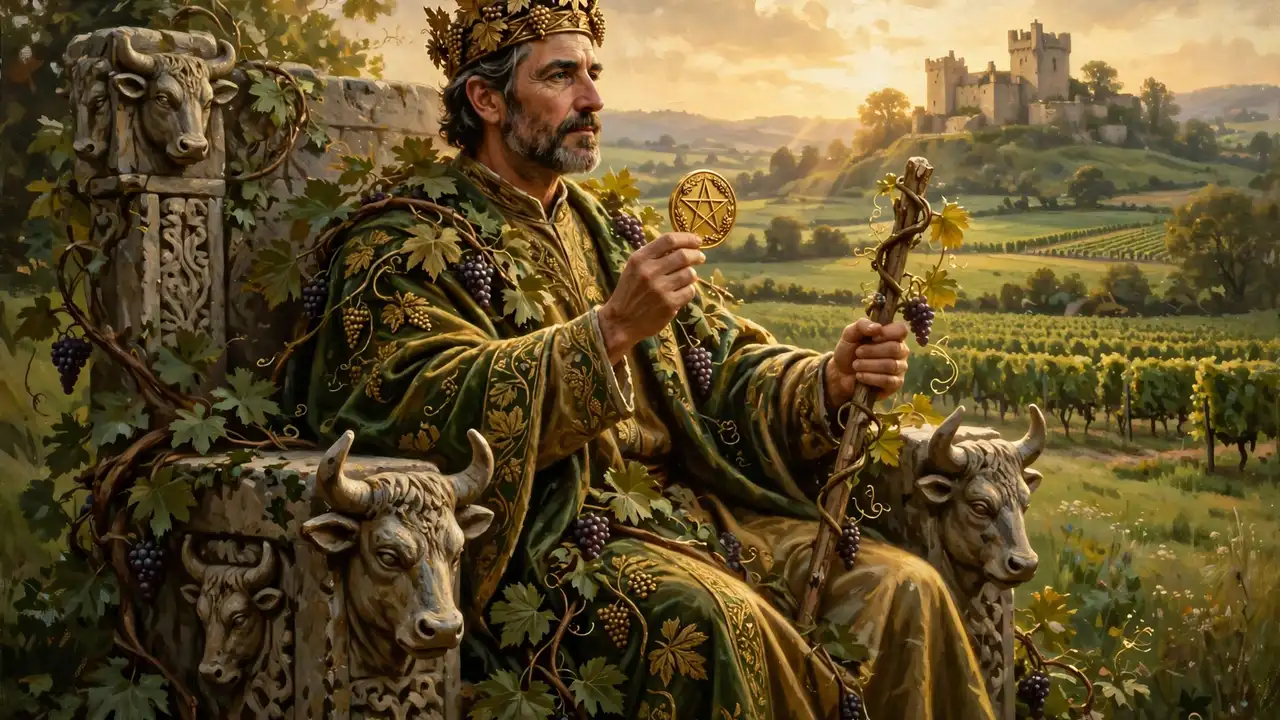
When the King of Pentacles shows up, many people immediately wonder whether the reading is about money. It is generally interpreted as being about more than cash: this card speaks to the ability to manage resources, time and trust patiently until they bear fruit. He is the most mature figure in the suit of Pentacles. He has already passed through the stages of learning, practicing and cultivating, and now he sits in a position he built with his own hands. So when this card appears, it often asks you a few quiet questions. What do you have that deserves steady care? Are the people around you dependable? And is the value you place on money protecting your life, or starting to crowd it out? The King does not ask you to chase more; he asks you to look honestly at what you already hold and how well you are tending it. If you want to ask these questions in a more specific way, you can begin with a tarot reading.
You may also see this card called the King of Coins; both names refer to the same card. Upright, the King of Pentacles is usually read as success, abundance, stability and reliability. It is the outward face of earth energy: someone who does not rush to prove himself and lets results do the talking. Reversed, the same qualities can be pushed to an extreme, turning into materialism, stubbornness, greed, or financial decisions made without enough care. The guide below starts with the imagery on the card, then moves through the core meaning, love, work and money, and the reversed position. It ends by setting the King beside the Ten of Pentacles, so you can tell the difference between the operator himself, the person who manages and builds, and the abundant outcome that such management can eventually produce. Keeping those two ideas apart makes the card much easier to read in context, whatever your question is about.
How to Read the King of Pentacles Imagery
The scene on the King of Pentacles feels settled and calm. The King sits on a throne carved with bull heads. In traditional symbolism the bull is often linked with the earth element, endurance and grounded strength. It never chases speed, yet it can plough an entire field one steady row at a time. His robe is covered with grapevines. Grapes need time to grow and need tending before they bear fruit, and here the vines almost merge with the throne and with his clothing, as if to say that his abundance is not an ornament added on top. It is a life that has grown into him.
In one hand he holds a scepter, and in the other he rests a single pentacle. The scepter stands for the power to decide and to govern, while the pentacle represents the resources he actually controls. Holding both at once suggests that he knows how to plan and also has something real to plan with. Behind him stands a castle. A castle is never built in a day; it needs foundations, brick after brick, and long-term upkeep.
Taken together, the imagery describes abundance built step by step through real ability. His posture is relaxed. He is not guarding against anything and not showing off; he simply sits at ease because he knows how everything he owns came to be. When you read this card, you can first ask yourself which parts of your current life resemble that castle, built slowly by your own hands. For a shorter card entry, see the King of Pentacles card meaning.
Core Meaning of the King of Pentacles
The King of Pentacles is generally interpreted through a handful of keywords: success, abundance, stability, reliability and real capability. He knows how to manage and how to accumulate. He understands that resources are not meant to be spent all at once, but placed where they can keep creating value over time. Compared with the younger figures in the suit, the King no longer needs to prove whether he can do something. He is the person who carries mature earth energy outward into the world, able to take care of himself and with enough left over to look after others.
When this card appears, a common reading is that you are in a period well suited to steadying your footing and doing things thoroughly. It does not encourage reckless leaps or wishful thinking. Instead it reminds you to look back at the foundation you already have: your skills, your network, your savings, your credibility, and even the good habits you have built over many years. These things may look unremarkable, yet they are the real reason the King sits on his throne.
The King of Pentacles can also point to a specific person. It might be an older relative, a manager or a partner who works steadily, whose word carries weight, and whom others trust with important tasks. It might also be the part of you that is willing to take responsibility and commit for the long run. For how court cards map onto people and personalities in general, see court card personality traits; here the focus stays on the King alone.
Put simply, the King of Pentacles suggests that real security comes from what you can hold and manage, not from a passing stroke of luck.
The King of Pentacles in Love
In love readings, the King of Pentacles is often seen as a mature, steady partner with a solid financial footing. He may not be the most romantic person and may not be good with sweet words, but he shows care through practical action: remembering what you need, planning for the life you share, and not running away when things get difficult. Relationships with this kind of person tend to be more stable, and it is easier to talk about the long-term future with them, such as where to live, how to split expenses, or whether to save toward something together.
If you are single, this card may be nudging you to notice people who are quiet but dependable. It may also be asking what you really want from a partner: the spark of attraction, or the grounded feeling of building a daily life together. The two are not in conflict, but the King of Pentacles leans toward the second.
If you are already in a relationship, the King of Pentacles is often read as a sign that the bond is entering a more settled phase, where both of you can focus on running a shared life. There is one thing to watch, though. When one person habitually expresses love through money or material things, over time that can turn into measuring love by money, or even controlling love with money. Gifts may replace conversation, the amount someone contributes may decide who gets a say, or financial reliance may become emotional leverage.
So when you draw this card, ask two questions at once. Is the stability this relationship gives me real? And is what we give each other mutual care, or mutual calculation? If financial dependence in your relationship leaves you uneasy, you may also want to read about the Nine of Pentacles reversed and financial dependence.
When the King of Pentacles Represents the Other Person
Many people who draw the King of Pentacles in a love reading really want to know one thing: is this person reliable? The King is generally interpreted as someone who takes commitments seriously and values practicality. When he agrees to something, he tries to follow through, and he is less likely to make impulsive choices driven by a passing mood. He has his own rhythm in life and plans for the future. If he includes you in those plans, that often signals that he is serious.
Still, reliable is not the same as perfect. People with King of Pentacles energy can be fairly conservative and slow to embrace change. They may also treat getting things done as more important than talking about feelings. You might feel well looked after and yet not truly understood. Rather than guessing, it usually helps to say clearly what you need; the King tends to respond well to direct, concrete requests.
It is also worth remembering that a card describes a tendency and a state, not a final verdict on a person. The card suggests that someone may be showing a steady, dependable side, but whether they truly are that way depends on how they treat you and their promises day to day. If you see words and actions that match, a willingness to share the load and respect for your boundaries, that fits the upright King. If you see money used to buy compliance or material things used to cover problems, it deserves a closer look.
Compared with the Knight of Pentacles, the Knight is the patient, slow and steady worker who keeps his word and is still moving forward on the road, while the King has already built results and has the capacity to carry responsibility. To compare the two, see the Knight of Pentacles meaning.
Reading the King of Pentacles for Work and Career
In career readings the King of Pentacles is a fairly positive signal. Common interpretations include professional success, being trusted by others, or your abilities finally being noticed. He represents someone who knows how to run things: how to allocate resources, lead a team and keep a project working over the long term, rather than producing one impressive result and moving on.
If you are thinking about starting or running your own business, the King of Pentacles is often read as advice to move forward steadily. Secure the basics first, then expand one step at a time. The card does not tend to support betting everything on a single move. It encourages you to think clearly about costs, time and cash flow before you commit. If you work inside an organization, the card may relate to stepping into a management role, taking on more responsibility, or being handed a long-term project, because others see you as someone they can rely on.
The King is also well suited to long-range planning. He looks at things on a longer timescale and does not change direction because of short-term ups and downs. When you draw this card, you might ask yourself: does my current work have a path where effort can keep accumulating? Am I constantly switching directions, or am I patiently cultivating the same piece of ground?
Keep in mind that the card points to a direction, not a fixed outcome. The King of Pentacles does not mean a promotion or a raise is certain. It is more of a reminder that you already have, or are developing, the abilities of someone who manages and builds, and that the next step is to use them steadily. The real results still come from your daily choices and actions, and from whether you are willing to accept some short-term dullness for the sake of long-term goals.
The King of Pentacles Money Mindset
When it comes to money, the most valuable lesson from the King of Pentacles is not how much he earns but the relationship he has with money. He is generally interpreted as someone who feels in control of his finances. He knows where money comes from and where it goes, and he can tell which expenses truly support his life and which are only momentary comfort. He does not spend to save face, and he does not freeze up and refuse to spend anything out of anxiety.
If you draw the King of Pentacles, you can start by reviewing a few habits. First, do you have a clear picture of your monthly income and spending? Second, have you left some room for the unexpected? Third, does the way you spend money match the life you actually value? There are no standard answers to these questions, but the King would want you to know your own answers.
The King also highlights the power of accumulation. Abundance rarely arrives all at once. More often it grows gradually through steady habits, much like the grapevines on his robe: they need tending, they need patience, and they need to be harvested in the right season.
Some people want to know whether this card hints at a particular investment. Tarot is not suited to picking specific assets or timing when to buy or sell. What it can help you see is your own mindset around money, for example whether you are too cautious, too hasty, or too dependent on other people's opinions. Investing carries risk, so please consult a qualified professional for specific decisions. Treating tarot as a tool for sorting out your thoughts, rather than as a basis for financial decisions, is far closer to the practical spirit of the King of Pentacles.
King of Pentacles Reversed Meaning
When the King of Pentacles appears reversed, a common reading is that the steadiness and capability of the upright card have drifted in an unhealthy direction. Someone who once knew how to manage may become materialistic, converting everything into a price tag. Someone who once valued steady accumulation may become greedy and feel that nothing is ever enough. Someone who was practical and grounded may become stubborn, unwilling to listen to others or to adjust methods that no longer work.
The reversed King can also relate to poor financial decisions, such as taking unnecessary risks in pursuit of more, or being so cautious that you miss arrangements you really should make. It does not necessarily mean a loss has already happened. More often it serves as a reminder: lately, has your judgment about money been pushed along by emotion, pride or comparison with others?
The core message of the King of Pentacles reversed is placing too much weight on money while neglecting people and feelings. When someone treats achievements, income and assets as the whole of their worth, they may slowly sacrifice time with family, friendships, or the life they actually want to live, often without noticing. The castle grows taller, yet the rooms inside feel emptier and emptier.
Drawing the reversed King does not mean you are a greedy or cold person. It works more like a mirror, inviting you to look at where you are right now. Is what you are chasing supporting your life, or starting to swallow it? If the answer makes you a little uncomfortable, that discomfort is a good starting point for adjustment, not a reason to blame yourself. Small, honest changes usually matter more than dramatic resolutions.
The Reversed King of Pentacles in Love and Work
In love, the King of Pentacles reversed is often read as a material imbalance in the relationship. One person may be using money or gifts in place of genuine time and communication. A financial gap may have turned into a power gap, so that one partner's voice carries less and less weight. In another version, someone treats their partner mainly as a source of security, while overlooking whether the two of them truly understand and care for each other. If you sense that someone in the relationship is using money to set the boundaries or decide who is right, it is worth pausing to talk things through properly.
At work, the reversed King may point to an excessive focus on performance and pay at the expense of how the team feels. A manager or business partner may have become domineering and rigid, looking only at numbers and not at people. Or it may be you who is clinging to one particular picture of success and refusing to admit that a plan needs to change.
When it comes to material boundaries, the reversed King offers a clear reminder. Money can be care, and it can also become control. It can be protection, and it can also become a cage. Healthy boundaries include knowing clearly which money is your own responsibility and which belongs to shared arrangements, not allowing money to become a tool for emotional pressure, and not giving up the respect you deserve for the sake of money.
When facing the reversed card, there is no need to rush into blaming yourself or the other person. Start by writing down the facts: what moments involving money and relationships have made you uncomfortable recently? Then think about how the next conversation could go, and what you could realistically adjust, one small step at a time.
King of Pentacles vs Ten of Pentacles
The King of Pentacles and the Ten of Pentacles are often compared because both are connected to abundance, yet they describe different things. Put simply, the King of Pentacles is a person: the operator who knows how to manage and build. The Ten of Pentacles is an outcome: the picture of an abundant family, the shape that resources and relationships take after accumulating over time.
When reading, one question helps tell them apart. The King of Pentacles asks how am I managing this, while the Ten of Pentacles asks what does abundance look like. When you draw the King, the focus is on your attitude, ability and decisions: how you handle resources, how you carry responsibility, and how you keep moving forward while staying stable. When you draw the Ten, the focus shifts toward results and legacy: family, roots, long-lasting security, and how these things are shared with more people.
The two cards can also complement each other. If they appear together in the same three-card reading, a common interpretation is that the way you are managing things is gradually leading toward a fuller picture of life. In reverse, if you deeply long for the kind of abundance the Ten of Pentacles shows, the King reminds you that such abundance needs someone willing to tend it over the long run, and that person may well be you.
To explore the imagery and meaning of the Ten, see the Ten of Pentacles meaning. Reading the two side by side makes it easier to see whether what you need right now is the ability to manage and build, or a clearer vision of the outcome you are working toward.
What to Ask After Drawing the King of Pentacles
After drawing the King of Pentacles, many people feel the message is positive but are unsure what to do next. This is a good moment to make your question more specific, so the card's message can land in your actual life. Instead of asking whether you will become rich, try asking which area of your life is most worth managing steadily right now. Instead of asking whether he is the right person, try asking whether the reliability you see in this relationship is real.
If you worry that you care too much about money, you could ask: what am I really concerned about underneath my anxiety about money? Or: how can I pursue stability without neglecting the people around me? Questions like these have no standard answers, yet they help you turn the King's reminder into action.
A three-card layout is another option. For example, the three positions could represent my current foundation, the way of managing that I need to adjust, and the direction where I can keep building next. This design is not a fixed rule; it simply helps you break a question apart and see each piece clearly.
The way you phrase a question shapes the information you can receive. For more on asking clear questions, see how to ask tarot questions. Finally, remember that tarot reflects states and tendencies, and the real work of managing your life still happens step by step through your own effort, just like the castle behind the King of Pentacles, built slowly, brick by brick.
References
Bring something you want to build steadily, or a question you hold about a relationship, and do a tarot reading to see where you stand right now.
Get a Tarot Reading