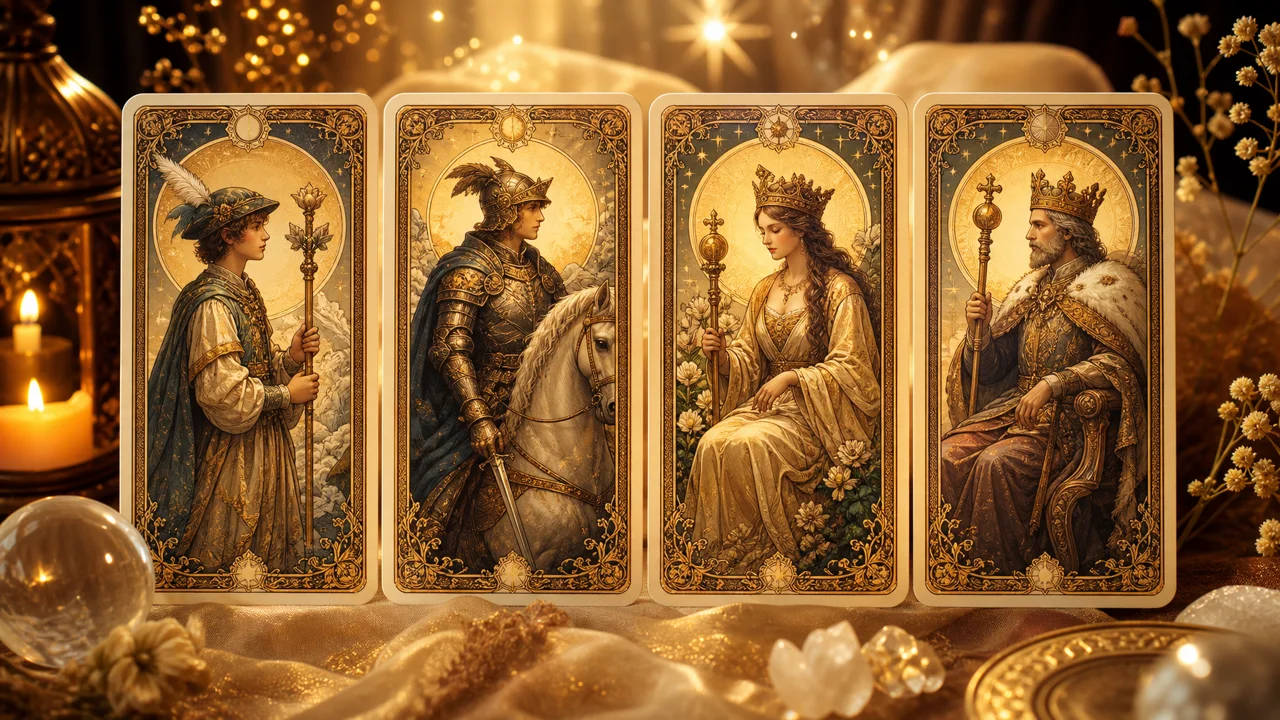
The 16 court cards in tarot are the people you get by crossing four ranks with four suits: the Page, Knight, Queen and King, each in Wands, Cups, Swords and Pentacles. When one shows up, the usual question is: who is this about? There are three possible answers: someone involved in your question, a role you are playing yourself, or the way of handling things you need right now.
Below, we start with what the four ranks and four suits stand for. Then a 16-card cheat sheet sums up each court card's personality, upright and reversed. Love and work examples at the end show how to work out who a card is pointing to.
How Court Cards Are Built: Four Ranks Times Four Suits
The Page, Knight, Queen and King already appear in early Italian tarot decks. The Tarot de Marseille and today's most common system, Rider-Waite-Smith, kept them. Some decks use other names such as Princess or Prince, and their ranks may come in a different order. Read your cards by the system of the deck you are using. Court cards belong to the Minor Arcana, which is separate from the 22 Major Arcana cards.
The Four Ranks: Maturity and How They Act
Rank | Personality | How they act | Common reversed look | In love | At work
Page | Curious, still learning, brings news | Tries things out, asks first | Immature, distracted, short-lived enthusiasm | Early testing of the waters and friendly signals | A newcomer, a new task, a plan just starting
Knight | Driven, chasing a goal | Charges ahead and keeps pushing | Goes too far, or never gets moving | Actively pursues; passionate but not always steady | The doer: pushes projects, works the sales calls
Queen | Mature, holds and nurtures from within | Makes things work through care and influence | Over-giving, controlling, or shut off from feelings | Tends the relationship and each other's needs | Runs team details, manages resources
King | Mature, takes outward responsibility and decides | Sets direction, owns the outcome | Domineering, controlling, or avoiding responsibility | Commits and can carry the relationship | The manager, the decision-maker, the expert authority
The Queen and King are both mature stages. They differ in direction: the Queen leans toward inner mastery and nurturing, while the King leans toward outward decisions and responsibility. They do not mean female or male. A woman who manages a team may well show up as a King, and a Page is not necessarily young; it may simply be someone new to a particular thing.
The Four Suits: What They Focus On
Suit | Element | Commonly linked signs | What it focuses on
Wands | Fire | Aries, Leo, Sagittarius | Action, passion, ambition
Cups | Water | Cancer, Scorpio, Pisces | Feelings, relationships, intuition
Swords | Air | Gemini, Libra, Aquarius | Thinking, communication, judgment
Pentacles | Earth | Taurus, Virgo, Capricorn | Money, work, practical life
The zodiac links are a common reference that helps you picture a character's temperament. Drawing the King of Cups does not mean the person must be a water sign. Treat the sign as a hint about personality, not as proof of who someone is.
Cheat Sheet: The Personality of All 16 Court Cards
Card | Personality | Upright | Reversed
Page of Wands | The eager explorer | Exploration, enthusiasm, new messages | Impulsive, unclear direction, enthusiasm fades fast
Knight of Wands | The adventurous doer | Adventure, passion, acting right away | Reckless, wrong direction, strong start but weak finish
Queen of Wands | The confident, magnetic one | Confident, independent, creative | Jealous, controlling, lacking confidence
King of Wands | The visionary leader | Vision, leadership, boldness | Domineering, rash decisions, short-sighted
Page of Cups | The sensitive dreamer | Sensitive, intuitive, willing to show feelings | Moody, immature, lost in fantasy
Knight of Cups | The romantic suitor | Romance, affectionate gestures, chasing ideals | Unrealistic, emotionally unsteady, avoids commitment
Queen of Cups | The empathetic listener | Empathy, intuition, emotional maturity | Oversensitive, dependent, neglects self
King of Cups | The emotionally steady caregiver | Mature, accepting, balances heart and head | Repressed, moody, uses feelings to manipulate
Page of Swords | The curious observer | Curious, quick-witted, gathers information | Gossip, snooping, hurtful words
Knight of Swords | The direct charger | Decisive, fast, takes direct action | Reckless, thoughtless, cutting words
Queen of Swords | The clear-headed one with boundaries | Clear, independent, speaks plainly | Overly critical, cold, shut off from feelings
King of Swords | The rational, fair decision-maker | Analysis, fairness, decisiveness | Biased, harsh, abuses power
Page of Pentacles | The grounded learner | Learning, diligence, starting from the basics | Procrastination, distraction, wasted chances
Knight of Pentacles | The reliable worker | Hardworking, dependable, step by step | Overly cautious, stuck, sluggish
Queen of Pentacles | The practical caregiver | Caring, practical, gives a sense of security | Hoards resources, overspends, or gives until self-neglect
King of Pentacles | The steady builder | Practical, accomplished, good with money | Greedy, controls through money, poor management
The same rank looks very different across suits. Take the Kings: the King of Wands leads people forward with vision, the King of Cups reassures people through emotional steadiness, the King of Swords judges by reason and principle, and the King of Pentacles builds results through long-term effort. For a fuller love and career reading of a single card, click the card's name in the table to open its meaning page.
How to Tell Who a Court Card Is About
1. Check the position first. In an 'other person' or 'outside environment' position, the card is more likely someone involved in your question. In a 'you' or 'your attitude' position, it usually describes you. In an 'advice' position, it is usually the way of handling things you need to bring.
2. Then check whether the traits fit. If the description sounds like how a certain person behaves, read it as that person first. If it fits no one, read it as a way of acting.
3. Look at clues like age and gender last. They are the least reliable. Don't rule out a woman in your life just because the card shows a man.
For example, the Queen of Swords in the advice position means 'say it clearly and hold your boundaries', not 'go find a certain woman'.
Love Example: Two Months of Flirting, Where Does He Stand?
Say you've been in a will-they-won't-they situation for two months. He texts often and asks you out, but things never go further. You write down: 'How does he feel about this relationship, and how can I respond?' You draw three cards:
- Situation: Knight of Cups upright. The connection feels romantic, and he reaches out and makes plans. This describes how he expresses himself, not a guarantee of his feelings.
- Obstacle: Page of Pentacles reversed. Once it comes to real plans, things stall. What was agreed often goes nowhere, and the relationship stays stuck at 'it feels nice'.
- Advice: Queen of Swords upright. Say clearly what you need, for example by asking him directly how he sees the two of you, instead of guessing.
The message of this spread: the Knight of Cups' romance is real, but watch whether it turns into action. Once you ask, how he responds will tell you more than the cards can.
Work Example: A New Manager Arrives, How Do You Work Together?
Say your department has a new manager and you can't read their style yet. You write down: 'What should I keep in mind when working with my new manager?' Three cards cover the manager, you and the advice:
- Manager: King of Swords upright. They value analysis, principles and fairness, decide with data and logic, and aren't swayed much by personal ties.
- You: Page of Wands upright. You are enthusiastic and full of ideas, but still figuring out what the new manager wants.
- Advice: Knight of Pentacles upright. Work step by step and deliver reliably: back proposals with data, finish a few small tasks on time first and build trust.
Here the King of Swords sits in the 'manager' position and the traits match, so it very likely describes the manager. It also reminds you that on this team, reason and evidence are the common language.
Common Mistakes
- Reading court cards as gender or age. The rank is about maturity and how someone acts, not biological sex or years.
- Forcing every court card onto a person. When it fits no one, read it as the stance you need or a way of acting that is already happening.
- Using court cards to check up on a third party. Cards are not evidence and aren't suited to guessing at someone else's private life.
- Mixing up the Queen and the Empress. The Empress is card 3 of the Major Arcana and speaks of a nurturing, abundant state of life. A Queen is a court card: a mature figure within one suit.
Now that you know how to read court cards, the quickest way to practice is to draw on a question about someone in your life. If a court card appears, come back to this guide to work out who it's about and what it's telling you.
Draw for your question