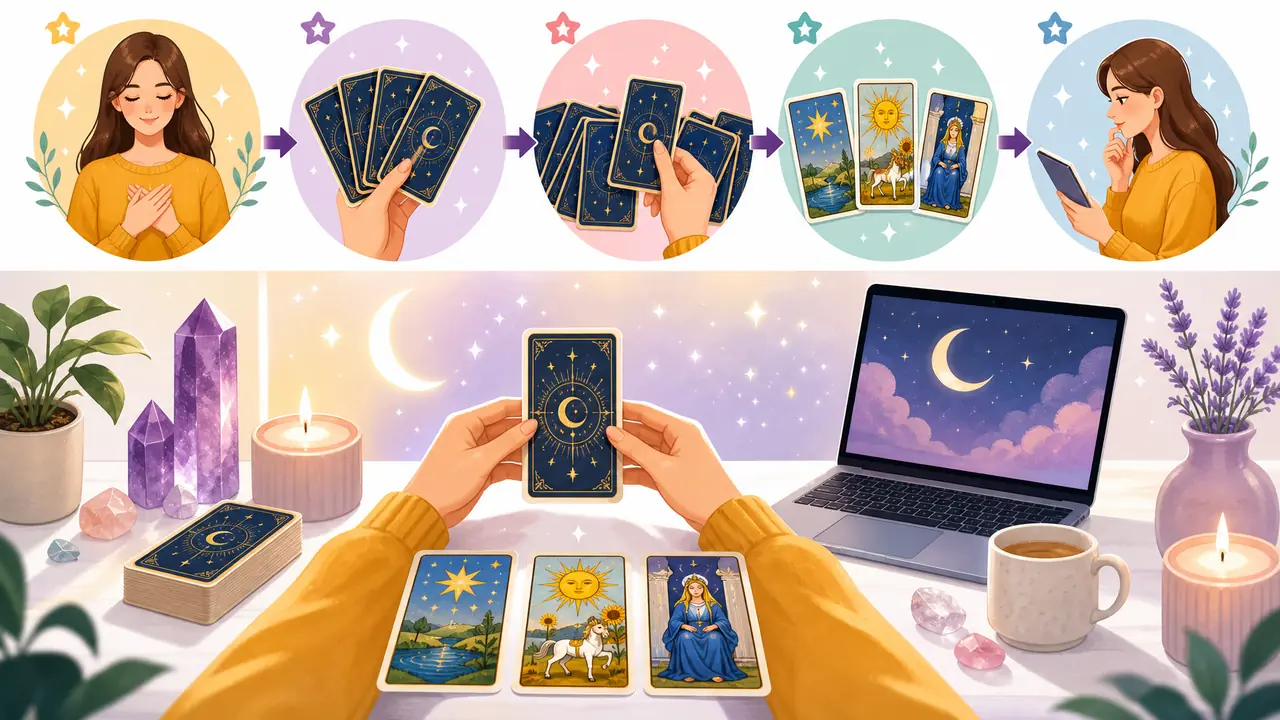
The most useful thing an intuitive tarot reading online can do is not hand you an absolute answer. It breaks vague anxiety into a question, some clues and a next step. Set a timeframe and the actions open to you first, and the reading will fit your real situation much better.
If you are in a situationship, hoping to get back together, thinking about changing jobs or waiting for a reply, this guide goes past surface meanings. It shows you how to ask, how to break down the cards, when a signal is worth trusting and when it is only anxiety looking for a way out. By the end, you can turn a draw into a concrete action instead of redrawing and second-guessing over and over.
Key points: write the question as “who + situation + timeframe” so the cards can get to the point. In intuitive reading, describe the picture and note your first feeling before checking it against the card meaning and position. One card shows the focus, three cards show the structure, five cards show the interaction. Every draw should end in one concrete action.
Intuitive Tarot Reading Online: First, Know What It Can Answer
An intuitive tarot reading online is best at answering “where is this heading right now” and “how should I look at it.” It is not a final verdict on your fate. It lays out where you stand, the outside trends and your inner blind spots side by side. When your question leaves room for action, such as whether to reach out first, whether to change jobs, or whether a relationship is worth watching a little longer, an intuitive reading can usually offer very practical judgement. When the question only wants an absolute answer, such as whether the other person loves you completely, the cards can usually show a tendency and nothing more. They do not make promises about reality.
This kind of reading depends heavily on how clear the question is and how much context it carries. The more specific you are, the more the cards land on something you can act on. Ask only “will it be okay” and the reading tends to drift. Tarot cards are often used for online readings because their visual language is so complete: from the Major Arcana to the element symbols in the Minor Arcana, the images help a reader turn abstract messages into real-life judgement.
Three Steps of Intuitive Reading: Picture First, Meaning Second
Intuitive reading is not making things up. You can follow three steps. First, before looking up any meaning, describe what you see in a sentence or two: what the figure is doing, which way they face, whether the mood feels tense or relaxed. Second, write down the first feeling or association that comes up, and do not rush to correct it. Third, check the card meaning and position to see which feelings have support in the card and which are only your own worries.
For example, ask “If I reach out first this month, where will the relationship go?” with a three-card spread of present, obstacle and advice, and draw the Four of Swords, the Eight of Cups reversed and the Two of Wands. The Four of Swords shows a figure lying at rest with three swords hanging above, and the first feeling is “this is not a time to be pushed.” The Eight of Cups reversed is wanting to leave but not being able to, and the feeling is “something has not been let go.” The Two of Wands shows a figure holding a globe and looking into the distance, like planning the next move. Checked against the meanings, this can be read as: the relationship needs breathing room, one side is still stuck in the past, and the advice is to get clear on what direction you want before deciding when and how to speak up, rather than forcing an answer today.
Which Questions Get the Most Useful Answers
The questions that get the most useful answers can be broken into a current state, a trend, options and consequences. “If I reach out next week, where will the relationship go,” “Is the timing right for me to change jobs,” and “What is the biggest risk in this partnership” are all questions the cards can work with. They have a timeframe, an action you take and an outcome you can observe, so the cards can map onto a concrete situation instead of offering only comfort or alarm.
If you want this kind of reading to actually help, rewrite your question as “What do I most need to know right now” or “What should I watch most closely over the next month.” These are much more likely to give clear direction than “Will it work out.” Often the cards are not telling you the ending. They are showing you where you are stuck and which choice is most likely to push things toward a different outcome.
Which Questions Only Get Vague Responses
When a question has no clear subject, timeframe or action focus, the cards easily become a projection of your mood. “When will I finally be happy,” “How much does he really love me” and “Am I just unlucky” tend to keep the reading circling around feelings without reaching a next step. The cards are not wrong; the question is simply too big to land anywhere. The best move here is not to keep redrawing but to narrow the question first.
Another kind of question that loses focus is one with a strong built-in answer. Maybe you have already decided the other person does not love you and are drawing cards to find proof, or you only want good news and screen out every risk signal. In that state, intuitive tarot easily turns into emotional compensation. A reading worth having does not replay what you already think; it shows you the part you have been ignoring.
- Ask about the current state before the outcome, and the trend before the conclusion
- Questions that break down into actions suit online readings better than abstract questions about fate
- The more you want a single answer, the more likely you are to see only what you want in the reading
How to Ask Tarot So the Cards Get to the Point
The heart of good tarot guidance is not memorising card meanings. It is learning to phrase your question in a language the cards can answer. The most reliable questions usually contain three parts: who it is about, what the situation is, and how far ahead you are looking. Take “how my current job develops over the next three months”: the cards can more easily point to pressure from the environment, your own strategy and where things are heading. Ask only “how is my career luck” and the reading becomes huge, floaty and hard to apply.
If you already know the basic meanings, you can pair this with The Complete 2026 Tarot Guide for Beginners: Everything You Need to Start Reading from Scratch to get the suits, elements and upright and reversed basics in order, then come back to how you phrase questions. Many online readings get stuck not on the cards but on a question that was never broken into layers. Online readings work the same way: the more complete the question is at the start, the more directly the reading can reach the point.
Turning a Vague Question into One You Can Judge
The first step is to drop empty adjectives. Instead of “Does he have feelings for me,” ask “What is the main reason he is keeping his distance from me right now.” Instead of “Can I succeed,” ask “What obstacle am I most likely to meet on this project.” This kind of rewrite pushes the question into cause and effect rather than leaving it in your imagination. Once the cards have a structure, the reading becomes steadier.
The second step is to state the timeframe. Are you asking about today, this week, next month or the next six months? The longer the window, the more variables there are, and the more the cards speak to trends rather than results. If you are asking about a short-term interaction, such as whether to send a message today, a short spread fits better than a large one. That is also why many online tarot tools separate one-card, three-card and five-card readings: different questions need different amounts of information.
How to Read a Reversed Card
A reversed card does not mean bad, and it does not mean your fate is flipped. In many cases it is closer to blocked energy, a direction that has drifted, or something that needs a second look. Across the four suits, a reversal is often a reminder that you are acting too fast or your drive is stuck (Wands), your emotions are overflowing (Cups), you are overthinking or communication is not flowing (Swords), or the practical conditions are not ready yet (Pentacles). Read every reversal as negative and you can miss what the card is really saying.
When reading a reversal, look at which card it is, which position it falls in and whether the cards around it support it. When a card that already stands for slowing down appears reversed, it may simply mean a delay rather than a disaster. When a card that already stands for conflict is reversed, it may point to things being held in and left unresolved. What online reading needs most is not a yes-or-no mindset but treating a reversal as a flag to look closer, not a death sentence.
- Write the question as: who + situation + timeframe
- Read reversals first as blockage, delay or drift, not automatically as negative
- The smaller the spread, the tighter the question; the larger the spread, the better it suits the overall picture
How AI Tarot Reads: Structured Judgement, Not Mechanical Translation
The value of AI tarot is not reciting card meanings line by line. It is quickly turning the images, positions, upright or reversed orientation and the context of your question into a conclusion you can read. A good AI reading should start from structure: what role this card plays in the question, whether it reinforces or pulls against the cards around it, and which action option it finally points to. The difference from a human reading is not whether there is inspiration, but whether that inspiration is gathered into a consistent process of judgement.
If you are comparing ways to get a reading, see AI Tarot vs. a Human Tarot Reader: What Is the Difference and Which Suits You. Whoever reads the cards, the underlying logic is the same: identify what each card is doing, identify what the question is really about, and only then give a conclusion. The imagery is rich: a figure’s posture, the light, the direction they face and the objects in their hands all hint at whether a card is pushing forward, stalling, protecting or changing.
What AI Reading Can Do
AI reading is best at organising information and pulling meaning together. When you draw three cards, five cards or an even fuller spread, AI can quickly point out repeated signals, opposing signals and turning points, helping you find the main thread. This is especially useful for people new to online tarot, because beginners often get carried away by a single card meaning and lose the overall context. The strength of AI is laying that context out for you first.
Another strength is consistency. People are affected by their mood, preferences and tiredness in the moment, while AI is better suited to producing consistent judgements under fixed rules. If your question is already clear, AI can break the spread into layers: present, obstacle, advice and outcome. This structured approach works especially well for questions about work, partnerships, study and moving a relationship forward.
What AI Reading Cannot Replace
AI cannot replace your judgement of your real situation, and it cannot carry your decisions for you. The cards offer angles, but they cannot verify what someone told you, manage risk on your behalf, or promise that something will happen. If a question involves legal, medical, financial or safety risks, tarot can only be a tool for sorting your own thoughts, never the sole basis for a decision. That boundary has to hold.
AI also cannot replace how honest you are about the question. If what you really want to ask is “Should I keep waiting,” but you change it to “Will he come back,” the reading may keep circling around the other person. Many stuck readings are not caused by a system that is not smart enough, but by a person who does not want to touch their own core choice. Once the question is right, AI has a chance to give you an organised reading that actually helps.
- AI is good at pulling the structure together, not at promising results
- Read the main thread first and the details second; do not translate word by word
- When risk, law or health is involved, tarot can only play a supporting role
Oracle Cards vs. Tarot: Message Cards and Picture-Based Readings
The clearest difference between oracle cards and tarot is the density and structure of the message. Tarot has a fixed number of cards, a fixed system and clear relationships between cards, which suits looking at how events unfold, how people interact and how things move over time. Oracle cards work more like message prompts, often using a single theme word or a simple image to point you toward a direction. The first is good for breaking a question down; the second is good for distilling a reminder. Mix the two into one way of reading and you may treat a message card as a full conclusion, or treat tarot as a tool with feeling but no structure.
If you just want a quick check on what matters right now, oracle cards are useful. If you want to know why something is stuck and what to do next, tarot fits better. That is why many online divination tools keep the two separate: one gives you theme-based prompts, the other gives you spread-based analysis. Understand the difference before you look at your draw, and you will not force messages from different layers into the same kind of answer.
When Oracle Cards Make Sense
When you only want today’s reminder, the emotions to watch in the near future, or the one thing a relationship most needs to adjust, oracle cards are often more intuitive than a complex spread. They do not emphasise a chain of reasoning; they emphasise a theme. Messages like “boundaries,” “healing,” “delay” or “trust” exist to remind you where to put your attention right now. If you have been busy and lack the energy for a lot of detail, oracle cards can help you focus first.
The limits are just as clear: oracle cards can easily feel like mood prompts without any event structure. When what you really need to know is “Will the other person make a move” or “Is this partnership worth continuing,” oracle cards can often give only a direction, not enough to judge by. Without tarot alongside them, you may end up with an answer that is beautiful but hard to act on.
When You Need to Come Back to Tarot
Whenever a question involves choices, interactions, consequences and time, tarot suits it better than message cards alone. Tarot meanings already contain positional relationships, element qualities and the logic of turning points, so they can connect “what is happening now” with “what to do next.” This matters especially for situationships, getting back together, job opportunities and evaluating partnerships, because none of these can be solved by a single reminder.
If you know the basic meanings, you can pair this with The 56 Minor Arcana Meanings at a Glance: A Full Guide to the Four Elements to confirm the element signals first, then use oracle cards as supporting notes. That way you will not read on feeling alone; you will be able to tell which card describes a state, which describes a trend and which is only reminding you to notice one thing.
- Oracle cards lean toward theme prompts; tarot leans toward structured judgement
- For how events unfold, how people interact and how things change over time, tarot is steadier
- The two can be combined, but they cannot be read with the same ruler
One, Three or Five Cards: Getting an Actionable Answer Online
For an online reading to be usable, what matters is not drawing many cards but matching the draw to the question. One card suits today’s focus, a reminder for the moment, or the main energy of a single option. Three cards suit present, obstacle and advice. Five cards are better for interactions between people, causes and effects, and where things tend to lead. More cards does not mean more accurate; it means more information to handle. If the question is simple, a big spread will only distract you. On Askaseer, the tarot reading on the home page draws three cards and reads them together, and the spread library also has dedicated five-card spreads, such as the Love Cross; a single card works best as practice with your own deck.
The most common mistake in online reading is treating each card as its own story and ignoring how they relate. The better approach is to find repeated elements first, then look at the turning position. For example, if the first two cards both point to stagnation and the third is an action card, the advice is to break the standstill. If the first two already speak of pressure and the last is a high-tension card, you need to deal with inner strain before pushing ahead.
Using One Card Without Staying on the Surface
A single card works best as a focus prompt, not a final verdict. You can ask “What do I most need to watch today,” “Where is this currently stuck” or “What should I adjust right now.” One card is fast and direct, but it is easy to stretch too far. If you draw a card that looks unwelcome, treat it as a reminder instead of reading it straight away as the end of a whole relationship or job.
The key to reading one card is matching its core action to one concrete behaviour in real life. If the card speaks of waiting, hold off on chasing answers. If it speaks of communication, make the information clear first. If it speaks of boundaries, pause and sort out your own needs again. One card looks simple, but it is the real test of whether you can bring an abstract signal down to the present moment.
How Three and Five Cards Divide the Work
Three cards make a basic framework for judgement, such as present, obstacle and advice, or past, present and future. The rhythm is clear, so you can quickly see which link is the problem. Five cards can add the other person’s state, outside influences and a possible outcome, bringing the reading closer to real interaction. For love or partnership questions, five cards usually show better than three who is pushing, who is pulling back and where the gap lies.
If you are practising, start with three cards and gradually move to five. The point is not to learn every spread at once, but to build a fixed way of asking and a fixed order of judgement. Then, when you look back at your draws, you will know whether you were reading a trend, an action or an emotion. If you want all the card meanings in one place, see All 78 Tarot Card Meanings and Tarot Reading Essentials (Updated Regularly) to connect single-card meanings with spread logic.
- One card shows the focus, three show the structure, five show the interaction and consequences
- More cards is not more accurate; a clearer question matters more
- Catch the repeated signals first, then the turning card, and only then draw a conclusion
Love Questions Go Off Track Easily: Situationships, Exes and Stuck Relationships
Love questions are the type most easily asked the wrong way in online tarot, because many people are not really asking about the relationship but about their own insecurity. Does the person I am talking to like me, will my ex come back, does this relationship still have a chance: on the surface these are relationship questions, but underneath they are often “Will I be chosen.” When the core of the question is an emotional need, the cards easily get pulled into endorsing the anxiety.
A better approach is to shift attention to the state of the interaction and future actions. For a situationship, look at whether contact is consistent, whether boundaries are clear, and who is pushing and who is pulling back. For getting back together, look at whether the reason you split up has truly been dealt with and whether both people are willing to pay the cost of change. For an existing relationship, look at communication, commitment and how well real life fits together. If you want to focus on situationship signals, read on with Does the Person I Am Talking to Like Me? Common Love Signals in a Tarot Reading for Situationships.
Situationships: Read the Interaction, Not the Fantasy
What matters most in a situationship is not what the other person says but whether the interaction is steady. If the cards keep pointing to watching, retreating, hesitating and back-and-forth, the relationship is usually still undecided. Only when the cards show progress, exchange, cooperation and clear action is there a real chance of moving forward. Do not draw a conclusion from one sweet-looking card; check whether the whole picture shows consistency.
In practice, you can ask “What is the main obstacle in this situationship right now,” “If I make the first move, what will follow” and “Is the other person leaning toward getting closer or keeping distance at the moment.” These help you see the truth better than “Does he like me.” A situationship has never really been about whether there is attraction; it is about whether anyone can turn that attraction into clear action.
Getting Back Together: First See Whether the Wound Was Dealt With
The most common misjudgement with an ex is treating “we still talk” as “we still have a chance.” Whether you can start again depends not on missing each other but on whether the core problem that caused the split has been dealt with. If the cards keep pointing to old problems, repetition, suppression and avoidance, the relationship can easily walk the same path again even if you get back together. Here tarot is not offering encouragement; it is reminding you to see the repeating pattern clearly.
If getting back together truly matters to you, the most practical questions are: “If I try to repair things now, what obstacle do I face first,” “Are we both willing to change the way we used to interact” and “Would going back now only numb the pain for a while.” These questions pull emotion back to reality and keep you from reading the other person’s silence as deep feeling, or your own frustration as fate.
- For love questions, check how consistent the interaction is, not just the feelings
- For getting back together, check whether the wound was truly dealt with
- The closer the question is to an action, the easier it is to avoid self-projection
Common Misconceptions and Limits: When a Draw Alone Is Not Enough
The biggest misconception is treating an intuitive tarot reading online as an absolute prophecy. The cards offer trends, angles and reminders, not promises. Especially when a question involves health, law, money, the risk of violence or a major life decision, tarot can only help you look at your emotions and concerns; it cannot replace professional judgement. If you already know there is serious real-world risk, do not let a card draw take the place of getting help or checking the facts.
Another common misconception is that intuitive means free association. Real intuition comes from combining card meaning, imagery, position and context, not from a flash of guessing. The details in the imagery, the thematic rhythm of the Major Arcana and each card’s position in the spread all shape the reading. Confuse intuition with randomness and you will end up with emotional conclusions instead of usable information.
When Not to Rush to Tarot
If you are deeply anxious, sleepless, panicking or clearly unable to think calmly right now, do not rush to draw cards. In that state you are likely to read any answer as the version you want to hear or the one you fear most. Tarot can keep you company while you sort out your thoughts, but it is not meant to magnify fear. Get yourself back to basic stability first, then come back and ask; the signals are usually much clearer.
Also, when a question needs outside evidence, do not draw conclusions from the cards alone. Whether someone is being honest, whether a job contract carries risk, whether a physical symptom needs a doctor: all of these need real information. Tarot can help you check whether you are overlooking a risk or trusting a story too quickly, but it cannot verify facts for you. The clearer this line is, the less likely your readings are to go astray.
What to Do After the Reading
The most practical next step is not another redraw but turning the cards into one small action. If the cards point to communication, arrange one clear conversation. If they point to boundaries, stop over-investing for now. If they point to waiting, observe for a fixed period and then see whether anything has changed in real life. Only by turning the draw into a concrete step will you know whether the reading actually helped.
If you want this method to be steadier, fix one way of asking, one spread and one observation period, then compare results each time. Do not ask about love today, work tomorrow and then redraw the same question the day after. When the question structure is stable, you can see at which step you lose focus. That is the value of online tarot worth keeping: not making decisions for you, but sparing you one more round of agonising over a decision.
- Tarot is not absolute prophecy and cannot replace professional advice or real evidence
- Intuition has to rest on structured judgement, not random guessing
- A reading is only truly understood once it leads back to one concrete action
References
Want to try intuitive reading? Write the question you most want clarity on as one sentence, draw once, note your first impression, then compare it with the key points AI pulls together from the cards you drew and your situation.
Draw for your question