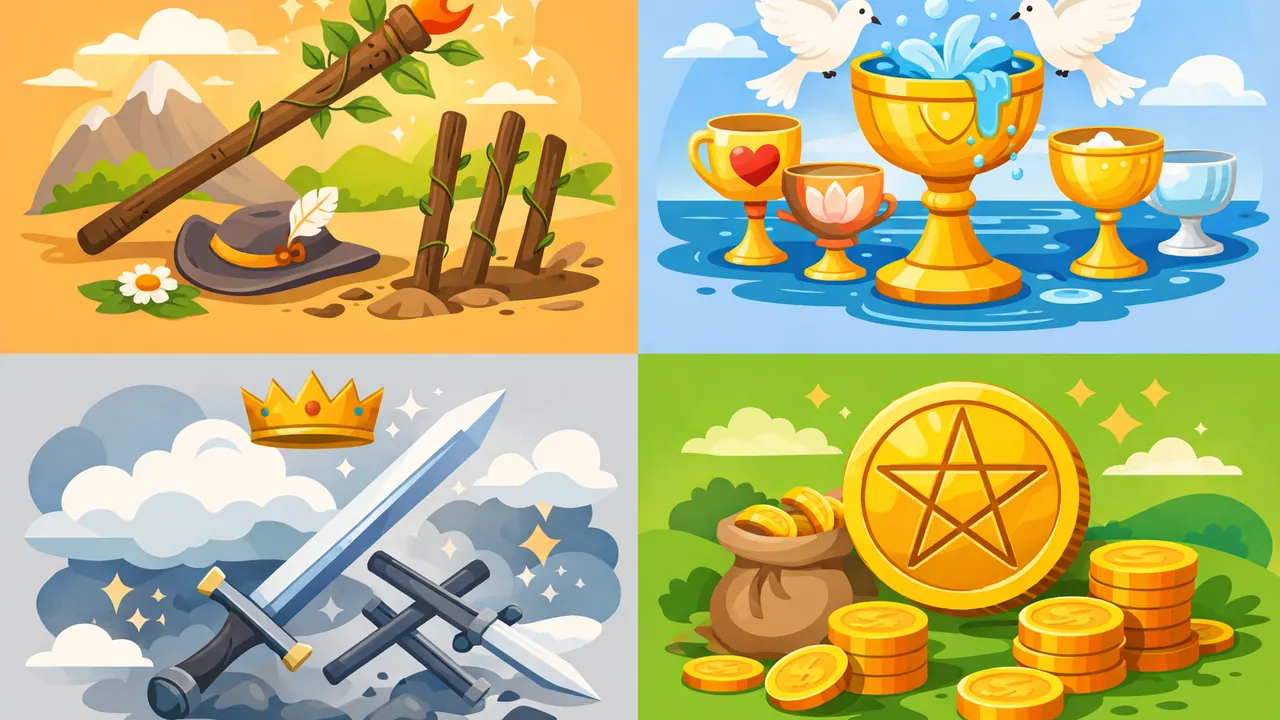
The Minor Arcana is the group of 56 tarot cards that shows the details of daily life and shifts in emotion. It is split into four suits, Wands, Cups, Swords and Pentacles, and each suit stands for a different area of life and a different kind of energy. Knowing the Minor Arcana meanings gives your readings more concrete, practical guidance.
We start with the basic structure of the Minor Arcana, then go through the upright and reversed meanings of each suit and look at what they usually suggest in love and career. After that comes a way to judge a card's meaning, the common mistakes, and hands-on methods for reading each card more clearly.
Whether you are new to tarot or want to deepen your understanding of the cards, this minor arcana guide gives you a clear framework and concrete examples to read with more confidence.
Key takeaways: this guide explains what the Minor Arcana is, walks through the four suits of Wands, Cups, Swords and Pentacles, covers upright and reversed meanings and their use in love and career, and offers a reading framework plus common mistakes so you can interpret tarot messages more clearly.
What Is the Minor Arcana? Basic Structure and Meaning
The Minor Arcana is the name for 56 cards in the tarot deck, split into four suits: Wands, Cups, Swords and Pentacles. Each suit has 14 cards, running from Ace (1) to 10, plus four court cards (Page, Knight, Queen and King). These cards generally describe concrete situations and details of everyday life, complementing the big life themes of the Major Arcana.
Each suit is linked to a different element and area of life: Wands belong to fire and stand for drive and creativity; Cups belong to water and relate to emotions and inner feelings; Swords belong to air and deal with thinking, decisions and conflict; Pentacles belong to earth and reflect money, material things and practical results. Knowing this structure helps you grasp the core message of every card.
- The Minor Arcana has 56 cards in four suits
- Each suit has 14 cards, including number cards and court cards
- The four suits match fire, water, air and earth
- They describe concrete details and changes in daily life
Wands Meanings: Upright, Reversed and Everyday Use
Wands belong to the fire element and stand for passion, creativity and action. Upright Wands are generally read as high energy, clear goals and a proactive attitude, encouraging you to chase your dreams and show who you are. Reversed, they may point to low motivation, blocked plans or acting too impulsively, suggesting you adjust your pace and strategy.
In daily life, Wands are often tied to career growth, starting creative projects and personal willpower. Drawing a Wand usually nudges you to seize the opportunity and try boldly, while not letting impatience make you miss the details.
- Upright Wands: passion, action, creativity
- Reversed Wands: low drive, obstacles, impulsiveness
- Relevant to career, creativity and pursuing goals
Wands Upright
Upright Wands symbolize drive, enthusiasm and action. They encourage you to face challenges head-on and show leadership and creativity. It is a time full of energy and opportunity, good for launching new plans or going after goals.
Wands Reversed
Reversed Wands suggest scattered energy, hesitation or excessive impulsiveness. You may hit obstacles or lack direction, so it helps to reset your mindset and strategy and avoid hasty moves that backfire.
Cups Meanings: Symbols of Emotion and the Inner World
Cups belong to the water element and represent emotion, intuition and relationships. Upright Cups are generally interpreted as rich feelings, harmonious relationships and inner calm, reminding you to listen to your inner voice and build sincere connections. Reversed, they may indicate blocked feelings, misunderstandings or over-dependence, calling for self-care and better emotional balance.
In love readings, Cups are the most common emotional signal. Whether the question is about romance, friendship or family, they offer clues about how feelings are flowing and how people interact.
- Upright Cups: love, harmony, intuition
- Reversed Cups: blocked emotions, misunderstanding, over-dependence
- Mainly reflect feelings and relationships
Cups Upright
Upright Cups represent love and harmony, with feelings flowing freely and sincerely. They encourage you to open up, form deep connections with others and trust your intuition.
Cups Reversed
Reversed Cups hint at blocked or confused emotions, perhaps misunderstanding, loss or mood swings. This is a time to reflect on your inner state and avoid emotional manipulation or leaning too heavily on others.
Swords Meanings: Guidance on Thinking, Conflict and Decisions
Swords belong to the air element and symbolize reason, thought, communication and conflict. Upright Swords are generally read as clear thinking, a sense of fairness and decisive choices, encouraging you to face problems rationally. Reversed, they may point to confusion, misjudgment or gossip and arguments, reminding you to communicate carefully and avoid being overly critical.
In career and relationships, Swords often signal the need for rational analysis and strategic thinking, offering useful guidance especially when you face a choice or a dispute.
- Upright Swords: reason, decisions, communication
- Reversed Swords: confusion, misjudgment, disputes
- Relevant to thinking, conflict and problem-solving
Swords Upright
Upright Swords represent reason, truth and decisiveness. They encourage you to analyze problems with a clear head and make fair, effective decisions.
Swords Reversed
Reversed Swords symbolize confusion, misunderstanding and communication breakdowns. Emotions may be clouding your judgment or you may be caught in arguments, so stay calm and adjust your attitude.
Pentacles Meanings: Money, Material Life and Practical Action
Pentacles belong to the earth element and represent the material world, wealth, work and tangible results. Upright Pentacles are generally interpreted as stability, steadiness and abundance, reminding you to value a solid foundation and steady effort. Reversed, they may suggest money troubles, laziness or poor investments, calling for re-planning and better self-management.
In readings, Pentacles are often used to look at finances, career progress and how stable life feels, reminding you to meet real-world challenges practically.
- Upright Pentacles: stability, abundance, groundedness
- Reversed Pentacles: money trouble, procrastination, setbacks
- Reflect material and practical circumstances
Pentacles Upright
Upright Pentacles stand for stability and abundance: effort pays off and life and work get on track. They encourage patience, steadiness and building up resources.
Pentacles Reversed
Reversed Pentacles hint at financial pressure, laziness or plans falling through. Losses may come from poor planning or delay, so it is worth reviewing your finances and your plan of action.
A Framework for Reading the Minor Arcana and Common Mistakes
When reading the Minor Arcana, start by combining the suit's element and the card's number with the actual situation. Number cards usually describe a process or stage, while court cards point to people or traits. Do not ignore upright versus reversed, since the two often reveal opposite or extended messages.
Common mistakes include reading only the picture by gut feeling while ignoring the symbolism of element and number, or relying on one card meaning and missing the flow of the whole spread. Treating court cards as fixed people rather than symbolic traits is another frequent beginner error.
- Combine element, number and orientation to read a card
- Court cards symbolize traits, not fixed people
- Do not read cards in isolation; look at the whole spread
Reading Framework
First identify the suit's element and the number, then add orientation and position in the spread. Number cards usually show stages of development; court cards reflect roles, traits or inner states. Your overall reading should account for how the cards relate to each other rather than explaining each one alone.
Common Mistakes
Mistake one is ignoring the difference between upright and reversed, which skews the reading. Mistake two is oversimplifying, applying a single meaning to every situation. Mistake three is treating court cards as fixed people and missing their symbolic nature. Avoiding these makes your readings clearer.
In Practice: How to Read and Apply the Minor Arcana
When reading the Minor Arcana in practice, look at the spread as a whole first, then go through each card's element, number and orientation. Ask specific, clear questions, since vague ones make it hard for the cards to focus. While reading, combine your intuition with card knowledge to balance logic and feeling.
Practicing the basic meanings of the four suits regularly and checking them through daily draws deepens your understanding and makes you more flexible. Rather than memorizing dictionary-style meanings, learn to adjust your angle to the specific question.
- Ask specific questions that get to the core
- Read with element, number and orientation together
- Pay attention to the whole spread and links between cards
- Practice regularly and use meanings flexibly
Asking Questions
Keep your question specific and focused, for example 'How can I improve my current work situation?' instead of a broad 'What does my future hold?' This gives the cards a clearer direction and avoids fuzzy readings.
Reading Steps
First take in the overall mood of the spread, then analyze each card. Combine element, number and orientation, and notice how the cards interact. Finally, tie the meanings together into concrete advice based on the background of your question.
Avoiding Pitfalls
Avoid rote memorization or leaning on a single interpretation; adjust flexibly using intuition and experience. Court cards are not fixed people, so read their symbolic traits in context.
Want to see these meanings in your own situation? Bring the question on your mind and draw three cards; it usually feels far more personal than reading keywords alone.
Start a Tarot Reading