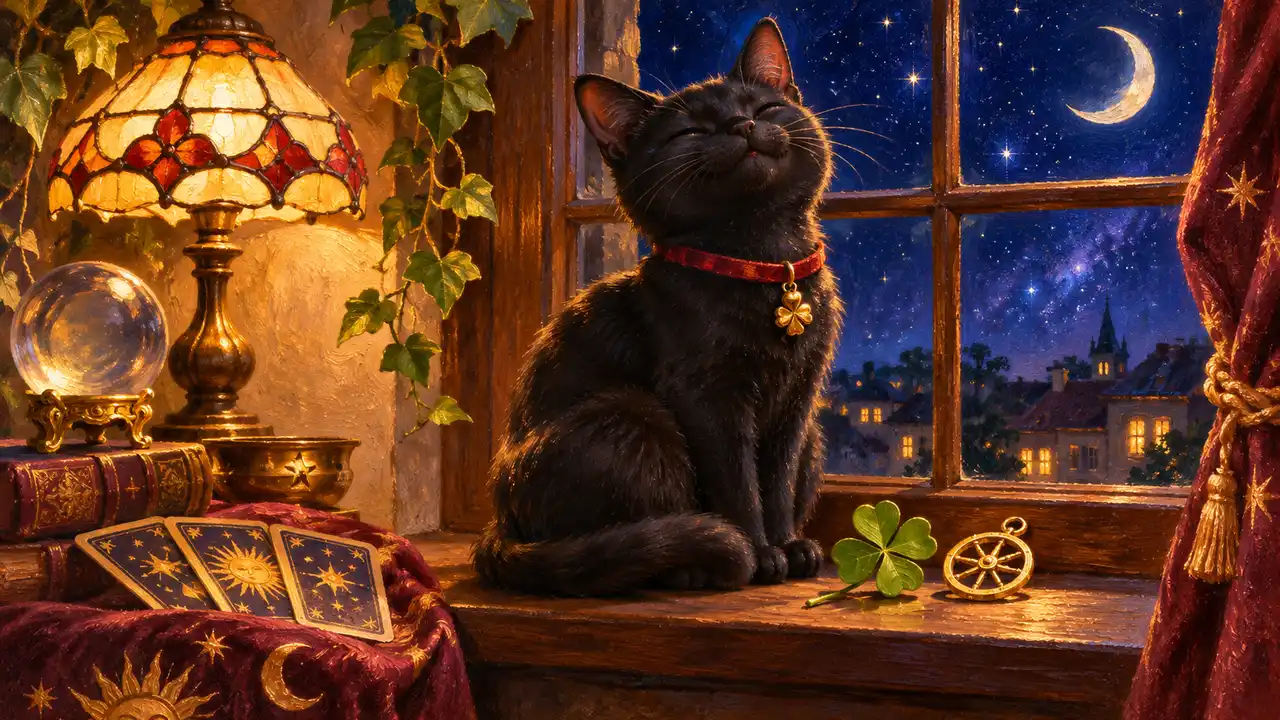
Today is Friday, November 13, 2026, and that slightly spooky combination has shown up on the calendar again. Is Friday the 13th actually unlucky? Nobody can hand down a verdict on the whole world's luck. The bad reputation of Friday the 13th mostly comes from folklore passed down over generations, not from a rule anyone can prove. On the very same day, one person works late, another gets good news, and someone else simply enjoys a quiet bowl of noodles. What really shapes your day tends to be the mood you carry out the door and how you respond when small things go sideways. So if you came here wondering whether today is cursed, the honest answer is that the date itself decides very little, and the way you meet it decides much more. That is good news, because mood and reaction are things you can actually work with.
In this question, tarot's job is not to forecast disaster but to change the angle of the question. Instead of asking 'Will something go wrong today?', try asking 'Where is my luck hiding today?' and 'What should I pay a bit more attention to?' The cards that genuinely talk about luck are the Wheel of Fortune and The Star, while cards like The Tower reversed and the Four of Pentacles reversed often speak to the unease and defensiveness inside us. Once you can tell those two groups apart, Friday the 13th stops being a day that makes you shrink back and becomes a chance to take a small inventory of yourself. Below you will also find a simple three-card daily tarot reading you can try today, with clear positions, an example of how to read the cards together, and answers to the questions people most often ask about luck on this famous date.
Why 13 Became an Unlucky Number
Why does the number 13 get such a bad rap? The most widely shared folk explanations fall roughly into three groups. The first has to do with completeness. Many cultures use 12 to express wholeness: a year has twelve months and a clock face has twelve marks. Some people say that 13, the one extra, breaks that sense of completion and feels unsettled or restless. The second has to do with the number of people at a gathering. In stories told in the West, the thirteenth person at a dinner table is often linked to an unhappy ending, and over time that turned into the taboo that thirteen people eating together is bad luck. The third is a wariness about Friday itself: in some Western folk customs, Friday was considered a poor day to set out on a long journey or to begin something new.
Put a not-so-popular Friday together with a not-so-popular 13th, and the two taboos stack into the date people love to whisper about. It is worth saying clearly that these are traditions, not facts. There are many versions, details often get embellished in the retelling, and there is no single origin that everyone agrees on.
What is interesting is that cultures have always disagreed about numbers. In many Chinese-speaking communities, the number people go out of their way to avoid is actually 4, because its pronunciation sounds close to an unlucky word, while 13 is just an ordinary number to many. In other words, whether a number feels lucky is largely something culture and habit teach us. Knowing this is not about mocking the legends. It is a reminder that superstition can be a fun conversation topic without being allowed to set the tone for your entire day.
Card 13 in Tarot Is Death
In the Major Arcana, card number 13 happens to be Death. Plenty of people get a jolt the first time they draw it, and with today being the 13th, it is easy for the imagination to run wild. The common view, however, is that the Death card is rarely read as literal death. It is generally interpreted as a card about endings and transitions: one phase reaches its natural close, clearing space so something new can come in.
You can think of it like a change of seasons. When autumn leaves fall, nothing is wrong with the tree; it is preparing for the next round of growth. Applied to a question about luck, Death is often read as a reminder that some old habits or old ways of thinking no longer fit you, and if you keep gripping them, good things have a harder time getting in. Think of the to-do item you keep postponing, a pattern in a relationship that has been wearing you out for a while, or a goal you no longer really want to chase.
So card 13 itself is not a symbol of bad luck. Setting it next to Friday the 13th is actually rather delightful: a number branded unlucky corresponds, in tarot, to clearing out and starting fresh. If you want to do something with that today, pick one small thing and bring it to a close. Delete a reminder you no longer need, reply to a message you have been sitting on, or tidy your desk. Small acts of closure like these often leave you feeling noticeably lighter. To explore how cards relate to energy, take a look at tarot energy.
Wheel of Fortune: Luck Is Meant to Turn
If you had to pick the one card among the 78 that speaks most directly about luck, most people would name the Wheel of Fortune. Its imagery usually centers on a wheel that never stops turning. It is generally interpreted as a symbol of cycles, timing and change: there are times of rising and times of falling, and no state stays frozen in place forever.
When the Wheel of Fortune appears upright, a common reading is that a good moment is approaching and things are starting to move. It is a good time to catch chances that show up by accident, such as an unplanned chat, a collaboration someone suddenly brings up, or an invitation you were planning to turn down. The card reminds you to stay open, because luck often pops up from unexpected directions.
When it appears reversed, many people tense up and assume a losing streak has arrived. A more common interpretation is that the rhythm has stalled, the timing is not right yet, or you are resisting a change that needs to happen. It is not saying you are doomed to bad luck; it suggests you stop forcing things for a moment and look at what could be adjusted.
Placed in the context of Friday the 13th, the Wheel's answer is a refreshing one: luck is not a fixed value set by the date, but a current that keeps moving. Even if you hit a bump today, the wheel has simply turned to a certain spot, and that does not mean tomorrow or next week will look the same. If you are curious how far ahead tarot can look, read how long tarot can predict and you will see why a daily reading works best as a gentle nudge rather than a verdict.
The Star: Good Luck Often Starts With Hope
The Star comes right after The Tower, and many people see it as the gentlest card in the deck. Its imagery often shows stars shimmering across a night sky and a figure quietly pouring water back onto the earth and into a pool. It is generally interpreted as a card of hope, healing, returning confidence and a renewed sense of direction for the future.
In questions about luck, The Star is not talking about luck that drops out of the sky. It describes a longer-lasting kind of good fortune. When you start believing again that things can get better, you become more willing to reach out and try, and opportunities become easier for you to notice. Put another way, good luck often begins to build the moment you allow yourself to hope.
When The Star is reversed, a common reading is a temporary loss of faith, feeling discouraged about what lies ahead, or caring so much about other people's opinions that you forget what you actually want. Even then, it is not announcing bad luck. It is nudging you to set down whatever is draining you and to rest, so your confidence can slowly return.
If you draw The Star today, try a small hope exercise. Write down one little thing that made you happy this week, or plan something to look forward to next month. It sounds simple, but when your attention shifts from 'Will something go wrong?' to 'What do I have to look forward to?', the whole day often feels different. The same logic applies to luck at work; for more on that, see career luck.
The Tower Reversed: Most Fear Lives in the Imagination
The upright Tower usually brings to mind sudden upheaval, like a tall tower struck by lightning. Here, though, the focus is The Tower reversed, because on a day like Friday the 13th it does an especially good job of showing how fear works.
The Tower reversed is generally interpreted as a change being postponed, an impact that turns out smaller than expected, or an effort to dodge something you will have to face sooner or later. Another common reading goes like this: what unsettles us most is often not the event itself, but our imagined version of it. You keep worrying that something is about to collapse, so you spend the day on edge, and then the thing that actually happens is frequently smaller than the scene you rehearsed in your head.
That mirrors the psychology of Friday the 13th neatly. On this date, many people find it easy to blow small things out of proportion. The bus is a few minutes late, a bit of coffee spills, and the thought jumps in right away: 'See, today really is cursed.' The Tower reversed works like a mirror, showing you whether you are paying anxiety in advance for something that has not happened.
If you draw The Tower reversed today, ask yourself two questions. Is the thing I am afraid of actually happening right now? And if it did happen, what is one small first step I could take? Once a fear is broken down into concrete questions, it stops being a vague storm cloud and becomes something you are capable of handling. In questions about luck, this card helps you tell real risk apart from the theater playing out in your mind.
Four of Pentacles Reversed: Grip Too Tight and Things Slip
The upright Four of Pentacles often shows a figure clutching coins tightly, one balanced on the head and two pinned under the feet, as if unwilling to let go of anything. It is generally interpreted as stability and restraint, and it can also point to excessive guardedness or possessiveness. Reversed, the reading gains more layers.
There are two common directions for the Four of Pentacles reversed. One is starting to loosen your grip: you realize that holding on so tightly has been exhausting, and you become willing to release some control and let resources flow again. The other is insecurity rising to the surface: fear of losing something leads to flustered decisions, like impulse spending when you feel stressed, or passing up a collaboration because you are afraid of getting the short end of the deal.
In a question about luck, this card is a great way to talk about the fear of loss. Many people feel unlucky because they are always bracing to lose something: afraid that effort will not pay off, afraid of being turned down if they ask, afraid that change will only make things worse. They end up locking themselves in place, so even when good luck walks past the door, there is no room for it to come in.
If you draw this card today, notice whether you are holding too tightly to money, time or relationships, or whether anxiety is making you clumsy. It is not telling you to be generous to the point of recklessness. It is reminding you to find balance: protect what needs protecting and release what needs releasing. Keep in mind that the cards are only a prompt for self-reflection; any major money decision should come back to real information and professional advice.
A Three-Card Daily Tarot Reading for Today
Now that you have met these cards, here is a three-card daily tarot reading you can use today. The key idea behind it is to swap a nerve-racking question like 'Am I going to have bad luck?' for three questions you can actually act on.
Once you have your deck ready, find a quiet corner, take a few deep breaths, and silently repeat your question, for example, 'How can I make today go more smoothly?' There is no need to rush the shuffle. Stop when it feels about right, then draw three cards one by one and lay them out from left to right.
Card one: where your luck is hiding. This card points to the area where today's good opportunity might appear, or the form it might take. It could be a conversation with someone, or a small spark of inspiration you have been overlooking.
Card two: what to keep an eye on today. This one is not warning you about disaster. It shows where you are most likely to get distracted or swept away by your emotions. Treat it as a friendly reminder card.
Card three: one action you can take. This is the most important position in the spread. It turns the messages from the first two cards into something you can actually do today, and the more specific the better, such as 'send someone a message first' or 'spend ten minutes on that task you keep putting off.'
If you are unsure how to phrase your question clearly, start with the tarot question guide. The more specific your question, the easier the cards' hints are to read.
How to Read the Three Cards Together
After you draw the three cards, the most common struggle is that each card makes sense alone, but you are not sure how to connect them. Just remember one principle: look at the overall mood first, then at what each card means in its position, and finally find the story that links them.
Here is a hypothetical draw to show how this works. Say you pull the Wheel of Fortune, The Tower reversed and The Star. The Wheel of Fortune lands in 'where your luck is hiding,' which can be read as today's opportunity being tied to timing, so watch for invitations or changes that appear out of nowhere. The Tower reversed lands in 'what to keep an eye on,' reminding you not to let your own worries spook you, since many things are less serious than they seem. The Star lands in 'one action you can take,' suggesting you plan a small thing that brings you hope. Linked together, they tell a complete story: the opportunity will come around, do not let fear block the way, and catch it with hope.
If you draw cards that look heavier, there is no need to panic. Read them again within the question of their position, and they can almost always be turned into a concrete reminder. Reversed cards work the same way; they often simply point to adjusting your pace rather than announcing that something bad is coming.
Once you have finished, jot down the three cards and your reading, then look back in the evening at what actually happened. Do this a few times and you will become more familiar with how the cards connect to your own life. For more techniques on reading cards in combination, see three-card tarot interpretation.
Fear Makes Us Hold Back; Tarot Helps You Spot Chances
The most interesting thing about Friday the 13th is not really the date. It is how clearly it shows the way fear shapes behavior. Once someone decides in advance that today will be unlucky, it becomes easier to hold back: not sharing an idea, not asking someone out, delaying a decision again and again. Doing nothing may look safer, but it also means missing good things that could have happened.
At the same time, worry makes our attention picky. When we are anxious, we are especially quick to notice small hiccups and use them as proof of what we already suspected. That is nobody's fault; it is simply mood coloring the way we see the day. Once you see that, you can relax a little: much of what feels like bad luck is ordinary small stuff that has been magnified.
Tarot's role here is not to help you dodge every problem or to predict an inevitable outcome. It brings your attention back to the parts you can influence. The Wheel of Fortune reminds you that luck turns, The Star reminds you to keep hoping, The Tower reversed reminds you to separate what is real from what is imagined, and the Four of Pentacles reversed reminds you not to lock yourself up out of fear of loss. They all point the same way: instead of spending energy being afraid, spend it on one small action.
So whether or not today is Friday the 13th, you can go about your life as usual, and maybe even do one extra thing that makes you happy. If there is a question on your mind, you can also try an AI tarot reading: bring your question, draw a set of cards, and see where today's opportunities are.
References
Is there a question you'd like to clear up today? Bring it along, draw a set of cards, and see where your opportunities are hiding.
Draw a set of cards with AI Tarot