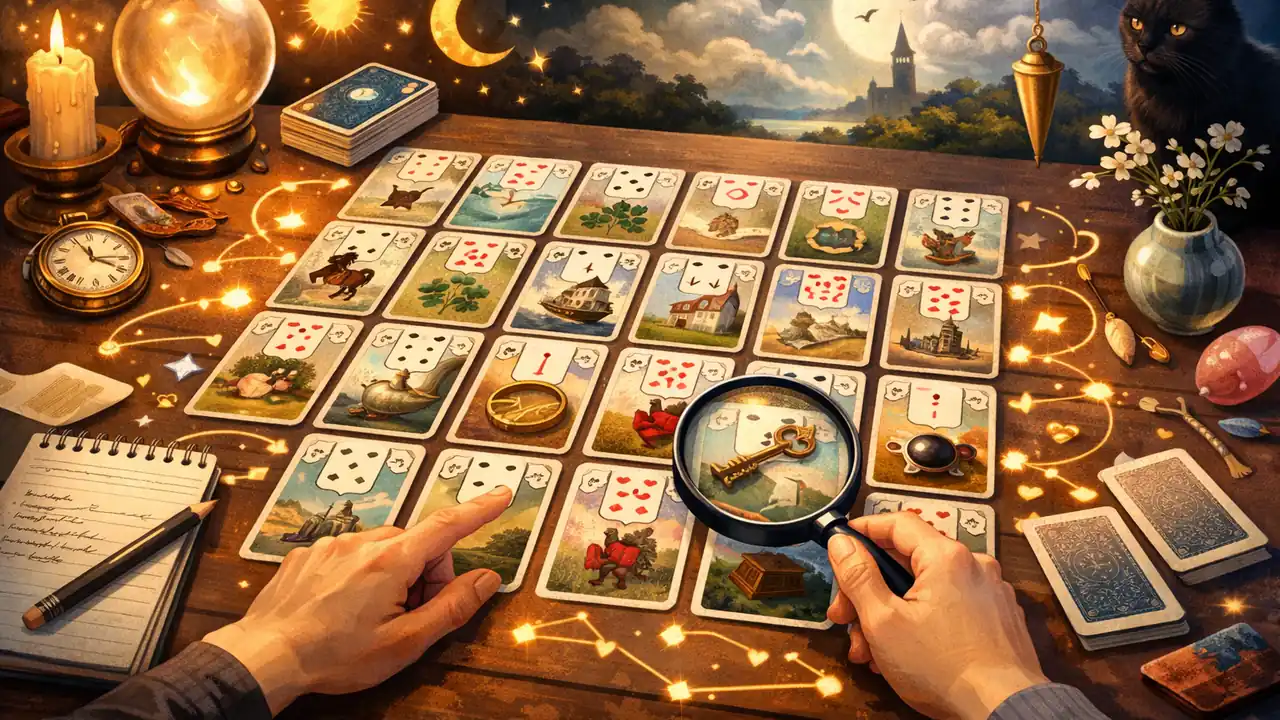
The Lenormand Grand Tableau (sometimes just called the big spread) means laying all 36 Lenormand cards on the table and reading them as one picture. There are two common layouts: 9x4 (four rows of nine cards), or 8x4 with a final row of 4 cards. It shows how love, work, family and money pull on each other at the same time, but it is also the slowest Lenormand reading and the one that asks the most of your card knowledge.
Reading a Grand Tableau is not about reciting 36 meanings one by one. You start from the person card that stands for you, then look at how close the other cards sit, which position they land in and how they connect. Below you will find the layouts, five core techniques and a small worked example to walk through. If you are still learning the meanings, try a five-card practice draw in online Lenormand reading first.
How the Grand Tableau differs from other Lenormand spreads
Spread | Cards | Best for
Three cards | 3 | One specific matter: background, core, direction
Five cards | 5 | How one matter unfolds from start to finish
3x3 grid | 9 | The full view of one theme: the center is the core, the edges are influences
Grand Tableau | 36 | Everything laid out: your whole life and how several themes affect each other
People sometimes call the 3x3 grid a Grand Tableau, but a 9-card layout is a 3x3 grid; a Grand Tableau always uses all 36 cards. Another common mix-up is the Grand Jeu. The Grand Tableau is a layout that uses the 36-card Lenormand deck (often called the Petit Lenormand), while the Grand Jeu is a separate 54-card deck with much busier imagery. They are not the same thing.
The Grand Tableau suits broad questions such as "how will the next three months look overall". If you only want to know whether someone will text back this week, three or five cards are enough; opening all 36 would bury you in information.
How to lay it out: 9x4 and 8x4+4
1. Decide the question or scope. Write down the themes and time frame you want to look at, for example "work and love over the next three months".
2. Shuffle all 36 cards and lay them out left to right, top to bottom.
3. Pick one layout and stick with it:
Layout | How to lay it | Notes
9x4 | Four rows of 9 cards | The neatest grid; rows, columns and diagonals are easy to find
8x4+4 | Four rows of 8 cards (32 in total), with the last 4 placed centered underneath | Many readers treat the last 4 cards as a summary of the whole reading
Traditional Lenormand has no reversed meanings, so simply turn every card upright as you lay it down. A card's meaning comes from its position, its distance from the person card and the cards next to it.
Step one: find your person card
The starting point of a Grand Tableau is the person card that represents you. Traditionally a male querent uses the Man (28) and a female querent uses the Woman (29); in love questions the other person card often stands for the partner. If you are in a same-sex relationship or would rather not split by gender, agree before the layout which card stands for whom, and do not change it while reading.
- Where it lands: a person card near the center usually means you are at the heart of things; near an edge or corner, it suggests you are more passive in the matter or standing at its margins.
- Which way it faces: in many decks the figure clearly faces one side. The side the face points to is often read as what you are looking at or moving toward; the side behind is what has passed or what you are not paying attention to. Facing direction varies between decks, so go by the one in your hands.
Five core techniques
All the examples below come from the same 9x4 Grand Tableau: the Woman (29) sits in the middle of the second row, in position 14. The cards around her are listed in full in the small demo that follows.
Technique | How to read it (with example)
Distance | The closer a card sits to the person card, the more directly you feel it and the stronger its influence; the farther away, the more it is background or something not yet surfaced. Example: the Heart (24) sits right at the Woman's lower left, so love is one of her most immediate concerns; the House (4) is in the far bottom-right corner, so home matters are not the focus for now.
Rows and columns | The row and column that pass through the person card. The row is often read as a timeline, with the past behind and what comes next in front; the column above is often read as what weighs on the mind, and below as the ground underfoot. Example: in the Woman's column, the Letter (27) is above and the Birds (12) below, which can read as a document or message on her mind, supported by frequent contact and conversation.
Houses | Each of the 36 positions carries a meaning of its own, matched to card numbers: position 1 is the house of the Rider, position 2 the house of the Clover, and so on up to position 36, the house of the Cross. A card is read together with the theme of the house it lands in. Example: the Woman herself is in position 14 (house of the Fox), so her focus in this period is work; the Heart (24) lands in position 22 (house of the Crossroads), so love is facing a choice.
Knight moves | Like the knight in chess: from the person card, move two squares one way and one square sideways (or two sideways and one up or down). The card you land on stands for people or things not right beside you but still affecting you indirectly. Example: two down and one right from the Woman is position 33, where the Fish (34) sits, suggesting money matters are indirectly affecting her.
Mirroring | Using the center line of the layout as an axis, two cards in symmetrical positions left and right (or top and bottom) echo each other and add to or contrast each other's meaning. Example: the far left of the first row is the Ship (3) and the far right is the Ring (25), so distance and a commitment echo each other, such as a contract that involves long-distance dealings.
Beyond these five, some readers also look at the diagonals through the person card (influences reaching outward), the four corner cards (the frame of the whole matter), and the final 4 cards of an 8x4+4 layout (the summary). Readers do not fully agree on what each direction of the rows and columns means, so choose one system and stay with it to build up your own reading experience.
Small demo: reading only the 3x3 around the Woman
Looking at all 36 cards at once is an easy way to get lost, so a better way to practice is to read only the 8 cards around the person card first. Say a woman uses a Grand Tableau to look at "work and love over the next three months". The Woman (29) lands in the middle of the second row (position 14), facing right. Here she is with the 8 cards around her; the first row is the three cards above her and the last row the three below:
Left | Center | Right
Fox (14) | Letter (27) | Mountain (21)
Clouds (6) | Woman (29) | Key (33)
Heart (24) | Birds (12) | Anchor (35)
- The three cards above (what weighs on her mind): Fox + Letter + Mountain. A work document or contract is stuck, progress is delayed, and it needs careful handling.
- Behind her (left): Clouds. A recent stretch of confusion and unclear vision is moving behind her.
- In front of her (right): Key. There is an answer in the direction she faces, and what is stuck has a chance to open.
- The three cards below (the ground underfoot): Heart + Birds + Anchor. There is a lot of talk in the relationship and a little anxiety, but a stable bond underneath.
Put into one line: "A stalled document process at work that needs careful handling is what worries her most right now; the earlier confusion is passing, and she has a chance to find the key solution; love is her backing, talkative and sometimes anxious, but on solid ground." Once these 9 cards are read, work outward one layer at a time: how far the Man (28) is from her and which cards sit between them, what choice the Heart (24) in the house of the Crossroads points to, and which cards her knight moves connect to, such as the Fish (34) mentioned above. Read this way, the 36 cards never land on you all at once.
How beginners can work up to the Grand Tableau
1. Get familiar with the core meanings of all 36 cards. One or two keywords per card is enough to start; check them against the 36 Lenormand card meanings overview.
2. Practice two- and three-card combinations. The heart of Lenormand is how neighboring cards form a sentence; how to read three Lenormand cards covers a full practice method.
3. Practice the 3x3 grid. Get used to reading the center as the core and the edges as supporting detail.
4. Lay out all 36, but read in layers. Read the 3x3 around the person card first, then add rows, columns and houses, and only then use knight moves and mirroring.
5. Keep a record every time. Write down the date, the question and the two or three main points you read, then look back after a while to see which reminders were useful.
The Grand Tableau holds so much information that it is easy to find any storyline you want among 36 cards, so write down the question and time frame first, and keep only two or three main points when you finish. Like other Lenormand readings, it is not suited to judging health, lawsuits or investments, nor to digging into other people's private matters.
Lenormand is good at breaking a matter down into concrete clues about people, events and timing. If you are not ready to lay out all 36 cards yet, write the one thing you most want to understand as a single sentence and draw five cards to see what the combination says.
Start a Lenormand reading