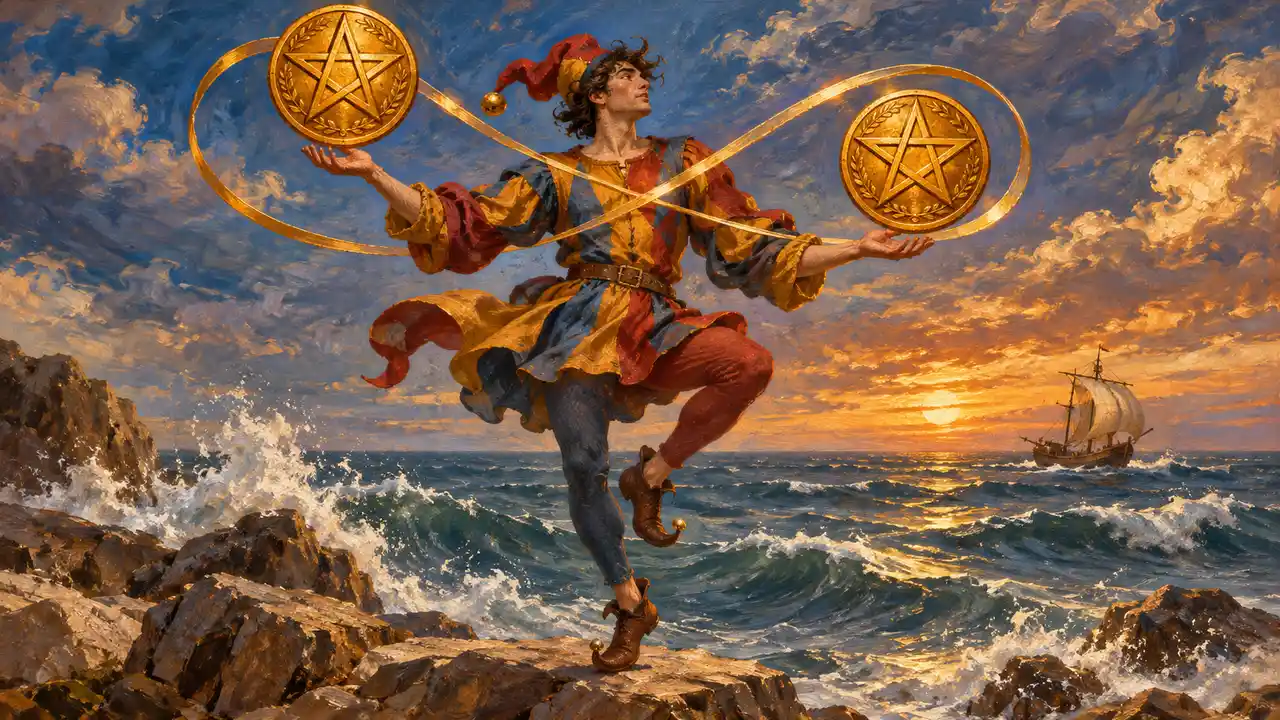
What does the Two of Pentacles mean? The card is generally interpreted as being less about whether you have money and more about how you divide your time, money and energy when two things need you at once. A young figure juggles two coins, stepping lightly as if dancing, while waves rise and fall in the background and a ribbon shaped like an infinity sign loops around both coins. The image describes balance in motion: not a life arranged once and then left alone, but one where you keep two things in the air while everything around you keeps moving. So when the Two of Pentacles appears, a common reading is that you are in a season of juggling, and the point is not to pick a side but to find a rhythm you can actually sustain. It is a card about pacing and practical choices rather than luck, which makes it unusually useful when you bring it a concrete question.
Many people see this card and immediately wonder, 'Am I short on money?' More often, the card points to something else: you are holding several responsibilities at the same time, and what wears you down is often not the tasks themselves but the constant switching between them. Upright, the Two of Pentacles looks like a skilled juggler who knows which coin to catch first and which can wait a beat. Reversed, it looks like scrambling, where the harder you try to hold on to everything, the more likely it all hits the ground. Below, we start with the details of the imagery, then look at both sides of the upright and reversed meanings, three common juggling situations, and finally how to phrase your questions so a reading can help you decide what comes first. None of this predicts a fixed outcome; it simply gives you a clearer picture of your own load.
How to Read the Two of Pentacles Card
The Two of Pentacles is full of movement. A young figure in a tall hat stands in the foreground, body leaning slightly as if stepping to a beat, holding a coin in each hand and tossing them back and forth. The expression is not tense. If anything, it looks relaxed, as though this is something the figure has done many times and knows exactly how it should feel.
The two coins are generally interpreted as two things that need attention at the same time: two income streams, two projects, work and family, or two expenses that have to be covered in the same stretch. The suit of Pentacles is tied to everyday reality, to money, work, health and time, the resources you can see and touch. So this card is not describing an abstract mood. It describes something very concrete: you have two things in your hands, and you need to keep both of them in the air.
Notice that juggling never really stops. The coins are not laid out neatly on a table; they stay in motion. That is the biggest difference between the Two of Pentacles and a card about stability. It accepts that life keeps shifting, and asks whether you can keep your touch while it does. The figure's feet matter too: one is slightly raised and the weight rests on the other, a stance ready to adjust at any moment rather than one planted firmly in place.
If you want the basic card meanings first, see the full Two of Pentacles meaning, then come back here for the juggling angle.
The Infinity Ribbon and the Waves Behind
Between the two coins runs a ribbon that forms an infinity sign, like a figure eight lying on its side. A common reading is that this ribbon links the two things together: they are not separate tasks but a loop in which each one pulls on the other. Spend more at work and there is less left for home; save a little more this month and next month has more room to flex. The infinity sign is a reminder that resources keep flowing between the two ends, and there is no day when everything is divided up once and for all.
Behind the figure, the sea rolls in large waves, and ships rise and fall with them. Waves are usually read as changes in the outside world: workload, what your family needs, an unexpected bill, plans that shift at the last minute. The ships do not capsize, but they cannot sit still either; they keep adjusting course with the swell. The background echoes the juggler in front. The world is moving, the person is adjusting, and the two rhythms are really one.
Put the three elements together: the coins are what you are responsible for, the infinity ribbon is how they affect each other, and the waves are the environment you cannot fully control. Balance in the Two of Pentacles is therefore not a still set of scales. It is more like riding a bike, where you have to keep pedaling and making small corrections to stay upright.
Once you see this, you are less likely to read the card as 'everything is going smoothly' or 'everything is going wrong.' It is closer to 'things are moving, so you need to move too,' and what you can control is how quickly and how carefully you adjust.
Two of Pentacles Upright: Flexible Juggling With Rhythm
When the Two of Pentacles appears upright, it is generally interpreted as the ability to adapt and reprioritize. You have plenty on your plate, but you broadly know what comes first, and you can switch between two demands without losing your direction. This is not the same as things being easy. It is more like 'busy, but with a rhythm': you have a rough schedule in your head for which days lean toward work and which belong to family, which bill gets paid now and which can wait a little.
The upright card is also often read as adaptability. When plans change, you are willing to adjust. When income is irregular, you know how to set aside some of a good month to cover a lean one. What it encourages is not gritting your teeth but staying flexible, and putting your energy into the coin that genuinely needs catching right now.
Still, the upright Two of Pentacles carries a gentle reminder. Juggling is a skill you can keep up for a while, not a state you can stretch out forever. If you notice you have grown used to handling too many things at once, or have started to take pride in 'I can always cope,' the card may also be asking: how long can this pace last? What could you set down, or share with someone else?
So when you draw it upright, there is no need to treat it as a sign that all is well. Read it as 'your current approach mostly works,' then check whether you have left any breathing room. The heart of the upright meaning is rhythm, and every rhythm includes a beat of rest.
Two of Pentacles Reversed: Dropping the Ball
Reversed, the Two of Pentacles looks like a juggling rhythm that has fallen apart. A common reading is dropping one thing to catch another: you try to take care of both sides and end up doing half a job on each, or you keep patching holes, fixing one problem only for another to pop up somewhere else. The reversed card is also often linked to money that does not stretch far enough, such as expenses scheduled too tightly, bills that land in the same week, or a late payment that jams your whole cash flow.
Another face of the reversal is the feeling that nothing will stay in your hands. It is not always that there is unusually much to do. Your attention may simply be spread so thin that you cannot focus; everything feels important, yet nothing actually moves forward. The exhaustion here often comes from the switching itself, not from how difficult each task is.
A reversed Two of Pentacles does not mean you did something wrong, and it does not say you are not capable enough. It works more like a mirror, showing that your current load has gone beyond what this rhythm can carry. Instead of juggling harder, it may be worth pausing to ask: which coin could rest on the ground for a while? Which commitments could be renegotiated?
If the reversal stirs up money worries in particular, it can help to read it alongside the Five of Pentacles and finding help in hard times. The Five of Pentacles is about noticing the support around you when things are tough, and it often echoes the 'I can barely hold on' feeling of the reversed Two. The goal is to give yourself room to breathe, not to blame yourself for what slipped.
Situation One: Work and Family Pulling Both Ways
The most common juggling situation is work and family pulling at you at the same time. At work your mind drifts to things at home; at home you are answering messages and thinking about tomorrow's deadlines. When the Two of Pentacles shows up here, it is generally not read as telling you to choose one over the other. Instead it asks: do both sides really need the same amount of you every single day?
We often picture balance as a perfect fifty-fifty split every day, and then feel we are failing both sides daily. The juggling in this card is not even, though; it takes turns. One moment this coin is high in the air, the next moment it is the other's turn. Maybe a work deadline matters most this week, so you explain that clearly at home and set a time next week to make up for it. Maybe someone in the family needs care, so you talk with your manager early about adjusting your workload.
Upright in this situation, the card is often read as a sign that you can coordinate, but that you need to say the rhythm out loud instead of carrying it all silently. Reversed, it may be pointing out that both sides have been running at 'barely passing' for a long time, and your body and emotions are sending signals.
If you want to draw cards about this, rather than asking 'Can I balance work and family?' try 'Which side needs my priority most this month?' or 'Which part could I adjust so both sides have more breathing room?' The more specific the question, the more practical the direction the cards can offer.
Situation Two: The Tug of War Between Income and Spending
The second situation is the tug of war between money coming in and money going out. The Two of Pentacles often appears when cash flow needs managing: payday and due dates do not line up, or you have more than one income source and the monthly total keeps changing. Here the two coins become the money arriving and the money leaving, and you need to keep both moving in rhythm without letting either drop.
A common reading is that the upright card shows there is still room to maneuver, such as spreading out large expenses or keeping a buffer from higher-income months. Reversed, it may suggest spending is running faster than income, or that many small costs have quietly piled up. To be clear: the Two of Pentacles is not financial advice, and it cannot tell you what to buy or what to invest in. It is better suited to helping you see your own money habits and where the pressure is coming from.
If money makes you anxious, see how to ask tarot about money anxiety to turn vague worry into concrete questions. And while the Two of Pentacles is about flow between two ends, the Six of Pentacles is about the balance of giving and receiving, such as lending, splitting costs and supporting each other; for more, read the Six of Pentacles in career and money.
In practice, when you draw the Two of Pentacles, try listing the dates of your income and expenses for the next few weeks and see where they collide. That simple step often brings back your juggling rhythm more than worrying in circles does. For real financial planning, it is still best to talk with a qualified professional.
Situation Three: Torn Between Two Choices
The third situation is being stuck between two options. It might be two job offers, two study paths, whether to move, or wanting to keep a full-time job and a side hustle at the same time. When the Two of Pentacles appears here, the figure is not holding an answer. It is holding two possibilities that are both still in motion.
In decision questions, the card is generally interpreted not as telling you which one to pick, but as describing where you are right now: still weighing both, leaning one way, then thinking the other side looks good too. This back-and-forth is nothing to be ashamed of. It is a natural part of getting to a decision.
The Two of Pentacles also points out that hesitation has a cost. The longer you keep a grip on both, the more energy goes into imagining and comparing, and the less is left for actually committing. Upright, it may be saying you can run both in parallel for a while, gather information and then decide. Reversed, it may suggest that delay is already making it hard to do either one well, and it is time to give yourself a deadline.
In this situation, a more useful approach is to ask about the two options separately: 'What would option A ask of me?' and 'What could option B bring me?' You can also lay out three cards, one for option A, one for option B, and one for the factor you most need to weigh right now. What you get is not a simple yes or no, but a fuller map of the trade-offs.
Two of Pentacles Compared With Other Pentacles Cards
Placing the Two of Pentacles back in its suit makes its role clearer. The Ace of Pentacles is a new resource or opportunity appearing; by the Two, that resource has become two, and it starts needing to be divided and managed. This is the first step from having to handling, which is why the Two of Pentacles often carries a feeling of being busy and still learning.
Compared with the Five of Pentacles, which shows hardship, cold and a sense of being left out, the Two is busy but still on its feet, even moving with a light step. When a reversed Two of Pentacles appears alongside the Five, a common reading is that pressure is building, and it is worth reaching out for help early rather than pushing through alone.
The Six of Pentacles is about the balance of giving and taking, with a figure holding scales and handing out resources; its focus is the flow between people. The Two of Pentacles is more like one person juggling between their own two concerns. By the Ten of Pentacles, the scene shifts to family, legacy and long-term stability; you can read more in the Ten of Pentacles meaning. From the Two to the Ten, you can see a path from scrambling to keep the coins in the air toward a foundation solid enough to pass on.
The point of this comparison is to remind you that the Two of Pentacles is one stage in a longer process. Needing to juggle and reprioritize right now does not mean life will always be this hectic. Once the rhythm becomes familiar, there is a real chance of moving toward something steadier.
How to Ask Tarot Questions About the Two of Pentacles
Because the Two of Pentacles is a card about allocation, the least useful question is a vague one like 'Can I have both?' It rarely gets a helpful answer, since the answer is almost always 'it depends on how you arrange things.' Three directions tend to work better: ask about priorities, ask about trade-offs, and ask about rhythm.
Asking about priorities might sound like: 'Over the next two weeks, what do I most need to deal with first?' That helps the cards show which coin needs catching first. Asking about trade-offs might be: 'If I cut back on my side hustle for a while, what would I gain and what would I lose?' That helps you see the cost of each choice. Asking about rhythm might be: 'Which part of my current work and life setup is most likely to throw me off balance?' That helps you find the piece that needs adjusting.
You can also use three cards: the first for your current state, the second for what most needs adjusting, and the third for a direction you could take. Compared with a single yes-or-no question, this makes it easier to turn the reading into steps you can act on.
It also helps to include a time frame and a specific focus, such as 'this month,' 'between me and my family' or 'these two income streams,' rather than 'my life' or 'my future.' The clearer the scope, the easier it is to connect the card's message to your real situation. And remember that the cards are a tool for sorting out your thoughts; you are still the one who makes the decision and lives with the result.
What to Do After Drawing the Two of Pentacles
After drawing the Two of Pentacles, the most practical move is not to change everything at once but to take a clear look at the coins in your hands. Grab a sheet of paper and write down everything you are currently looking after: work deadlines, what your family needs, fixed expenses, a side hustle or a course. Once it is on paper, you will often find that some things are not as urgent as they felt, while others have been quietly neglected.
Next, put those things in order for this week. It does not need to be perfect; it just needs to tell you which coin to catch today. Juggling in this card happens one beat at a time, not with both hands straining at full force at once.
Then leave some buffer. Whether it is time or money, keep a small blank space for yourself. A juggler can keep the rhythm going because there is a gap between the two coins. If every minute and every dollar is already booked, any small surprise can throw the whole rhythm off.
Finally, if you notice you have been living in the reversed state for a long time and feel that nothing will stay in your hands, it is worth talking with someone you trust, or renegotiating some of your commitments. Balancing two things does not mean carrying everything alone. Knowing when to set one coin down for a while is sometimes exactly what lets you catch the other more steadily. To compare the full upright and reversed meanings, head back to the complete Two of Pentacles meaning.
References
If you are juggling two sides of life right now, bring your own question about priorities or trade-offs to the cards and see which coin most needs catching first.
See the full Two of Pentacles meaning