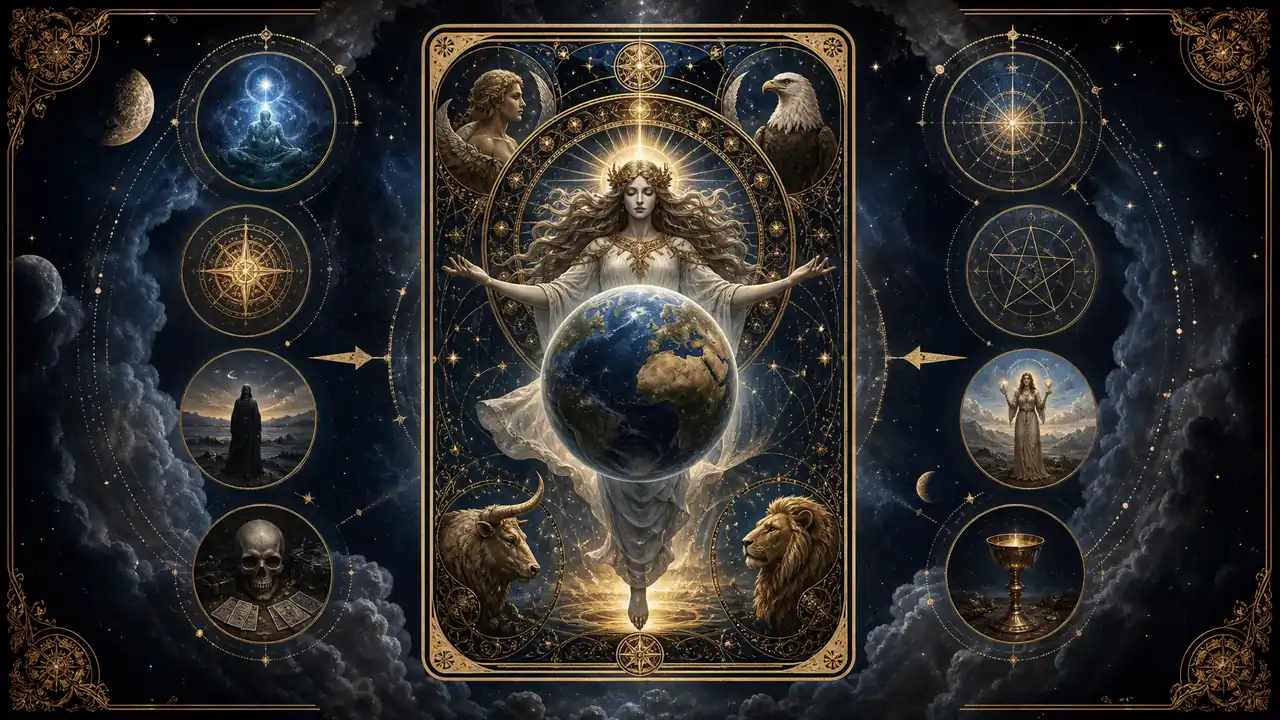
The World is not simply a “good card” or a “perfect ending.” What it actually points to is a cycle reaching its point of closure: you have walked through a learning stage, and the experience you gathered now needs to be sorted, accepted and carried with a more complete version of yourself into the next journey. When it appears reversed, the message is usually not failure. More often, some step is still unfinished: a responsibility, a goodbye, a final review, a shift in mindset, or a situation you know should end but where you are still standing still.
In the tarot system, The World is the last card of the Major Arcana (number XXI) and is often seen as the point where the Fool's Journey comes together. The laurel wreath, the four guardian figures in the corners and the dancing figure all remind the reader not to look only at the outcome, but to ask whether the person is truly ready to move forward once something is complete.
Beginners most often read The World as “it will definitely succeed,” “you will definitely be together” or “the result will be perfect.” But a tarot reading can't settle everything on a single card. You also need to look at the question itself, the card's position, the neighboring cards, upright or reversed, and how much room the person has to act. Placing The World in love, career, personal growth and real spreads shows how to judge it, how to ask about it and how to avoid misreading it.
Key points: The World marks a cycle that has reached a stage where it can be closed and reviewed. It does not guarantee success or permanent happiness. Upright, it means a mature ending, which can be fulfillment or a mature goodbye. Reversed, it usually means one last step is missing, so check whether something practical, emotional or identity-related is still unfinished. In reconciliation questions, separate a mature restart from a complete farewell.
The Core Answer: Completion Is Not the End but a New Start After Integration
The core message of The World fits in one sentence: a journey has reached the stage where it can be wrapped up, reviewed and integrated, but the real point is not the ending. It is whether you can turn this experience into the foundation for your next step. The card doesn't express joy and manifestation as directly as The Sun, and it doesn't emphasize awakening and calling the way Judgement does. The World is more like standing on high ground and looking back over the whole road, confirming that you are no longer just pushed along by events, and that you can place success, failure, waiting, sacrifice and choice into one complete picture.
In the Rider-Waite tarot, The World usually shows a dancer at the center of a wreath, with figures in the four corners often linked to the four elements, the four fixed signs or the four Evangelists. These elements suggest balance, order and a complete structure, not a single stroke of good luck. For beginners, the most useful question when The World appears is not “will it definitely succeed?” but “how mature is this situation already,” “which closing step am I still missing” and “have I turned this experience into an ability I can carry forward?” For upright and reversed keywords, see the World card meaning page. If you are building a full foundation of card meanings, read it alongside the complete guide to all 78 tarot card meanings to understand how the whole deck fits together.
The World is easy to misread because its image looks so complete and it sits at the very end of the Major Arcana, so beginners naturally treat it as the ultimate yes. In tarot, though, completion is usually tied to a stage. Finishing a period of adjustment in a relationship doesn't mean there will never be conflict again. Finishing a project doesn't mean your career will be free of pressure from now on. Finishing part of your own healing doesn't mean old wounds will never be touched again. A more precise reading of The World is to see that a cycle has reached a state where it can be named, organized and handed over.
The World in the Fool's Journey
If the Major Arcana is read as the Fool's Journey, The World is where the Fool arrives after the Magician's beginning, the High Priestess's inner knowing, the Lovers' choice, the Chariot's will, Death's transformation, the Tower's collapse and Judgement's awakening. It is the place where all of that experience can be integrated. The story doesn't stop here. The main character finally understands why they had to walk those roads. This also means that when you read The World, you can't only ask whether the outcome looks beautiful. You also need to ask whether the person has the maturity to receive it.
Completion versus integration
Completion leans toward outer events: an exam ends, a collaboration wraps up, a relationship is defined, a project is delivered. Integration leans toward inner digestion: do you understand what you learned, what you won't repeat next time, and which abilities you can take with you? The World contains both layers, but the imagery puts more weight on integration. If an event has ended on the surface while you still feel confused, resentful or avoidant inside, The World may be reminding you that the real closing hasn't happened yet.
- The keywords of The World are not simply success, but completion, integration, review and the closing of a cycle.
- To judge it correctly, look at whether the situation is mature, whether responsibilities have been handed over, and whether the person is ready for the next stage.
Reading the Imagery: What the Wreath, the Dancer and the Four Creatures Say
At the center of The World is a figure dancing inside a wreath, with a human, an eagle, a lion and a bull in the four corners. The wreath can be read as the scope of completion: what is the standard for this to count as finished, and are the boundaries clear? The dancer stands for flow and adaptability: can you stay flexible inside your results instead of stopping the moment you reach the finish line? The four creatures point to integration on several levels: are reason, will, emotion and practical conditions all in place? If one of them is clearly missing, The World is usually saying “almost complete,” not “nothing wrong here.”
The World Upright: Maturity, Fulfillment, Review and the Next Stage
Upright, The World usually means a situation has reached a fairly complete state. The effort you put in may finally be recognized, and you may move into reviewing results, defining a relationship, finishing a course of study, delivering a project or changing roles. Its energy is steady and mature. It is not sudden luck but a result formed by long accumulation. If you ask “will this have an outcome?”, an upright World generally suggests there will be a clear one, and that the result will help you make sense of everything that came before instead of leaving you stuck in vagueness.
But an upright World doesn't necessarily mean everything will match your expectations. It is closer to a card of “this can be brought to a close” than a card of “every wish comes true.” In love, it may mean a relationship moves into stable commitment, or that two people complete a relationship in a mature way. At work, it may mean a project finishes smoothly, or that you have learned what you needed in your current position and it is time to think about a transfer, promotion, job change or a bigger stage. So the real question behind an upright World is whether you are willing to admit that a chapter is complete and start facing the choices of the next one.
The World is often linked to a sense of completion in the overall order and structure of things. That completion is not stagnation but dynamic balance: the four corners provide support, the wreath marks boundaries and cycles, and the dancer in the middle keeps moving freely within those limits. This reminds the reader not to treat The World as passively waiting for a reward, but as “I already have enough resources to turn this experience into my next action.” If you want to fill in the context before and after it in the Major Arcana, see the 22 Major Arcana meanings and the Fool's Journey.
Common situations for an upright World
An upright World often shows up when long-term effort finally pays off: finishing a degree, passing an important review, closing a project, publishing work, completing a move, making clear arrangements in a long-distance relationship, or a relationship that kept going back and forth finally settling into a clear definition. It can also point to crossing regions or cultures, online collaboration, travel and expansion, because the card itself carries a sense of wide vision and crossing borders. Still, these situations have to come back to the actual question. Seeing The World doesn't mean you can declare that someone will move abroad or get married.
Upright doesn't mean it costs nothing
An upright World sometimes brings a subtle feeling of emptiness: you reached the goal, yet you don't know what to pursue next. This isn't a bad sign. It is the transition period that naturally follows completion. You may need to set new goals, rearrange your time, or even admit that some people or things no longer belong in the same place. If Death, The Tower or the Eight of Cups appear nearby, the fulfillment of The World may come with a goodbye. If The Star, the Ten of Pentacles or the Three of Wands appear nearby, it reads more like a stable result opening up a new direction.
- An upright World usually means the situation is mature enough to close or to announce a result.
- It can mean fulfillment, or a mature goodbye; read it together with the question and the neighboring cards.
The World Reversed: Unfinished, Stuck, Delayed or Not Truly Ending
The most common meaning of a reversed World is “one step short.” The situation may be close to complete, but paperwork, communication, a commitment, a final review, emotional readiness or practical arrangements are not yet in place. There's no need to read it as failure right away. It works more like a reminder: you thought it was over, but some part still hasn't been properly dealt with; you thought you were ready, but inside you are still resisting leaving the old pattern. For beginners, the key distinction with a reversed World is between outer delay and inner lack of integration.
Outer delay can be very concrete: a contract isn't signed yet, the other person hasn't clearly stated their position, a project is still being revised, graduation requirements aren't met, a move is stuck. Inner lack of integration is less visible: you don't want to admit a relationship has reached its end, or even when you get an opportunity you feel you don't deserve it, so you use delay, nitpicking and endless double-checking to avoid really beginning. A reversed World often feels like a loop: the same problem replays, the same conversation keeps happening, the same fear keeps stopping you from stepping out.
A reversed World can also mean your view has become too narrow. Upright, The World sees the whole picture. Reversed, you may be caught up in small gains and losses, seeing only one person's reply, one interview or one paycheck, and forgetting to check whether the overall direction has already changed. Tarot isn't asking you to rush to a conclusion here. It is reminding you to zoom out: where exactly is this stuck? Is it a lack of resources, an incomplete plan, an unclear commitment, or do you not actually want to finish? If reversed cards tend to make you anxious, see reversed tarot reading for beginners to build the habit of not equating reversals with bad news.
Three common sticking points
The first is unfinished procedure: a confirmation, signature, payment, timeline or someone else's cooperation is still missing. The second is unfinished emotion: on the surface the person says they've let go, but they still hope the other person will come back or make amends. The third is unfinished identity: the old role no longer fits and the new one isn't stable yet, such as not daring to start a new job after leaving the old one, still acting like a partner after a breakup, or not knowing how to face adult responsibilities after graduating. All three delay The World's sense of completion.
Better questions to ask when it's reversed
When The World comes up reversed, turn a question that is too broad into one you can act on. Instead of only asking “will I succeed?”, ask “which condition is still missing before this is complete?” Instead of only asking “will they come back?”, ask “what is the core of what hasn't been closed in this relationship?” Instead of only asking “when will I change jobs?”, ask “what preparation do I need to finish before I'm ready for the next career stage?” The more precise the question, the more useful the reversed World becomes as a guide to action.
- A reversed World often means one last step is missing; there's no need to call it failure.
- If the same problem keeps repeating, a reversed World is usually pointing to unfinished inner work.
The World in Love: Stable Commitment, Stage Transition or a Goodbye
When The World appears in a love reading, many people's first reaction is “will we have a happy ending?” The card can indeed point to a relationship becoming mature and stable: making it official, meeting the family, moving in, getting married, ending the distance and living in the same place, or two people finally understanding each other more fully. But it can also mean a relationship has completed its task for this stage, and the two people need to redefine it or even part in a mature way. The key is not whether the card looks beautiful, but whether you are asking about how things will develop, reconciliation, the other person's feelings or the current state of the relationship.
If you're asking about a situationship, an upright World may mean things are about to be clearly defined. That doesn't automatically mean dating; it may also mean both sides finally state their boundaries. If you're asking about a stable partner, The World usually shows the relationship reaching a milestone, a good time to talk about future plans, living together, family matters or long-term commitment. If you're asking about getting back together after a breakup, The World can go two ways: either both of you have finished the time apart and can see each other in a new way, or the relationship has fully ended and reuniting would pull you back into the old cycle. Check whether the surrounding cards show reconnection, such as the Two of Cups, The Lovers or Judgement, or closure, such as Death, the Ten of Swords or the Eight of Cups.
In love, the most important idea in The World is “a whole person.” It doesn't encourage you to hand all your missing parts to someone else to fill in, and it doesn't encourage you to use a relationship to prove your worth. If you ask “is this person my soulmate?”, The World may remind you that a truly mature relationship comes from two people meeting as relatively whole selves, not from one waiting to be rescued by the other. If you are dealing with uncertainty in a situationship, read does my crush like me? Common love signals in tarot to place The World in a more detailed love reading.
If you're single
For a single person, The World often means you are finishing a period of sorting yourself out, or are about to step out of an old relationship pattern. You may know more clearly what you want than before, and be better at not mistaking loneliness for a need for love. With the Three of Wands, The Star or Temperance in the spread, it may suggest your social circle is widening and new connections could come through travel, cross-field exchange, online communities or people from different cultures. With The Hermit or the Four of Cups, you may still be in a period of integrating yourself, with no need to rush into a relationship.
If you're in a relationship
For someone with a partner, The World usually means the relationship is reaching a review point. You may need to talk about living together, marriage, how to split money, family responsibilities, where to work, or whether your long-term goals line up. Upright, both of you have a chance to look at the bigger picture maturely rather than fighting over a single incident. Reversed, the relationship may look stable while some issues remain unspoken: one person avoiding commitment, one sacrificing too much, or two different visions of the future that no one says out loud.
The World in breakup or reconciliation questions
In breakup or reconciliation questions, The World calls for real care. It may mean “this relationship has finally ended completely,” or “after time apart, both of you could restart in a more mature way.” Look at the position: in the past position, the old cycle may be complete; in the obstacle position, someone may be unwilling to truly close it; in the future position, the relationship may be heading toward a clear outcome. Don't read it as a successful reunion just because it's a positive card.
- In love, The World is about whether the relationship stage is mature, not just whether they like you.
- In reconciliation questions, tell apart a mature restart from a complete farewell.
The World in Career and Money: Finished Projects, Milestones and Expansion
In career readings, The World often means a project is finished, work is delivered, a promotion threshold is reached, a stage goal is achieved, or you have gained enough experience in a role to step onto a bigger stage. It isn't a card of short bursts but of mature results after long effort. If you ask whether work will go smoothly, an upright World usually shows the task can be completed and the results can be seen by others. If you ask whether you should change jobs, The World may mean you have already learned the key lessons of your current environment, and the next question is whether you're ready to take on bigger responsibility.
With money, The World doesn't point to family wealth or long-term assets as directly as the Ten of Pentacles, nor to a new earning opportunity like the Ace of Pentacles. It more often points to integrating your financial structure: settling a payment, completing a financial plan, combining scattered income into a stable pattern, or widening income through collaboration across regions, platforms or fields. Reversed, watch for unsettled accounts, open contracts, late payments, a plan that isn't complete, or a situation you believed was stable while some process still has a gap.
The World is also often linked to international work, distance, the internet and public visibility. If you work in content, design, education, consulting, trade, travel, tech or cross-regional collaboration, it may show your work is about to reach a wider audience. That doesn't mean drawing The World brings overnight success. It asks you to get your quality, process, positioning, communication and delivery in order, because the bigger the stage, the more completeness it requires. The right move is not blind expansion but first checking whether your system can handle more visibility.
Job hunting
In a job-search question, an upright World may mean your résumé, skills and target role are already well connected, especially for roles that need integration skills, cross-team collaboration, an international outlook or full project experience. With the Six of Wands, The Sun or the Three of Pentacles in the spread, positive feedback is more likely. Reversed, your résumé may not yet tell a complete story, or the role looks attractive but doesn't yet connect to your past experience.
Starting a business or side hustle
In questions about a business or side project, the focus is whether the business model can be fully delivered. Upright, your product, service, audience, process and brand image may be taking shape, making it a good time to launch publicly or reach more people. Reversed, it warns against getting lost in the vision while neglecting cash flow, after-sales support, contracts, time management and customer communication. The World's sense of completion needs a concrete system behind it; otherwise a bigger stage will only expose what hasn't been integrated.
Financial planning
In money questions, The World isn't necessarily a sign of sudden wealth. It is more like sorting out a financial cycle: paying off a debt, reaching a savings target, consolidating accounts, setting a budget or getting ready to upgrade how you earn. Reversed, the common problem is that money seems to be coming in while spending, taxes, debt or commitments are still unclear. Rather than asking “will I earn more?”, ask “which part of my financial system most needs fixing right now?”
- In career readings, The World means results can be reviewed, and may hint at moving to a bigger stage.
- In money readings, The World values a complete structure and shouldn't be read as a sudden windfall.
Common Beginner Mistakes: Treating Completion as a Guarantee and Fulfillment as Forever
The most common beginner mistake with The World is treating it as an unconditional guarantee. Because the image looks complete, people jump to “it will definitely succeed,” “you'll definitely get back together,” “you'll definitely marry” or “you'll definitely get the job.” This ignores the layers of the card's meaning, as well as the position in the spread and the context of the question. The World means completion, but completion can mean reaching a goal or leaving after finishing a lesson; it can mean two people moving toward commitment or two people finally admitting they are no longer a fit. If you don't first establish what is being completed, it's easy to read the card as the answer you want to hear.
The second mistake is treating The World as permanent stability. The round wreath makes people think of a perfect closed circle, but cycles in tarot aren't sealed circles; they are spirals of growth. Finishing this round is what leads into the next. Even if a relationship moves into marriage, it will face new responsibilities. Even if a project closes successfully, new standards will follow. Even if personal growth breaks through a plateau, the next stage will bring higher-level challenges. The World doesn't promise that nothing will happen from now on. It announces that you now have the capacity to handle the next level.
The third mistake is panicking at a reversal. A reversed World is often read as failure, being unable to end things or having no result, but a more careful reading is that the conditions for completion haven't been met yet. It may simply be reminding you to fill in missing information, confirm a commitment, sort out your emotions or finish a goodbye, not ruling that you'll never get what you want. Reversed cards especially need an action-oriented reading, because they often point to something that can be fixed. Instead of being frightened, use it as a checklist: what isn't finished? Who hasn't responded? Which decision am I still avoiding?
Wrong example: forcing keywords onto the question
Say someone asks “will my ex come back?”, draws The World, and is told “yes, because The World means fulfillment.” That's a classic forced reading. A better approach is to check the position first. If The World is in the past, the relationship may already be complete. Only in the future position might it point to a clear outcome. In the obstacle position, one person may still be caught between ending and not ending. Then check whether the neighboring cards support a reunion; if they don't, The World isn't necessarily about getting back together.
Right example: define what is being completed
When you see The World, ask yourself three questions first. One, is this spread asking about an outcome, a state of mind or advice for action? Two, which part of this relationship or plan is closest to completion right now? Three, will completion lead to continuation or to a goodbye? These questions keep you from reading The World too sweetly and from reading it reversed too gloomily. The more specific the reading, the more practical The World's message becomes.
- The World doesn't grant every wish; it marks a cycle reaching its closing point.
- No need to panic at a reversed World; first check the unfinished conditions and your inner resistance.
How to Read It in Practice: Question, Position, Neighboring Cards and Real Options
To read The World accurately, the first step is to go back to the question. If the question is “how will this relationship develop?”, The World leans toward summing up and defining the relationship's stage. If it's “should I quit my job?”, The World may show your current job is close to a full learning cycle. If it's “what is the other person thinking?”, The World may mean they see you as important and whole, or that they feel the interaction has reached a conclusion. The same card shifts its focus completely depending on the question.
The second step is the position. In the present position, the situation is close to maturity or already closing. In the obstacle position, someone is unwilling to finish, afraid to say goodbye, or still missing a final condition. In the advice position, you need to look at the problem as a whole instead of grabbing a single fragment. In the future position, things usually move toward a clear outcome. In a three-card spread, read The World along the timeline; in a relationship spread, see whether it sits in your mindset, the other person's mindset, the way you interact or the future direction.
The third step is the neighboring cards. With The Sun, The Star or the Ten of Pentacles, The World often carries a sense of stable results. With Judgement, it may mean a restart after an old stage closes. With Death or the Ten of Swords, it reads more like a complete ending. With The Hanged Man or The Moon, there may still be waiting, clarifying or uncertainty to face. With the Three of Wands, it often points to expansion, distance, overseas or cross-field growth. These combinations aren't fixed rules; they help you judge whether The World is about a fulfilling continuation, a mature goodbye or a final sorting-out before completion.
A three-step method
First, write down your original question so you don't quietly change it after seeing the cards. Second, mark The World's position and confirm whether it describes the present, an obstacle, advice or the outcome. Third, list the cards before and after it and see whether they support completion, delay it, or point to a new start after an ending. These steps move beginners away from single-card superstition and toward reading in context.
Questions that suit The World
The World works well with questions about stages, such as “what stage of completion has this reached?”, “what do I still need to add to close this smoothly?”, “what is the next mature direction for this relationship?” or “how can I integrate past experience as I enter a new stage?” Questions that are too absolute don't suit it, such as “will we be together forever?”, “am I guaranteed to succeed?” or “will they choose me for sure?” Tarot can offer trends and reminders, but it can't replace real conversations and real-world action.
A worked example: three cards
Suppose the question is “how will this job develop over the next three months?” and the cards are the Eight of Pentacles in the past, The World in the present and the Three of Wands in the future. One reading is: in the past you put in steady practice and built your skills; now you have reached a stage of reviewing results or completing responsibilities; ahead there may be expansion, a transfer, cross-team work or a new market opportunity. The suggested action isn't to quit right away, but to gather your work, results and transferable skills so The World's completion can turn into the wider view of the Three of Wands.
- Check the question first, then the position, then the neighboring cards, to avoid reading one card out of context.
- The World suits questions about stage completion, closing conditions, integration and next steps.
The World's Limits: Tarot Can Show Direction but Can't Make Your Choices
Although The World symbolizes completion and integration, it can't make real-life choices for you. An upright World doesn't mean you can do nothing and wait for a perfect result; a reversed World doesn't mean you're bound to fail. Tarot offers a symbolic map that helps you see where the current cycle stands, what needs closing and where you can move forward, but you still have to complete the paperwork, say the words, set the boundaries and take the next step yourself. This is a boundary every card reading has to respect.
This matters most in major decisions such as marriage, divorce, leaving a job, investing, moving, or medical and legal issues. The World can only serve as a tool for self-reflection and a reference for trends; it can't replace professional advice. If an upright World appears in an investment question, at most it means the plan looks complete or the stage is mature, and you still need to verify risks, costs and contract terms. If it appears reversed in a health question, don't diagnose yourself; take it as a reminder not to put off a check-up or ignore your body's signals. Using tarot maturely means letting the cards help you ask better questions, not handing your responsibility to the cards.
After reading The World, the most practical next step is to make a closing checklist: what has already been completed? What's still missing? Who needs to be told or talked to? Which commitments need to be honored? Which feelings need sorting out? After completion, am I moving toward continuation, an upgrade or a goodbye? When you can translate The World into these concrete actions, it stops being just a beautiful symbol of fulfillment and becomes a tool that genuinely helps you through a stage.
An action list after The World
You can turn The World's message into five actions: confirm results, fill gaps, complete communication, sort out lessons, set the next step. Confirming results means seeing what you've already achieved. Filling gaps means handling unfinished procedures. Completing communication means stating boundaries and commitments clearly. Sorting out lessons means writing down the abilities you gained and what they cost. Setting the next step means deciding whether to continue, upgrade or say goodbye. These five steps turn an abstract card meaning into decisions you can carry out.
When to pause the reading
If you keep drawing cards on the same question, especially hoping The World will confirm whether there's a perfect ending, it usually means you're not lacking an answer but a sense of security or the courage to act. At that point, pause the readings and go back to real information: what the other person actually said, where the contract stands, what preparation you've already done, and what you could finish today. The World is a reminder to integrate, not to keep asking for proof.
- The World can point to the stage and the direction for closing, but it can't replace communication, verification and choice.
- The most effective approach is to turn the card's meaning into a closing checklist and a next action.
References
If you want to see whether The World points to completion, transition or something not yet wrapped up in your own question, draw cards with your current situation in mind and read the meaning against your real-life context.
Start a Tarot Reading