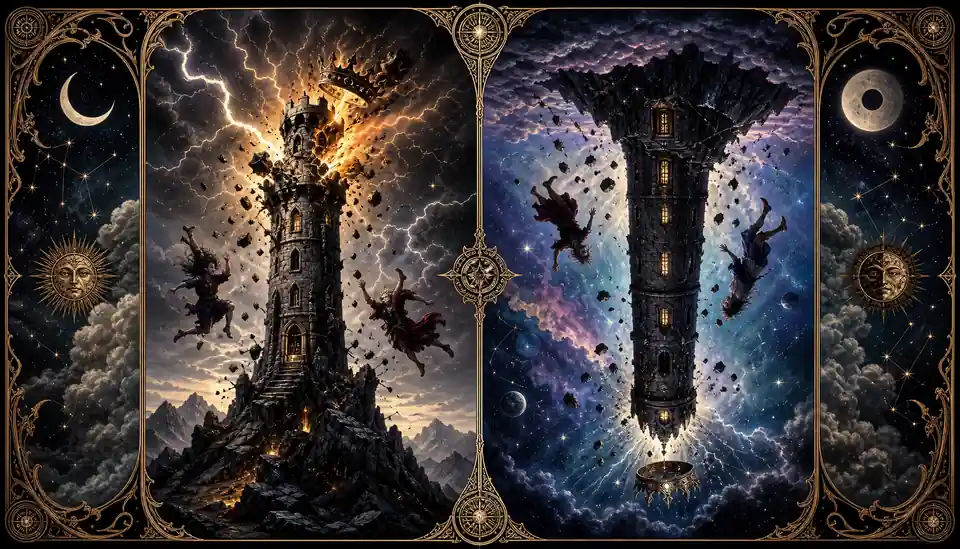
When you pull the Tower, the first thing to know is not that something terrible will happen. It means a situation that looked solid is being forced apart. The Tower upright often shows an outside event, a sudden shock or a truth coming to light; the Tower reversed often means you already feel uneasy but are still trying to hold the old pattern together. The message: the lightning didn't come out of nowhere. The tower was built on shaky ground long before.
Below, we break down the Tower's imagery, its upright and reversed meanings, how it reads in love and career, the most common misreadings and a practical way to judge it.
The Tower is one of the most intense cards in the Major Arcana. On the Rider-Waite card, lightning strikes the tower, the crown falls and people tumble out, showing a man-made sense of safety broken by a greater force. The real work of interpreting it is working out what is being torn down: a relationship, a belief, a career structure, or a fantasy you have been holding about something.
Key takeaways: the Tower is not simply a bad card. It shows an unstable structure being forced apart. Upright usually means a sudden event or a truth coming out; reversed usually means the problem is being held down or postponed, which is not necessarily safer. When you draw it, first find which foundation is failing, then use your question, the card position and the nearby cards to judge how big the shake-up is. If you feel anxious, don't redraw or make big decisions yet. Work through the damage-control checklist step by step.
The Core Answer: Not a Disaster Card, but Collapse and a Wake-Up Moment
The Tower is card XVI of the Major Arcana, and its most direct meaning is a built structure shattered by a sudden force. The image is dramatic, so many people tense up the moment it appears. But the Tower is not about plain bad luck. It points to something that was already unhealthy, untrue or impossible to keep up, now exposed in a forceful way.
In one line, the Tower is the card of “you can't pretend everything is fine anymore.” It can match a breakup, a fight, a company restructure, a cancelled plan, a secret coming out or a belief falling apart. It can also simply be the moment you suddenly see something clearly and can't go back to fooling yourself. The Tower is not only about material damage; it is just as often linked to mental structures, false assumptions and a self-image that collapses.
When reading the Tower, don't only ask whether disaster is coming. Ask which tower is falling. Is it a lie in a relationship, an unfair system at work, a high-risk money arrangement, or an idealized picture of someone? If your question already involves a relationship crisis, a risky partnership or a job change, the Tower usually pulls the answer back to the structure itself instead of offering comfort.
The Tower in the Fool's Journey
The Tower sits after the Devil and before the Star, and that order matters. The Devil often points to attachment, desire, bondage and things you refuse to face; the Tower is that attachment collapsing once it has been pushed to its limit; the Star is the healing, faith and new direction that come after the ruins. So the Tower is not an ending but the break point between being unfree and seeing clearly. For the full arc, see the 22 Major Arcana meanings and the Fool's Journey.
The Tower's Keyword Is Foundation, Not Fear
Many people remember only the lightning, the flames and the fall, and miss what the card is really asking: why did this tower fall? It usually isn't saying everything will be destroyed. It points out that the way something was built was flawed from the start. If a relationship is held together by suppression, a career by burnout, or a plan by luck, the Tower is the alarm telling you to check the foundation rather than only asking whether it will hurt.
- The heart of the Tower is not punishment but clearing away an unstable structure.
- First find which foundation can't hold, then look at what form the event takes.
- The Tower is often followed by healing and rebuilding, so don't read it as a final ending.
The Tower Upright: Sudden Change, Truth Revealed and a Forced Rebuild
The Tower upright usually means the shock comes more from outside events: a sudden breakup, an abrupt policy change, a partnership falling through, a plan flipped upside down, a secret exposed, or something you believed turning out to be false. The upright Tower has a “no time to talk it through slowly” feel. It is not a gentle nudge; the situation has reached the point where it must be faced. If your question is about the near future, upright often means change will arrive in a visible, hard-to-ignore way.
But the Tower upright does not mean every outcome is bad. It can also be a clean cut, a truth finally clarified, an end to stalling, or a fantasy broken. Say a relationship has been out of balance for a long time and both people keep the peace through silence. The upright Tower may be the argument that puts the problem on the table: painful in the short term, but it finally shows you whether to talk, leave or rebuild. Its value is turning a hidden problem into one you can deal with.
In practice, read the upright Tower together with its position. In the “present” position, the event has already started or the mood is very tense. In the “obstacle” position, it shows fear of change or an unstable factor in the environment. In the “advice” position, it isn't telling you to create chaos; it asks you to take down false assumptions yourself before outside forces do it for you. If you are still building your foundation in card meanings, the ultimate beginner's guide to tarot can help you practice reading positions.
Common Upright Signals
The upright Tower's signals are usually clear: sudden, revealed, out of control, reversed fortunes, rupture, shock. It may not be the outcome itself but a turning point. Ask “will this partnership go smoothly?” and an upright Tower doesn't necessarily mean permanent failure. It does mean the partnership's structure, division of responsibility or basis of trust has a serious problem, and if it isn't renegotiated, it is likely to blow up more violently later.
Don't Sugarcoat It, Don't Scare People Either
When reading the upright Tower, the worst move is to call it “just a small change, nothing to worry about,” because the person asking may miss the chance to check the risks. But you also shouldn't declare that disaster is certain. A responsible reading names the scope of the change, its possible source, what the person can control, and what needs checking right away. Reading the Tower well is about clarity, not fear.
When explaining the card, avoid defining the Tower with words like “bad” or “doom.” Framing it as “a prompt to adjust,” “truth revealed” or “structural reset” is closer to what the card is generally understood to mean. Also confirm the scope of the question first, and notice whether fear is making the person read the card as worse than it is.
- Upright leans toward visible outside shocks and turning points.
- It often brings truth to light, making a blurry problem clear.
- As advice, the upright Tower means facing things and rebuilding, not reckless destruction.
The Tower Reversed: Resisting Collapse, a Delayed Crisis and Inner Upheaval
The Tower reversed is often read as “the disaster will be smaller” or “you dodged a bullet.” Sometimes that holds, but it's incomplete. More often, the reversed Tower describes this: you already know something is wrong but still want to keep things looking stable; outwardly nothing has fallen, but inside it has started to crack. It's like covering a crack in the wall with a poster instead of finding the structural problem.
In real situations, the Tower reversed can mean change is postponed, conflict is suppressed, a breakup hasn't been said out loud, company problems aren't public yet, or anxiety is quietly building. It isn't necessarily safer than upright: upright at least lets you see the problem, while reversed can keep you stalling until it erupts in a messier form. If you ask “will this blow up?”, reversed often hints that someone is suppressing, hiding, enduring or avoiding, but the root problem hasn't gone away.
Reversed can also mean slowly recovering from a major shock. If a breakup, resignation, move or family upheaval has already happened, the reversed Tower can show that the worst collapse has passed and you are dealing with the aftershocks. Then the focus is no longer predicting the next blow, but helping you see which old structures shouldn't be rebuilt, which boundaries need resetting, and which decisions shouldn't be reversed just because the empty space feels scary.
Four Common Reversed Patterns
One is resisting change: knowing a relationship is unhealthy but talking yourself into staying. Two is a delayed crisis: the problem hasn't exploded yet, it's only being held down. Three is post-quake repair: the event has happened and you are clearing up the emotional and practical fallout. Four is incomplete change: change has started but only halfway, the old structure isn't fully cleared and the new order isn't in place, which can lead to confusion. Work out which pattern applies before reading it; don't automatically call it improvement or a smaller impact.
How to Tell Recovery From Stalling
Look at whether nearby cards show stability, repair or honest communication, such as Temperance, the Star or the Knight of Pentacles. These usually point to rebuilding after the shock. If the neighbors are the Moon, the Devil or the Seven of Swords, it looks more like concealment, avoidance or self-deception. When the reversed Tower lands in the advice position, it often asks: how much more energy will you spend propping up a situation that no longer fits you?
- Reversed isn't automatically better; the problem may just be postponed.
- Reversed can mean collapse on the inside while the outside pretends to be stable.
- If the event already happened, reversed can mark aftershocks, repair and rebuilding.
The Tower in Love: Breakups, Fights, a Situationship Ending or the Truth Coming Out
When the Tower shows up in a love reading, most people want to know one thing: does this mean a breakup? The answer: the Tower does often point to a strong shock to the relationship's structure, but it doesn't always equal a breakup. More precisely, some suppressed conflict, secret, power imbalance or gap in expectations can no longer be held together by just putting up with it. If both people are willing to be honest, the Tower can be the flashpoint before rebuilding; if one person only wants to avoid it, things are more likely to break.
In a stable relationship, the Tower upright can be a big fight, broken trust or a sudden clash of values. It can also be an outside event that makes the old dynamic impossible, such as distance, family pressure or a job change. The Tower reversed is more often a cold war, quiet endurance, pretending all is fine, or someone already wavering but afraid to say so. If you ask how the other person feels, the Tower doesn't necessarily mean there is no love; it means their sense of security, trust or picture of the relationship has been shaken.
In a situationship, the Tower often means the bubble bursts. You may find the other person isn't as invested as you imagined, or a single comment or action suddenly snaps you awake. This isn't the time to only ask “do they like me?” Better questions: “what makes this connection unstable?”, “am I mistaking ambiguity for romance?”, “can they actually follow through consistently?” If you're in that in-between stage, read more in the most common love signals during a situationship.
Drawing the Tower When You're in a Relationship
If you have a partner, the Tower usually asks you to check three things: whether there's a core conflict you have avoided discussing for a long time; whether one person is buying surface peace by putting up with things; and whether outside pressure is widening the cracks. The Tower isn't telling you to break up right away. It's reminding you not to replace real communication with “it'll probably get better.”
Drawing the Tower When You're Single or Dating
When single or in a situationship, the Tower is often about an ideal falling apart. You may suddenly see who the other person really is, or realize you were attracted to an image you projected. If the Lovers or the Two of Cups sit nearby, there may still be a chance to redefine the connection; paired with the Moon, the Three of Swords or the Devil, be careful of a lack of transparency, hurt and cycles of attachment.
- In love, the Tower means the relationship's structure is shaken, not that a breakup is certain.
- Upright leans toward things erupting; reversed toward cold wars, suppression or avoidance.
- In a situationship, the Tower often means a fantasy breaks and things must be defined.
The Tower in Career and Money: Job Changes, Plans Upended and Managing Risk
In career readings, the Tower upright often points to sudden workplace change: a reorganization, a new manager, a cancelled project, a partnership falling apart, an unstable role, or long-running problems surfacing all at once. It doesn't necessarily mean you'll lose your job, but it is rarely a sign that things will go smoothly as planned. If you're asking whether a new job will be stable, the upright Tower usually suggests checking the systems, contract, management style and company finances first, rather than being won over by surface perks.
The Tower reversed at work often shows up where everyone knows something is wrong but no one has said it yet: low morale, process gaps, wavering decisions from above, projects held together by a few people. Reversed can also mean you're avoiding change, such as knowing a job doesn't suit you but not daring to leave, or knowing a deal is unfair but taking it anyway. The card pushes you to ask: am I keeping things stable, or just postponing the cost?
With money, the Tower is a strong reminder about risk. It can point to unexpected expenses, an investment plan going sideways, a cash-flow break, too much leverage, or an income source you thought was safe suddenly in doubt. The Tower shouldn't be read as “you will definitely lose money,” but it is a very poor match for gambling on luck. If you're asking about investing, borrowing, starting a business or a big purchase, re-check the worst case, your contractual obligations, your cash flow and the loss you can actually absorb.
What to Look at in Work Questions
For work questions, first work out whether the Tower points to a change in the environment, a decision from above, team relationships, or your own career beliefs falling apart. If the Tower lands in the future position, keep a backup plan for the short term; in the advice position, it may mean you should update your résumé, clarify your responsibilities and stop accepting vague promises, instead of waiting to be told about the change.
Action Points for Money Questions
When the Tower appears in a money question, step one isn't panic but listing what you can and can't control. You can control your budget, insurance, contracts, emergency fund and borrowing levels; you can't control market swings, company policy or other people's reliability. When the Tower appears, the worst move is to dress up high risk as courage. Real courage is admitting the risk exists and setting a stop-loss line first.
- In career, the Tower usually means a system, plan or career assumption is broken.
- In money, the Tower warns against gambling on luck and over-leveraging.
- When the Tower appears, backup plans, contracts and cash flow matter more than optimism.
Common Myths: It Doesn't Always Mean Disaster and Shouldn't Be Used to Scare People
The first common myth is treating the Tower as a major disaster. It does carry impact, but a tarot reading isn't a verdict on your life from a single card. It may simply be a confession, a plan changing course, a relationship being redefined, or an inner awakening. Declaring “something big will definitely go wrong” without looking at the question, positions, nearby cards and real-life context is both crude and needlessly frightening.
The second myth is over-romanticizing the Tower and stopping at “the universe is clearing things out for you.” That has a spiritual-growth ring to it, but it skips the real-world consequences. The change the Tower brings may truly hurt and truly need handling: renegotiating contracts, moving, getting treatment, finding work or rebuilding a support system. A healthy reading acknowledges both the pain and the possibilities, rather than covering real stress with pretty words.
The third myth is assuming reversed means everything's fine. A reversed Tower in the obstacle position may actually point to avoidance, denial and suppression. In love and at work especially, the absence of an explosion doesn't mean safety; many problems get harder precisely because they go undiscussed for so long. With a reversed Tower, ask: who is holding back the change? Why is the truth not allowed to come out? What does dragging it out cost?
The fourth myth is calling the Tower “the worst card in tarot” or confusing it with Death. Death is usually a gradual ending and transformation, with its own rhythm like the turning of seasons; the Tower stresses a sudden, unpredictable shock where the point is truth being uncovered, not an inevitable ending or grief. When both appear together, the change runs deeper and is harder to undo. For the Tower's full meanings across positions and combinations, see the complete Tower card meaning.
- The Tower is not a one-card verdict; never read it apart from the question and the spread.
- Don't just scare people, and don't turn it into empty positivity either.
- Reversed doesn't mean safe; it often means facing things later.
- The Tower isn't the worst card, and it isn't the same as Death.
How to Read It in Practice: Using Position, Question and Nearby Cards
To read the Tower well, start with the question itself. Drawing the Tower for “will we get back together?” differs from drawing it for “how should I handle this relationship?” The first usually points to a serious crack or an unresolved truth on the road to reconciling; the second may be advice to stop following the old script and admit the relationship has changed. The Tower is unkind to vague questions: the vaguer the question, the more it shows only a blur of impact.
Step two is the position. The Tower in the past shows a break that already happened, such as a breakup, a resignation or broken trust; in the present, the shock is underway; in the future, a clear upheaval may come if the current pattern doesn't change; in the advice position, it says to take down false assumptions yourself; in the obstacle position, it usually means fear of facing the truth. The same card reads in a completely different tone depending on where it sits.
Step three is the nearby cards. With the Star, the Tower often brings healing and rebuilding after the shock; with Temperance, it calls for easing, repairing and rebalancing; with Death, the transformation can't be undone; with the Moon, the truth is unclear and fear is magnified; with the Three of Swords, emotional hurt is more obvious; with the Five of Pentacles, watch for issues of resources, loss and security.
Also, an upright Strength next to the Tower often shows you have the strength to rebuild after the upheaval; with the Lovers, there is still room for reconciliation and renegotiation.
Step four is calibrating the intensity. If the question is everyday or light, overplaying the Tower's negative side only causes needless panic; if the spread has few Major Arcana and feels calm overall, the Tower may just mean a small shift or an inner realization. First tell whether this is large-scale collapse or a local adjustment, then decide how much effort to put into responding.
A Four-Step Reading Process
First, confirm the area of life: love, work, money, health or personal growth. Second, confirm the Tower's position: is it describing what has happened, what is happening, what is coming, or giving advice? Third, check the tone of the nearby cards: are there repair cards, concealment cards, rupture cards or resource cards? Fourth, calibrate the intensity: how weighty is the question, and is the spread calm overall? Follow these four steps and the Tower stops being just “scary.”
Example: A Three-Card Love Reading
Say the question is “how will things go between us over the next month?” and the cards are the Moon, the Tower upright and the Star. The Moon shows current unease, guessing or unclear information; the upright Tower shows something hidden or held back will come out, possibly with a fight or a change in how the relationship is defined; the Star shows there's still room for calm repair after the shock. This combination shouldn't be read straight as a breakup. It suggests getting ready to face the truth and keeping room for clear-headed talk after emotions boil over.
Example: A Three-Card Work Reading
Say the question is “should I take on this partnership now?” and the cards are the Four of Pentacles, the Tower reversed and the Seven of Swords. The Four of Pentacles shows resources and terms being held tightly; the reversed Tower shows instability in the partnership's structure that is being kept quiet; the Seven of Swords warns that information is incomplete or someone is holding back. The advice isn't to refuse at once, but to ask for everything in writing first: clear responsibilities, payment milestones and exit terms. Otherwise vague promises are likely to cause conflict later.
- Look at the question first, then position and nearby cards, then calibrate intensity.
- In the advice position, the Tower often means taking down false assumptions yourself.
- The Tower with the Star or Temperance reads very differently from the Tower with the Moon or the Devil.
What to Do After Drawing the Tower: Questions, Actions and a Damage-Control Checklist
After drawing the Tower, don't rush to ask “is it all over?” Better questions: “Which structure is most unstable right now?” “What truth am I still avoiding?” “If change comes, what can I prepare first?” “Should I speak up and clarify things, or protect myself first?” These questions turn the Tower from a fear card into an action card. Tarot isn't there to give you a sense of fate; it helps you see your options before and after change.
In love, the next step can be to stop guessing and list what needs confirming: how the relationship is defined, boundaries around loyalty, future plans, how conflicts play out, and whether both people want to repair things. At work, back up your files, update your résumé, check your contract, keep records of communication and assess your financial cushion. With money, reduce high-risk exposure, keep an emergency fund and re-check spending and debt. The stronger the Tower feels, the more you need to turn vague anxiety into a concrete list.
If the Tower touches on health, safety, violence, legal matters or major financial risk, please don't rely on a reading alone. Tarot can help you sort out feelings and direction, but it cannot replace medical, legal, mental health or financial professional advice. The Tower's limits are clear: it can point out where things are unstable, but it can't guarantee the details of events, and it shouldn't be a reason to delay getting help. A mature reading means taking appropriate action once you've seen the warning.
Better Follow-Up Questions
Instead of asking “will something go wrong?” again and again, ask “what reality do I most need to face?”, “what can't be put off any longer?”, “what three things can I do first to limit the damage?”, “if I choose to stay, what condition needs rebuilding?” Questions like these bring the cards back to action and choice instead of trapping you in fear.
Let Your Emotions Settle First
Feeling scared after drawing the Tower is a completely normal reaction, and you don't need to force it down. To calm yourself, write down what you're worried about or talk to someone you trust to release some of the pressure; then bring your focus back to actions you can control instead of replaying the worst case. If anxiety is already affecting your sleep or daily life, please consider professional support such as counseling.
A Damage-Control Checklist for the Tower
First, pause major impulsive decisions, unless safety is at risk. Next, save key information such as contracts, messages and financial records. Then talk it over with someone you trust, so you're not looping alone in anxiety. Finally, set deadlines: decide when to talk, when to walk away and when to seek professional help. What the Tower fears most is you knowing things are unstable and gambling anyway; what it needs most is clarity and boundaries.
- Change “is it all over?” to “where is it unstable, and what can I do?”
- The stronger the Tower, the more you need a concrete backup plan and stop-loss line.
- For safety, health, legal or major financial matters, seek professional help as well.
References
If the Tower made you realize a choice is starting to shift, such as whether to stay or leave, write the two options down separately and use the two-option spread to compare how each might unfold, what it would cost, and the one thing you truly care about.
Start a Two-Option Reading