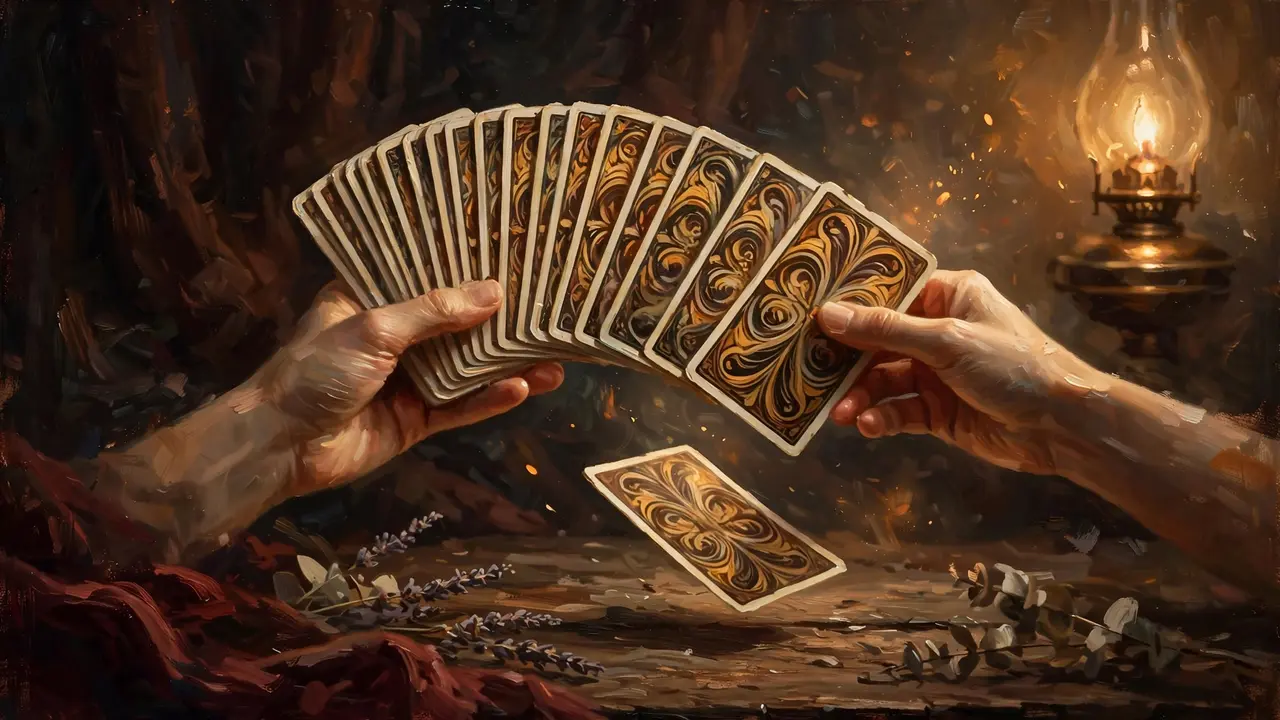
Many readers use the term jumper card for a tarot card that slips out of the deck while you shuffle. It shoots out between your fingers and lands on the table before you have drawn anything. A jumper card is not a bad omen, and you don't have to interpret it. It is more like a small hiccup in the shuffle: a slick deck, a loose grip or worn edges can all send a card flying. What does need handling is how you treat that card next. There are three common options. You can note it as a prompt card, put it back and reshuffle the whole deck, or let it not count this time and draw the spread in full. All three are reasonable. The key is to choose one before you shuffle, not to decide whether it counts after you have seen the card face. If the whole process is still new to you, a good place to start is a tarot reading.
The first time a card jumps, many people wonder whether that card is trying to tell them something. The feeling is natural. The rhythm of shuffling breaks, your attention snaps onto one card, and its image looks unusually vivid. But being eye-catching and carrying special meaning are two different things. Rather than worrying about what it means the second it hits the table, go back to the rule you set for yourself. If this reading's rule says it counts, read it as a reference. If the rule says it does not, put it back and keep shuffling. The sections below start with what a jumper card is and why cards physically fall out. They then cover the three ways to handle one, what to do when the Tower or Death jumps, how physical decks differ from drawing cards online, and how to adjust your shuffle if cards jump all the time.
What Is a Tarot Jumper Card?
A jumper card is any card that leaves the deck while you are shuffling or cutting. It might land on the table, in your lap or even on the floor. Sometimes a single card slides out; sometimes two or three escape together. It may land face up, so you see the image right away, or face down, showing only the back.
What defines a jumper is that you did not choose it. The normal flow goes like this: you shuffle with your question in mind, cut the deck, then turn cards over one by one according to the positions of your spread. Each position has a meaning agreed in advance. A common three-card layout uses past, present and future, for example, and another uses situation, obstacle and advice. A jumper card appears before the process ever reaches the drawing step. It has not been assigned to any position, which makes it fundamentally different from a card drawn into a position.
That is exactly why jumpers leave people unsure what to do. Does it count as part of this reading? Which position should it be read in? Should it be treated as an especially important message? There is no single answer, and different reading habits handle it differently. The steadier attitude is to accept first that it was an accident in the process. Then let a rule you set beforehand decide its fate, instead of letting the accident steer the whole reading.
If the basic steps of shuffling and drawing still feel unfamiliar, read how to shuffle and draw tarot cards first and get the normal flow clear. Once you know how each step is supposed to go, it becomes much easier to see which step a jumper interrupted and where to pick things back up.
Face-Up and Face-Down Jumpers
A jumper usually lands in one of two ways. Either it falls face up and you see the image before you were ready, or it falls face down and you only see the card back until you flip it. Many people feel the face-up card has more to say, simply because it appeared right in front of them.
A common view is that landing face up or face down does not change the meaning of the card itself. What changes is whether you have already seen it. A face-up card has been seen, so even if you put it back and reshuffle, part of you will remember it. A face-down card keeps your options open, because you can apply your rule before turning it over. If the rule says it does not count this time, you simply set it aside without flipping it. Some readers put this in their rule explicitly: face-down jumpers are never turned over, so the image cannot influence them.
Another frequent question is about reversals. A jumper that hits the table often lands at an odd angle: sideways, diagonal or completely upside down. Should it be read as reversed? If you normally read reversals, you can decide in advance that a jumper's orientation is whichever way it faces you when you pick it up. Or you can decide that jumpers are always read upright. Either works, and once again the point is to decide beforehand. For how and when to read reversed cards, see reading reversed tarot cards.
Think these three things through (face up, face down and orientation), and you will not need to make a judgment call in the few seconds after a card drops. You just follow the agreement you already made. With less hesitation in the moment, one unexpected image is far less likely to throw the rest of the reading off balance.
Why Do Cards Jump Out of the Deck?
Before looking at any symbolic meaning, look at the physical causes, because most jumper cards have a very practical explanation.
The first is a slick new deck. A freshly opened deck usually has a smooth coating, so there is very little friction between cards. A little extra force while shuffling sends one sliding out. After the deck has been used for a while and the surface wears in, jumpers usually become less frequent.
The second is shuffling technique. In a riffle shuffle, the kind used for playing cards, too much force as the two halves spring together makes cards fly off the edges. In an overhand shuffle, a loose grip or a fast push lets cards slip through your fingers. Tarot cards are usually bigger than playing cards, and people with smaller hands find it harder to hold the whole deck securely. That is another common cause.
The third is static. In dry weather or on certain table surfaces, cards can cling to or push away from each other, so a few of them separate more easily than the rest.
The fourth is worn edges or bent cards. With long use, corners can fray or lift, and humidity can make an entire deck bow slightly. A curved card does not sit flush in the stack and gets squeezed out during shuffling. If the same few cards keep jumping, those cards may simply be more bent than the rest or have thicker corners.
Rule these causes out first and you will see that most jumpers are ordinary and easy to explain. A jumped card can still spark a useful thought. The point is to know why it fell before deciding whether to read it. Taking things in that order keeps you much steadier and stops a moment of surprise from carrying you along.
Option One: Read It as a Prompt Card
The first way to handle a jumper is to treat it as a prompt card. You look at it, note it down and place it beside the spread, where it does not take up any position. Then you carry on as planned: shuffle, cut and draw a card for every position in the spread.
A prompt card works more like background music than the main melody. It can hint that some aspect of your question deserves attention, but it does not replace any positional card or override the structure of the spread. Say you are using three cards to ask about a work collaboration and a card from the suit of Swords jumps out. A common interpretation would treat it as a reminder about communication and judgment. After reading the three positional cards, you look back to see whether that theme echoes in them.
This approach suits people who like a few extra clues and are comfortable taking in more information. It has one catch, though: it is easy to give a prompt card too much weight. Because the card jumped out on its own, it is natural to feel it matters more than the positional cards, and the question the spread was meant to answer gets pushed aside. A better habit is to limit your reading of the prompt card to a sentence or two in the margin of your notes, rather than letting it become the conclusion of the whole reading.
If you pick this option, also decide in advance how many prompt cards you will note per reading. Some people only record the first jumper and put any later ones back; others allow a maximum of two. With a cap in place, several cards falling in a row will not turn the reading into a tangle. For the basics of the three positions and how they relate, see how to read a three-card spread. Read the positional cards carefully first, and the prompt card will not steal the show.
Option Two: Put It Back and Reshuffle the Whole Deck
The second option is the simplest. When a card jumps, put it back in the deck, reshuffle everything and draw as you normally would. The thinking is that a jumper just means the shuffle did not go cleanly, and since the process was interrupted, you start it over.
People who choose this usually value a clean process. They want every reading to contain only cards drawn into positions, with no extra variables. It is also a friendly choice for beginners. There is no need to work out how to read a prompt card, and the spread never gains an extra card that is hard to place.
Reshuffling does have a small trap. If the jumper landed face up, you have already seen it. If that same card then turns up in the spread after the reshuffle, you may feel it has come back on purpose and give it extra weight. When that happens, remind yourself that it now sits in a position and should be read for that position. It gets no extra weight just because it jumped earlier. Drawing the same card again and again over several days is a separate topic. Why the same tarot card keeps appearing covers repeated themes and how often you ask, which is different from a card jumping mid-shuffle.
The other thing to watch is endless reshuffling. If a card jumps again after you reshuffle, apply the same rule and reshuffle once more. But if cards jump on every attempt, stop starting over and check your technique or the condition of the deck. The last section, on shuffling technique, covers this. For now, remember that reshuffling exists to keep the process complete, not to keep going until you get a card you like.
Option Three: It Does Not Count, Draw the Spread in Full
The third option sits between the first two. The jumper does not count this time: you set it aside unread and keep drawing from the deck until every position is filled. Unlike option two, you do not return the jumper and reshuffle. It simply sits out this round.
The advantage is that the process barely pauses. You do not have to shuffle from scratch or read an extra prompt card. You move the card out of the way and continue where you left off. If you have already been shuffling for a while and feel focused, this lets you keep that focus instead of having to settle back in.
Keep in mind that, for this round, the card you set aside does not exist. It will not appear in any position, and you do not need to interpret it. If it jumped face down, it is best not to flip it at all. Lay it to one side and return it to the deck after the reading ends. If it landed face up, you have already seen it, so just tell yourself it does not count this time and leave its meaning alone.
Some people worry that removing a card makes the result incomplete. The general view is that a spread is about the positions and how they relate to each other. One card set aside for the round does not narrow what each position can draw much, because the deck still holds more than seventy other cards. How clearly you asked the question tends to affect the quality of a reading far more. See how to ask tarot questions for that. A well-asked question matters more than whether one card should count, and it helps the cards you draw respond to what you actually care about.
Write Down Your Rule Before You Shuffle
All three options are valid, and none is more correct than the others. What really muddles a reading is making up the rule after the card has already landed.
Picture this: a card that looks lovely jumps out, so you decide to keep it as a prompt card. Next time, a card that unsettles you jumps, and you decide it does not count. At that point the jumper is no longer an accident in the process. It has become a way to pick the results you want to see. A spread is valuable because it shows you information you did not expect. If the rule can change depending on which card turns up, the reading will only reflect what you were already hoping for.
So the most practical advice is to write your rule down before shuffling. Put it at the top of your tarot journal or in a note on your phone. It does not need to be long. For example: face-up jumpers are prompt cards, maximum one; for face-down jumpers, put them back and reshuffle the deck. Or simpler still: every jumper goes back and the whole deck is reshuffled. Once it is written, keep using that rule for a while instead of switching it every reading.
If after a while it does not suit you, you can of course adjust it. But the time to adjust is between readings, when you are calm, not the moment a card hits the table. In other words, changing your rule is fine; changing it after you have seen the card is not.
This small habit may seem fussy, but it lets you stay calm whenever a card jumps. You do not need to guess what the card intends. You handle it the way you agreed to, then bring your attention back to the question itself. Over time you will also get a clearer sense of which option best fits your own reading rhythm.
What If the Tower or Death Jumps Out?
What many people really fear is not the jumper itself. It is the jumper turning out to be the Tower, Death, the Ten of Swords or another card that looks frightening. When it lands face up with a striking image, it is hard not to tense up.
The short answer first: a jumped Tower or Death is not a forecast of disaster. Handle it in this order. First, use the rule you wrote beforehand to decide whether it counts. Second, only if the rule says it counts, read its meaning. Never reverse that order. Do not suddenly declare that it does not count because you saw the Tower. And do not make Death the centre of the whole reading because it jumped.
When your rule says it counts, interpret it the way you normally would. The Tower is generally interpreted as relating to sudden change, an existing structure coming loose, or finally seeing something that had been overlooked. Death is usually understood as the end of one phase and a move into the next, not literal death. Both cards carry a range of meanings, some uncomfortable and some a relief. Read in the context of your question, the card raises a question of its own: is there anything here that no longer fits and needs to be let go?
When your rule says it does not count, let it truly not count. It may stay on your mind, which is perfectly normal: your attention was just interrupted and that card grabbed it. Take a deep breath, remind yourself that this reading's rule has already dealt with it, and bring your focus back to the spread.
The most important point: do not change your rule out of fear. The whole value of a rule is that it keeps your judgment steady when your emotions are running high.
Jumper Cards Versus Drawing Cards Online
Jumper cards only happen with physical decks. When you draw cards on a website or app, the system shuffles the cards at random and then lets you tap them or turn them over in order. There are no fingers and no tabletop, so no card can slip out of your hand.
The difference is revealing, because it shows what a jumper really is: a side effect of handling physical cards. The card stock, the size of your hands, the force of your shuffle and the day's humidity all affect whether it happens. None of those variables exist online, so you never have to decide whether a jumper should count. If jumpers bother you often, or you keep changing the rule after a card lands, switching to an online draw now and then can help. It keeps your attention on the question and the card meanings.
Physical decks have their own advantages, though. Many people use the time spent shuffling by hand to sort through their thoughts and slow down, and that rhythm is a big reason they love a physical deck. Jumpers are an occasional interruption in that process. Once you know how to handle them, they will not spoil the experience.
Neither is better; they simply suit different situations. You might use a physical deck when you want to take your time with a question, and draw online when you want to sort out a question quickly. Whichever you choose, the core of reading stays the same: ask a clear question, read the cards by position and relate their meaning to your own situation. The tool is only a way in. What makes a reading useful is looking honestly at what comes up and finding one small change you can make next.
If Cards Jump Often, Practice Your Shuffle First
If cards jump almost every time you shuffle, treat that as a sign to work on your technique, not as a message. Frequent jumpers do not mean the deck is protesting, and they do not mean you and the cards are a bad match. Most of the time your hands simply have not gotten used to the deck yet.
There are a few ways to adjust. First, slow down. Many jumpers come from shuffling too fast or too hard, and cards are less likely to fly at a slower pace. Second, try a different method. If riffling keeps sending cards out, spread the deck face down on the table and mix it slowly in circles with both hands. This method rarely produces jumpers and is gentler on the cards. Third, work in small stacks. When your hands are small or the cards are large, split the deck into two or three piles, shuffle each one, then combine them. You will have a much steadier grip.
You can also check the deck itself. If the whole deck is slightly bent, lay it flat under a heavy book for a while. If a few cards have lifted corners, keep an eye on where they are when you shuffle. If a new deck is too slick, shuffle it more and use it for a while, and the surface usually becomes easier to handle. Storing the deck away from damp places also reduces warping.
After these adjustments, jumpers usually happen less often. When one still happens, handle it with the rule you wrote down. Treating jumpers as a technical issue rather than an emotional one takes the pressure off your relationship with the deck and lets you focus on what you really want to ask. After all, shuffling is there to help you get ready to face your question. Once your shuffle feels smooth, your mind tends to settle too.
References
Shuffle, set your rule, and bring the question you want to clarify to a tarot reading. Then relate the card meanings to your own situation.
Start a tarot reading