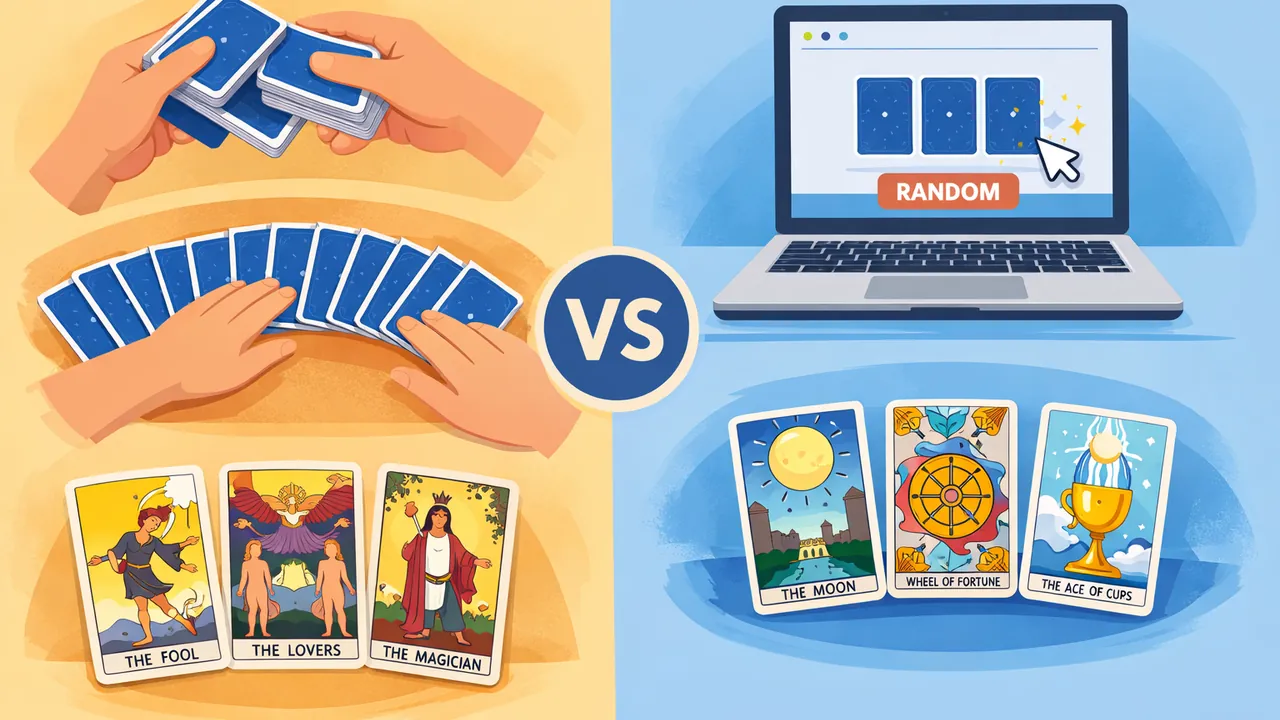
It is not more accurate, and it is not less accurate. Whether you shuffle by hand or let a computer draw, the cards you get are random. The real difference is the process: a hand shuffle gives you a few minutes of touching the cards and settling down, while an online draw is available anytime and does not require you to learn any shuffling technique first.
If you are searching for this, there is usually a worry behind it: "Are the cards I draw on my phone less connected to me than ones I shuffle myself?" or "Could a computer draw be rigged?" Below, the two methods are compared side by side, then you will see how Askaseer actually shuffles and draws, and finally how to stay steady and ask a clear question when drawing online.
Key points: (1) Both methods produce random cards; neither is more accurate. (2) The difference is ritual, convenience and how you focus, so pick whichever suits you in the moment. (3) What really shapes the quality of a reading is how specific your question is and how calm you are when you read the cards.
Hand shuffle vs online tarot draw: what is the difference?
Start with the comparison table. On randomness the two are equal; the differences all come down to the situation you are in.
Comparison | Manual shuffle (physical deck) | Online draw (Askaseer as an example)
How the order gets mixed | Mashing, overhand shuffling and cutting break up the card order | The browser's built-in secure random generator fully shuffles the whole deck in one go
Can a card repeat | No, a deck has only one of each card | No, each card appears at most once in the same draw
Where upright and reversed come from | Mashing naturally mixes card directions; some people also turn one pile around after cutting | Every tarot card has an even 50/50 chance of being upright or reversed
What you need | A deck, a clean table, about ten minutes | A phone or computer, done in a few minutes
Common sticking points | Clumsy technique, cards flying out, a new deck not shuffled enough | So convenient that it is easy to keep redrawing the same question
Best for | Slowing down, enjoying the feel of cards in your hands | Being out, having no deck at hand, wanting to see a reading right away
How Askaseer actually shuffles and draws
Many people distrust online draws because they do not know what happens after they press the button. Here is the actual process on Askaseer:
1. Choose a spread and start shuffling: a shuffle animation plays on screen.
2. When the draw screen opens, the whole deck is fully shuffled once: the system uses the browser's built-in secure random generator (crypto.getRandomValues) to set the card order for this draw. Whether it is the 78-card tarot deck or the 36-card Lenormand deck, every card has the same chance of appearing, and no card repeats within the same draw; each tarot card also has a 50/50 chance of being upright or reversed.
3. You tap the cards, and they turn over in the shuffled order: each tap flips the top card of the shuffled pile and places it in a position. This works the same way as dealing a physical deck from the top after shuffling.
4. The AI writes your reading from your cards and your question: the reading is based on the cards drawn, their positions and the situation you described. Which cards you get is never adjusted according to what you asked, and nobody behind the scenes picks cards for you.
So you can set aside the worry that a computer draw is manipulated. What an online draw lacks is the feel of the cards, not randomness.
What about "shuffling by hand connects you to the cards"?
Some people believe that shuffling by hand puts your energy into the deck, so the reading is more accurate. It is a common idea in divination traditions, and for many people it really does mean something: during those minutes of shuffling, your attention pulls away from your phone, work and errands and settles on one question.
But stretching that into "hand-shuffled cards are accurate and online cards are not" has no basis. Which card comes up is random either way; what shuffling actually changes is your state of mind while you read. In other words, focus helps the reading, not the drawing.
That also means an online draw can have its own ritual: put your phone on Do Not Disturb, take three deep breaths and repeat the question silently before you draw. What you need is a moment to settle yourself, not necessarily a physical deck. For more on calming your mind before a draw, see why to meditate before a tarot reading.
How to shuffle tarot cards by hand: three common methods
If you prefer a physical deck, any of these three methods works. Use whichever feels natural:
- Mashing (swirling the cards on the table): spread the cards face down and stir them around in circles with both hands, then gather them into a pile. It is gentle on the cards and naturally mixes their direction, so upright and reversed cards blend easily. Great for beginners.
- Overhand shuffle: hold the deck in one hand and, with the other, pull a small stack from the middle and drop it on top, repeating several times. Cards rarely fall, so it works on a small table or even standing up.
- Cutting: after shuffling, split the deck into three piles and stack them back in an order of your choosing. Many people go over their question once more while cutting, as a final step before drawing.
There is no set length of time, but not shuffling enough really does happen. New decks come in numbered order, so shuffle several extra rounds the first time; two or three passes do not truly break up the order. Normally, shuffle until the cards feel mixed and your mind feels settled, then begin. If a card flies out, just put it back and keep going; some people note jumping cards as a hint, which is a personal habit and does not affect the cards you formally draw. For full shuffling, cutting and drawing steps, see Shuffling: the first step of a tarot reading.
Staying calm and asking clearly when you draw online
1. Write your question as one specific sentence: ask about one thing at a time, with a time frame and what you can do. For example, change "Does he still love me?" to "We have not spoken for a week. If I reach out first over the next month, where is the relationship more likely to go?" The more specific the question, the more the reading can respond to your situation. For tips, see how to ask tarot questions.
2. Give yourself 30 seconds before drawing: turn off notifications, take three deep breaths and repeat the question in your head. If you are angry or have just been crying, write the question down and draw a bit later.
3. Do not overthink which card to tap: go with your feeling in the moment. Every card has the same chance of being turned over, so there is no "wrong" tap.
4. Note the reading down before anything else, and do not redraw right away: drawing the same question again and again in a short time only gives you more conflicting answers. Use follow-up questions for anything unclear, and ask again with new information once the situation has changed. For timing, see how often to read tarot.
5. Treat the reading as a reference for sorting out your thoughts: the cards can show angles you had not considered, but your next step still has to be weighed against the real information you have.
Which method when? Three everyday examples
- Say you want to unwind from a day of work stress before bed: you have a deck and time, so shuffle a physical deck slowly, let the shuffle become part of relaxing, and draw one card as a reminder for the day.
- Say a message from them arrives during your commute and you do not know how to reply: an online draw is more practical here. Write down "What did they mean by this message, and how should I reply?", draw three cards and look at where you stand and how you might respond.
- Say you are torn between two job offers: either method works. The key is to write the two options out separately first and compare how each could unfold and what it would cost using the two options spread. Once you pick a method, draw only once for that question; do not draw by hand and then again online to compare.
Whichever method you use, tarot is a tool for organizing your thoughts. For decisions involving health, legal matters or large sums of money, rely on a doctor, lawyer or qualified professional, and treat the cards only as a reference while you think.
Want to try an online draw yourself? Write the question you most want clarity on as one sentence, draw your cards, and let the AI pull out the key points based on the cards you drew and your situation.
Draw for your question