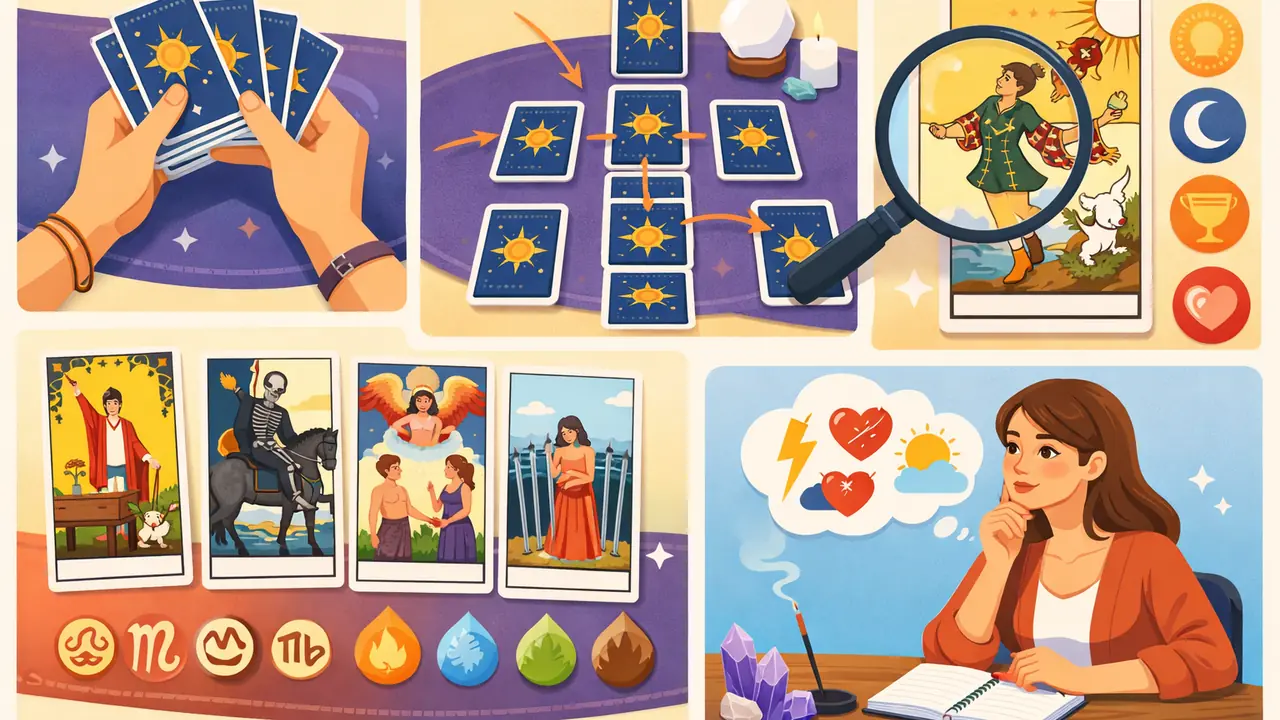
Reading tarot images isn't about guessing what the artist meant. Look at four things in order: what the figure is doing, what they are holding, the setting around them, and the symbols that keep coming back. Once you've looked at those four, most of the card's meaning is already visible, and you can fill in the rest from the card meanings.
Take the Eight of Swords. A woman stands blindfolded and bound with cloth, surrounded by eight swords. Look more closely, though: her feet are free, the swords don't fully close her in, and she could take the blindfold off if she chose to. So the card isn't about having no way out. It's about feeling trapped. Some of the limits are real, and some come from not being able to see the exit yet.
The image descriptions here follow the Rider-Waite-Smith system, the deck most people start with. Other decks draw the cards differently, but the same reading order still works.
Four Steps to Reading a Tarot Card
1. Start with what the figure is doing. Are they standing, sitting, lying down, walking away, or turned away from you? The action is often the heart of the card. The figure in the Eight of Cups turns away from eight cups and walks toward distant mountains, so the card is about leaving. The figure in the Nine of Swords sits up in bed with their face in their hands, so it speaks of anxiety and sleepless nights.
2. Next, look at what they hold. Do they grip it tightly, leave it on the ground, or hand it to someone? The figure in the Four of Pentacles clutches a coin to their chest and keeps two more under their feet: holding on. In the Two of Cups, two people offer their cups to each other: an exchange that goes both ways.
3. Then look at the setting. Is it indoors or outdoors, day or night, sunshine or snow? In the Five of Pentacles, two people trudge through the snow past a lit stained-glass window. Besides hardship, the card is often read as missing the support that is actually close by.
4. Finally, look for recurring symbols: pillars, water, mountains, animals, flowers. They show up again and again across the deck with similar meanings, and the table below gives you a quick reference.
After the four steps, say in one sentence what you think the card is about. Then look up the meaning and compare what you saw with what the book says. What stays with you then is a picture, not a string of keywords.
Common Tarot Symbols at a Glance
Symbol | Common meaning | Where it appears
Twin pillars | Standing between two forces, a threshold, a need for balance or a choice | The High Priestess (one black, one white), The Hierophant, Justice
Infinity sign (a sideways 8) | Endless energy, mastery, cycles | Above the heads of The Magician and Strength; the band linking the coins in the Two of Pentacles
Blindfold | Not seeing, choosing not to look, holding off judgment | Two of Swords, Eight of Swords
Water | Emotions, the subconscious, flow | Common in the Cups suit; the water poured out in The Star, the pool in The Moon, the water behind The High Priestess
Mountains | Goals, challenges, ideals still far away | The distant peaks behind The Fool, The Hermit on a summit, the mountain between The Lovers, the far hills at the end of The Moon's path
Roses and lilies | Red roses usually stand for passion and desire, white lilies for pure intention | The Magician's garden; the white rose in The Fool's hand; the white rose on Death's banner
Dog and wolf | Tamed instinct and wild instinct | The dog and wolf in The Moon; the white dog at The Fool's feet
Crayfish | Fears or thoughts rising from deep in the subconscious | The Moon (crawling out of the pool)
Sun and sunflowers | Clarity, vitality, being seen | The Sun; the sunflower in the Queen of Wands' hand
Chains | Bondage, but often the kind you can undo yourself | The Devil (the chains hang loosely around the two figures' necks)
This table is a starting point, not a formula. The same symbol carries a different weight on a different card or in a different question, so always read it alongside the figure's action and the setting.
Four Cards, From Imagery to Meaning
The Fool: A Figure at the Cliff's Edge
The image: a young person walks forward with their head held high, right at the edge of a cliff. They carry a white rose in one hand and a stick with a small bundle over one shoulder. A white dog follows at their feet, with the sun and distant mountains behind them.
Turning details into meaning: looking up instead of at the path means setting out with curiosity and trust, not knowing what lies ahead. The small bundle means traveling light, with little experience and little baggage. The white rose stands for a pure heart. The cliff says the risk is real. The white dog is often read as instinct and intuition keeping them company. Put together, that's the core of The Fool: a new beginning full of possibility, as long as you know you're walking near the edge.
Back to the question: if you ask whether to switch to a completely different career and draw The Fool upright, the image offers both encouragement and a warning. You can set out, but first see where the cliff is, for example by saving enough to live on during the transition and keeping a fallback.
The High Priestess: Seated Between Two Pillars
The image: a woman sits quietly between two pillars, one black and one white, marked B and J. Behind her hangs a veil covered in pomegranates, a half-rolled scroll rests in her lap, and a crescent moon lies at her feet.
Turning details into meaning: she sits still, so this isn't an action card but one of waiting and watching. The black and white pillars place her between two forces, in no hurry to pick a side. The veil and the half-rolled scroll point to information not yet spoken or laid open. The crescent moon ties her to intuition and the subconscious. That's why The High Priestess is usually read as: the answer hasn't fully surfaced yet, so keep watching, and trust what you sense but can't yet put into words.
Back to the question: if you ask what the other person really thinks and draw The High Priestess, the image is telling you the information is incomplete. Rather than keep guessing, watch a while longer, or find a chance to ask them directly.
The Moon: A Dog, a Wolf and a Crayfish by the Path
The image: a moon hangs in the night sky, and a path runs from a pool to the distance between two towers. Beside the path a dog and a wolf howl at the moon, and a crayfish crawls out of the pool.
Turning details into meaning: things are hard to see by moonlight, which points to uncertainty and misreading. The dog and the wolf show both tamed and wild instincts stirred up. The crayfish climbing out of the water is a buried fear coming to the surface. The path still leads on, so there is a way forward; it's just hard to see while you walk it. The Moon is about fog and unease, which isn't the same as someone deceiving you.
Ten of Swords: Light in the Darkest Sky
The image: a figure lies face down with ten swords in their back under an almost black sky. Yet a band of light breaks along the horizon, and the water ahead is calm.
Turning details into meaning: ten swords means the pain has hit bottom and can't get worse. The light on the horizon says that once this chapter ends, day will come. The Ten of Swords is a heavy card, but the image already gives half the answer: this is an ending, the lowest point before starting again.
Three Common Mistakes When Reading Card Images
- Judging upright or reversed from a figure's expression: upright and reversed depend only on the card's direction when drawn. If it comes out right side up, it's upright; upside down, it's reversed. The figure's expression and the surrounding cards have nothing to do with it.
- Forcing one meaning onto one color, such as "red always means passion." Read color in the context of the whole card. The same red leans toward power and will on The Emperor's robe, and toward drive and action on The Magician's cloak.
- Drawing a conclusion from a single symbol: seeing The Moon and saying someone is lying, or seeing Death and predicting disaster. Read symbols together with the figure's action and the setting, and with your question and the card's position.
What If Your Deck Looks Completely Different?
If you use another deck, the figures and symbols may look nothing like the examples above. In the Tarot de Marseille, for instance, most Minor Arcana cards show only an arrangement of suit symbols with no scene, so you'll lean more on numbers and suits. When you switch decks, read that deck's guidebook first to understand what its creator meant to draw, then apply the same four steps.
A Daily One-Card Practice for Reading Images
The most effective practice is to draw one card a day and, before looking up its meaning, spend three minutes writing down what you see using the four steps: what the figure is doing, what they hold, what the setting is like, and which symbol stands out most. Finish with one sentence on what you think the card is saying. Then check it against the complete tarot card meanings and see what you missed, and where your own reading actually fits your situation better than the book.
Keep this up for a month and you'll find you remember many cards without memorizing them. To make the meanings stick even better, read how to remember tarot card meanings, which links the 56 Minor Arcana cards through numbers and suits.
The quickest way to practice reading images is to draw for a question you truly care about. Say what you see on the card first, then compare it with the reading to see which details you already catch and which you haven't noticed yet.
Draw for your question