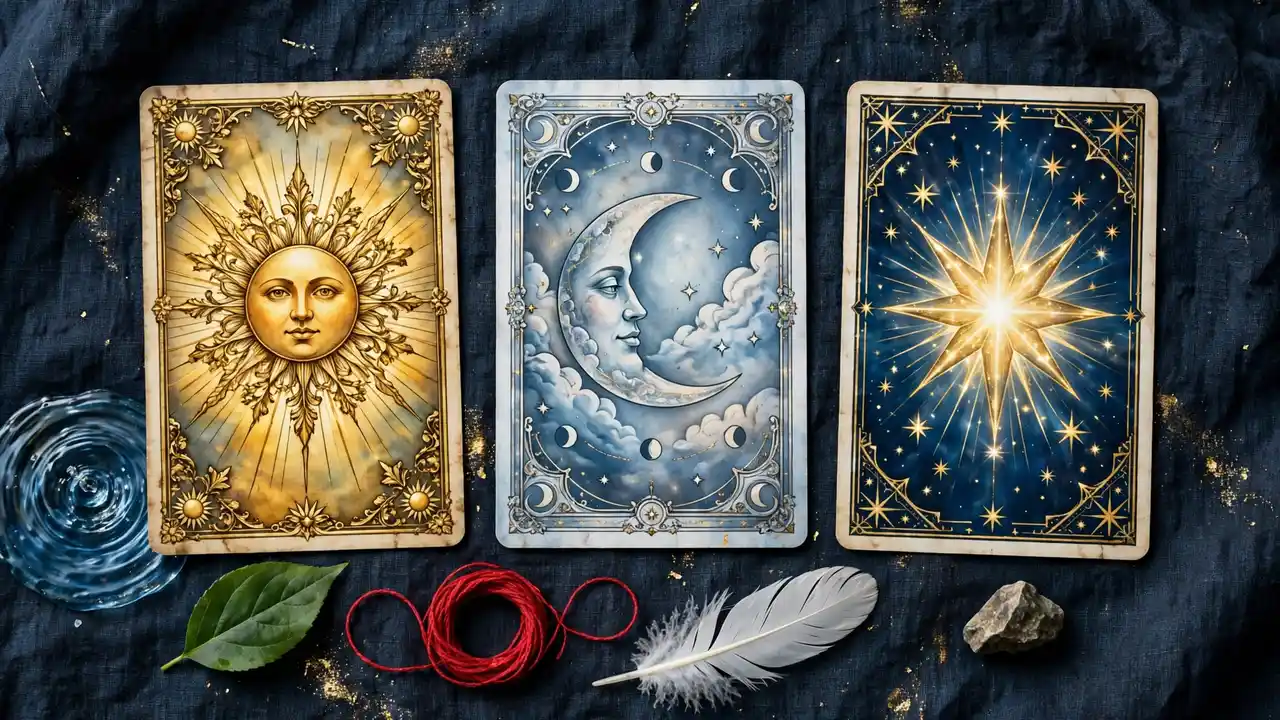
Drawing a card and suddenly blanking on its meaning happens to almost everyone who learns tarot. The good news is that you do not have to memorize every meaning, because the picture on each card is itself a hint. Is there a sun or a moon in the sky? Is there running water or a tall mountain on the ground? Is the figure dressed in red or in blue, striding forward or sitting with their head bowed? All of these are clues you can read directly from the card. The meanings of tarot card symbols and colors repeat across many cards, so once you recognize a handful of them, you can say roughly what a card is about even when the book explanation will not come back to you. If you do not have a deck at hand and want to feel what drawing and reading a card is like first, you can start with a tarot reading.
Below are ten of the most useful visual clues, grouped into five kinds: the sky, the ground, colors, body posture, and numbers and repetition. After them comes a three-step method you can fall back on whenever a meaning escapes you. The method is not meant to replace card meanings; it gives you a starting point that begins with the picture: notice first, then compare, then join everything into one sentence. The more cards you read this way, the more you will see that the picture and the meaning are two ways of saying the same thing, and memorizing meanings becomes much easier as well. Keep in mind that the color and symbol meanings described here are commonly read interpretations, not absolute rules. In a real reading, always come back to your question and to the card as a whole, and let the clues support each other rather than letting one detail decide everything.
Why Look at the Picture First When You Forget a Meaning
The picture on a tarot card is not decoration; it is the meaning drawn out in shapes and colors. In general interpretation, every element on the card adds something to its theme. How bright or dark the sky is tells you whether things can be seen clearly. What the figure is doing tells you whether this is a moment of action or a moment of waiting. The water, mountains and plants in the background describe the kind of environment the situation is unfolding in. So when the textbook explanation slips your mind, most of the answer is already sitting right in front of you.
Even more useful, the same set of symbols keeps returning across different cards. The sun does not only appear on The Sun; it shows up in the background of other cards too. Water is almost everywhere in the suit of Cups, and it also appears on The Star, The Moon and several numbered cards. Mountains often stand quietly behind a figure. Learn one symbol and you gain a key that opens several cards at once. That is why many people eventually find that, rather than memorizing card after card in isolation, it works better to get familiar with the recurring symbols first, and the meanings start to connect on their own.
If you want the full symbolism and meaning of each card, see the symbolism and meanings of all 78 cards. If you want a ground-up overview of the kinds of images that appear on tarot cards, read the complete guide to tarot imagery. The skill practiced here is different: the card is already face up, your mind has gone blank, and you need to read the clues with your eyes first instead of rushing to a book or giving up on the reading altogether.
Clues in the Sky: The Sun, the Moon and the Stars
The sky is the part of the picture people overlook most often, yet it sets the mood of the whole card. Look at the top of the card first. You will usually find one of three light sources, and each one describes a different state.
The sun is commonly read as clarity, truth and vitality. Where sunlight falls there are no shadows, so when the sun appears it often suggests that things can be seen plainly, and that your mood is brighter and you have the energy to move forward. On The Sun, a large sun hangs high in the sky while a child below opens their arms, and there is hardly a hidden corner anywhere on the card. It is generally interpreted as openness, joy and a situation becoming clear.
The moon is the opposite. It is commonly read as unease, the unconscious and not seeing clearly. Moonlight is borrowed light: it shows outlines but not details, so when the moon appears it often hints that your current judgment may be mixed with imagination and worry. On The Moon, a narrow path leads into the distance, a dog and a wolf howl at the moon on either side, and something is crawling out of a pool. The whole picture seems to say that the road ahead is not clear yet, so do not rush to a conclusion.
The stars are commonly read as hope, healing and guidance from afar. Starlight is not as strong as the sun, but it can still point the way in the dark. On The Star, one large star shines among several smaller ones, while the figure below quietly pours water back into the pool and onto the land, giving a feeling of slow recovery after a storm.
Put the three cards side by side and you will notice that the strength of the light matches the strength of the state: the sun is full brightness, the stars are a faint light with a direction, and the moon gives light without clarity. Next time you draw any card, check which kind of light is in the sky, and you have already read half the atmosphere.
Clues on the Ground: Water, Mountains and Plants
After the sky, look at the landscape under and behind the figure. Clues on the ground describe the environment the situation is happening in and what you are facing right now.
Water is the most frequent landscape symbol. It is commonly read as emotion, the unconscious and flow. A calm surface usually suggests steady feelings and a clear inner state; a rushing river or rolling waves hint that emotions are churning or that circumstances are changing. Water pouring out of a vessel is often interpreted as giving and sharing feelings, while a figure standing at the water's edge or turning their back to it may be facing or avoiding their own emotions. Nearly every card in the suit of Cups shows water, which ties that suit closely to themes of feeling and relationships.
Mountains are commonly read as obstacles, tests and heights that need to be climbed. A mountain far in the distance usually means a goal or challenge is still some way off; a mountain directly behind the figure may mean a hard stretch has already been crossed; a figure standing on a summit is often read as a widening view and the ability to see further. Pay attention to the color of the mountain too: snowy white peaks feel cool and remote, like a state that takes time and patience to reach.
Flowers and plants are commonly read as growth, joy and things already in motion. Flowers in full bloom suggest that something is coming to fruition; dense trees and vines describe a rich, lively environment; bare or withered plants hint that a phase is winding down. The sunflowers on The Sun and the field of grain around The Empress both use plants to say that something here is growing.
When you read the ground, ask yourself one simple question: if I were standing inside this picture, would the ground under my feet feel steady, wet or steep? That feeling is often exactly the situation the card wants you to notice.
A Color Guide: Six Common Tarot Colors
Color is the most direct emotional signal on a card. Sometimes you feel whether a card is warm or cold before you have even worked out what the figure is doing. Here are the six colors that appear most often in tarot symbolism. Their meanings are common interpretations, not absolute rules.
Red: action, passion and desire. Red often appears on cloaks, banners and roses. It describes energy pushing outward and the urge to go after what you want. Cards with a lot of red usually carry initiative, drive or strong feeling.
Blue: calm, intuition and the inner world. Blue is common on robes, skies and water, and it feels quiet and inward-looking. Cards with a lot of blue often suggest listening to your intuition before you act.
Yellow: clarity, joy and understanding. A yellow sky or golden light is commonly read as a clear mind and a bright mood, as if something has finally clicked into place.
Green: growth, healing and balance. Green usually comes from grass, trees and clothing. It suggests that something is slowly growing, or that a relationship or state of mind is recovering and settling into harmony.
White: purity and new beginnings. White horses, white clothing and white flowers often carry a sense of cleanliness, simplicity and a fresh start, and they also stand for possibilities that have not yet taken on any color.
Black: the unknown, endings and what has not been seen yet. Black is not automatically bad. It is more like a door that has not opened, reminding you that some things are not visible right now, or that one phase is ending and handing over to the next.
When you use this guide, first notice which color covers the largest area of the card; that is usually its main tone. Then look at the colors the figure is wearing, which often describe the energy the figure carries. For example, a yellow background with a figure dressed in red can be read as taking action from a clear state of mind. Color gives you the tone of voice; in the end you still return to the card's theme and to your question.
Body Posture and the Direction of the Gaze
If there is a person on the card, their body is the most direct clue of all. Posture tells you whether the card's energy is active or waiting, and the direction of the gaze shows where attention is being placed.
Start with standing or sitting. Figures who are standing, walking or riding a horse are commonly read as energy in motion, progress, or a call for you to take the initiative. Figures sitting on a chair or throne are often interpreted as stability, control and holding on to what is already there, and sometimes as a need to stop and think. Figures lying down or kneeling often carry a sense of rest, acceptance or humility.
Next, check whether the figure faces left or right. A common view in general interpretation is that a figure facing right looks toward what lies ahead and the future, with a feeling of moving forward and welcoming what comes. A figure facing left seems to look back at the past, suggesting reflection, review or lingering attachment. A figure looking straight out at you is often read as direct, honest and dealing with things in the present moment. This directional reading does not fit every card, but when a meaning escapes you it is a very handy place to start.
Finally, notice whether the head is bowed or raised. A bowed head is often linked to contemplation, sorrow or focus on what is right in front of you. A figure looking up at the sky or into the distance often carries expectation, longing or a search for answers. If the figure is looking down at something that has fallen, the card may be speaking about a loss that is hard to let go of; if the figure is gazing up at a light, it may be describing a direction your heart wants to follow.
When reading posture, try putting yourself in the picture. Sit or stand the way the figure does and notice whether it feels like a body getting ready to set off or a body that wants to pause. Very often, that physical sense tells you the answer faster than any written explanation.
Numbers and Repeated Elements
Beyond the symbols themselves, how many of something there are is also a clue. Whatever repeats within a single picture usually marks a theme of special importance; the card is using quantity to say, look here.
For example, if water is everywhere on the card, in a pool, a waterfall and a stream pouring from a vessel, then emotion and the unconscious are likely the core of the card. If the sky is full of stars, the sense of hope and guidance is amplified. If the background is lined with the same flower or the same object, the meaning of that object deserves a closer look. Repetition is emphasis, and it is the simplest and most dependable rule in reading pictures.
The numbered cards carry information about quantity as well. On each Minor Arcana card, the number of objects shown is the card's number, and general interpretation often treats the numbers as stages of a process. One is a beginning, like a seed. Two and three bring early interaction and first results. Four is often linked to stability and stopping. Five tends to carry change or conflict. Six suggests exchange and balance. Seven is often about tests and choices. Eight is movement and adjustment. Nine is close to completion, and ten closes a cycle. This is not a formula to memorize rigidly; it simply shows that the higher the number, the closer things usually are to the end of a stage.
Also watch for anything that appears only once. If the whole scene is busy but one object sits alone in a corner, that lonely object may be the key. Repetition shows the theme, and the single item shows the focal point. Read them together and the picture gains depth.
Try this in practice: after turning over a card, count what appears most often and what appears only once, and write one word for each. Put those two words side by side and you often have the skeleton of the card's message.
A Practical Three-Step Method, Shown With The Sun
So far we have covered symbols, colors, posture and quantity. Now let us turn them into steps you can use with any card. The method has only three steps; you just need to remember the order.
Step one: name the three most visible things in the picture. Do not think about the meaning, and do not worry about the card's name. Use only your eyes and say whatever you see first. You can say it aloud or write it down, but keep to the simplest nouns, such as sun, child, white horse.
Step two: compare each item with the symbol and color meanings above. The sun is clarity, truth and vitality. The child can be read as innocence, a new beginning and openness. The white horse combines the color white with the movement of an animal, so it can be read as pure strength moving forward. If something is not on the list, ask yourself how it makes you feel and describe it in one word.
Step three: join the three clues into one sentence; that sentence is the card's answer to your question. With The Sun, the three clues might become: in a clear and bright state, with an open heart, let your strength move forward naturally. Suppose your question was about a new proposal at work. The sentence could then be read this way: the direction is actually quite clear, you do not need an elaborate strategy, simply share your idea openly and keep moving it forward.
Now compare this with the common meaning of The Sun. General interpretation speaks of joy, openness and things going smoothly, which matches the direction you read from the picture almost exactly. That is the value of the three-step method: it is not guessing, it is reassembling clues the card already placed in front of you.
Your question matters too if you want the sentence to fit your situation. The more specific the question, the more easily the three clues line up. See how to ask tarot questions to sharpen your question first, then come back and read the picture.
Common Mistakes: Do Not Rely on a Single Clue
Reading from the picture works well, but there are a few common mistakes. Watching out for them makes your readings steadier.
The first mistake is treating color as a fixed answer. Seeing black and assuming something bad, or seeing red and assuming there must be conflict, easily pulls a reading off course. Color is a tone of voice, not a verdict. Black in a night sky may speak of the unknown and of waiting, while black on clothing may suggest dignity and protection. Red may mean passion, or it may mean impulsiveness. Color has to be read together with the other things in the picture before you can tell which way it leans on that particular card.
The second mistake is assuming a symbol means the same thing on every card. Water on The Star speaks of healing and replenishment, while on The Moon it takes on unease and a sense of not seeing clearly. A mountain may be a distant goal in one picture and a hardship already crossed in another. Symbols are clues, not fixed dictionary entries; their meaning shifts with what surrounds them, what the figure is doing and the overall mood.
The third mistake is drawing a conclusion from just one symbol. Some people see the moon and immediately say someone is deceiving you, or see the sun and declare that everything will go perfectly. That is jumping too fast. The three-step method asks you to find at least three things precisely so that a single clue does not lead you by the nose. When three clues confirm one another, the sentence you build can stand on its own.
One more reminder: green and stars are often linked with healing, but that refers to recovery of mood and state of mind. If you feel physically unwell, please see a doctor; tarot speaks about inner states and does not replace medical judgment. In the same way, when Pentacles or yellow appear, use them only to reflect on your attitude and habits around money, never as a basis for any financial decision.
How to Practice Every Day
Reading from the picture is a skill that gets faster with practice. The best approach is to set aside a little time every day and look only at the picture, not at the book.
The routine is simple. Draw a card in the morning or before bed. When you turn today's card over, do not look up its name or meaning yet. Just look at the picture and write down three clues. They can be a symbol, a color and a posture, for example blue robe, bowed head, lots of water. Then use the three-step method to join them into a sentence and write it in a notebook or on your phone.
Afterward, look up the card's common meaning and compare it with your reading. Keep the record simple: how many of your three clues matched the meaning, and whether your sentence pointed in the same direction. You do not need to be right every time. The point is to notice what you tend to miss and what you tend to misread. Some people discover that they always ignore the mountains in the background; others find that they automatically assume the worst whenever they see black. These are valuable discoveries.
After some time, add a little difficulty. Draw three cards, still looking only at the pictures, and see whether any colors or symbols repeat across them. If all three cards show water, the emotional theme stands out strongly. If one card is The Sun and another is The Moon, consider whether things are moving from clarity into confusion or from confusion into clarity.
When you look up meanings, use the symbolism and meanings of all 78 cards together with the complete guide to tarot imagery. Little by little you will stop worrying about forgetting meanings, because the picture itself is a book you can open at any moment.
References
Bring the question that matters most to you right now to a tarot reading. When the cards are turned over, try reading the answer from three clues in the picture first.
Start a Tarot Reading