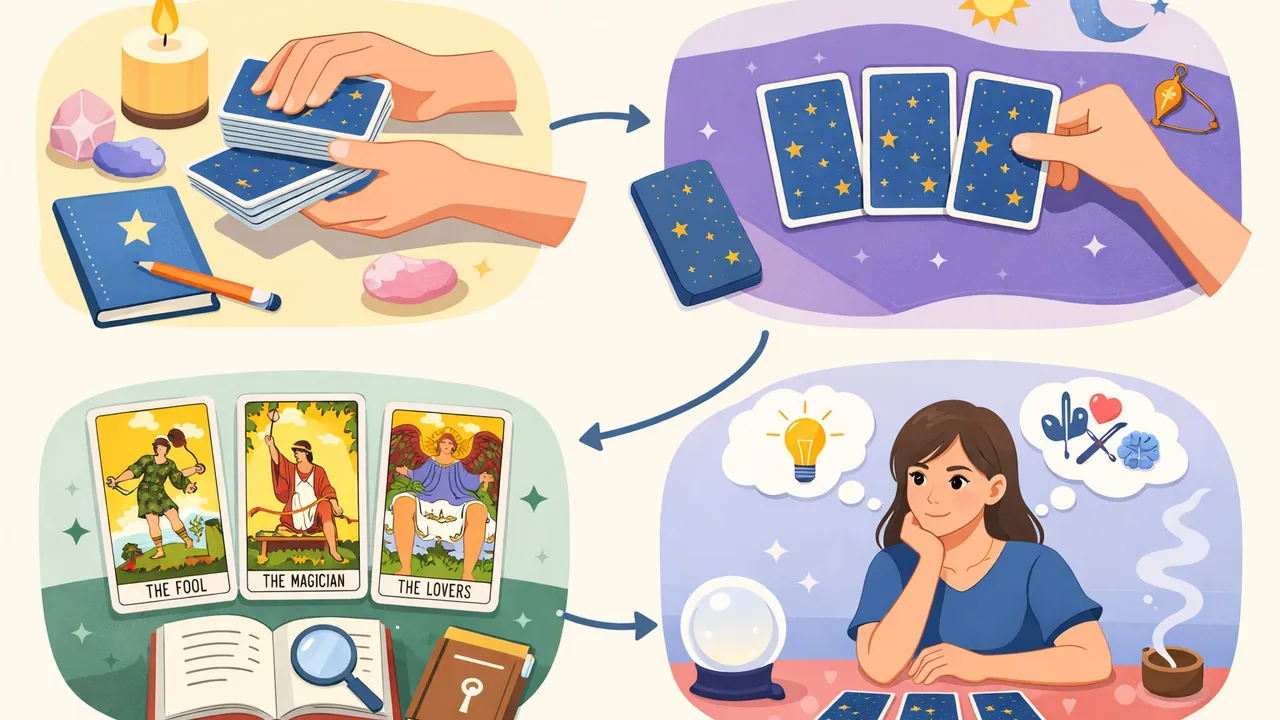
You don't need to memorize all 78 cards before you start learning tarot. A faster order is to understand how the whole deck is built, then learn how to actually look at a card, and only then use spreads to answer questions. In that order you can do your first complete reading in the first week.
Every step below comes with real card examples. If you don't own a deck yet, you can follow along with an online draw first and choose a deck you like once you know you want to keep going.
The short version
- Learn in this order: structure, image, spread. You don't need to memorize all 78 meanings first.
- Read a card in three layers (subject, interaction, setting), then bring it back to your question.
- Draw one card a day and write three sentences. After 3 to 6 months of this, most people can read on their own.
Tarot Basics Step One: Understand How the 78 Cards Are Organized
A tarot deck has 78 cards: 22 Major Arcana and 56 Minor Arcana. The Major Arcana run from 0, The Fool, to 21, The World, and deal with life lessons and major turning points. The Minor Arcana are split into four suits of 14 cards each (Ace, 2 through 10, and four court cards: Page, Knight, Queen and King), and they describe what's happening in everyday life.
Group | Cards | What it covers | Example
Major Arcana | 22 | Life lessons, major turning points | Death: one chapter ends so a new one can begin
Wands | 14 | Action, passion, ambition | Three of Wands: standing on high ground watching ships set out, waiting for a plan to pay off
Cups | 14 | Feelings, relationships, intuition | Two of Cups: two people face each other and exchange cups, drawn to each other
Swords | 14 | Thinking, communication, conflict | Two of Swords: blindfolded, arms crossed over two swords, putting off a decision
Pentacles | 14 | Money, work, the body and practical matters | Eight of Pentacles: head down, carefully carving coins, building skill bit by bit
You'll use this structure as soon as you start reading. Lots of Major Arcana in one draw generally suggests the matter touches a deeper life lesson. Mostly Minor cards suggest the focus is on how you handle day-to-day things. A suit that shows up a lot also tells you where the weight lies. If you ask about work and get a pile of Cups, the sticking point may be people and emotions rather than ability. You can look up the full meaning of any card in the complete guide to all 78 tarot card meanings.
Learning With the Rider-Waite-Smith Deck: Why Most Beginners Start Here
The most common tarot deck today is the Rider-Waite-Smith, published in England in 1909. The main reason it suits beginners is that every one of its 56 Minor Arcana cards shows a scene. The Three of Swords shows three swords piercing a heart. The Five of Pentacles shows two people in the snow walking past a lit church window. You can make associations just from the picture. The older Marseille-style decks mostly show only numbers and suit symbols on the Minor cards, which makes them hard for a beginner to read from the image.
The other reason is resources. Most tutorials, card-meaning books and online meanings are based on this deck's imagery, and our card-meaning pages are written from it too. For your first deck, pick the original or a deck redrawn from it. Choose one with clear images that you'll want to pick up every day. For more on choosing, see how to choose your first tarot deck.
How to Read a Single Card: Subject, Interaction, Setting
Memorizing keywords stops working quickly, because the same word means different things in different questions. A steadier method is to break the image into three layers:
1. Subject: what the most important person or object in the picture is doing.
2. Interaction: what's happening between the subject and the other elements.
3. Setting: the overall mood, weather and place, which point to limits or support.
Practice with the Four of Cups. Subject: a person sits under a tree with arms folded. Interaction: he stares at three cups in front of him and doesn't notice a hand reaching out of a cloud beside him, offering a fourth. Setting: a quiet hillside where nothing much is happening. Put the three layers together and you get "can't get excited about what's in front of you, and may miss a new opportunity." In a work question, that could be burnout in your current role while you overlook a new opening inside the company. In a love question, it could be losing interest in the relationship, or not noticing the other person reaching out.
The Two of Cups also shows cups, but here two people face each other and exchange them, so the focus becomes "mutual." This is why looking at the image matters: whether a cup is ignored, exchanged or offered changes the meaning completely. Keywords are a way in, but the answer has to come back to the picture and your question.
Upright and Reversed Tarot Cards: How to Read Them
The rule is simple. If the image is upright when you draw it, the card is upright. If it's upside down, it's reversed. You don't decide based on a figure's expression or the cards around it. A reversal isn't automatically a bad card either. There are three common ways to read one, shown here with Strength reversed:
Reading | Meaning | Strength reversed
Blocked | The card's energy can't get out | You want to keep going but can't find the courage
Turned inward | Nothing shows outside; it's happening inside you | You look calm, but you keep doubting yourself
Overdone | Used too much, out of balance | You've held your feelings in for so long that they finally explode
If that feels like too much, use only upright meanings for the first month and add reversals once you're comfortable. What matters is deciding the rule before you draw, not changing it after you get a card you don't like. For more on reading reversals, see how to read upright and reversed tarot cards.
How You Ask Decides How Useful the Answer Is
How you phrase a question doesn't change which card you draw, but it does decide whether the reading is useful. Here are the three most common fixes:
Original question | What's wrong | Try instead
Will I be happy this year? | Too broad, so you only get a vague answer | What do I most need to watch for in love over the next three months?
Does he still love me? | It asks about someone else's mind, and the cards can't read minds for you | Where is our relationship stuck right now, and what can I do?
Should I quit my job? | Only two possible answers, and the conditions aren't clear | If I stay or if I leave, what will I face over the next six months in each case?
Your First Full Walkthrough: Ask a Real Question With Three Cards
Say you're planning to change jobs and want to ask: "What do I most need to pay attention to while job hunting this month?" Use the most basic three-card spread: current situation, obstacle, advice.
1. Write the question down and keep it in mind while you shuffle.
2. Draw three cards and lay them out in order. Say you get the Eight of Pentacles upright (situation), the Seven of Cups upright (obstacle) and the Ace of Swords upright (advice).
3. First, describe what you see on each card. Eight of Pentacles: someone carefully carving coins. Seven of Cups: seven cups floating on clouds, holding a castle, jewels, a wreath and more. Ace of Swords: a hand reaching from a cloud, holding a sword topped with a crown.
4. Then place them in their positions. Your skills have been building up (Eight of Pentacles). You're stuck with too many options and want all of them (Seven of Cups). The next step is to make a clear choice (Ace of Swords).
5. Turn it into one sentence and one action: "You're prepared enough; the problem is you're spread too thin. This week, pick the three roles you want most and write a tailored résumé for each."
6. Record the question, the three cards and your reading, then compare them with what happened a month later.
Once you've done this, you've gone through the whole reading process. Single-card practice and bigger spreads follow the same steps.
A Practice Plan From 7 Days to 6 Months
Use the first week to cover the basics once:
Day | Focus | What to do
Day 1 | Structure | Sort all 78 cards into the Major Arcana and the four suits, and go through each pile
Day 2 | Major Arcana | Go from The Fool to The World and note just one keyword per card
Day 3 | The four suits | Pick 2 cards from each suit and say which part of life each one is about
Day 4 | Upright and reversed | Pick 3 cards and read each one with all three reversal approaches
Day 5 | Single card | Draw one card in the morning as a reminder for the day; at night, write where it matched what happened
Day 6 | Three cards | Do your first three-card reading with a real question
Day 7 | Review | Go over the week's notes and write down your own keywords
After that, slow the pace. In weeks 2 to 4, draw one card a day and write three sentences (what you see, what it brings to mind, where it matched your day). In months 2 to 3, do a three-card reading with a real question once a week. In months 3 to 6, review your notes once a month, compare your readings with what actually happened, and start trying spreads of five cards or more. For a note format, see the tarot reading journal template.
How do you know you've got it? When you can turn any card into four sentences (what you see, what state it shows, what it points to in this question, and what you can do next), you can already read on your own.
Three Places Beginners Most Often Get Stuck
- Treating card meanings like a dictionary: the same card stresses different things in different questions. Look at the image first, then the question, and the keywords last.
- Redrawing when a card doesn't make sense: confusion usually means the question is too big or too rushed. Make the question smaller instead of swapping cards.
- Treating one draw as a verdict: tarot is a tool that helps you sort through information. For major decisions about health, legal matters or money, please talk to a doctor, lawyer or financial professional.
For more cases where beginners misread cards, with side-by-side examples, see the most common tarot beginner mistakes.
Now that you know the method, the fastest way to practice is to draw for a question you actually care about, then compare with the reading. You'll see what you can already read and what you hadn't thought of.
Draw for your own question