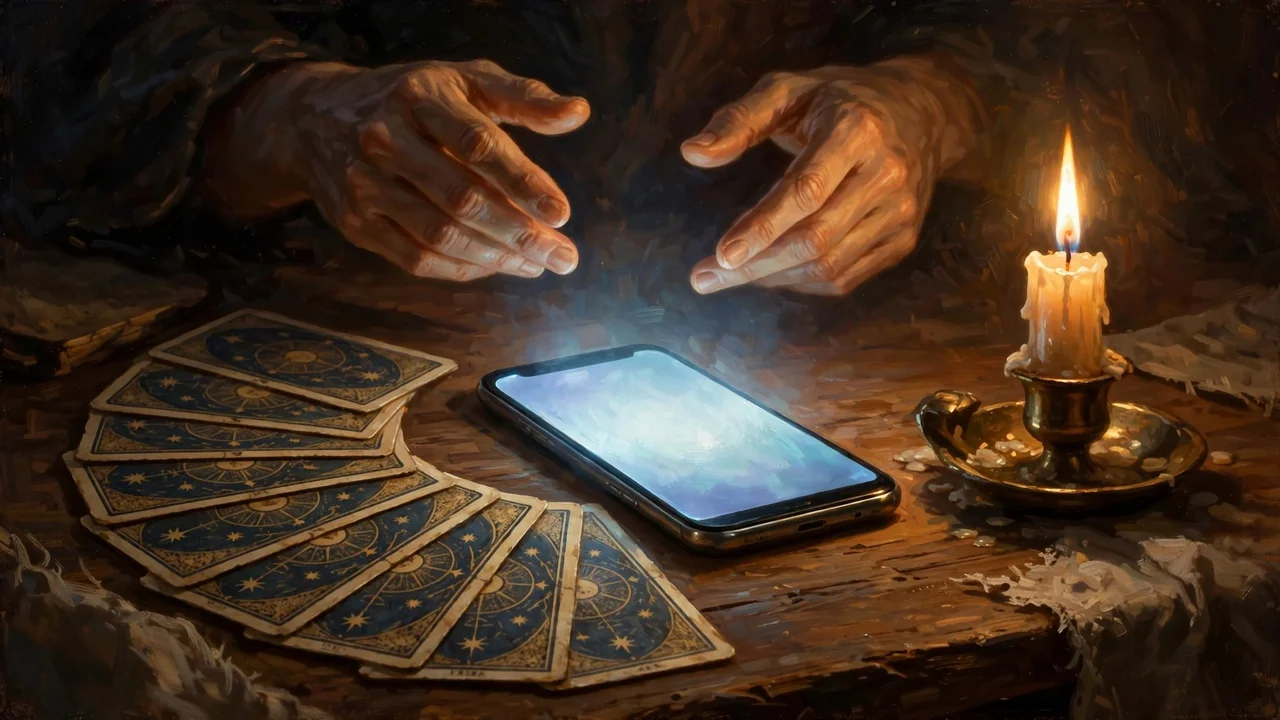
Is online tarot as accurate as shuffling a real deck? Many people ask this the first time they tap a card on a screen. You never touched the cards and never shuffled them with your own hands, so does the result really count? The short answer is that the way you draw changes your experience far more than it changes what the cards can tell you. An online draw relies on a random result generated by software. A physical shuffle relies on the movement of your hands and the changing order of the deck. At heart, both do the same thing: out of a pile of uncertainty, they let one result appear at the moment you decide. Neither method calculates your fate, and neither one owns the meaning. The images and symbols on the cards are the same whether they are printed on card stock or shown on a phone. If you already have a question on your mind, you can start with a tarot reading.
What makes a reading useful is rarely where the cards came from. It is the question you bring and the way you look at what shows up. A vague question stays vague even with the most careful shuffle, and the reading turns into a blur that could mean anything. A clear question that you are willing to face honestly can reveal an angle you had overlooked, even if you draw on your phone during a train ride home. That is why it helps to look past the tool itself. Online draws follow the same basic logic as a shuffle, and the real differences between tapping a screen and handling a deck come down to three things: ritual, focus, and how easy it is to keep a record. Once those are clear, the question of accuracy becomes much simpler, and so does the choice between a quick draw on the go and an unhurried session with physical cards spread out on a table.
How Online Tarot Draws Actually Work
Most online tarot tools rely on a piece of code that generates random numbers. Inside the system, the whole deck is simply a list, and every card has its own number. When you press the button to draw, the program uses randomness to scramble that order, or picks results straight from the list at random. Some designs also decide whether each card lands upright or reversed. On screen this may look like nothing more than a card-flip animation. Underneath, though, it is doing something very similar to a physical shuffle: breaking up the original order so that the next card cannot be predicted in advance.
Some people worry that anything a program produces must be fake, or that the outcome was set beforehand. In principle, the point of randomness is that you cannot know the result ahead of time, and a good shuffle achieves exactly the same thing. However long you shuffle a paper deck, all you are doing is making the order hard to predict. A phone simply hands the scrambling job to software. Neither one is calculating your destiny. Both create a state of uncertainty you cannot control, then let a result emerge from it.
So online tarot and a physical shuffle share the same underlying logic: a result is selected out of uncertainty, and then you or a reader work out what it means in your situation. A card does not change its meaning because it is an image on a screen rather than printed paper. Card symbolism is generally understood to come from a visual language built up over a long time, and that language reads the same in either format. If you are curious how the same question plays out with a different deck, see online Lenormand vs physical shuffle. The two systems differ, but people's doubts about them are surprisingly similar.
The Moment You Tap Is Your Choice
When shuffling a physical deck, many people care about who shuffled and who cut the cards, because that is what ties the draw to them personally. An online draw removes the physical contact, so it can feel as if part of your participation is missing. Look at it from another angle, though. You decide when to press the button. You decide how far into silently repeating your question you get before you tap. Those moments belong entirely to you, and the result the system produces at that instant is the result that answers that particular moment.
This is closer to cutting a physical deck than it might seem. Which pile you cut and which position you pull a card from are also choices made in a split second, without knowing what lies there. An online draw condenses that choice into a single tap. The form is simpler, but you are still bringing an answer into view without knowing in advance what it will be.
Some people keep redrawing on their phone until they get a result they like. That habit affects how much a reading is worth far more than the tool does. You could shuffle and redraw a paper deck endlessly too. It just takes more effort, so people do it less. Because online draws are so convenient, they call for a personal rule: ask each question only once within a given period. Read the result fully first, then decide whether you need to ask from a different angle.
Treat the tap as a deliberate act rather than a button you brush past. Before pressing, pause for a few seconds and state the question clearly in your mind. That small pause makes your connection to the draw more concrete. It also makes you more willing to relate the result to your own life instead of glancing at it and closing the app.
Difference One: Ritual
The most obvious difference between drawing on a phone and shuffling by hand is ritual. A physical deck has weight and texture. It makes a soft rustling sound as you shuffle, and when you lay out a spread, a row of images appears on the table. The process itself tells you it is time to pay serious attention to something. Many people like to clear the table first, switch on a lamp, or keep a cloth just for their cards. None of these steps directly affects the outcome, but they help your mind settle out of the rush of everyday life.
Online draws usually skip all of this. You open the page, type your question, tap once, and the result is there, sometimes in under a minute. That speed is convenient, but it can also leave you feeling that something is missing. What goes missing is not the power of the cards. It is the stretch of time that lets you step out of the rhythm of your day.
Ritual works more like a way of building a space reserved for asking. Shuffling gives you a natural buffer in which to check your question again and again. With an online draw, you have to create that buffer yourself. If you mostly use your phone, try designing a small step of your own: take three slow breaths, write the question down before tapping, or always draw in the same quiet corner.
Ritual does not measure accuracy. It is a tool for concentration. Some people really need it and find it hard to settle down without the shuffle. Others feel more at ease when things are simple and direct, and elaborate steps only distract them. What matters is knowing which type you are, then choosing the approach that best helps you face your question.
Difference Two: Focus
The second difference is focus. A phone is a device full of interruptions. While you draw, a message notification might pop up or a social media alert might appear, or you may already be half-busy with something else. These distractions do not change the cards, but they change the state in which you read them. You might glance at the result without finishing the interpretation, swipe away too soon, or try to make sense of the cards while still carrying emotions you have not dealt with.
A physical deck tends to draw you into the moment more easily. When the cards are in your hands, your hands and eyes are busy with the same task, so you are less likely to do something else at the same time. Once the cards are spread out, you are also more willing to spend time on the details: the expressions of the figures, the shifts in color, the relationships between neighboring cards. Slowing down to look like this often brings up associations you would not otherwise have had.
Still, the tool alone does not decide how focused you are. You can hold a paper deck, be miles away, and get nothing from it. You can draw on a phone in a quiet place with notifications switched off and be completely present. If your phone is your usual choice, turn on do-not-disturb before drawing and read the result all the way through before leaving the screen. Then spend a minute or two asking yourself which parts match your situation and which parts make you a little uncomfortable.
The uncomfortable parts often deserve a second look, because they may point to something you have been avoiding. Focus is not just staring at a screen or a spread. It means being willing to set the result honestly against your real life. Any tool can support that. A physical deck usually makes it easier to start, while a phone asks you to block out a few more distractions on your own.
Difference Three: Keeping Records and Looking Back
The third difference is record-keeping and review, and here online drawing actually has the edge. Results from an online draw can usually be saved directly, with the question, the cards drawn and the interpretation kept together. When you come back weeks later, it is easy to compare what you were thinking at the time with how things actually unfolded.
Doing the same with a physical deck takes extra effort. After drawing, you need to take a photo, or write in a notebook the date, the question, which cards came up, their positions and how you read them at the time. Many people keep careful notes at first, then gradually stop because it feels like a chore. A few months later, when they want to look back, they can no longer remember what they drew or how they read it.
Why does looking back matter so much? Because tarot works more like a mirror that helps you sort out your thoughts than like a prophecy written in advance. Reviewing old notes, you may find that some cards made little sense at the time but feel meaningful in hindsight, and that results you thought were bad were really just asking you to pay attention to something. Comparing notes like this slowly builds your own understanding of the cards. It also shows you which questions are worth asking and which ones do not help. For how far ahead a reading can reasonably look, see how far ahead tarot can predict. When you record a draw, jot down the time frame you had in mind, so it is easier to judge later whether the result matched.
Whichever method you use, building a recording habit is worth it. Online draws save you the time spent organizing, and physical cards need a little discipline. Keeping records will not make results more accurate, but it will help you learn more from every draw.
Where the Difference in Accuracy Really Lies
With the three differences covered, back to the question most people care about: is online tarot accurate? The honest answer is that the difference usually lies not in the cards but in how you ask and how you interpret. Whether you draw on a phone or shuffle by hand, the cards only provide a set of symbols. What gives those symbols meaning is how specific your question is and whether you are willing to face what the reading shows.
Take an example. A question like “Will my love life go well?” is so broad that almost any card can be stretched to fit it a little, and none of them fits it well. Change it to “Where is communication between us getting stuck lately, and what could I adjust first?” and the cards suddenly have something concrete to land on. The link to your current situation becomes much easier to see. With a clear question, both methods are equally useful. With a vague one, switching methods will not produce an answer.
Honest interpretation matters just as much. When something matters to us, it is easy to pick out only the parts we want to hear. Draw a card that looks difficult and you may rush to redraw it or reword the question. Draw one that looks great and you may skip over the cautions it contains. Reading selectively like this means no draw, by any method, is worth much as a reference.
It also helps to remember that tarot speaks to states and possible directions. It is not a tool that delivers certain answers. For major medical, legal or financial decisions, turn to professional advice. If you feel unwell, see a doctor: tarot can reflect how you are doing, but it does not replace medical judgment. For more on how to treat free or online results, read is free tarot accurate, which also covers how to tell whether a reading has genuinely helped you.
How You Ask Matters More Than How You Draw
Since phrasing matters this much, a few minutes spent shaping your question before drawing is usually worth more than choosing the right tool. Step one: turn “will it happen” into “what can I do.” “Will they come back?” only waits for a yes or a no. “How can I respond to the changes in this relationship right now?” gives the cards room to offer direction and reminders.
Step two: give your question a scope. Scope covers the people, the situation and the time frame. Which specific matter at work are you asking about? Which person is the relationship with? Are you looking at the next few weeks, or a longer stretch of time? The clearer the scope, the easier it is to compare the reading with reality, and the less tempted you will be to force every card in the same direction.
Step three: put yourself into the question. Many people approach tarot as bystanders, asking how events will develop. Yet the cards tend to help most with the part you can act on, for example “What am I overlooking in this situation?” or “Which habit could I adjust first?” When you bring the focus back to yourself, the result is easier to turn into concrete action, and you are less likely to feel that all you can do is wait.
If you are just starting to read cards, practice with a three-card layout in which the positions stand for the current situation, the obstacle and the advice. Then follow the steps in a beginner's tarot reading method to connect the cards one by one. You can practice this on a phone or with a physical deck. The point is to get used to linking the cards to real life rather than memorizing meanings. Over time you will get better at knowing how to ask, and the way you draw will matter less and less.
When an Online Draw Makes Sense
The biggest strength of online tarot is convenience, which suits the moments when you want to sort things out right away. The first situation is when you want to check a passing thought quickly. Perhaps you are unsure whether to reach out to someone, or you cannot quite settle a decision at work. You do not need a full ritual for that. State the question clearly, draw, and see whether there is an angle you had not considered. That alone can help untangle your thoughts.
The second situation is a sleepless night when you want to settle your feelings. Many worries grow larger late at night, and getting up to find your cards, clear a table and shuffle may only wake you up further. Drawing on your phone is lighter and can be done quietly in bed. Afterwards, try writing a few lines about how you feel, so the thoughts circling in your head have somewhere to land. One caution: emotions swing more easily at night. If a result feels upsetting, do not jump to conclusions. Look at it again in daylight the next day, and you will often see it differently.
The third situation is being away from home without your deck. When you are commuting or traveling for work or on vacation, carrying physical cards is not always practical, and you may not have a table to spread them on. A phone lets you do a simple check-in during spare moments. If you want to go deeper once you are home, the physical deck will still be there.
If you would like a fuller written interpretation online, try AI tarot: draw with your question in mind, then read the result slowly against your own circumstances. For how much weight to give online interpretations, AI tarot accuracy sets out a few ways to judge them. It can help you take a balanced view, neither trusting results blindly nor dismissing them outright.
When a Physical Shuffle Is Worth It
If online draws suit quick sorting, a physical shuffle is better for moments that call for deeper thought. The first situation is when you want to do a full, serious reading. When you face a bigger choice, such as changing careers, moving home or thinking about where a relationship is heading, it is worth giving yourself a proper block of time. Preparing, shuffling, cutting and laying out the cards: every step helps pull your attention back, giving you the chance to think the question through more thoroughly.
The second situation is when you want to build a connection with the cards. Many people learning tarot find that handling a deck and looking at the cards every day makes the details stick far better than viewing images on a screen. You gradually notice a card's colors, a figure's posture and the small objects in the background, and these details often spark new associations during a reading. That kind of familiarity takes time to build, and a physical deck offers a very natural way to practice.
The third situation is when you want to slow down and think. Some questions do not need an immediate answer. They need you to work out your feelings gradually along the way. A physical shuffle has a slower rhythm. While shuffling, you tend to turn the question over in your mind without noticing. Once the cards are out, you are more willing to pause and look longer, or even leave them on the table and come back later.
Of course, a physical deck does not make results more accurate. It simply makes it easier to get into a thoughtful state. If you usually find it hard to concentrate, physical cards can help a lot. If you already tend to approach questions calmly, the method makes less difference. Many people end up using both: a phone for everyday thoughts, and a physical deck for the things that matter most.
References
Bring a question you truly care about, take a quiet moment, and do a tarot reading to see what the cards can help you sort out.
Start a tarot reading