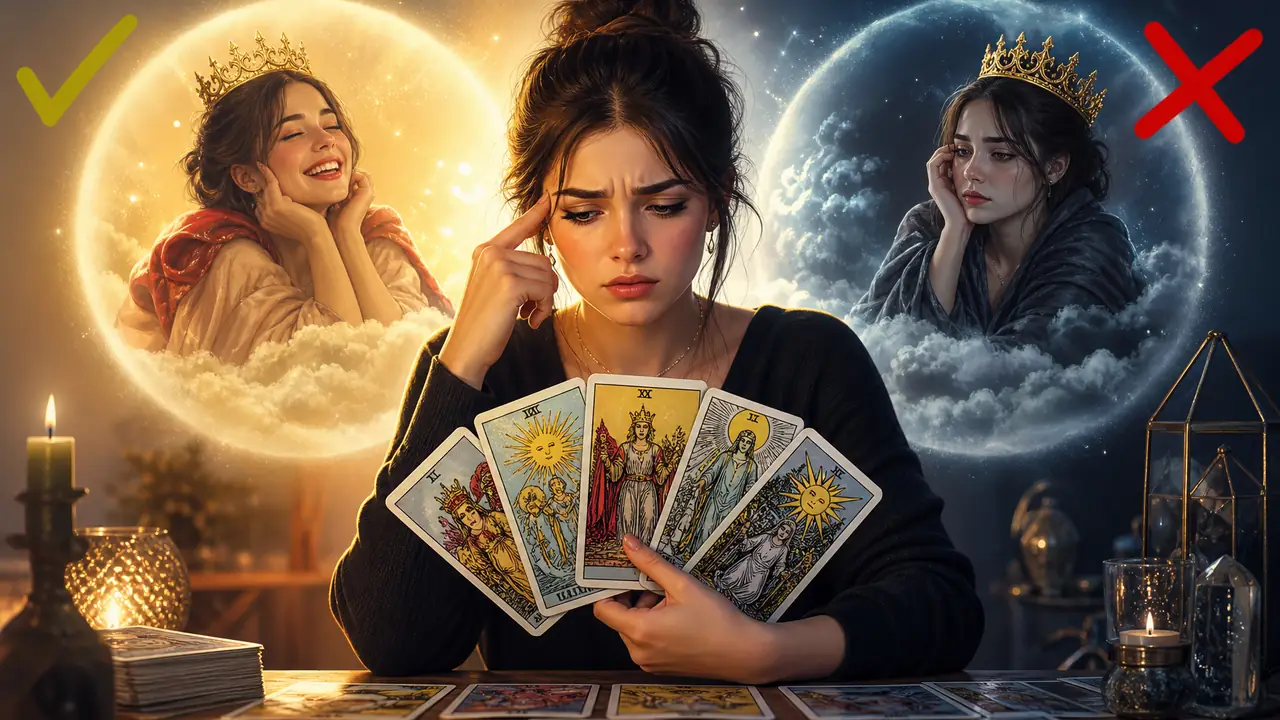
You turn over the cards and see several Major Arcana, and you tense up right away. Is the relationship about to change dramatically, is something going wrong at work, or is fate forcing a decision? That reaction is very common, and it is also the easiest way to give a spread more weight than it carries.
Major Arcana cards often point to important themes, inner lessons or life stages. That does not mean the situation is huge or fixed, or that every detail is already settled. What decides the reading is the card positions, the scope of your question, the Minor Arcana next to them and the actions open to you.
Quick summary: 22 of the 78 cards are Major Arcana, about 28%, so around 3 in a 10-card spread is normal. Only when more than half are Major Arcana is it clearly a lot. Many Major Arcana means the issue sits at a deeper level, not that it must be serious. Check which positions they fall in and which Minor Arcana sit beside them, then rewrite each Major Arcana card as one reminder you can act on.
The Core Answer: More Major Arcana Does Not Mean More Serious
When you see many Major Arcana in a tarot spread, the first answer is not “this must be serious.” It is that this spread is pulling your attention toward a deeper theme. The Major Arcana often point to values, transformation, relationship patterns, life stages or inner work, and they do not have to be read as disaster, a breakup, job loss or a warning from fate.
What you really need to work out is whether these cards describe an outside event, your inner state, or the attitude you need to bring to the situation. Narrow your question down to one decision first, such as “Should I reach out and talk?”, “Should I delay signing?” or “Where is this relationship stuck right now?”, instead of only asking whether the outcome will be bad.
Read “serious” as “deeper”
First, know what “many” means. 22 of the 78 cards are Major Arcana, about 28%. In a 10-card Celtic Cross, around 3 Major Arcana is normal, and only more than half is clearly a lot. One Major Arcana card in a three-card spread is also ordinary. A spread full of Minor Arcana usually leans toward everyday matters you can handle by changing how you do things. Many Major Arcana suggest the matter involves a longer-term lesson or a choice about values.
The Major Arcana often use symbols of growth, trials and turning points to show you the wider context, not just whether one event succeeds or fails. If you want to brush up on the basics first, see the complete guide to all 22 Major Arcana meanings, but when you read, keep coming back to your question, the positions and the actions you can take.
- Ask first: is this spread answering “what will happen,” or describing “how should I face it”?
- Do not just count the Major Arcana. Check whether they cluster in the past, obstacle, advice or outcome positions.
Find the Issue Level: Which Life Theme the Major Arcana Point To
Next, work out what level of issue the Major Arcana are pointing to. In a love question, they may not be predicting a sudden marriage or breakup. They may be pointing to attachment patterns, trust issues, fear of commitment or a power struggle in the relationship. In a work question, they may be about your career direction, a choice about values or the long-term path.
A practical method is to translate the cards into real-life terms: what current condition does this card match? The Hierophant may be systems, rules or traditional expectations. The Hermit may be pausing, observing and judging for yourself. The Wheel of Fortune may be a period of change, which does not mean you have no choice at all.
Four levels to place the message
Check four levels in order. First, is an outside event actually changing? Second, is your state of mind being amplified? Third, does a pattern keep repeating in your relationship or at work? Fourth, does it involve long-term values and life direction? The Major Arcana are not only describing an outcome. They ask you to recognise how deep the theme goes.
- If there is already clear real-world pressure, the Major Arcana are usually marking the key lesson rather than making a prophecy on their own.
- If nothing has happened yet, the Major Arcana may first be reflecting inner anxiety, expectations or a way of judging things that needs adjusting.
A Framework: Reading Position, Question, Neighbouring Cards and Ratio Together
Once you know the issue level, the next step is not to recite each card meaning. Put each Major Arcana card back into its position. You can read Major Arcana by position like this:
Major Arcana in | How to read it
Past | A background or long-running influence that explains how things got here.
Present | The theme at work right now, and the first thing to deal with.
Obstacle | What is blocking you is not a small thing but a lesson you need to face.
Advice | You need to adjust your attitude or act now. This calls for action more urgently than a card in the past position.
Outcome / Future | The likely trend if things continue as they are. It is not final and changes with your choices.
The same card also carries different weight in different questions. If you ask “Will they text me back?” and draw Judgement, it may not be a call from destiny. Your question may be too small, and the spread is pulling you back to whether the relationship needs to be redefined. If you are asking about a career change, Judgement is closer to a calling, an evaluation and a fresh start.
Fix the question before linking card meanings
When many Major Arcana show up in a spread, first check whether your question is too closed, too anxious or too fixed on a single answer. Change “Is he destined to leave me?” to “What is the most important lesson in this relationship right now?” and it becomes easier to see whether the spread is about attachment, boundaries, commitment or the pace of communication.
Let neighbouring cards ground the Major Arcana
The Minor Arcana next to a Major Arcana card matter because they often turn an abstract theme into a concrete situation. If The Lovers sits beside the Two of Swords, the focus may be on choosing and avoiding a decision. If it sits beside the Three of Pentacles, it may be about cooperation, coordination and building something together. Tarot imagery invites you to notice which way figures face, their gestures and the scene, not to read card names in isolation.
- Check the position first: is this Major Arcana card describing the background, the present lesson, an obstacle or advice?
- Then check the scale of the question: the bigger the question, the more likely the Major Arcana point to a life theme. The smaller the question, the more likely you need to ask again.
- Finally, check the ratio and spread: Major Arcana clustered in the advice position usually call for action now more than ones clustered in the past position.
Common Mistakes: Treating Major Arcana as Fate, Prophecy or a Final Answer
The most common mistake is reading many Major Arcana in a tarot spread as “this is already decided.” Major Arcana cards do carry strong symbolism, but they work more like a doorway to a deeper view than a stamp on your life. The Wheel of Fortune does not mean you can only be pushed along, and Death does not mean everything must end.
Another mistake is counting Major Arcana without looking at how the cards interact. Three Major Arcana in five cards and three in ten cards carry different density. If the Major Arcana support each other, the theme may be consistent. If they pull against each other, you may be caught in a clash of values or contradictory actions.
Turn prophecy into a reading process you can check
Use four steps. First, write down the original question and check whether it can lead to action. Second, mark the position and role of every Major Arcana card. Third, find the concrete scenes offered by the neighbouring Minor Arcana. Fourth, rewrite each Major Arcana card as one actionable reminder. The Tower, for example, is not “it will collapse” but “which assumptions are already unstable and need shoring up or taking down.” Reading this way lowers panic and stops you treating the cards as a final answer.
Do not use Major Arcana to avoid real information
The cards can offer symbolic clues, but they cannot replace checking the facts. A love question still depends on how the other person actually behaves. A work question still depends on the contract, pay, skills and market conditions. If you read The World as sure success and ignore that you are underprepared, that is not trusting tarot. It is handing your responsibility to the cards.
- Avoid saying “it will definitely”; say “the current tendency shown in the spread is” instead.
- Avoid reading Death, The Tower or Judgement straight as disaster; first ask what they want you to end, rebuild or face.
- Avoid drawing more and more cards until you lose focus. If you only want to calm your anxiety, stop reading and go back to facts you can confirm.
A Practical Method: Turning Many Major Arcana into a Clear Message
When you see many Major Arcana in a tarot spread, do not rush to explain them one by one. Split the spread into four layers, theme, position, interaction and action, so each card handles one reading task.
Start by circling the most central positions, such as present, obstacle, advice or outcome, then see which Major Arcana fall there.
Organise the spread into four-column notes
Take a sheet of paper and make four columns: “card and position,” “the issue level it points to,” “what neighbouring cards add” and “the action I can take.” The Lovers in the advice position does not necessarily mean choosing a person. It may ask you to be honest about a choice of values. If Swords cards sit beside it, the action may be clarifying boundaries and having a conversation.
- Find the positions in the spread that matter most for the decision instead of giving every Major Arcana card equal weight.
- Rewrite each Major Arcana card as a reminder you can check, such as “I need to confirm my long-term direction” instead of “fate wants me to change.”
- Keep only three points at the end: the main lesson, the biggest blind spot and the next action you can take.
Reading Limits: When Not to Stretch the Meaning of Major Arcana
Even when a spread is full of Major Arcana, you cannot pin every life outcome on the cards. If the question involves health, legal matters, investments, large financial decisions or personal safety, tarot can only help you sort through anxiety, values and options. It cannot replace professional advice, and it is not suited to passing judgement on other people.
Another limit is your emotional state. Right after an argument, losing a job, a sleepless night or drawing on the same question again and again, the Major Arcana are easy to read as huge warnings, when anxiety may simply be magnifying the symbols. At that point it matters more to pause, write things down and go back to real evidence than to draw more cards straight away.
Three checkpoints for your next step
After reading several Major Arcana, ask yourself three things. Does this message connect to a concrete situation? Is there an action I can control? Do I need outside information or professional help? If you cannot answer any of the three, do not stretch the reading into a prophecy. You can wait a while, gather real-world information and then draw again with a more focused question.
- When not to over-read: the question is too vague, emotions are too strong, real information is missing, or you only want the cards to confirm your fear.
- A good next step: take one small action you control, then set a time to review, such as checking the conversation or decision conditions three days later.
- If the spread touches on serious risk, treat tarot as a tool for sorting yourself out, not as your only basis for deciding.
Next Steps: When to Draw Again, When to Wait and When to Decide
At this point you no longer need to scare yourself with “so many Major Arcana.” You need to decide your next move. If the spread already shows the theme, the limits and an action you control, do not draw more cards. Asking again and again only lets anxiety pass itself off as checking, and it blurs clues that were already clear.
To choose between drawing again, waiting or acting, look at three things: whether the question is still unclear, whether real-world conditions are ready, and whether you already have options you can act on. When many Major Arcana show up in a spread, the real point is not to find one more card that makes you feel safe, but to turn what the Major Arcana remind you of into a concrete choice.
A second-level check for your next step
Drawing again makes sense when the original question was too big, or when one Major Arcana card has an unclear role in the spread. If The Lovers appears in the future position, you can follow up with “What choice do I need to clarify now?” rather than “Will we end up together?” Waiting makes sense when the spread points to a cycle, integration or inner change, such as The Hermit, The Hanged Man or Temperance. Set an observation period and record how things change. Deciding directly makes sense when the spread already marks clear limits for action: Justice asks you to see responsibilities clearly, The Chariot asks you to focus your resources, and Strength asks you to handle conflict gently but firmly.
- Draw again: only clarify a role that is unclear, and do not keep drawing until you hear a comforting answer.
- Wait: set an observation period, such as three days, a week or until after the next key conversation.
- Decide: when you have enough real information and the risk is acceptable, let the spread be a reminder, not an excuse to delay.
References
Now that you know the method, the quickest practice is to draw cards for a question you truly care about, then compare with the reading to see what you can already pick up and what you had not thought of yet.
Draw cards for your question