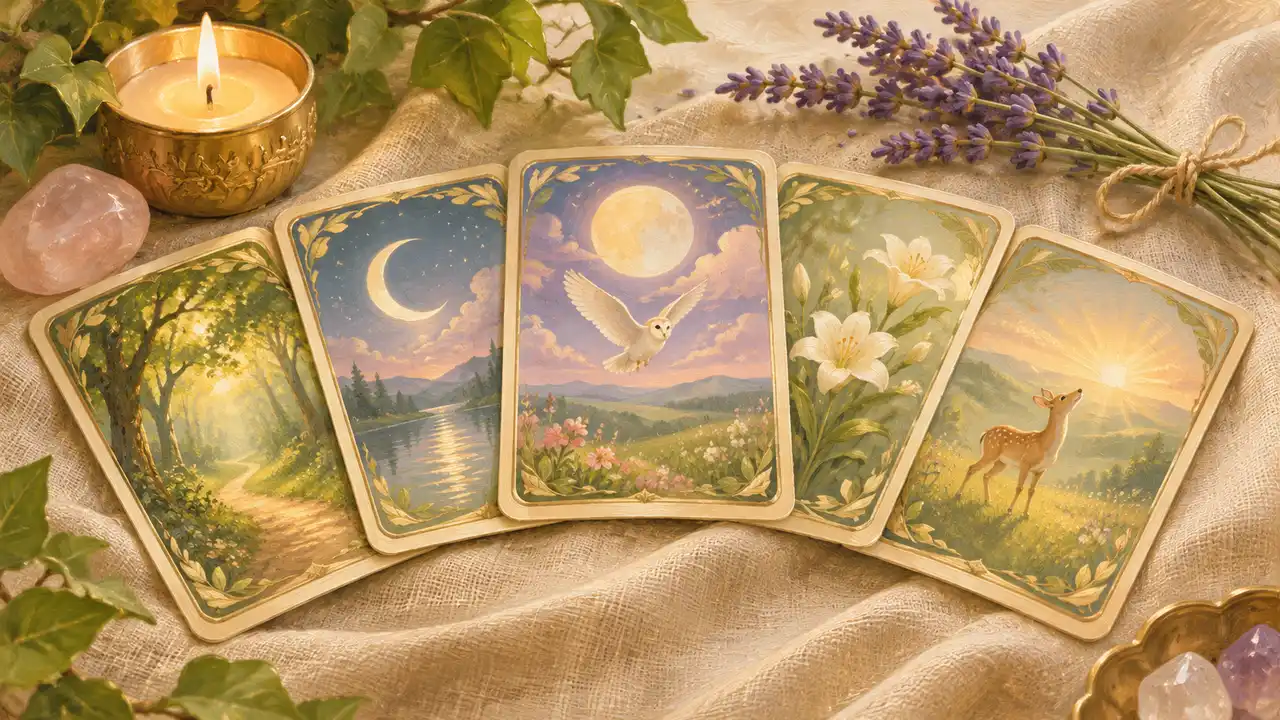
Oracle cards are themed cards that carry a written message on their face. There is no fixed number of cards and no structure shared across decks: each deck is designed by its creator around a theme of their choosing, such as goddesses, angels, animals or the moon. You shuffle with a question in mind, draw a card, and the words printed on it become its response. Compared with tarot, oracle cards don't ask you to memorize a large system of card meanings before you start. If you can read the text, you can begin, which is why many people pick up an oracle deck as their very first set of cards. A low barrier doesn't mean oracle cards are only for a casual glance, though. The same line, say “slow down first,” can point you toward completely different things depending on whether you asked about your job or your love life. The real way to use oracle cards is to treat the message as a mirror that helps you notice what most deserves your attention right now.
If you already read tarot, you might wonder why you'd need oracle cards at all. Put simply, tarot is good at taking a situation apart so you can understand where things stand, what is in the way and where they might be heading. Oracle cards are good at handing you one sentence about the attitude to carry forward. The two tools answer questions on different levels, so they don't compete with each other. You can even use them side by side, letting tarot map out the situation and an oracle card sum up the mindset to bring with you. Think of what follows as a friend introducing you to a new tool. It covers what oracle cards are, the three main differences between oracle cards and tarot, a step-by-step way to draw and read them, which questions suit them and which don't, how to choose your first deck, and how to pair oracle cards with tarot. By the end you should feel ready to try a reading of your own.
What Are Oracle Cards? Getting to Know the Tool
Oracle cards are themed cards that carry a written message. Unlike tarot, they don't follow a structure that every deck shares. Each oracle deck is built by its creator around their own theme, and the number of cards is up to them: some decks have a few dozen cards, others have more, and there is no fixed rule. Each card you pull usually has an illustration, a title and a sentence or short passage that tells you directly what the card wants you to notice.
If you had to sum it up in one line, an oracle deck is a bit like a friend who talks back. You bring the question on your mind, draw a card, and the words on it are the reply. It might say something like “slow down first,” “trust that you are already prepared” or “bring your attention back to yourself.” You don't need to learn a whole symbolic system before you can take a direction from it.
That is why many people begin exploring divination tools with oracle cards. The barrier to entry is low, since you only need to read the text, and the artwork tends to feel gentle and soothing. Low barrier doesn't mean shallow, though. The same sentence can bring up very different thoughts depending on the question you asked, and that is what keeps oracle cards worth returning to.
If you'd like to get a feel for it first, try drawing with your own question in our oracle card reading and notice how the card's message speaks to you. Coming back to the rest of this guide afterward makes each step much easier to follow.
Every Oracle Deck Has Its Own Theme
The most interesting thing about oracle cards is that no two decks are alike. Whatever art style a tarot deck uses, its underlying structure stays roughly the same. Oracle decks have their own personality from the theme up. Common themes include goddesses, angels, animals, the moon, flowers and plants, nature and color, and the theme shapes the way a deck speaks to you.
A goddess deck, for example, often links each card to a quality such as courage, tenderness, boundaries or creativity, so its messages tend to read like a reminder that you already hold that strength. Animal decks often borrow an animal's habits to make their point: some animals stand for patient waiting, others for nimble changes of direction. Moon decks usually focus on cycles, rest, release and fresh starts, which makes them useful for sorting out emotions and the rhythm of daily life. Angel decks tend to have an especially soft voice, mostly offering comfort and encouragement.
This also means that if you ask the same question with decks built on different themes, the tone of the answer can vary a lot. One deck soothes, another gives you a direct wake-up call, and another leans toward practical action. None of them is better; each simply suits a different version of you at a different time.
So when you're getting to know oracle cards, rather than rushing to memorize what a particular card means, start by sensing what this deck wants to talk to you about. The theme is the deck's personality. Once you know it, every reading flows more easily and you can hear what the cards are really trying to say.
Oracle Cards vs Tarot: Three Key Differences
One of the first questions people ask is whether oracle cards and tarot are basically the same thing. In practice they feel quite different to use, and the gap comes down to three main points.
The first difference is structure. A tarot deck always has 78 cards, split into 22 Major Arcana and 56 Minor Arcana, and the Minor Arcana are further divided into four suits. Every card has its own place in the overall system. Oracle cards have no set number of cards and no shared way of grouping them; everything depends on how the creator designed the deck.
The second difference is reversals. Tarot readers often look at whether a card appears upright or upside down, and a reversed card is generally interpreted as energy that is blocked or delayed, or as a sign to look inward. Oracle cards are not designed with reversals in mind. You read whichever card you draw, without that extra layer of judgment.
The third difference is whether you need to memorize card meanings. Tarot cards are mainly visual, so reading them in depth usually takes time spent learning each card's symbols, numbers and elements. Oracle cards print their message right on the card and usually come with a guidebook, so beginners can start without memorizing anything.
In short, tarot is like a complete language: once you learn it, you can trace how a situation came about and where it might go. Oracle cards are like a timely reminder that helps you see what needs your attention now. If you're curious how other card systems compare, our Lenormand vs oracle cards comparison shows where each type of deck fits.
Five Steps to Draw Oracle Cards
There is no required ritual for drawing oracle cards, and you're free to do it your own way. As a beginner, though, it helps to practice with the five steps below and shape them into your own habit once they feel familiar.
Step one: settle on your question. Find a quiet moment and put what's on your mind into a single sentence, such as “In my current job, what do I most need to remind myself of?” The clearer the question, the easier it is to connect the words on the card to it.
Step two: shuffle. Use whatever method feels natural. You can shuffle like playing cards or spread the deck on a table and swirl the cards around with your hands. Keep your attention on your question while you shuffle; you don't need to force your mind blank.
Step three: draw. When it feels like enough, stop and pull a card from the deck. For a fuller picture, you can draw three cards and treat them as your current state, what to watch out for and the direction you can move in. If a card jumps out of the deck while you shuffle, many people treat it as a card with something extra to say and read it as well.
Step four: read the message. Look at the image first, then the title and the line of text. Before reaching for the guidebook, notice the first feeling or picture that comes to mind; that is often the most direct clue.
Step five: connect the message to your question. Place the card's words back into your question and ask yourself what this line is reminding you of. Finish by writing down a sentence or two, which will be rewarding to look back on later.
After Reading the Card, How to Link It Back to Your Question
Many beginners get stuck at the last step. The card's message is perfectly clear, but what does it have to do with my question? This is where the “three follow-up questions” approach can help.
First follow-up: what scene from my life does this line bring to mind? Say you asked about love and drew a card that says “take good care of yourself.” Maybe you realize you've been bending to fit the other person lately while rarely asking what you actually want. That scene is the bridge between the card and your question.
Second follow-up: is this line encouraging me to do something, or reminding me to stop something? Most oracle messages are not predictions; they are suggestions about attitude. Once you can tell whether the card is asking you to move forward, wait, let go or adjust, your reading becomes much more concrete.
Third follow-up: if I followed this line tomorrow, what is one small thing I could do? Turn the reminder into a small, doable action, like going to bed earlier, voicing one feeling out loud or putting something off for now. That way a reading is more than a glance; it actually makes its way into your life.
If nothing clicks even after this, that's fine too. Take a photo of the card or note it in a journal and look again in a few days. Often it suddenly makes sense at some unexpected moment. Sometimes a card's message is more like a seed that needs time to sprout. There's no need to force an answer on the spot, and no need to keep redrawing until a line you like appears.
What Questions Are Oracle Cards Good For?
What oracle cards do best is hand you a single reminder. The questions that suit them are mostly about mindset, direction and taking care of yourself.
The first kind is questions where you need a reminder. For example: “What do I most need to pay attention to these days?” or “What should I remind myself of in this relationship?” These questions don't have standard answers, but one fitting line can make you pause and see what you've been overlooking.
The second kind is questions where you need direction. For example: “If I want to change jobs, what can I prepare right now?” or “This project has stalled; where can I start adjusting?” Oracle cards won't make the decision for you, but they can offer an angle to start from, so you know where to point your thinking next.
The third kind is questions about shifting your mindset. For example: “I've been anxious lately; how can I treat myself?” or “Facing a loss, what do I need to accept first?” Here the gentle voice of oracle cards is especially helpful, like someone beside you giving your shoulder a pat.
You'll notice these questions share something: they ask what I can do and how I can think, not how things will ultimately turn out. When you keep the focus on yourself, oracle messages feel closer and become more useful. If you want to sharpen your questions, the way of breaking questions down in our guide to asking Lenormand questions works just as well for oracle cards: split a big question into smaller ones, then pick the one you care about most.
Questions That Don't Suit Oracle Cards
Once you know what to ask, it also helps to know which questions are a poor fit, so your readings feel clearer.
The first type is yes-or-no questions. Questions like “Will they come back?” or “Will I pass the exam?” can only be answered with yes or no, and oracle cards usually answer them vaguely. The words on the card are suggestions and reminders, not a yes or a no, and trying to force a verdict out of them tends to leave you more confused the longer you look. A better way to ask is, “What can I do to prepare for this?”
The second type is specific timing. “When will I meet the right person?” or “Which month will I get a raise?” Oracle decks aren't designed with a system for timing, so it's hard to convert a message into a date. If you want to explore pacing, ask instead, “Is this a time for me to wait or to act?”
The third type is other people's privacy. Questions like “What are they thinking right now?” or “What do my coworkers really think of me?” involve someone else's inner life, and even if you draw a card, what you read is mostly your own projection. Rather than guessing about others, ask, “What do I need to see clearly in this relationship?”
Also, matters that need professional judgment, such as health, legal issues or investments, belong with qualified professionals. Oracle cards can keep you company while you sort through feelings and steady your mindset, but they can't replace advice from a doctor, lawyer or financial professional. Keep them in the right place and they can genuinely help.
How to Choose Your First Oracle Deck
The most important step in getting started is picking a deck you actually like. There are many kinds of oracle cards, and beginners can choose by looking at three things.
First, the theme. Ask yourself what you've been caring about lately. If you want to look after your emotions, moon, flower or healing themes tend to be gentler. If you want to reclaim your strength and confidence, goddess or courage themes may resonate more. If you love nature, an animal or forest theme might feel especially close. When the theme matches where you are, every draw feels more meaningful.
Second, the art style. Oracle cards are a very visual tool, and you'll be looking at the same set of images again and again. Some decks are dreamy and soft, some are bold and colorful, and some lean toward hand drawing, printmaking or photography. Choosing a style that feels comfortable and makes you want to keep looking matters more than picking what someone else recommends. Before buying, look up photos of the actual cards to check the overall feel.
Third, whether the text on the cards is in a language you read well. This is easy to overlook but important. The heart of an oracle deck is the message on each card. If the text is in a language you're not comfortable with, you'll be reaching for a dictionary every time and lose that moment of instant recognition. Beginners are best served by a version printed in a language they know, or at least one with a guidebook they can understand.
Finally, there's no need to buy many decks at the start. Building a rapport with one deck and learning its voice will give your readings more depth than collecting several.
How to Use Oracle Cards and Tarot Together
Many people who have learned tarot wonder whether they can add oracle cards to their practice. They can, and the two tools don't contradict each other; they complement each other.
A common approach is “tarot first, oracle second.” Start with tarot to see the structure of the situation, for example by drawing three cards for the present, the obstacle and the advice, so you understand how things came about and which forces are in play. Then draw an oracle card for a single reminder that works as a summary or mindset tip for the whole reading. Tarot takes the situation apart; the oracle card tells you what feeling to carry as you move forward.
Here's an example question: you want to understand how you're adjusting to a new job. Tarot might show where the pressure is coming from and where you can shine. An oracle card that says “allow yourself to take it slowly” then acts like a gentle footnote to the entire reading.
If the two seem to say different things, don't worry. Tarot mostly describes what a situation looks like, while oracle cards mostly suggest an attitude, so they answer questions on different levels. Reading them side by side usually gives you a fuller picture.
To try the combination yourself, start with an AI tarot reading to see the structure of the situation, then visit the oracle card reading for a reminder. For more ways to pair them, see how to combine AI tarot and oracle cards, which walks through more practical combinations.
A Few Tips for Beginners
To finish, here are a few situations beginners often run into, so you can use oracle cards with more ease.
First, don't keep redrawing. When you get a message you don't like, it's tempting to draw again, but that usually leaves you feeling more lost. Try accepting the first message and think about why it makes you uncomfortable. That discomfort often points to exactly what's worth noticing.
Second, the guidebook is a reference, not the answer key. It can help you understand what the creator had in mind for a card, but your final interpretation should come back to your question and your life. Your intuition and feelings are part of the reading too.
Third, keep a record of your draws. Each time, note the date, your question, the card you drew and what you were thinking at that moment. After a while, looking back, you'll find you know the deck better and better, and you understand your own thinking habits more as well. You can also jot down how things unfolded a few days later and see where the reminder helped.
Fourth, stay open without becoming dependent. Oracle cards are a tool for organizing your thoughts, not someone who makes decisions for you. For important choices, weigh the real-world information, talk things through with people you trust, and then make the call yourself.
If you'd like to get to know other card systems, our tarot vs Lenormand comparison explains what each type of deck does well, so you can gradually find the combination that suits you best.
References
Bring the question that matters most to you, shuffle, draw, and hear the reminder the oracle cards have for you.
Draw oracle cards