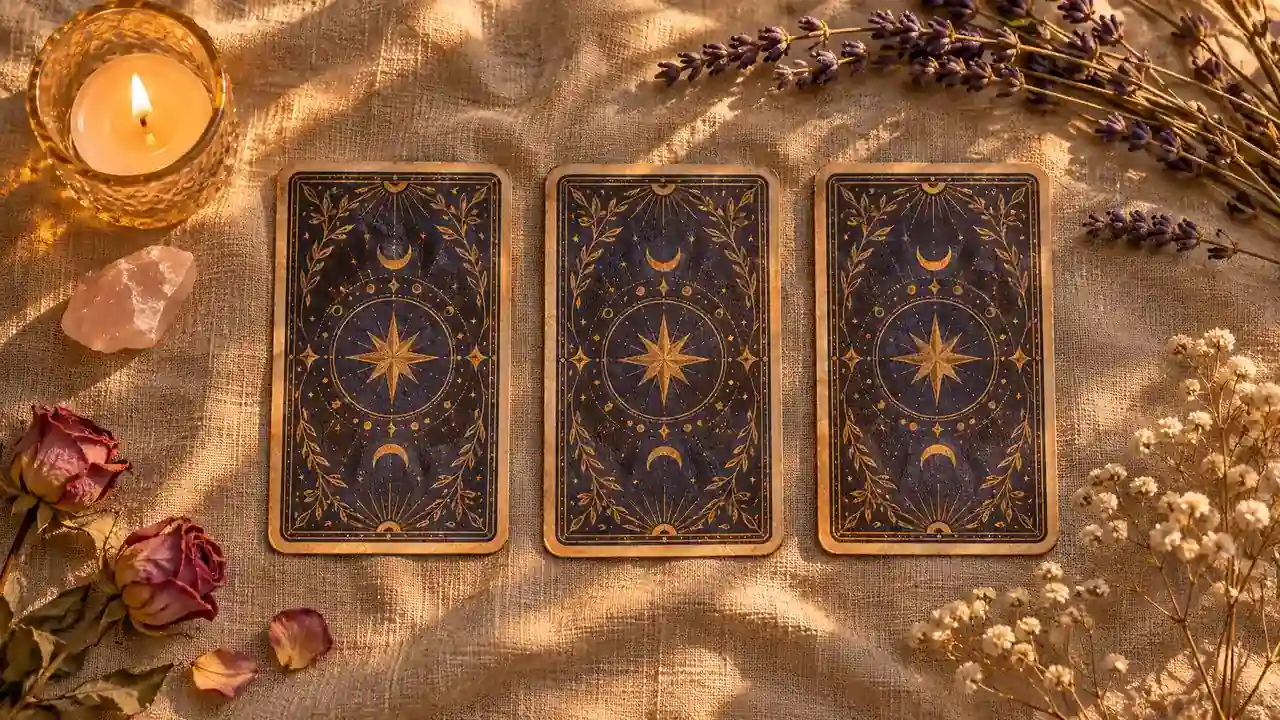
“When is this finally going to happen?” is probably the most common thought people have when they reach for a tarot deck. You might be waiting for news about a job, hoping a relationship becomes clearer, or watching a project that hasn’t quite taken off, and what you want is a date. Tarot, though, is better at answering a different question: how is this unfolding? Where is it stuck right now, what change is coming next, and where might it head further out? That is why the most practical tarot spread for timing is a simple three-card timeline. The first card shows the present state, the second shows what develops next, and the third shows the longer-range direction. Read together, the three cards show you whether things are moving quickly or slowly, and where the road is likely to bend.
This approach doesn’t need a complicated layout. It rests on two things: asking the right question, and reading the three cards as one story. Swap “When will he text me?” for “How is this relationship likely to develop over the next three months?” and the cards suddenly have something clear to answer. Once you’ve drawn, don’t fixate on a single card in search of the answer. Look at how the three relate. Do they push steadily forward, stall in place, or take a turn halfway through? And keep in mind that the cards offer rhythm and conditions, not a date written into your calendar. What actually moves the timeline forward is the step you decide to take after the reading. Treat the spread as a map of the road ahead and you’ll get far more from it than from any single guessed day.
Ask the Right Question Before You Ask About Timing
Many people pick up the cards to ask about timing and open with “When will it happen?” The trouble with that phrasing is that it assumes the event is definitely coming and only the date is missing, yet the cards rarely speak that directly. What usually follows is a guessing game. You draw a card that looks positive and think “It must be soon,” then a heavier card shows up and you worry “Maybe it will never come.” The more you read, the more anxious you get.
A more useful approach is to give the question a frame. Change “When will I find a new job?” to “What progress can I expect in my job search over the next three months?” Or turn “When will this project succeed?” into “What does this project need to get done between now and the end of the year?” The frame can be a few weeks, a few months, or the time until a specific milestone. What matters is that it has visible edges, so the three cards have somewhere to land.
Another small trick is to put yourself back at the center of the question. “When will they reply?” is hard to read, because you can’t see everything going on with the other person. “How can I take care of myself while I wait for a reply?” leaves plenty of room for the cards to speak. If you’re still getting used to shaping a question before you draw, start with how to draw cards and lay out a spread, which walks through the basic order from question to layout. Then come back and try this timeline. It will feel much smoother.
Decide What Time Each Card Covers Before You Shuffle
It’s natural to care most about which cards you draw, but one thing matters more, and it happens before you shuffle: deciding which stretch of time each card stands for. The most versatile setup for a three-card timeline is this: the first card is the present, the second is the period coming up next, and the third is the longer-range direction.
“The present” doesn’t mean this exact moment. It means the overall state of the situation right now, including what has already built up and the mindset you bring to it. “Next” usually covers the first half of your question’s time frame. If you’re asking about three months, think of it as the changes most likely to show up over the next few weeks to a month or two. “The longer-range direction” covers the later part of the frame, or even a little beyond it. It shows where things are heading and which conditions aren’t in place yet.
These three positions don’t have to be equal in length, and there’s no need to chop them into a fixed number of days. What matters is having a clear picture in your mind, and ideally writing it down, for example: “1: where things stand now; 2: the next month or so; 3: the direction around three months out.” With the plan in writing, you won’t be tempted to move a card to a different time slot once you see what it is.
If your question is large and touches many areas of life, three cards may feel thin. In that case, look at the structure of the Celtic Cross spread, which has positions for the past, the near future and the likely direction. For most “when” questions, though, three cards are enough to see the way forward clearly.
Card One: See Where Things Are Stuck Right Now
The first card is the one people skip most easily. Many draw their three cards and let their eyes jump straight to the second and third, eager to know what comes later. Yet the first card is the starting point of the whole timeline, and if you misread the starting point, everything after it tends to drift off course.
When you read the first card, ask yourself two things: where is the situation stuck right now, and which way is it already moving? Say you draw the Eight of Swords. It is commonly read as being bound by your own thoughts and feeling there is no way out, when the restraints are actually looser than they seem. In this position, the card may be saying that things haven’t moved because you are still hesitating, not because outside circumstances won’t allow it. The Three of Wands is generally interpreted as having taken the first step and waiting for a response, which suggests the situation is a little further along than you thought.
The first card often reveals your own state too. The same situation reads very differently depending on whether you approach it with anxiety or with hope, and that colors the rest of the timeline. So pause here and ask: do I recognize the state this card describes? If it rings true, treat it as the foundation of the whole reading. If it doesn’t fit at all, check whether your question was too vague.
To look up a card’s fuller meaning, browse the tarot card meanings. Remember that meanings are raw material, though. They only become useful once you read them back into the “present” position.
Card Two: The Changes and Lessons Coming Next
The second card is the middle of the timeline. It answers two questions: what changes are likely to show up soon, and what needs to be done before then. Think of it as a signpost on the road, pointing to where you’re headed next and which checkpoints might lie along the way.
It helps to read the second card in two layers. The first layer is outward change. Will new news, new people or new opportunities appear, or will things slow down for a while? The second layer is your own homework: what should you prepare during this stretch, and what might you need to let go of? The Chariot is generally interpreted as moving forward and taking control of direction. That may point to a chance for things to start moving, and it also reminds you to keep your own hands on the wheel. The Hermit is commonly read as a need to slow down and sort things out inwardly. Progress during this period may not come as outside news at all, but as you getting clear on what you actually want.
One thing to watch closely: the second card describes a process, not an ending. A card that looks great doesn’t mean the story wraps up at this stage. Likewise, a card that looks hard is only saying this part of the road will take more effort. Read the second card as “the stretch I’m about to walk,” not “the final answer,” and the timeline will make sense.
Many people want to pull extra cards for clarification at this point. There’s no rush. Read all three cards and connect them first, then decide whether you really need more.
Card Three: The Longer-Range Direction and Missing Conditions
The third card looks further out. If things keep moving at their current pace, roughly where are they heading, and what is still missing before you get there?
There’s a common trap here: reading the third card as “the outcome.” It’s closer to an extension of the road you’re currently on. If you make different choices during the second stage, the direction the third card describes can change too. So when you read it, ask one more question: what conditions does this card need in order to come true? The Star is generally interpreted as hope slowly returning and things moving toward healing and calm, and its condition might be your willingness to stay patient through the earlier stages. The Wheel of Fortune is commonly read as circumstances turning and outside change stepping in. What matters then is whether you can adjust as things shift, rather than sitting still and waiting for the wheel to stop in front of you.
The third card is also a good place to check what’s missing. Sometimes it’s a card with some resistance in it, such as the Tower, which is generally interpreted as an existing structure breaking apart. That doesn’t mean the thing you’re hoping for won’t happen. It may be a reminder that something unstable needs attention before you can reach the next step.
After reading the third card, set it beside the first one. What lies between where things start and where they are heading? That gap is often exactly where your effort is best spent in the weeks ahead, and seeing it turns a vague wait into something you can actually work on.
Reading All Three Together: Moving, Stalling or Turning
What makes a three-card timeline interesting is that it isn’t three separate answers but one short story. Instead of interpreting each card on its own, lay all three out and step back to look at the whole. Do they push steadily forward, stay stuck in place, or change direction partway through?
In a forward-moving timeline, each card’s energy usually leans further ahead than the last, for example from waiting, to action, to things coming into bloom. A spread like this tends to say the rhythm has already started, and if you keep at it, things will gradually take shape. In a stalled timeline, all three cards may carry hesitation, waiting or repetition. Rather than pressing “but when?”, go back to the first card and ask whether the reason things are stuck has actually been dealt with. In a turning timeline, a clear change appears in the second or third card. You might see a smooth start followed by a card that calls for adjustment, or a stuck start followed by a card that opens things up. A turn isn’t necessarily bad news. It often means your plan may take a detour, so keep your route flexible.
Beyond the direction of the energy, you can watch how the suits shift. Some readers associate Wands with action, Cups with feelings, Swords with thinking and Pentacles with practical results. Following how the suits flow across the three cards can show whether the story moves from idea to action, or from feeling to reality. This is only a supporting lens, not a fixed rule, so use it only to help you see where the story is going.
If you often hesitate between two paths and land on a turning timeline, pair it with the crossroads spread to compare where each choice tends to lead.
Set Your Rules Before Drawing and Don’t Change Them After
One of the most common problems in a reading is changing the rules after the cards are already on the table. You agreed the second card would cover the next month or so, but you don’t like what came up, so you decide “this one is probably about something further away.” Or the third card disappoints you, so you draw again to see if a nicer one appears. It may feel reassuring in the moment, but it hands control of the reading to your own expectations, and the cards can no longer tell you anything new.
A steadier approach is to settle three things before you shuffle: what the question is, how long the time frame is, and what each card position stands for. Write them on paper or save them in a note on your phone. After drawing, read according to the plan you wrote down. Even if one card feels uncomfortable, leave it in its original position and think about what it might mean at that point in time.
If something genuinely doesn’t make sense after reading, you can add a clarifying card, but decide its purpose first, for example “this card adds detail on how to act during the second stage.” Don’t keep drawing until you’re satisfied. Drawing on the same question again and again over a short period usually just muddies the message. Give yourself some time and wait until there’s been real movement. Then look at the timeline again with the same question, and it will be much easier to see whether the rhythm has changed.
If you notice you always want to redraw at the same point, or a certain card never seems to sink in, that card may be touching something you’d rather not look at. Try the blind spot spread to explore what you might be overlooking.
Three Common Misreadings
When people ask tarot about timing, a few misreadings come up again and again. Knowing them in advance makes them much easier to avoid.
The first is treating the middle card as the final answer. Because the second card stands for “what comes next,” it’s tempting to read it as “what will happen,” feeling relieved by a good card and disappointed by a hard one. But the second card is only one stretch of the process. The real direction comes from reading it together with the third card, and the first one too. A tough middle followed by an opening later on is a very common timeline, so don’t draw conclusions halfway down the road.
The second is skipping the present. The present card often says something you’d rather not admit, such as that you aren’t quite ready yet, or that things haven’t started moving at all. Jumping past it to the later cards is like asking how long the trip will take without looking at the map. The answer can’t line up.
The third is forcing the cards into the date you want to hear. Some people use the numbers, seasons or elements on the cards to work out a specific month or number of days, then treat that as certain. These associations circulate as reference sayings, and they differ from reader to reader and spread to spread. They can be a playful prompt, but there is no fixed conversion from cards to days. Taking them as fact only leaves you more let down when the date arrives, or waiting passively until then.
All three misreadings come from the same place: being in a hurry for a conclusion. Slow down and read the three cards as one complete stretch of road. You’ll find a timeline offers far more than a date.
After the Reading, Look at What You Can Do
The last point is the most important: a three-card timeline gives you rhythm and conditions, not a date that will arrive on schedule. It shows where things are now, what they might pass through next, where they may head further out, and what is missing along the way. The real value of that information is in helping you choose your next step.
After reading, try answering three questions. First, from the first card: what do I most need to acknowledge or deal with right now? Second, from the second card: what is one concrete thing I can get done in the coming stretch? Third, from the third card: what conditions are still missing before things can move that way? Which of them can I work on, and which simply need time? Write your answers down and you’ll have an action list that is yours alone.
A timeline also isn’t settled after a single reading. Circumstances change, and so do you. Come back after a while with the same question and compare the two sets of cards. You’ll often see whether the choices you made have created a different rhythm. If the first card in your second reading sits further along than last time, the timeline is moving.
If a change you hoped for still hasn’t arrived, that doesn’t mean you read the cards wrong or did something wrong. Real-life timing depends on many things outside any spread. So the next time you want to ask “when,” try a different mindset. Don’t ask the cards to name a day. Invite them to help you see how the road ahead unfolds. Let life reveal the date, and focus on the step that’s in your hands.
References
Turn that “when” on your mind into a question with a time frame, then bring it here and draw three cards to see the current rhythm of things and your next step.
Ask the Tarot