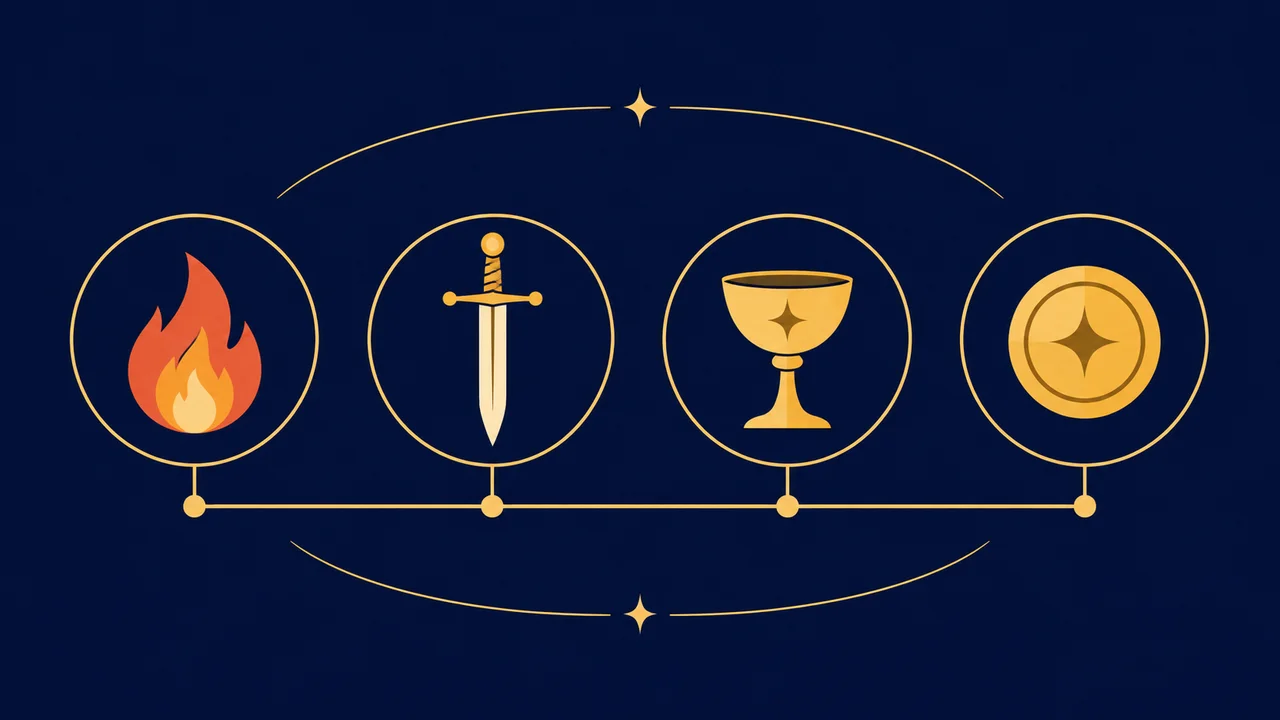
After the cards are drawn, many people's first thought is simple: so when will it happen? Will they text back soon? How long until the interview result arrives? When will a stalled plan finally move? Tarot can offer clues about timing, but it does not give you a mark on a clock. It gives you something closer to a sense of rhythm: is this situation speeding up, still brewing, or already winding down? Tarot timing indicators are the handful of clues that help you read that rhythm. They include the element of a card's suit, the number printed on the card, what the figures in the image are doing, and whether they are acting or waiting. Each one tells part of the story, and none of them is a calendar. Reading them together is less about memorising rules and more about training your eye to notice momentum, pauses and endings in the pictures already in front of you. Here is the short answer first. A common reference saying ranks Wands as fastest, Swords next, Cups slower and Pentacles slowest. Low numbers feel like a beginning and high numbers feel close to completion. Images of running or flying lean fast, while sitting, waiting or holding steady lean slow. Still, these are only reference sayings, and they vary from reader to reader and from spread to spread. What actually works is to look at several cards at once and compare them with what you are asking about. Replying to a message and changing careers simply do not happen on the same timescale. However fast the cards look, they cannot move faster than the natural pace of the matter itself. Read the cards as a description of momentum within that natural pace, and the timing clues become far more useful and far less frustrating. That shift, from asking for a date to asking about rhythm, is where reading timing in tarot really begins.
Timing Indicators Are Not a Clock
When people first hear about tarot timing, many assume each card maps to a specific date, like an entry in a lookup table. A more common view is that reading timing is closer to reading the weather than reading a clock. You can see clouds gathering and the wind picking up, so you know rain is probably on the way, but you cannot say the exact minute it will start.
Timing indicators are those clouds and that wind, and they usually fall into four groups. The first is the element: whether a card belongs to Wands, Cups, Swords or Pentacles. The second is the number, which runs from the Ace up to Ten and then on to the court cards. The third is the movement in the image, such as someone running or something flying through the air. The fourth is the state of the figure. Are they standing and watching, sitting and resting, or already gathering a harvest?
Each of these clues tells only part of the story. None of them is enough on its own, but put them together and the outline of the rhythm slowly appears. So instead of asking “how many days does this card mean?”, it helps to ask “does this spread as a whole look like it is moving forward, or waiting?” The second question is much closer to what tarot is good at answering, and it keeps you from getting tied to a single number.
If you are not yet comfortable with the basic meaning of each card, browse the complete guide to all 78 tarot card meanings first. Once the meanings and images feel familiar, timing clues become much easier to read, because rhythm always comes out of the meanings and pictures themselves.
The Four Elements and Their Reference Speeds
When timing comes up, the idea quoted most often is a speed ranking for the four elements. The commonly shared reference saying goes like this. Wands belong to fire, and fire burns quickly, so Wands lean fast. Swords belong to air, and wind arrives suddenly but also scatters quickly, so Swords come second. Cups belong to water, which flows but takes time to gather, so Cups lean slower. Pentacles belong to earth, which must be tilled before crops can grow, so Pentacles are usually considered the slowest.
This ranking is easy to remember and genuinely helps you build a first layer of intuition. But to be clear, it is a reference saying, not a fixed formula. Readers have different habits. Some see Swords as faster than Wands, since wind arrives the moment it blows. Others feel that emotional shifts in Cups can come on very suddenly. The same card also changes meaning depending on the spread and its position in it.
A healthier way to use the ranking is to treat the element as a tendency rather than an answer. If most of your cards are Wands, you might read the energy around the matter as active and full of push. If most are Pentacles, the matter looks more like something that needs to proceed step by step and build up gradually. The element cannot tell you how long it will actually take, and it should not be forced into a set number of days or weeks.
The most important habit with elements is to remember the ranking without treating it as an iron law. The element is the first filter. It helps you sense the overall mood quickly, and you can then add numbers, movement and the figures' states on top of it.
The Fast Rhythm of Wands and Swords
Wands cards often carry a forward-charging energy. They are generally interpreted as action, passion and beginnings, so when a spread has plenty of Wands, things tend to be easier to set in motion. The card most often cited as a symbol of speed is the Eight of Wands: eight staffs streak across the sky with no figure and no pause, only motion in flight. A common reading is that it points to messages going back and forth, things accelerating and progress suddenly picking up.
Even so, the Eight of Wands is only a sign that the rhythm leans fast. It does not mean there will be a result tomorrow. If it sits next to cards that call for waiting, the overall message might become “once this starts it will move quickly, but there is still a wait before it starts.”
Swords bring a different kind of speed. The air element deals with thought, communication and decisions, so its speed feels more like a sudden change of mind, a quick exchange in conversation, or a decision made all at once. The Knight of Swords galloping forward is often seen as swift action, even a little impatient. Yet the Swords suit also holds plenty of cards that bring things to a halt. In the Eight of Swords, for example, a bound and blindfolded figure conveys being stuck and unable to see a way out.
This is a reminder that speed varies a lot within a single element. Not every Wands card is charging, and not every Swords card is flying. The element is only the first layer. Look at the number and the image as well, so you do not jump to conclusions from the suit alone.
The Slower Rhythm of Cups and Pentacles
Cups and Pentacles usually sit in the slower half of the speed ranking. Cups belong to water and are generally interpreted as being about feelings, relationships and the inner world, and emotions and bonds naturally take time to develop. In the Four of Cups, a figure sits under a tree and shows little interest in the cups in front of them. This is often read as a period of settling, when the person is not yet ready to accept something new, so the pace feels slow.
Pentacles belong to earth and deal with work, money, the body and tangible results, all of which build up one step at a time. The classic example is the Seven of Pentacles: a figure leans on a tool and looks at the coins growing on a vine. The crop has grown, but it is not yet time to harvest. A common reading is that the card is about reviewing progress and waiting patiently, because effort takes a while to show a return.
Again, slow does not mean bad, and it does not mean something will never happen. Some things are meant to be slow, such as building trust, saving money or letting the body recover. A slow signal in the cards sometimes says “this is worth taking your time over” rather than declaring that there is no hope.
Cups and Pentacles also contain more dynamic cards. The Knight of Pentacles is slow but keeps moving steadily forward, while the Knight of Cups arrives holding out a cup, carrying a sense of invitation. The element describes the general direction, but individual cards still need a closer look. To review the full meanings of the minor cards, see the complete guide to the 56 Minor Arcana cards.
How to Read High and Low Numbers
The numbers on the minor cards are another common timing clue. The widely shared reference saying is that low-numbered cards feel like the opening of a story and high-numbered cards feel like its later chapters. The Ace is a seed that has just landed. Two and Three begin to show direction and early results. Four through Six are about growth and adjustment. Seven through Nine bring tests, accumulation and the approach to completion, and Ten feels like a cycle reaching its end.
Seen this way, numbers say less about “how long” and more about “how far along.” If an Ace or a Two appears for your question, everything may only be beginning, with a good stretch still ahead. If a Nine or a Ten appears, the matter may already be close to an outcome, with only the wrap-up or a transition left.
There is a common trap here, though: drawing conclusions from the number alone. The Ten of Swords has a high number, yet it shows a heavy ending. The Ten of Pentacles is also a Ten, yet it shows stable fulfilment. Both cards say the end has arrived, but the way things end is completely different. If you only look at the number, it is easy to miss what the card itself is saying.
So when you look at numbers, first ask whether the matter in this spread is just starting, in the middle or nearly finished. Then go back to the card meaning to see what kind of beginning or ending it is. The number is the coordinate and the meaning is the content, and the two should be read together. You can apply a similar sense of sequence to the Major Arcana, but those cards carry more weight. They are usually best read alongside the whole spread rather than used on their own to estimate timing.
What Movement in the Image Reveals About Pace
If elements and numbers feel too abstract, the most intuitive clue is right there in the picture. You do not need to memorise any rule. Just ask whether the person or object on the card is moving, and how fast.
Some cards look fast at a glance. The staffs of the Eight of Wands fly through the air. The driver of the Chariot is pushing forward. Most of the knights ride horses, though at different speeds: the Knight of Swords is charging, while the Knight of Pentacles is almost standing still. The Wheel of Fortune is turning and is often read as a sudden change in circumstances or a turning point.
Other cards are clearly slowing down. In Temperance, the figure slowly pours water back and forth between two cups, conveying balance and patience. The Hanged Man hangs upside down and still, which is commonly interpreted as a pause and a chance to see things from another angle. The Hermit walks alone up a mountain carrying a lantern, and the pace there is inward and unhurried.
Movement is intuitive to read, so even beginners can pick up the feel straight away. But it is still only one clue among several. The Chariot, for example, is moving forward, yet when it appears reversed it is generally read as scattered direction or blocked progress. To see how reversals can affect rhythm, read the beginner-friendly guide to reversed tarot cards. It covers several common ways to read reversals that help when you judge pace.
The Figure's State: Waiting, Stuck or Harvesting
Beyond movement, the state a figure is in is also worth noticing. Movement tells you about speed, while state tells you about stage. Is the figure waiting, stuck, resting, or already gathering the harvest?
In waiting cards, the figure is usually looking into the distance or at something not yet in hand. In the Three of Wands, a person stands on high ground watching ships at sea, and a common reading is that something has already been sent out and they are waiting to hear back. The figure in the Seven of Pentacles, leaning on a tool and looking at the crop, is also waiting for time to let the results grow. The rhythm of these cards is not a standstill. It is more like “it is already on its way, and it needs a little patience.”
Stuck cards feel more like being held back by something. The Eight of Swords shows someone bound and blindfolded. The Four of Swords shows a figure lying down to recover, and the Four of Cups shows someone sitting, unable to muster interest in what is in front of them. These cards are generally read as saying that things cannot move for now, whether because of outside obstacles or because the person is not ready yet.
In harvest cards, the figure usually already holds the results. The Nine of Pentacles stands at ease in a garden, the Ten of Cups shows a family under a rainbow, and the Ten of Pentacles shows security shared across generations. In terms of timing, these cards suggest that something has already come to fruition or is about to.
With these three groups, you can quickly see whether a spread's centre of gravity lies in waiting, being stuck or harvesting. That often tells you more than asking whether things are fast or slow, and it says more about what to do next.
Read Timing Indicators Across the Whole Spread
Of all the clues so far, this is the most important point: read timing indicators across the whole spread, and do not judge pace from a single card.
Imagine a combination. Say you draw three cards: the Eight of Wands, the Seven of Pentacles and the Three of Wands. Looking only at the Eight of Wands, you would think things are moving fast. Looking only at the Seven of Pentacles, you would think there is a long wait ahead. Seen together, the picture becomes much clearer. There may be quick progress or a flurry of messages, but real results still need time to build, and right now you are watching and waiting to hear back. This reading is closer to real life than any single card could give you.
When you read the whole spread, try three things. First, count the elements and see which one dominates, to catch the overall tendency. Second, look at how the numbers are spread out, to judge whether the matter is roughly at the start, in the middle or near the end. Third, look at the movement and the figures' states in the images, to find where things are pushing ahead and where they are stuck.
If all three clues point the same way, you can say with more confidence that the pace leans fast or slow. If they contradict each other, the matter usually unfolds in several stages, or some parts move quickly while others move slowly. The contradiction is itself an answer, because it shows that this matter does not have a single speed. There is no need to rush to pick a side. Note the fast parts and the slow parts separately, and you will often get a clearer view of the whole.
Start With the Timescale of the Question Itself
One last key point that is often overlooked is the nature of the question itself. Whatever tarot says about fast or slow is always relative to the matter you are asking about.
Replying to a message or arranging a meeting can easily happen quickly. Changing jobs, moving house or letting a relationship settle takes longer by nature. Even if the cards lean fast in both cases, a fast message and a fast job change do not mean the same thing. So when you see fast cards, a more reasonable reading is “sooner rather than later, within the time this kind of matter normally takes.” There is no need to squeeze everything into the same speed.
It also helps to consider how much is in your own hands. When the cards show a slow rhythm, the matter is often waiting for some condition to ripen, and that condition may well be an action of yours. You might reach out first, send in an application or write your plan down. Timing indicators do not pass judgement on fate. They help you see the current rhythm clearly, so you can decide whether to wait, adjust or give things a push.
So when you ask, try to be specific. A question like “over the coming period, which direction is this matter most likely to move in?” will draw more useful clues from the cards than “exactly how many days until there is a result?” If the matter involves major decisions about health, legal issues or money, turn to professional advice. Tarot can keep you company while you sort through your thoughts, but it cannot replace those judgements.
References
Bring the question about timing that is on your mind to the tarot, and see where its rhythm stands right now.
Ask the Tarot