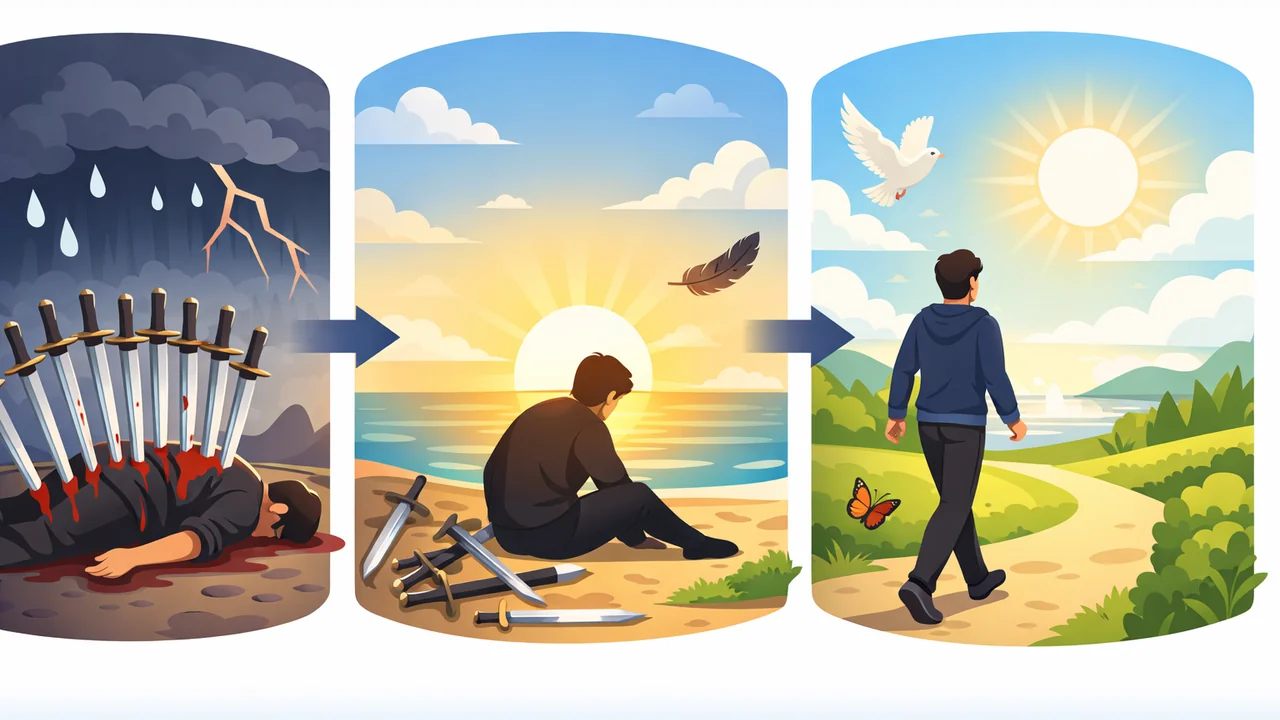
What does the Ten of Swords mean in tarot? This card is often misread as nothing but disaster or failure, yet its deeper meaning is the close of a painful cycle that clears the way for something new. Once you understand that, the card can show you a turning point and a chance for renewal in a reading, not just bad news.
Below, we start with the upright and reversed Ten of Swords, then look at love and career separately, untangle the common misconceptions, and finish with a concrete framework and method for reading it, so you can catch its message accurately and avoid misusing or misjudging it.
Whether you are a beginner or an experienced reader, you can approach the Ten of Swords with more confidence, read its meaning clearly, and use it in real readings to help yourself or others move through hard times toward a fresh start.
Key takeaway: this guide explains what the Ten of Swords means in tarot, from its upright and reversed meanings and its message for love and career to common misunderstandings and practical ways to judge it, so you can read this card of endings and pain correctly and use it well in practice.
Ten of Swords Core Meaning
The Ten of Swords is a key card of endings, pain and turning points. Upright, it is generally interpreted as the close of a chapter, often with sharp pain or loss, but this ending is necessary and clears the way for renewal. It signals that an old pattern, relationship or situation cannot go on; you have to face the truth and accept the failure or hurt before change can come.
Reversed, the Ten of Swords usually points to pain easing and the first light of recovery, or to refusing to accept that something has ended, which leads to delay and repetition. It can also mean that the pain is still there, but new hope and strength are starting to grow inside you as you prepare to rise from the hurt. Overall, this is a card about endings and rebirth: even in pain, a new beginning is waiting.
The Upright Ten of Swords
The upright card typically shows a figure lying on the ground with ten swords in their back, a picture of being trapped in pain and failure. On the horizon, though, a band of light breaks through, often read as a sign that the worst is already over. It points to the end of a relationship, plan or life stage, bringing deep loss and helplessness.
It reminds you that some endings are hard to undo, and accepting reality matters more than forcing things to continue. The process hurts, but that pain is exactly what teaches you to let go and makes room for renewal.
The Reversed Ten of Swords
The reversed Ten of Swords is often read as pain easing or as avoiding an ending. It may mean the wound is slowly healing and you are finding the strength to start over.
But be careful: sometimes the reversal suggests refusing to face reality, leaving you stuck and unable to truly get out of the situation. Read it together with the other cards and the querent's circumstances.
Ten of Swords in Love
In a love reading, the Ten of Swords usually points to the end of a relationship, perhaps a breakup, a betrayal or a rift that cannot be repaired. The card reminds you that while the ending hurts, it is a necessary step toward healing and growth.
Upright, it can suggest the relationship has reached a very difficult point, and simply holding on without dealing with the problems tends to deepen the hurt. Reversed, it may mean reconciliation is still possible, or that the emotional pain is easing and you are getting ready to move on.
Warning Signs of Breakup and Betrayal
The upright Ten of Swords often appears in love readings as a sign of a serious crisis of trust or an emotional rupture. This is usually not an ordinary argument; a more fundamental problem in the relationship is coming to the surface.
At this point, seeing the reality clearly matters more than rushing to save things. Even if you want to repair it, start by talking about that root problem, so you do not get caught in a pointless cycle of pain.
The Possibility of Healing and Renewal
The reversed Ten of Swords may show the hurt beginning to heal. The process is slow, but you have a chance to learn from the damage and rebuild your sense of self-worth.
It can also be a reminder that letting go of past pain is what opens the door to new love or personal growth.
Ten of Swords in Career
In a career reading, the Ten of Swords stands for the end of a work phase or project, possibly a job loss, a failed project or the fallout of workplace conflict. It reminds you that despite the setback, this is a necessary process of clearing old obstacles and making room for new opportunities.
Upright, it stresses facing the failure honestly and learning from mistakes so you do not repeat them. Reversed, it may suggest you have not fully let go of past hurt, or that a turnaround is near.
The Reality of Failure and Endings
In career matters, the upright Ten of Swords often means a plan falling through or a working relationship breaking down. The ending hurts, but it helps you see the root of the problem and stop going down the wrong path.
In this situation, accepting the facts and adjusting your mindset are key.
A Chance to Start Again
The reversed Ten of Swords may suggest you are in a recovery period, or that a new career opportunity is coming. This is a good time to reflect and adjust, preparing for the next stage.
Staying open-minded and actively looking for ways to change will help you break through.
How to Read an Upright or Reversed Ten of Swords
Whether the Ten of Swords is upright or reversed depends only on the direction it faces when you draw it: if it comes out right side up it is upright, if it comes out upside down it is reversed. You do not need to, and should not, decide this based on the situation. Upright usually shows the ending and pain plainly, while reversed more often points to an inner shift or a delay in accepting reality. The querent's situation and the surrounding cards affect how heavily to read the card and which part of life it falls on.
In practice, read it in this order: first check the direction of the card to confirm upright or reversed; then look at which position it lands in and which part of the question it speaks to, comparing it with the querent's current situation; finally, look at the surrounding cards to see whether the pain is happening now, already over, or starting to ease.
- First check the direction to confirm upright or reversed
- Then look at the position and the querent's situation
- Use the surrounding cards to gauge the state of the pain
Adjusting to the Querent's Situation
If you draw the upright Ten of Swords and the querent is going through an obvious ending, such as a breakup or a failed job, you can read it as the outer situation having reached its end, with the focus on accepting it and picking up the pieces.
If you draw it reversed and the querent is still struggling and unwilling to accept reality, you can read it as inner resistance or delay; if the hurt has already been around for a while, it leans more toward gradual healing.
Using the Surrounding Cards
If Death or The Tower appears nearby, the theme of ending and transformation in the Ten of Swords becomes stronger.
If cards like The Star or Strength sit beside it, then whether the Ten of Swords is upright or reversed, you can put the emphasis on the recovery and renewal that follow.
Common Misreadings of the Ten of Swords
Many people assume the Ten of Swords means only total failure and disaster, overlooking that it also stands for renewal and a turning point after the ending. This one-sided reading can leave the querent feeling hopeless and miss the chance to learn from the pain.
Another common mistake is ignoring the positive side of the reversed Ten of Swords and treating it as more of the same bad news, which leads to misjudging the querent's inner state and future possibilities.
Treating the Ten of Swords as Purely Negative
The Ten of Swords does carry pain and endings, but it is also a turning point, a reminder that we have to let go of the past to welcome something new.
Ignoring this layer makes readings overly gloomy and can weigh on the querent's mindset.
Missing the Positive Message of the Reversal
The reversed Ten of Swords is often misread as hopelessness or stalling, but it also shows the hurt beginning to heal and inner strength slowly returning.
Reading the reversal correctly helps give the querent hope and constructive direction.
Using the Ten of Swords in Real Readings
In an actual reading, when the Ten of Swords appears, first confirm whether it is upright or reversed, which position it sits in and which cards surround it, so you understand the stage and emotional state the querent is in. Then, for the topic of the question, read it on four levels: ending, pain, acceptance and renewal.
A step-by-step approach works well: first name the current reality of pain and ending, then guide the querent to think about how to accept and let go, and finally point to the possibility of renewal and a direction for action.
- Confirm direction, position and surrounding cards
- Read the ending and pain in layers
- Guide toward acceptance and letting go
- Offer concrete steps toward renewal
Confirming Direction, Position and Nearby Cards
Whether the Ten of Swords is upright or reversed (based on its direction when drawn) is the foundation of the reading. The surrounding cards add detail, such as whether there are supportive cards that help the change or heavier cards that deepen the pain.
This information helps the reading fit the querent's real situation more closely.
Reading in Layers and Giving Guidance
First, state the reality of the ending and pain clearly rather than vaguely, so the querent can face the problem.
Next, encourage acceptance and letting go, stressing that this is a necessary step toward a new beginning.
Finally, offer concrete actions, such as seeking support, adjusting their mindset or planning new goals.
Limits and Cautions When Reading the Ten of Swords
Although the Ten of Swords stands for endings and pain, it should never be read in isolation. Combine it with the querent's overall situation, the background of the question and the other cards to avoid excessive pessimism or misjudgment.
Also, the Ten of Swords appearing does not mean fate is sealed; it is more a reminder of the present state and the lessons that must be faced. Avoid absolute statements, and leave the querent room and hope.
Do Not Read It in Isolation
The meaning of the Ten of Swords only becomes complete when combined with the other cards.
Looking at it alone can lead to misjudgment and cause you to miss other possible turning points or sources of support.
Avoid Absolutes and Fatalism
The Ten of Swords points to the current state and the challenges that must be faced, not to an unchangeable destiny.
When reading it, emphasize the querent's own agency and ability to change, so they are not left feeling powerless.
Want to see what this card means in your own situation? Bring the question on your mind and draw three cards. It usually feels far more relevant than reading keywords alone.
Start a Tarot Reading