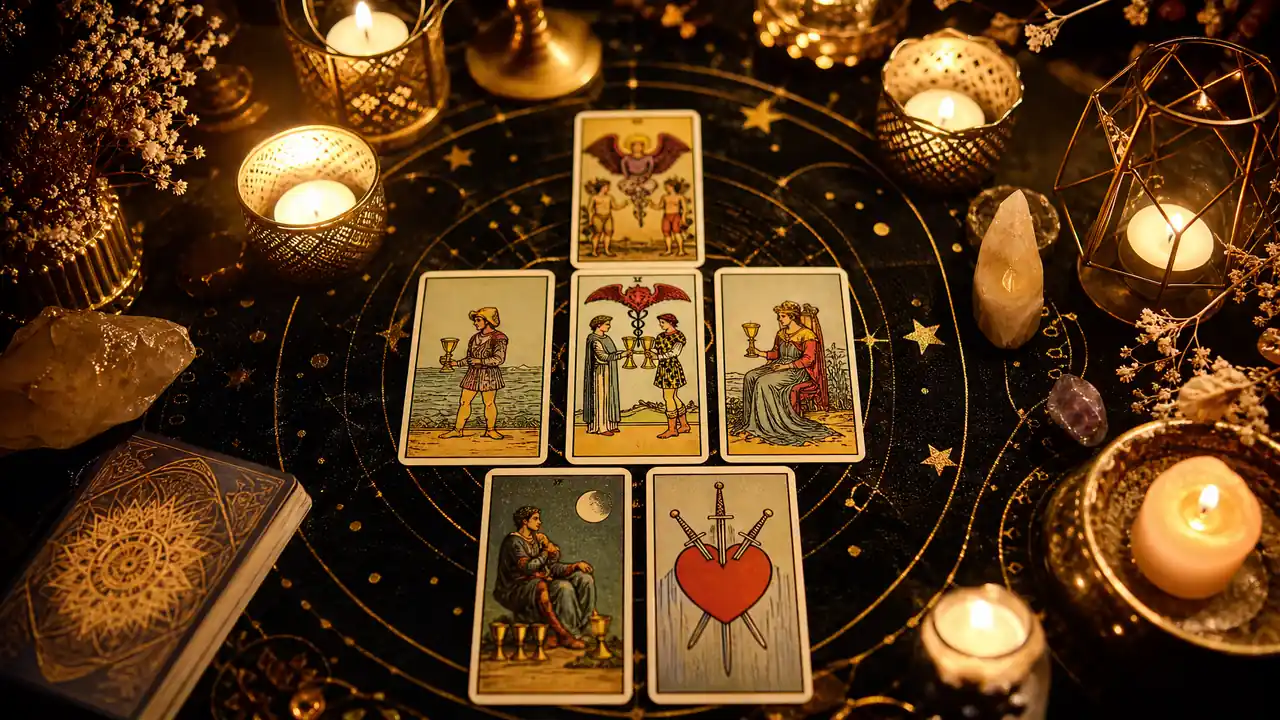
When you use tarot to look at how someone feels about you, the point isn't to draw a single “do they love me” card. Break the question down instead: how they feel right now, what they care about, what they're afraid of, whether they intend to act, and where things between you are actually stuck. One card can point a direction, but feelings usually need a spread to cross-check. That keeps you from reading one Cups card as deep love, or one Swords card as proof they feel nothing.
Below are the five-card and seven-card layouts often used in love and relationship readings. For each, you'll see what every position asks and how to read the other person's emotions, doubts and leanings from the cards. You'll also see the usual mistakes, like treating reversals as a flat no, treating the Major Arcana as fate, or projecting your own anxiety onto the other person.
If you're in a situationship, a cold war, still talking after a breakup, or just feeling someone run hot and cold, this approach gives clearer answers than asking “do they like me?” It also helps you decide whether to move closer, wait and watch, talk it through, or bring your focus back to yourself.
Key points: to read someone's feelings, look at heart, doubts, action and obstacles separately. Having feelings doesn't mean acting on them. Start with five cards, and use seven when the relationship is complicated or the signals are mixed. After the draw, sort the result into three columns: what the cards show, whether real life backs it up, and what you'll do next.
The Short Answer: What Layers a Partner-Feelings Spread Should Cover
A spread for someone's feelings isn't meant to stamp a verdict of love or no love. It breaks the relationship into layers you can actually judge: emotional feelings, inner doubts, real-life pressure, willingness to act, your place in the relationship, and where things are heading in the short term. That way the cards don't turn into vague comfort. For example, if they're drawn to you but the action card is the Two of Swords, they may still be on the fence or avoiding a choice. If the feelings card is the Two of Cups but the obstacle card is the Devil, there may be strong attraction, along with dependence, possessiveness or an unhealthy push and pull.
The Rider-Waite deck is full of concrete scenes, which makes it great for noticing body language, where figures are looking, and how much distance there is between them. When you read someone's feelings, don't rely only on memorized keywords. Look at whether the figures face each other, seem closed off, are moving, or look trapped. If you want a solid foundation in card meanings first, see the complete guide to all 78 tarot card meanings, then come back and practice love spreads.
Feelings and action are not the same thing
The most common mix-up is confusing “do they feel something” with “will they make a move.” Cards that show feelings don't mean they'll come closer right away. Cards that show stalled action don't automatically mean they feel nothing. The Six of Cups can mean nostalgia, familiarity and emotional connection, but if the Hanged Man sits in the action position, things may stay still for now. On the other hand, the Knight of Wands suggests quick advances and impulsive pursuit, yet if the heart position shows the Seven of Swords, they may just be testing the waters, holding back or not being fully honest.
The spread reads the relationship, not a way to control someone
A reasonable goal is to understand the signals and limits in your interactions so you can make clearer choices. It isn't meant for checking what they think every minute. If you use a spread as a surveillance tool, you can fall into a loop where one draw doesn't settle you and the next only confuses you more. A healthier way is to set a clear timeframe, for example: “Over the next month, what is their main attitude toward this relationship, and what might they do?”
- Look at feelings, doubts, action, obstacles and direction separately.
- Feelings don't equal action, and strong action doesn't equal stable, sincere feelings.
- A spread helps you judge the relationship. It doesn't help you control the other person.
The Basic Five-Card Spread: See Their Feelings and Obstacles Quickly
The five-card spread suits anyone just starting to read a partner's feelings. The structure is clear, the information stays manageable, and you avoid losing focus by pulling too many cards at once. The suggested positions are: 1. their surface attitude toward you; 2. their true inner feelings; 3. their doubts or obstacles; 4. what they may do in the short term; 5. the reminder this relationship most needs you to see. It works for situationships, new connections, fewer messages, or uncertainty after a date.
When reading five cards, focus on how the positions compare rather than judging each card alone. If the surface card is the Six of Wands, they may come across as confident, proactive and enjoying the attention. If the inner-feelings card is the Four of Cups, they may not be truly invested and could feel hesitant or emotionally drained. If the obstacle card is the Eight of Pentacles, the issue may not be you at all. They may be focused on work, daily routine or personal goals. Asking “do you even like me?” may not help here. Watch instead whether they're willing to set aside real time for the relationship.
The five positions
Card one shows the outer attitude, how they come across when you interact. Card two shows inner feelings, so you can check whether surface and inside match. Card three shows the obstacle, why they aren't moving forward. Card four shows action, whether they're likely to come closer, respond or pull back soon. Card five is the reminder, which usually points to the angle you need to adjust. A big gap between cards one and two suggests hidden emotions. If cards three and four contradict each other, they may want to move but are stuck for now, practically or emotionally.
Questions that work well
Good questions are specific, have a timeframe and focus on how the relationship is moving. Try: “Over the next month, what are this person's feelings toward me and their likely actions?” or “What are this person's main feelings, doubts and leanings in this relationship right now?” Avoid asking “Are they destined to love me?” or “Will they only ever love me?” Questions that absolute tend to turn the cards into a screen for your anxiety. If you're new, read the ultimate tarot guide for beginners first to set up your drawing and questioning routine.
- Five cards are good for quick judgments, not for complicated love triangles or long-tangled situations.
- If surface attitude and inner feelings are opposite, first track whether their behavior is consistent.
- An obstacle card doesn't always mean no love. It may mean pressure, timing or self-protection.
The Advanced Seven-Card Spread: Separate Feelings, Doubts and Willingness to Act
The seven-card spread suits relationships that have gone on for a while, or ones full of mixed signals. The suggested positions are: 1. the surface of the relationship as you see it; 2. their emotional feelings toward you; 3. their rational view of the relationship; 4. the doubts they don't say out loud; 5. their willingness to act soon; 6. what you need to adjust in the relationship; 7. where the relationship is heading over the next six to eight weeks. Compared with five cards, it can tell apart subtler states such as “has feelings but won't move,” “wants contact but not commitment,” or “thinks it won't work yet is still drawn in.”
Here are both layouts side by side, so you can set them out before you draw:
Position | Five-card spread | Seven-card spread
1 | Their surface attitude toward you | The surface of the relationship as you see it
2 | Their true inner feelings | Their emotional feelings toward you
3 | Their doubts or obstacles | Their rational view of the relationship
4 | What they may do in the short term | The doubts they don't say out loud
5 | The reminder this relationship most needs | Their willingness to act soon
6 | — | What you need to adjust in the relationship
7 | — | Where the relationship is heading in the next six to eight weeks
The biggest strength of seven cards is that it separates feeling from judgment. People rarely hold just one state of mind, especially in situationships and after a breakup. Someone can miss you, fear repeating old mistakes and be unsure whether it's worth trying again, all at once. A single “do they love me” card easily oversimplifies that. Seven cards split emotion, reasoning, doubt and action, so one great or terrible card is less likely to pull you along.
Comparing the emotion card and the reason card
If the second card, the emotion card, is the Queen of Cups, the Lovers or the Two of Cups, there's usually connection, admiration or a wish to get closer. But if the third card, the reason card, is the King of Swords, the Two of Swords or Justice, they may be weighing circumstances, boundaries or consequences. This isn't simple liking or not liking. It's heart and head pulling against each other. If the action card is the Knight of Pentacles, they may watch slowly and not declare anything soon.
Reading the doubts card to find the obstacle
The fourth card, the doubts card, is key. The Moon often points to uncertainty, fear of misunderstanding or unclear information. The Hermit may mean they need space or aren't ready for closeness yet. The Five of Pentacles can relate to insecurity, practical hardship or low self-worth. The doubts card isn't there to make excuses for them. It helps you decide whether this relationship needs a conversation, more time, lower expectations, or an end to the drain.
Never read the outcome card apart from the first six
The seventh card, the outcome, is the one most easily blown out of proportion. If it's the Sun but the doubts card is the Eight of Swords and the action card is the Hanged Man, the Sun may only mean one brighter interaction soon, not a stable relationship. If the outcome is the Tower, don't assume the relationship is ruined. It may mean the truth comes out, or an unstable pattern breaks. Place the outcome back into the whole spread to tell whether it's an event, an emotional outburst or the relationship being redefined.
- Seven cards suit complicated relationships, especially situationships, lost contact and post-breakup contact.
- Read emotion, reasoning, doubts and action separately instead of blending them into one answer.
- The outcome card shows a trend, not a verdict that can't change.
Reading the Signals: Attraction, Hesitation, Avoidance and Coldness
The most practical way to read someone's feelings is to look at clusters of signals, not whether single cards are good or bad. Cups are generally tied to emotion, attachment, memories and the need for closeness. Wands often point to attraction, heat, impulse and desire to pursue. Swords lean toward thinking, defensiveness, distance, communication and conflict. Pentacles relate to stability, practical conditions, time invested and long-term plans. When many Major Arcana cards appear, the relationship likely carries heavy psychological weight for the person, or is at an important turning point.
The Two of Cups, the Lovers, the Sun, the Star and the Knight of Cups in feelings positions often show attraction, connection, hope or a wish to come closer. If the Seven of Swords, the Moon or the Devil appear alongside them, watch for secrecy, fantasy, dependence or an unbalanced pull. On the other hand, the Four of Swords, the Hermit and the Four of Cups don't necessarily mean no feelings. They can mean withdrawal, rest, cooling off or temporarily having nothing to give. What really decides the reading is the position: in inner feelings, doubts or action, the same card means different things.
Cards showing attraction usually show connection
When figures lean toward each other, exchange cups or face one another, there's usually a willingness to engage. The Two of Cups is the classic picture of mutual feeling. The Lovers can mean attraction and choice. The Four of Wands often suggests enjoying time together and wanting a shared space. Still, check whether these cards fall in core positions. If they only show up in the position for your hopes while their heart shows the Two of Swords, the sweetness you feel doesn't mean they've made a choice.
Cards showing hesitation often show stalling or a dilemma
The Two of Swords, the Hanged Man, the Chariot reversed, the Two of Pentacles and the Moon often appear when they haven't decided, lack information, feel emotionally confused or face shifting practical conditions. These cards don't reject you. They show that the other person has no clear direction right now. If you draw them, the next step isn't to press for answers. Watch whether they're willing to invest in concrete actions, like keeping regular contact, making plans to meet, or explaining their boundaries.
For avoidance and coldness, look for a lack of investment
Coldness isn't just fewer messages. It's a whole spread lacking signals of emotion, action and commitment. If the heart card is the Four of Cups, the action card the Four of Swords and the outcome the Four of Pentacles, they may be closed off, guarded and unwilling to change things. If the Seven of Swords or Seven of Wands appears, also watch for defensiveness, holding back or deliberately keeping distance. Rather than chasing their feelings, set your own limits: how long you can accept not knowing, and what kind of response you need to feel respected.
- Cups show emotion, Wands show heat, Swords show distance and thinking, Pentacles show steady investment.
- A good card in the hopes position doesn't mean they're truly invested.
- For coldness, check whether the whole spread lacks emotion, action and time invested.
How to Ask: Don't Turn the Spread into Emotional Reassurance
When reading someone's feelings, the question matters more than the spread. If you ask “do they love me or not,” you'll tend to hunt for one positive card to calm down, or treat any negative card as a disaster. It works better to turn the question into something you can observe, act on and compare. For example: “Over the next six weeks, what are this person's main feelings toward me, their obstacles and their likely actions?” or “How should I understand their recent hot-and-cold behavior?” Questions like these let the cards give you more information about the relationship.
Also avoid prying too far. Tarot can help you understand the energy and signals in a relationship, but it shouldn't become a tool for crossing into someone's privacy. If what you really want to know is whether they have a partner or someone else on the side, shift the focus to “Is this relationship transparent, am I being respected, and how do I protect myself?” rather than demanding the cards prove something. For more on situationships, read does my situationship like me? the most common love signals in tarot.
Questions worth asking
Try: “What are this person's emotional and rational views of this relationship?”, “Over the next month, which way are our interactions most likely to go?”, “If I start an honest conversation, how might they respond?”, “What blind spot in this relationship do I most need to see right now?” These keep the focus on judgment and action instead of chasing a single yes.
Questions to avoid
Avoid: “Will they definitely come back?”, “Am I 100% the only one in their heart?”, “How long until I'm loved?” These hand your choices away and turn the spread into an extension of your anxiety. The real value of a love reading is seeing your own position and options clearly, not leaving you stuck waiting.
- Give the question a timeframe, such as four weeks, six weeks or three months.
- Change “do they love me” into “what are their feelings, obstacles and actions.”
- Keep your power to choose. Don't hand your life over to one card.
Common Mistakes: Readings That Make You More Anxious the More You Draw
The first common mistake is treating one card as the final answer, like assuming the Lovers means you'll definitely end up together, or that Death means it's completely over. In fact, the Lovers can also mean a choice or a test of values, and Death can mean an old pattern of interaction ending, not that the feelings have vanished. Card meanings need to be read within the question, the position and the whole context. In love spreads especially, a powerful Major card often signals that the relationship is stirring deep change, not a simple good or bad.
The second mistake is treating every reversal as no, failure or a bad outcome. A reversal may mean blocked energy, something turned inward, delay, excess or an immature expression. The Knight of Cups reversed doesn't necessarily mean no interest. It might mean unsteady romantic expression, weak emotional commitment, or lots of talk with little follow-through. The Empress reversed might point to unbalanced caretaking, clinging or sinking self-worth. For a fuller look at reversals, see tarot reversals made easy for beginners.
Projecting your hopes onto the cards
When you badly want a relationship to work, it's easy to read every card as “they really love you, they're just scared, busy, hurt or not ready.” Any of those might be true, but none replaces looking at real life. If a spread keeps showing the Four of Swords, Four of Cups, Four of Pentacles and the Hermit, the energy is reserved. You need to admit they aren't investing enough right now, instead of writing a whole story of hidden devotion to explain their silence.
Drawing again and again lowers the quality of your judgment
Drawing repeatedly on the same question in a short time is usually about soothing emotions, not understanding. If you draw coldness in the morning, want to draw “they miss you” in the afternoon, and check the outcome again at night, you'll just pile up contradicting messages. For the same relationship and timeframe, wait until something concrete happens before reading again, such as a reply from them, meeting up, or a new reaction after you speak up.
- A single card is not a verdict on love. Read it with its position and the full context.
- Reversed doesn't mean no. It often means blockage, delay or immature expression.
- Repeated draws mostly manage anxiety. They don't add clarity.
Worked Examples: How the Same Spread Can Show Different Situations
Say you use the five-card spread with the question: “Over the next month, what are this person's feelings toward me and their likely actions?” First combination: surface attitude is the Knight of Wands, inner feelings the Two of Cups, obstacle the Eight of Pentacles, action the Three of Wands, reminder Temperance. This suggests attraction and emotional exchange. They may come across as warm and proactive, but the obstacle lies in their schedule, work commitments or lack of stability. The Three of Wands suggests they may wait to see what's next or arrange a new meeting, and Temperance reminds you not to get swept up by the heat. Watch whether they can stay consistent.
Second combination: surface attitude is the Four of Swords, inner feelings the Six of Cups, obstacle the Moon, action the Hanged Man, reminder the High Priestess. This often shows up when there are memories and emotions but, for now, no clarity, no statement and no action. The Six of Cups shows they may still feel nostalgia or familiarity, but the Moon and the Hanged Man point to uncertainty, stalling and avoidance. The High Priestess reminds you not to force an answer. First look for what's hidden: whether they're still working through a past relationship, whether they have doubts they can't explain, or whether the information you have is incomplete.
Third combination: surface attitude is the Page of Pentacles, inner feelings the Two of Swords, obstacle the Devil, action the Seven of Swords, reminder Justice. This one can't be read as “they still care a little.” The Page of Pentacles may mean they keep up basic contact or are testing the waters, but the Two of Swords shows they don't want to decide. The Devil points to unhealthy attraction, dependence, desire or control, and the Seven of Swords hints they may hold back, not be honest, or dodge the main issue. Justice reminds you to judge by facts, not feelings alone. If their words and actions don't match, trust the actions first.
Turning the examples into your own judgment
Sort each reading into three columns: what the cards show, whether real life backs it up, and what you can do next. If the cards show feelings but in reality they rarely reply, never make plans and won't acknowledge the relationship, don't let the cards paint over that. If the cards show strong obstacles but in reality they're willing to talk and change, there's still room to adjust. A spread doesn't replace reality. It helps you understand it.
- Passionate cards plus stable cards look more like lasting investment.
- Nostalgic cards plus stalled cards often mean feelings without action.
- Attraction cards plus secrecy cards mean protect yourself and confirm boundaries first.
Limits and Next Steps: What to Do After the Reading
Tarot can help you understand how someone feels, but it can't replace talking directly, and it can't guarantee what they'll do. Feelings are shaped by time, pressure, choices, values and how two people interact. A spread shows trends from now into the short term. If the reading suggests there's still a chance, the next step isn't waiting forever. Design a small action you can check, like inviting them out once, stating your needs clearly, and seeing whether they respond. If the reading shows strong obstacles, you still have choices. It's a reminder to bring your attention back to boundaries and protecting yourself.
The most practical thing to do after a reading is turn it into an action list. First, write down their clearest emotional signals and obstacles. Second, set a time to observe, such as two weeks or a month. Third, decide what you'll do: talk openly, stop chasing for answers, invest less, or end an unequal dynamic. Fourth, check the spread against what actually happens. If they keep leaving you anxious, unsure and waiting, take your own feelings as important information, no matter how romantic the cards look.
Three steps from spread to action
Step one: identify the main signal in the spread. Is it feelings that are stuck, high heat with no stability, or coldness with little investment? Step two: pick the smallest action to test it, like sending one clear but no-pressure message, or suggesting a specific time to meet. Step three: see whether they answer with the same clarity. If they only give vague promises, avoid making plans, or come close briefly only when you step back, reassess whether this relationship is worth more of your energy.
When not to keep reading
If readings are affecting your sleep, work or eating, or you're checking card meanings over and over in a single day, it's time to stop drawing. What you need then isn't more answers but a break from the trigger, time to sort out your feelings, and, if needed, a talk with someone you trust. Tarot should leave you clearer, not more dependent on uncertainty. If a relationship keeps costing you your self-respect, boundaries and sense of safety, put your own wellbeing ahead of any card.
- Set a time limit for observing after a reading. Don't wait forever.
- Check the spread against their behavior, not just their words and promises.
- If readings make you more anxious, stop drawing and lean on real-life support.
References
The hardest part of a situationship is not knowing what the other person is thinking. Write down how things have gone between you lately, and use a love reading to see where the relationship is heading and how you might respond now.
Start a Love Reading