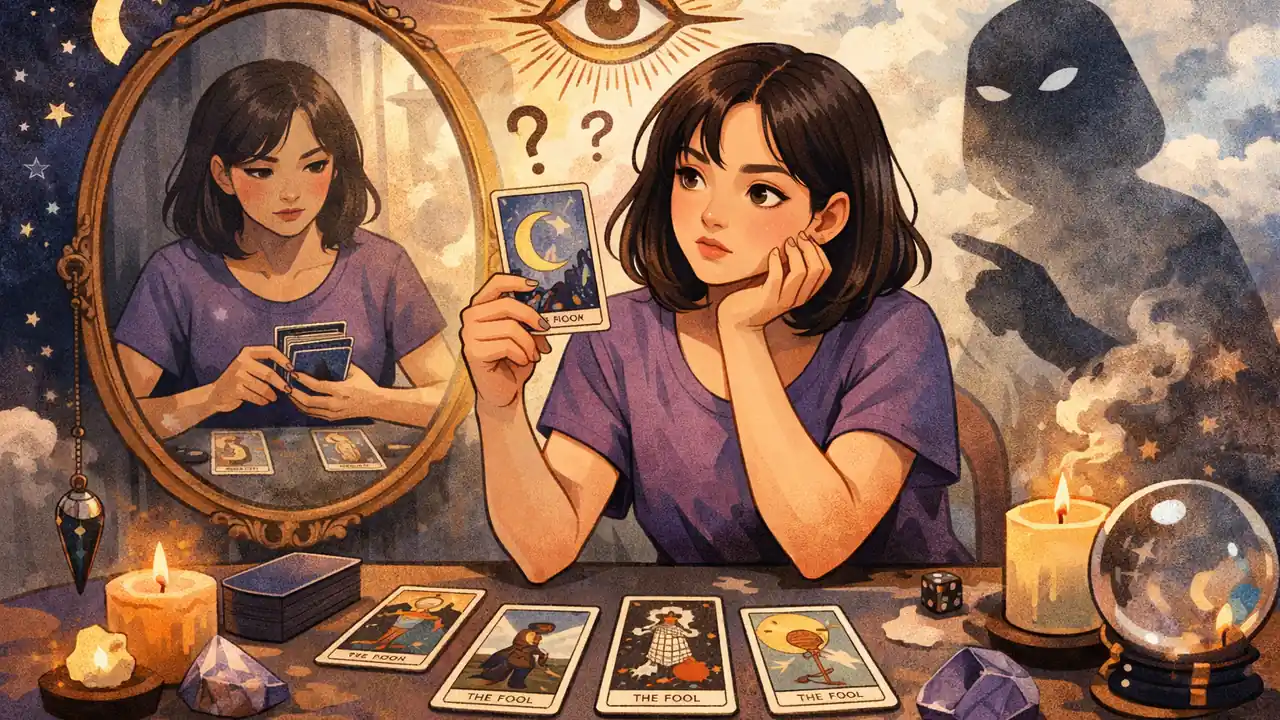
Accuracy has nothing to do with who draws the cards: whether you shuffle yourself or someone does it for you, the cards come up at random. What really goes wrong in a self-reading is the interpretation. Because you care so much about the answer, it is easy to pick only the meaning you want to hear, decide on a conclusion first and then hunt for evidence in the cards, or quietly change what a position means when an unwelcome card lands there.
The good news is that each of these biases can be avoided: write down your question and card positions before you draw, never redraw for the same question, and reread your interpretation the next day. Do those three things and reading tarot for yourself becomes a genuinely useful way to sort out your thoughts.
Three common biases when you read your own cards
Bias | What it looks like | How to avoid it
Picking the meaning you want | You draw The Tower and read it as “just a small change”; you draw the Two of Cups and decide he must like you too | Write down the card’s basic meaning first, then apply it to your situation
Answer first, evidence second | You have already decided to get back together, so every card gets read as “yes” | Before drawing, write down the answer you hope for, then compare afterwards: is this the card talking, or you?
Changing positions after the draw | You dislike the card in the “outcome” position, so you say it is really about “obstacles” | Write down what each position means before drawing, and read them as written
There is also a bias that comes from mood: when you feel low, even neutral cards look like bad news. Say you are worried about your future with your partner and you draw the Nine of Swords. It is tempting to read it as “this relationship is doomed.” But the Nine of Swords is generally interpreted as sleeplessness and repetitive worry, a state of mind. It points to your anxiety, not your partner’s decision. Your mood affects how you read a card, not which card you draw.
Five steps for a self tarot reading
1. Write down your question and time frame: for example, “Over the next month, should I ask him out?”
2. Write down what each position means: for example, three cards for current situation, obstacle and advice.
3. Honestly write down the answer you hope for: this is the step people skip most often, and the one that best catches bias.
4. Draw, write the basic meaning first, then apply it: jot two or three keywords for each card, then say what it means in this position and for this question.
5. Read it again the next day: compare with yesterday’s interpretation and look for places where emotion or hope pulled you off course.
You can fill in this log template each time:
- Date and question (including time frame)
- Spread and the meaning of each position
- The answer I hoped for
- Cards drawn (upright or reversed) and their basic meanings
- My interpretation
- Thoughts on rereading the next day
- What actually happened a month later
The last column matters most. After a few readings you will see where you tend to drift, for example “I always read Swords cards too harshly.” For a fuller note format, see the tarot reading journal template.
Once you have drawn for a question, do not draw again. If you want to ask again, wait until something new has happened or you have taken a new step. For when it makes sense to re-ask, see how often you should read tarot.
A worked example: should I ask him out?
Scenario: you have feelings for a coworker and want to ask, “Should I ask him out this month?” Before drawing, you honestly write down your hope: “I want the cards to tell me to go for it.” The three cards are:
Position | Card | Basic meaning
Current situation | Two of Cups, upright | Mutual attraction, an equal exchange
Obstacle | Nine of Swords, upright | Anxiety, repetitive worry
Advice | Four of Swords, upright | Rest, stepping back for a while, regaining clear judgment
The biased reading: “Two of Cups! He likes me too, I’m asking tonight.” This reads only the card you most wanted to see and skips the advice position.
A more honest reading: the possibility of mutual interest may be real (Two of Cups), but your anxiety (Nine of Swords) makes you want an answer right now. The Four of Swords in the advice position asks you to slow down and ask once you feel steadier, not to fire off an impulsive message when your anxiety peaks. Compare this with the hope you wrote down and you will see that “ask tonight” is what you wanted to hear, not what the cards said.
If you reread it the next day and still conclude “yes, ask, but steady yourself first,” you can act on it: for example, chat a little more naturally at work, then make the invitation before the weekend.
When you need a second perspective
If you notice you only ever see the answer you want, or the matter is so important and emotional that you cannot step back, compare with another perspective: look at an AI interpretation of the same cards, or ask a friend you trust to read them, and note where their reading differs from yours. The point is not who is more accurate, but adding a view that does not carry your hopes.
| Reading it yourself | AI reading | Asking a person
Upside | You know your situation best and can practice anytime | Carries none of your hopes, available anytime, lets you check against card meanings | You can talk it through face to face and feel supported
Watch out for | Picking only the meanings you want | Only knows the background you give it, so describe your question and situation clearly | Costs money and time, and watch for manipulative sales tactics
To compare when an AI reading or a human reader suits you better, see AI tarot vs a human tarot reader. If you are thinking of paying someone for a reading, watch for these warning signs: using fear to push you into buying “cleansing” services, claiming you have been cursed, guaranteeing a reunion or a definite outcome, or raising the price step by step. If you see these, stop; if you suspect fraud, contact your local consumer protection or anti-fraud hotline.
What self-readings suit and what they don’t
Good for self-reading | Better not to rely on self-reading alone
Everyday reminders, what to watch for this week | Major health, legal or financial decisions
Sorting out how you feel about a relationship | When your emotions are overflowing and every reading looks bleak
Laying out your options before a decision | When you have already drawn for the same question many times
For health, legal or financial matters, please consult a doctor, lawyer or qualified professional; if low mood is affecting your daily life, reach out to a local mental health or crisis support line.
Conclusion: reading honestly matters more than who draws
Reading tarot for yourself can be very useful, as long as you are willing to read honestly: write down your question and positions, note your hopes, never redraw for the same question, and look again the next day. Do this, and what you get from the cards is a reminder, not just the answer you already wanted to hear.
Want to practice reading your own cards honestly? Write down your question and the answer you hope for, draw once, then compare with the AI interpretation to see where it differs from your own reading.
Draw for your question