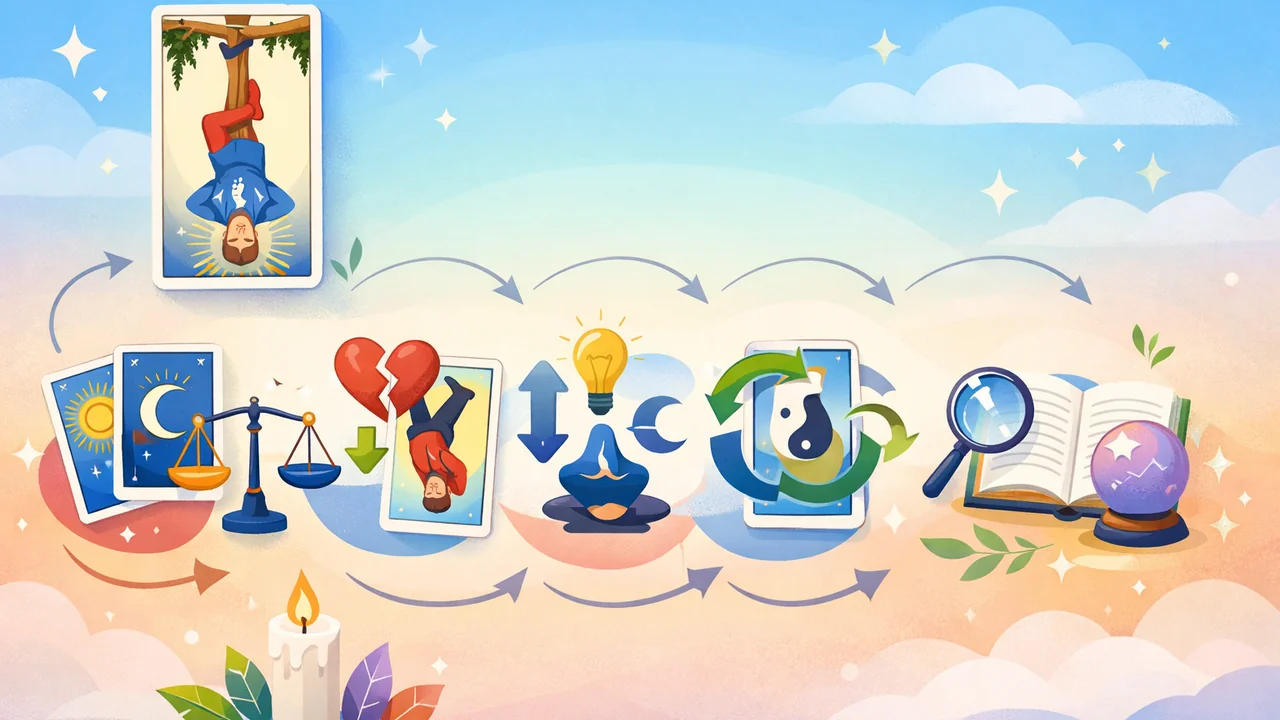
How do you read reversed tarot cards? A reversal isn't simply bad news. It can point to blocked energy, inner reflection, or a quality being expressed too strongly. Knowing how to work with reversals is one of the most useful skills for getting more out of a reading.
Below are five ways to interpret reversed cards, followed by a decision framework, common misconceptions, practical steps and the limits of reading reversals, so you can apply them in both love and career spreads.
Whether you are new to tarot or already read regularly, these methods help you recognize what a reversed card is pointing to in context and avoid jumping to the wrong conclusion.
Key takeaway: reversed cards have several possible readings, not one. Use the five methods, avoid the common traps, and always read a reversal in light of your question and the rest of the spread.
What Does a Reversed Tarot Card Really Mean?
A reversed tarot card is not automatically "bad news" or a negative omen. It is generally interpreted as a shift in the energy of the upright meaning. Reversals often point to energy that is blocked, turned inward for reflection, or expressed too strongly, each one a different facet of the upright card. A reversal asks you to notice hidden issues, inner feelings or outside obstacles rather than deciding whether the outcome is good or bad.
When a reversed card appears, it suggests things are not flowing completely smoothly and may need to be reassessed or redirected. It can also hint that some energy isn't ready yet, or that there is fear or resistance underneath the surface. Understanding what a reversal is really saying is the key to avoiding misreadings and keeping your interpretation grounded in real life.
- A reversal is not the same as bad news; it shows energy in an unusual state
- Reversals reflect inner blocks or overexpression
- A reversal is a signal to adjust and reflect
Five Frameworks for Interpreting Reversed Cards
The five most common lenses for reading reversed cards are: the opposite of the upright meaning, blocked energy, inward energy, excess, and delay. Looking through all five helps you see a reversal from several angles instead of falling into a single, rigid reading.
These frameworks are not mutually exclusive. You can use them flexibly depending on the spread and the question. Once you know them, you can match the specific question and card combination to the meaning that fits the reversal in this particular reading.
Opposite of the Upright Meaning
This approach treats the reversal as the flip side of the upright card: its power or event is weakened or turned around. The Fool upright is generally read as adventure and new beginnings; reversed, it may suggest recklessness or hesitation. It's the most intuitive method, but it can miss a reversal's deeper message.
Blocked Energy
Reversed cards often suggest energy that isn't flowing, with things stalled or obstructed. The Three of Wands upright is generally read as expansion and collaboration; reversed, it may point to blocked partnerships or delayed plans. This reading focuses on obstacles in your surroundings or inner state.
Inward Energy
Sometimes a reversal shows energy turning inward: introspection, self-reflection or hidden emotions. Seen this way, a reversed card isn't necessarily negative; it invites you to pay attention to your inner world.
Excess or Imbalance
A reversal can also signal energy that is overdone or out of balance, such as overconfidence, a strong need for control or emotional outbursts. It reminds you to watch for extremes in behavior or attitude.
Delay
A reversed card may suggest that something isn't ripe yet and a plan or wish needs the right timing rather than being rushed. This reading emphasizes timing and patience.
Common Mistakes and Misconceptions About Reversals
The most widespread mistake is assuming a reversed card always means something bad or unlucky. Reversals are far more nuanced than a good-or-bad split, and ignoring that leads to skewed readings and missed messages.
Another common error is treating a reversal as the simple opposite of the upright card, overlooking meanings like inward energy or delay. Some readers also lean too heavily on reversals and ignore the overall energy of the spread and how the cards interact.
- A reversal isn't necessarily bad news
- A reversal isn't the exact opposite of the upright meaning
- Ignoring the spread as a whole and the links between cards leads to misreadings
How to Read Reversed Cards in Practice: Steps and Tips
Before interpreting a reversal, confirm the spread and the background of the question, then read the reversed card within that whole context. Next, check the card against each of the five frameworks and choose the angle that best fits the situation.
In practice, keep an open mind while drawing and don't rush to conclusions. When a reversal shows up, start from the upright meaning as a base, then layer in perspectives like blocked or inward energy so a single reading doesn't lead you astray.
Step 1: Clarify the Spread and the Question
Understand the specific question and the structure of the spread, and note where the reversed card sits and how it connects to the others. This makes your reading much more precise.
Step 2: Apply the Five Frameworks
For each reversed card, go through opposite meaning, blocked energy, inward energy, excess and delay in turn, and pick the most reasonable explanation.
Step 3: Combine Other Cards with Your Intuition
Bring in the upright and reversed meanings of the other cards in the spread, along with your intuition, to form a complete reading.
Reversed Cards in Love Readings vs. Career Readings
In love readings, reversed cards often point to emotional blocks, poor communication or inner conflict. The Lovers reversed, for example, is generally read as an imbalanced relationship or a hard choice, inviting you to look more closely at what both people really feel.
In career readings, reversals often reflect delayed plans, friction in collaboration or low personal motivation. Understanding a reversal's multiple meanings can help you pin down a work bottleneck and find a way to adjust.
Reversed Cards in Love Readings
In relationship questions, reversed cards often indicate blocked emotions or hidden issues. Pay attention to each person's inner struggles and how well they are communicating.
Reversed Cards in Career Readings
In career questions, reversed cards flag stalled progress, teamwork problems or too much pressure, which makes them useful for spotting when you need to change pace.
The Limits of Reading Reversals: When Not to Overinterpret
Reversed cards carry a lot of information, but they shouldn't be overread or taken too pessimistically. If a spread is full of reversals, it may reflect tension in the moment or a question that isn't clear enough, so consider rephrasing the question first.
A reversal also has to be read together with the whole spread and the querent's actual situation; a single reversed card can't be judged in isolation. Relying too much on reversals can lead to misreadings and make the reading less useful.
- Don't treat reversed cards as purely negative
- Read reversals in light of the whole spread and the situation
- Vague questions make reversals easy to misread
To see what these meanings say about your own situation, bring the question you have right now and draw three cards. It usually feels more meaningful than reading keywords alone.
Start a Tarot Reading