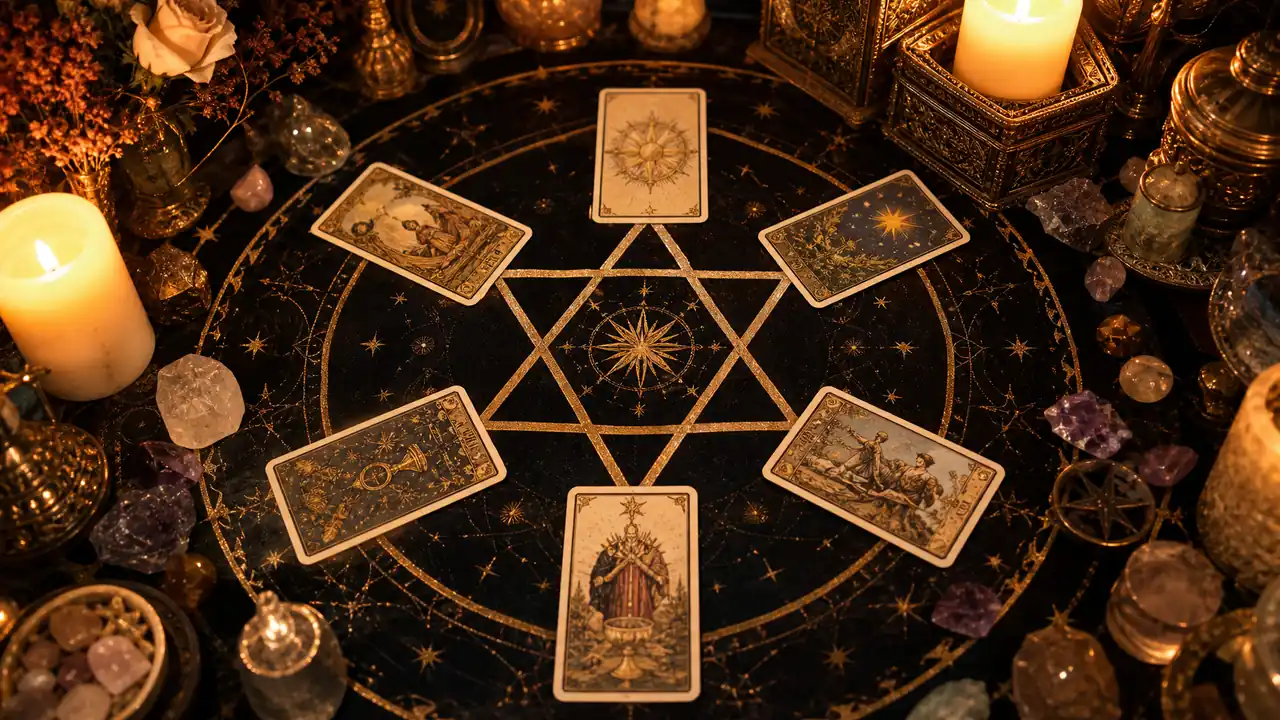
A six-pointed star spread is not just “draw six cards and get an answer.” It looks at one question from six angles: where things stand now, which forces push it forward, what holds it back, what resources you have, how the outside world is affecting it, and which direction is most worth taking next. The most common beginner mistake isn't weak card knowledge. It's not asking a clear question first, so every card seems to mean something but the reading never reaches a conclusion.
Below you'll find how to actually use the hexagram spread: the positions, the shuffle-and-draw routine, what each card is responsible for, example questions for love and work, how to fit upright and reversed cards into the overall picture, and when this spread is the wrong tool. If you're still building your card vocabulary, keep the complete guide to all 78 tarot card meanings open for cross-reference.
The hexagram spread works best for questions that are “complicated but still open to action”: whether to move a situationship forward, whether a job change is worth it, where a joint project is stuck. It isn't meant for simple yes-or-no questions, and it isn't meant for redrawing over and over when your emotions are at their peak. It gives you a structured way to judge a situation; it does not take the responsibility of choosing off your hands.
Key points: each of the six cards has its own job: present situation, obstacle, inner motive, outside influence, resources or advice, short-term direction. Before drawing, write the question as “who + situation + time frame.” Turn card five, the advice card, into one thing you can do within seven days. Card six shows a direction, not a verdict.
What the hexagram spread is for: see the whole picture, then find a direction
The point of the hexagram spread is to break one question into several angles instead of rushing toward a single answer. When you ask “Will this relationship go anywhere?” or “Should I change jobs?”, what you usually need isn't a yes or a no. You need to know why the situation looks the way it does, where the resistance is, what you can still do, whether outside conditions support you, and which way things are more likely to lean in the short term. That's exactly the kind of pressured, multi-option, what-do-I-do-next question this spread handles well.
When you read it, look at the cards individually and at how they interact. If the Five of Wands lands in the obstacle position and the King of Swords lands in the outside-influence position, the combined picture may point to competition, rules, authority or communication pressure, rather than the Five of Wands simply meaning “an argument.”
Remember one principle from the start: the hexagram spread isn't there to stamp a seal on fate. It builds a map for judgment. Think of it as a situation analysis: the cards show which forces are forming, which blind spots need correcting and which actions are likely to work. If tarot's basic structure, such as the difference between the Major and Minor Arcana, is still unfamiliar, start with the ultimate beginner's guide to tarot and come back to the hexagram spread on firmer ground.
Questions that suit the hexagram spread
The best questions for this spread usually meet three conditions: you're facing a concrete situation; more than one factor is involved; and you still have room to choose how to act. “Things with someone I'm seeing have stalled. Should I take the initiative?” suits it far better than “Do they really love me?” The first lets you look at background, resistance, resources and advice. The second squeezes the spread into a mind-reading test.
When not to rush into six cards
If your question is a plain either-or, or you mainly want reassurance, six cards can leave you more confused. The spread gives you a lot of information, and when you're unsettled it's easy to read every card as a warning and spiral into anxiety. Use one card to clarify where you are right now, or three cards for past, present and advice, then move to the hexagram once the question has a clear outline.
- The hexagram spread suits layered questions, not one-line yes-or-no answers.
- What matters isn't which card you drew but what each card answers in its position.
- The spread supports decisions about action; it doesn't hand down a fixed verdict on the future.
The six positions: every card has its own job
Tarot readers name the hexagram positions in slightly different ways, but for practice it helps to use one stable version: card one shows the present situation and the core of the issue, card two the obstacle or conflict, card three your inner motive and what you truly care about, card four the outside environment and other people's influence, card five your available resources or advised action, and card six the likely short-term direction. Each card gets a clear job, so the meanings don't overlap.
Here's how to lay it out: cards 1 to 3 form an upright triangle (card 1 at the top, card 2 lower right, card 3 lower left), and cards 4 to 6 form an inverted triangle over it (card 4 at the bottom, card 5 upper left, card 6 upper right). Together they make the six-pointed star. You'll also often see a seven-card version, usually past, present, near future, approach, surroundings and your state of mind, plus a final-outcome card in the center. Both work. What matters is deciding what each position means before you draw, and not changing it afterward.
Position | Where it sits | What it answers
1 Present situation and core issue | Top point | What is really going on right now
2 Obstacle or conflict | Lower right | Where things are most stuck
3 Inner motive | Lower left | What you truly care about and want
4 Outside influence | Bottom point | How the environment and other people are affecting it
5 Resources or advice | Upper left | What you have to work with and what you can do
6 Short-term direction | Upper right | Where things are likely to head if the current energy continues
The star shape itself also helps you read the cards as a whole. The top can stand for awareness, goals or ideals, the bottom for practical foundations, the subconscious or conditions not yet seen; the left leans toward the past and inner factors, the right toward the outside world and forces pushing into the future. It isn't the only way to read it, but a fixed structure lowers the odds of a beginner reading at random.
Don't give all six cards equal weight. Cards one and two usually set the focus; cards five and six shape the actionable conclusion. Cards three and four fill in the inner and outer factors you can't see. If card one is the Two of Cups, card two the Eight of Swords and card five Temperance, the reading may say there's a real connection, but it's stuck in self-limitation or overthinking, and the advice isn't to demand an outcome but to rebuild the flow with steadier, step-by-step communication.
Position one: the present situation and core issue
The first card answers “what is actually going on right now.” It isn't an outcome card or a card for the other person's feelings; it's the theme of the whole spread. A Major Arcana card here, such as the Wheel of Fortune, Judgement or The Tower, suggests a bigger-scale event involving a turning point, a reckoning or a structural shift. A Minor Arcana card usually sits closer to everyday interactions, choices, emotions or how resources are spent.
Position two: obstacle and conflict
The second card answers “where are things most stuck.” It isn't necessarily a bad card, and it doesn't mean someone is blocking you on purpose. The Sun in this position may point to too much optimism or too strong an urge to lay everything out; The Hermit may mean both people have retreated into their own worlds and stopped sharing. Don't equate the obstacle position with negative cards. Ask instead: is this card's energy too strong, too weak, or aimed in the wrong place?
Positions five and six: read advice and direction together
Card five is what you can do; card six is where things are likely to go in the short term if the current energy continues. Always read them as a pair. With the Knight of Wands in five and the Ten of Swords in six, pushing ahead impulsively may wear down the relationship or plan. With the Eight of Pentacles in five and The Star in six, steady skill-building and earning trust may lead to a gentler recovery and renewed hope.
- Card one sets the topic, card two finds the sticking point, card three looks inward, card four looks outward.
- Card five is the advice and card six the short-term trend; don't read them separately.
- A “good” card in the obstacle position can mean imbalance; a “hard” card in the advice position can mean facing reality.
How beginners should ask: a badly framed question blurs the whole spread
The step most often skipped with the hexagram spread is rewriting the question so the spread can actually answer it. Beginners tend to ask “Are they my soulmate?”, “Will I succeed?” or “Is this meant to be?” These sound direct, but they make the spread rigid: six cards that could analyze causes, limits and actions get forced into one verdict about destiny. A better version is “What is the current state of things between me and this person, and how could I adjust over the next thirty days?”
A good question has three parts: who, what situation, and what time frame. Who: me, me and someone, me in my current job. Situation: a stalled situationship, preparing to change jobs, negotiating a partnership. The time frame keeps card six from being blown up without limit. Ask “What will the future hold?” and it's easy to read the cards as a life sentence; ask “What's the trend over the next one to three months?” and the reading stays closer to something you can check against reality.
One more pitfall: don't make someone else's private life the main question. Tarot can look at the signals in an interaction from your point of view, such as “How should I understand their recent hot-and-cold behavior?”, but it isn't suited to a question built entirely around “Who are they really thinking about?” For love questions where you want to understand an undefined relationship more clearly, read can tarot answer questions about a situationship and shift the question from spying on the other person to seeing the interaction pattern and your own choices.
Bad questions and better versions
Common bad questions: “Will they come back?”, “Am I definitely getting the job?”, “Is this person bad?” Better versions: “What unresolved ties do my ex and I still have, and if I want to reach out again, what should I watch for most?”, “What are the strengths and obstacles in my job search right now, and what should I strengthen over the next two weeks?”, “Where are the risks in working with this partner, and how should I set boundaries?” Change the question and the hexagram spread can do real analysis.
How to set the time frame
The hexagram spread is best for short- to mid-term judgment: two weeks, a month, three months, or one decision cycle. Use about thirty days for a love interaction, one to three months for a work project, and up to the date of the exam or interview for those. A time frame doesn't limit tarot; it keeps you from misreading short-term energy as lifelong fate.
- A good question has a who, a situation and a time frame.
- Turning “will it happen?” into “what's the current state and what can I do?” makes the reading far more useful.
- Don't use the spread as a mind-reading or snooping tool.
Doing the reading: from shuffling to a combined conclusion
Before you start, write the question down rather than holding a vague version in your head. Writing it lets you check whether it's too broad, too rushed or too focused on controlling the outcome. Then set the time frame so you're looking at a specific period, not forever. While shuffling, keep your attention on the question; you don't need a mysterious ritual. What matters is being steady, focused and consistent. After drawing, lay the cards out in a fixed order, and don't start over because you dislike a card.
Read in three rounds. In round one, just note a few gut keywords for each card without drawing conclusions. In round two, put each meaning back into its position: The Moon in the outside-influence position may mean unclear information, an opaque environment or people whose stance is uncertain, not a flat claim that someone is lying. Only in round three do you connect the cards and find the main thread. That thread should answer: what's happening, where it's stuck, what you can do, and where it may go if nothing changes.
Whether you use reversals is up to you, but there's no need to read them as frightening at first. A reversal is often seen as energy that's blocked, turned inward, delayed, excessive or lacking. If you're practicing reversals, start from the card's upright core, then ask: “In this position, is that energy flowing, stuck, or pointed the wrong way?” To strengthen your basics, pair this with tarot reversals made easy for beginners.
Suggested drawing and note-taking steps
Keep the routine fixed: write down the question and time frame; shuffle and cut; draw six cards in order without skipping or adding; photograph or note the cards; write three keywords per card; finish with one paragraph of combined judgment. Notes matter a lot, because in the moment beginners are often carried by emotion and later realize they only remembered the parts they wanted to hear.
When it's fine to draw a clarifier
Clarifier cards aren't forbidden, but they need a clear purpose. If a key position shows something very ambiguous, such as The Moon, the Seven of Cups or The High Priestess, you can draw one more card to ask “Which layer is this fog coming from?” Don't keep adding cards because you dislike card six. That breaks the spread's structure and makes you lean on drawing instead of judgment.
- Record first, interpret second; single cards first, then the whole.
- A clarifier can only clarify; it shouldn't overturn the original spread.
- A reversal can be read as blocked, delayed, internalized or unbalanced energy.
Worked examples: reading love and work with the hexagram spread
These examples don't lock each card into one fixed answer; they show how to combine position, meaning and the context of the question. Suppose a love question asks: “The person I've been seeing has been in touch less lately. Should I push things forward over the next thirty days?” The cards: present, Two of Cups; obstacle, Eight of Swords; inner motive, The Lovers; outside influence, Four of Pentacles; advice, Temperance; direction, Three of Wands. This spread shouldn't be read as whether they love you. It shows a relationship with a real basis for connection that is currently held back by anxiety, caution and questions of security.
In this love example, the Two of Cups as the present suggests there has been mutual feeling or attraction. The Eight of Swords as the obstacle points to what may be trapping the relationship: guessing, fear of saying the wrong thing, over-reading messages. The Lovers in the inner position suggests what you really care about is choice, confirmation and defining the relationship. The Four of Pentacles in the outside position may mean the other person or the circumstances are cautious and reluctant to take quick risks. Temperance as advice doesn't mean simply waiting; it's a reminder to restore contact in a steady, gentle, step-by-step way. The Three of Wands as the direction suggests that, handled well, there's still room to watch and expand.
Now a work question: “Should I change jobs within three months?” Suppose the cards are: present, Ten of Wands; obstacle, The Emperor; inner motive, The Star; outside influence, Six of Swords; advice, Eight of Pentacles; direction, Wheel of Fortune. The core here isn't simple encouragement to quit. It points to an overloaded present and heavy pressure from organizational rules or management, while inside you're hoping for a direction with more hope and long-term growth. The Six of Swords in the outside position shows real signs of movement, adjustment and leaving an old pattern, but the Eight of Pentacles as advice says that before switching you need to build up your portfolio, resume, skills or interview prep. The Wheel of Fortune in the direction position suggests a turning point may come within three months, but whether it becomes a good opportunity depends on whether you're ready to catch it.
Details for love questions
The biggest mistake with love questions is grabbing one card and declaring a verdict. The Lovers doesn't automatically mean you'll end up together, and The Devil doesn't automatically mean there's no love. Look at the position. The Lovers in the inner-motive spot may be your longing for choice and commitment; in the outside-influence spot, both of you may be facing options; only in the direction spot does it look more like an upcoming point of choice in the relationship.
Details for work questions
With work questions, pay special attention to the balance of Pentacles, Wands and Swords. Many Pentacles usually involve pay, resources, stability and practical results; many Wands point to drive, ambition, competition and pushing projects forward; many Swords relate to communication, systems, contracts and the pressure of decisions. A high share of Major Arcana suggests the decision may be about more than a work task, possibly a shift in life stage or values.
- Read examples by position; don't treat a single card as a fixed answer.
- Love readings are about interaction patterns and timing, not only the other person's feelings.
- Turn work readings into concrete steps on your resume, skills, communication and risk management.
The most common beginner mistakes: scattered, overstuffed and fatalistic readings
The first common mistake is reading the six cards as six unrelated mini-stories. You see the Three of Cups and think of a party, the Nine of Swords and think of anxiety, The Sun and think of a happy ending. Without returning to each position's job, the spread becomes a collage of keywords. Each card has to answer its position's question: is it describing the present, the obstacle, the inner side, the outer side, the advice or the direction? Once the jobs are clear, the meanings stop drifting apart.
The second mistake is reading too much. Beginners often pour every symbol of every card into the interpretation, so one card ends up meaning a dozen things and nothing has priority. A tarot reading isn't a display of how many meanings you know; it's choosing the signals most relevant to the question. For a job change, The Empress may lean toward nurturing resources, a comfort zone or a supportive environment; for a situationship, toward attraction, acceptance and waiting for the other person to come closer. Card meanings serve the question, not the other way around.
The third mistake is reading the direction card as unchangeable fate. In practice, a spread is more a reflection of current conditions. Card six shows “the direction more likely to appear if the current energy continues,” not a verdict you can't change. The hexagram spread has an advice position precisely because you can shape what happens next through action. If the advice position clearly says to communicate, prepare, slow down or set boundaries, don't just stare anxiously at the outcome card.
Don't let drawing cards replace a conversation
This shows up most with love questions. You might keep drawing to ask what the other person thinks without sorting out what you want, what you can accept and how you plan to say it. The hexagram spread can show you the structure of an interaction, but it can't have a necessary conversation for you. When Swords, Judgement, Justice or Temperance keep appearing, they're often a nudge toward clearer communication and boundaries.
Don't use clarifiers to change the answer
Many beginners who dislike the direction card keep adding cards until a more comforting one appears. That only undermines the reading's credibility. A clarifier should work like a magnifying glass, sharpening one card's layer, not like an eraser rubbing out the original message. If you badly want to redraw, it usually means you need to deal with your emotions first, not ask again.
- Bring each meaning back to its position's job instead of making a keyword collage.
- Pick the priority signals; don't cram every symbol into one paragraph.
- The direction card isn't fate; the advice position is your way to change the situation.
Limits of the hexagram spread: questions it isn't suited for
The hexagram spread is useful, but not for every question. Medical diagnoses, legal outcomes, investment returns, monitoring other people's private lives and serious safety risks shouldn't be decided by tarot alone. Tarot can help you sort through your state of mind, your sense of risk and your options, but it can't replace a doctor, lawyer, financial professional or emergency support. If the cards show heavy stress, with the Nine of Swords, The Moon or The Tower showing up repeatedly, get real-world support first instead of asking about outcomes again and again.
Another limit: the hexagram spread asks the reader to have some basic ability to combine cards. If card meanings are completely new to you, six cards can be too much. Start with three cards for “situation, obstacle, advice,” then add inner, outer and direction once you're comfortable.
Watch out for repeat readings, too. If you ask the same thing with the hexagram spread every day, what you get usually isn't a sharper answer but a trace of your anxiety. A better approach is an observation period: for example, one draw per question within thirty days, turning the advice position into action in the meantime, and only reading again after you've actually tried something new and the situation has clearly changed. That keeps tarot from becoming a tool for checking your emotions.
Pair big decisions with real-world information
When the question involves quitting, moving, breaking up, signing a contract or a large sum of money, the hexagram spread can help you see risks and blind spots, but you still need real data. For a job change, look at pay, duties, industry outlook and contract terms; for a relationship, look at the other person's actual behavior, willingness to communicate and differences in values. Tarot reminds you to notice patterns; it doesn't let you skip checking the facts.
Pause when your emotions are overflowing
If before drawing you're already panicking, losing sleep, feeling strong urges or checking compulsively, you may read the spread as even more pressure. Sort out your emotions first: write down the three things you fear most, the one thing you most need to confirm, and one small action you can take today. Once you're steadier, draw the cards; the reading will be far clearer.
- Medical, legal, investment and safety issues can't be judged by tarot alone.
- Don't redraw the same question daily; act on the advice first, then observe.
- When you're emotionally overloaded, steady yourself before using the spread.
After the reading: turn the cards into your next step
The real value of the hexagram spread is that it turns vague anxiety into a next step you can carry out. After the reading, don't just remember whether the outcome looked good. Sort the reading into three columns: what I see, what I need to stop, and what I'll do next. If the Eight of Swords sits in the obstacle position, you can stop filling in stories in your head; if Temperance is the advice, you can plan one low-pressure, clear conversation that doesn't disrupt the other person's pace; if the Three of Wands is the direction, you can give each other an observation period instead of demanding an immediate decision.
In practice, turn card five, the advice card, into one action you can finish within seven days. The Eight of Pentacles could mean updating your resume, working on a portfolio or setting up a practice schedule. The Queen of Swords could mean writing down your boundaries, checking the facts and stating your needs in clear language. The Six of Cups could mean returning to what mattered at the start, repairing trust and reconnecting gently. The Two of Wands could mean mapping out a route before rushing out the door. The more concrete the action, the less the reading stays stuck as an abstract feeling.
Finally, look back at your notes after the observation period ends rather than immediately judging whether the reading was “right.” Ask yourself: did the obstacle actually show up? Did you carry out the advised action? How did the situation change afterward? Did card six appear as an event, a mindset, or the mood of the relationship? This kind of review deepens your understanding of the cards and turns the hexagram spread from a ritual into a steady tool for your own judgment. Next time, write the question and time frame first, read by position after drawing, and turn the advice card into one doable action. That's the steadiest path for a beginner.
- After reading, sort it into three columns: see, stop, act.
- Turn card five into a concrete step you can finish within seven days.
- Review your notes after the observation period to build real reading skill.
References
Now that you know the method, the quickest practice is to draw for a question you genuinely care about, then compare it with the reading to see what you can already pick up and what you hadn't thought of yet.
Draw for your own question