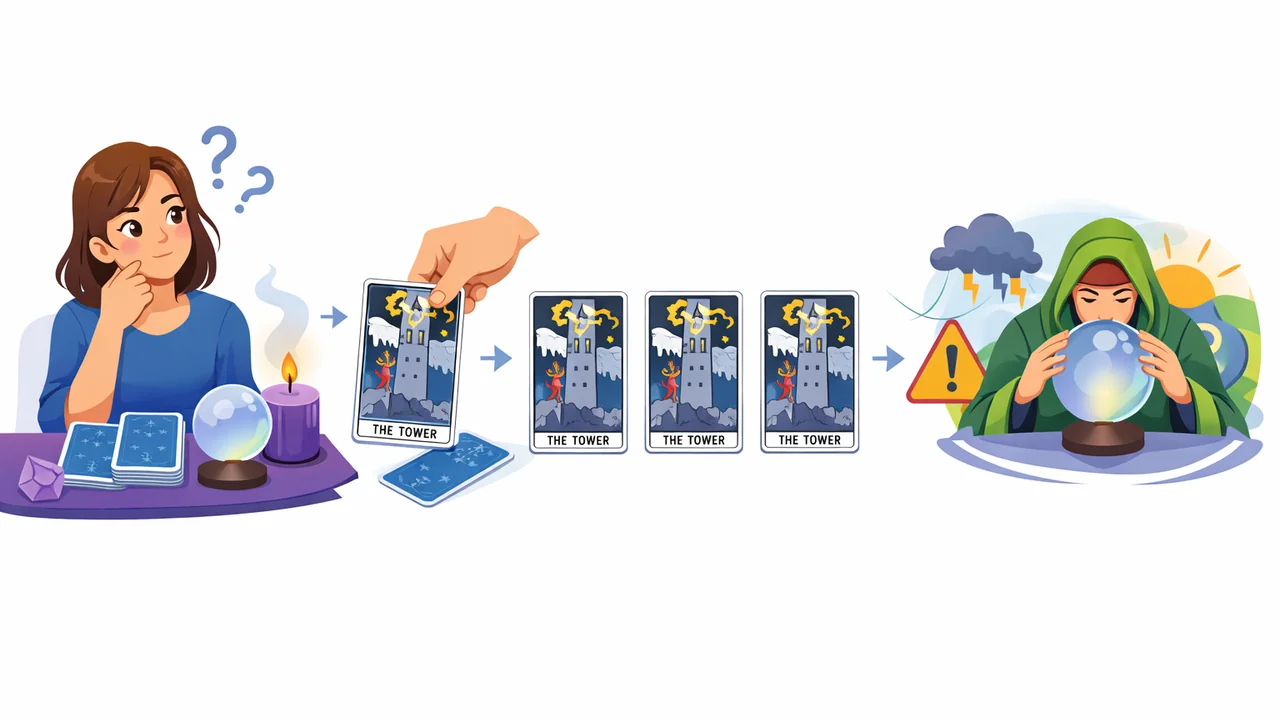
When the same tarot card keeps appearing, the most direct reading is not 'fate demands you obey.' It means one theme keeps coming back. You may not have fully understood what the card is pointing to, you may already know the answer but haven't acted on it, or you may be asking similar questions over a short period, so the cards keep reflecting the same state of mind.
You can't judge this from the card alone. Look at which questions it appears in, which spread positions it lands in, whether it is upright or reversed, how it relates to the cards around it, and how settled you felt when you asked. If you're still learning the basic meanings, check the complete guide to all 78 tarot card meanings first, then come back here for the deeper reading.
This guide takes a practical approach to common situations: the same card showing up in love readings, a work question that keeps producing the same card, pulling it again on the same day, different spreads pointing to one card, and knowing when to stop reading and start journaling and acting instead.
In short: this guide helps you tell whether a repeating tarot card is a meaningful signal, shuffling chance, a repeated question or anxiety showing through. It then uses spread position, upright or reversed orientation, layers of card meaning and concrete action to show how to read the card, how to ask follow-up questions and how to keep your readings from getting more confusing.
The short answer: what a repeating card is usually pointing to
When the same tarot card keeps appearing, it usually means one of three things. First, the theme of that card is central to your life right now. Second, you haven't taken clear enough action on the matter, so the cards keep pulling the focus back to where you started. Third, your questions are more alike than they look: the wording changes, but underneath you are chasing the same answer. These readings aren't mutually exclusive, and in practice they often overlap.
Take the Two of Swords appearing again and again in love readings. It doesn't only mean the other person hasn't decided; it may mean you are avoiding a choice yourself. The Eight of Wands repeating in career readings doesn't necessarily promise that things will move fast; it may warn that information is moving quickly and details need checking early. Either way, a repeating card usually narrows your focus. It isn't there to add mystery.
In the common pictorial deck tradition, the imagery itself tells a story: figures, posture, objects, backgrounds and direction all help you grasp the meaning. When one card keeps returning, don't ask whether it's strange. Ask whether its image keeps pointing to the same stance, such as waiting, avoiding, starting, imbalance, holding back, breaking through or wrapping up.
A repeating card is not a prophecy
Pulling the same card again and again doesn't mean something is bound to happen. Tarot works more like a symbolic mirror: it helps you see the current shape of your situation and where it might be heading. If you ask 'Will they come back?' and keep getting Judgement, it can be read as revisiting the past, reassessing the relationship or facing old history. It doesn't mean the other person will definitely reach out. You still need to consider whether you can communicate, why you separated, how you interact now and what the rest of the spread shows.
It may also mean your questions are too similar
Many people think they're asking different questions when they're really asking the same one. 'Do they like me?', 'Are they thinking of me?', 'Will they contact me?' and 'Do we have a chance?' sound different, but each one is trying to confirm the other person's feelings and where the relationship is going. If you draw on these questions repeatedly over a short time, a repeating card may not be the universe raising its voice. Your anxiety may simply be locking every question into the same frame.
- Treat the repeating card as a focus cue, not an absolute command.
- Check whether you've been asking the same question in different words.
- Read the card through its spread position and your real situation.
A framework: question, spread position and layers of meaning
To work out what a repeating tarot card means, start by writing down the question behind every draw. Don't just remember 'The Lovers again.' Record whether you were asking about a choice, love, work or your own state of mind. The same card does different work in different questions. In a choice question it may be about weighing values; in a love question, attraction, defining the relationship or temptation; in a self-reflection question, bringing your inner and outer needs together.
Next, look at the spread position. The same card in 'present', 'obstacle', 'advice' or 'outcome' reads very differently. Say the Four of Cups keeps coming up. In the present position it may mean emotional numbness or not seeing the options in front of you; as the obstacle, an unwillingness to receive kindness; as advice, a prompt to pause before reacting and re-examine what you actually want. That gets closer to a real reading than looking up a meaning.
Third, consider the layer of meaning. The Major Arcana usually points to bigger life themes or psychological processes, while the Minor Arcana tends to deal with everyday events, habits and specific interactions. A recurring Hermit may point to long-term inner searching and withdrawal; a recurring Seven of Swords is more about hidden information, strategy, self-protection or avoidance. To sort out the difference, use the 22 Major Arcana meanings explained alongside the quick reference to the 56 Minor Arcana cards.
First: are you asking about events, them or yourself?
A repeating card often signals that your question is aimed at the wrong place. Suppose you keep asking whether the other person will make a move, yet Strength keeps appearing. The card may not describe their next step at all; it may describe how you need to handle desire, waiting and pride more maturely. If the question points outward but the cards keep showing self-regulation, try asking 'What do I most need to adjust right now?' instead of pressing for their next move.
Then: the position sets the tone
A repeating card isn't saying the same sentence every time. If Death first lands in the obstacle position, it may show resistance to an ending; in the advice position next, a need to cut off an old pattern yourself; in the outcome position after that, a clear transformation ahead. Link the positions together and read them like one continuing story, not as separate answers.
Finally: upright or reversed?
If you read reversals, orientation matters when a card repeats. Upright often means the card's energy is flowing naturally; reversed may mean delay, excess, turning inward or blockage. The Sun upright generally reads as cheer, clarity and hope; reversed it isn't necessarily bad, but may mean joy is muted, confidence is low, or the answer is already obvious and you aren't ready to admit it. If you're new to reversals, read everything upright for now so you don't over-interpret.
- Record the exact wording of every question so you don't reinterpret it later.
- A repeating card means more than its keywords; its position matters too.
- A repeating Major Arcana card usually signals a core theme rather than a passing event.
Common mistakes: don't read a repeating card as an absolute command
The most common mistake is treating a repeating card as 'fate has spoken.' Tarot offers symbols, reminders and angles to consider, but it can't replace real decisions. If The Devil keeps showing up in love readings, it doesn't mean you're doomed to stay entangled, or that the other person means you harm. It may point to attachment, desire, control, compulsive dynamics or a pattern you know is unhealthy but find hard to leave. Treating the card as an order takes your choices away from you.
The second mistake is relying only on keywords: The Tower means a breakup, collapse or failure; The Lovers means true love, reunion or destiny. Reading tarot isn't keyword matching; it's reading context. Traditional symbolism emphasizes structure and correspondences, but a practical reading still has to come back to the question, the position, the surrounding cards and the person asking. No card comes with a fixed verdict.
The third mistake is redrawing over and over until you get the card you want. This makes you more anxious and muddies the information. If the same card has already appeared two or three times, stop and ask instead: what does this card want me to see? Do I already have a next step I could take? If not, draw an 'advice card' or a 'blind spot card' rather than asking the same question again.
Mistaking coincidence for punishment
A repeating card can be striking, but there's no need to read it as a punishment, a warning or a force you can't resist. A deck has a limited number of cards, and repeats are entirely possible, especially with small spreads, frequent draws or a deck that isn't shuffled thoroughly. A healthier view is to accept that the card may carry symbolic meaning while also allowing for basic probability and how you handle the deck. The two don't contradict each other.
Assuming repetition makes the answer stronger
Repetition doesn't necessarily mean more intensity. It may just mean your question hasn't changed. If you asked 'Should I quit my job?' yesterday and got The Hanged Man, then asked 'Is staying in this job good for me?' today and got The Hanged Man again, it may not be reinforcing an outcome. It may be showing that you're still stuck in the same suspended state: unclear, unable to move, needing a new angle. Instead of asking again, break down why you're stuck.
- Don't treat a repeating card as an unchangeable forecast.
- Don't replace a full reading with one keyword.
- Don't keep redrawing the same question out of anxiety.
In practice: steps for reading a repeating card
When a card repeats, don't draw again right away. Start with a four-column log: time, exact question, spread position and how you felt. Those four columns show why the card is really repeating. If you notice you were anxious, sleepless or desperate to know someone's feelings every time you asked, the cards are likely reflecting that state. If the same card turns up across different times, topics and spreads, it's more worth treating as your core theme for now.
Then break the card into three layers: the surface event, your inner state and the suggested action. Take the Nine of Wands. The surface event may be a situation that's exhausting but not over yet; the inner state is defensiveness, vigilance, still standing after being hurt; the action is to hold your boundaries, check your resources and not give up at the last stretch. That's far more useful than the single word 'struggle,' and it gives you a next step.
Finally, if you want to know which layer the card is speaking to, don't repeat the original question. Ask a sharper follow-up. If 'Will they come back?' brought Judgement, follow up with 'What in this relationship most needs to be faced again?', 'If I reach out, what should I be most careful about?' or 'What pressure is the other person facing about this relationship?' The point of a follow-up isn't to force a promise from the cards; it's to turn a vague signal into something you can judge.
Step one: stop redrawing and write it all down
The second time you draw the same card, pause for at least a few minutes and write down the question and the cards. Many misreadings don't come from inaccurate cards; they come from remembering only the feeling and not the exact question. Don't polish it: if you asked 'Do they not love me at all?', write that down rather than 'How is our relationship developing?' The tone of the question is itself a clue.
Step two: find the card's core verb
Every card can be summed up with a core verb that moves you from abstract meaning to action. The Chariot is to push forward and steer; The High Priestess is to observe quietly and let information surface; the Knight of Pentacles is to execute steadily; the Three of Swords is to acknowledge pain and cut through to the truth. When a card repeats, ask: what action is it asking of me? Stop, choose, talk, close, take responsibility or let go?
Step three: turn the meaning into one testable action
A useful reading has to land somewhere real. If Temperance keeps appearing, the action might be holding off on an impulsive message, adjusting your routine, communicating more gently or giving both of you some breathing room. If Justice keeps appearing, it might mean checking a contract, clarifying responsibilities or putting verbal promises in writing. You don't need a grand life answer. Just complete one small action you can test in real life.
- After the second repeat, log it before you draw again.
- Split the meaning into event, mindset and action.
- Narrow your follow-ups; don't rephrase the same question.
Different situations: love, work, money and personal growth
In love readings, a repeating card most often reflects a pattern of interaction, not just the other person's feelings. If The Moon keeps appearing, common signals include ambiguity, too much guessing, projection, fear of the truth coming out, or missing information in the relationship. Rather than asking 'Do they love me or not?', ask 'What am I not seeing clearly right now?' or 'What kind of clear communication is missing between us?' If you're in an undefined situationship, read can tarot help with an ambiguous relationship.
In work readings, a repeating card usually points to your career situation or a blind spot in a decision. A recurring Eight of Pentacles may mean building skills, long-term effort and attention to detail, or it may mean being stuck in repetitive work with no path forward. A recurring Five of Wands may mean competition, clashing opinions, fighting over resources or a team where everyone wants to lead. Shift your question from 'Will I succeed?' to 'Which skill should I strengthen?' or 'What is the real source of this conflict?'
In money readings, be especially careful not to make impulsive decisions. The Four of Pentacles isn't only about holding on to money; it may point to insecurity, over-control or fear of loss. The Wheel of Fortune doesn't mean you can leave your finances to luck; it reminds you that circumstances shift, cycles turn and risk needs managing. Tarot can help you see your attitude and possible directions, but investments, legal matters, health or major contracts still call for professional information and a realistic look at the risks.
Love: their signal or your attachment pattern?
In love readings it's tempting to read every card as the other person's feelings, but a repeating card sometimes points to your own attachment response. If the Nine of Swords keeps coming up, you may think they are causing your pain, when the card may be showing that you keep spiraling in your head, losing sleep and treating the worst case as fact. Try asking 'Which of my thoughts lack evidence?' or 'How can I get myself back to steady ground first?'
Work: a task reminder, career direction or team dynamics?
With work questions, sort out which layer a repeating card belongs to. A recurring Emperor may mean a manager, systems, authority or management, or a reminder that you need to set rules. A recurring Fool may mean a new start, risk-taking and exploration, or not being prepared enough. If you're changing jobs, cards like these can't decide whether to stay or go on their own; weigh them alongside pay, the role itself, team culture and how much you can handle.
Personal growth: often more important than the event
Some repeating cards aren't answering an outside question at all; they reveal the inner work you keep running into. The Empress may keep reminding you about self-care, your body, creativity and receiving; The Hermit may ask you to step away from outside noise and return to your own judgment. When one card appears across love, work and relationships alike, it's usually about more than one event. It reflects the theme of this stage of your life.
- A repeating card in love readings may describe your reactions, not just theirs.
- Break a repeating work card into tasks, authority, people and direction.
- A repeating card about money can support reflection but not replace risk assessment.
Limits: when to stop redrawing or change the question
Once you've drawn on the same matter more than twice and the core of the question hasn't changed, stop drawing. Tarot is at its worst when it feeds anxiety: the more you crave a certain answer, the more likely you are to read every card as a crisis or a promise. If the same card keeps coming back, you already have enough to start processing it. Drawing more usually just complicates a message that was already clear.
Another sign to stop is when you start using cards in place of real conversations: wanting to know if your partner is unhappy but not bringing it up, wanting to know if your manager values you but not reviewing your performance and career needs, wanting to know if a friend is drifting away but not noticing how you actually interact. Tarot can help you work out how to ask and how to face things, but it can't forever ask the other person the real question for you.
Tarot also isn't suited to certain high-stakes judgments: diagnosing illness, guaranteeing investment returns, predicting the outcome of a legal case or intruding on someone else's privacy. If a repeating card involves health, law, financial security or personal safety, treat it only as a cue to take stock and seek professional help, never as your only basis for a decision.
Three situations where you should stop reading now
First, you know you only want a reassuring card. Second, every card makes you more afraid. Third, you're about to let the cards replace something you actually need to do. In these states, more draws won't bring clarity and may cost you your judgment. Rest, write things down and look again tomorrow, or turn the question toward action, such as 'What is one thing I can do today to steady myself?'
Changing the question beats redrawing
If the original question was 'Will they come back?', try 'If I want to reconnect, what boundary matters most?' If it was 'Will I succeed?', try 'What is affecting the outcome most right now?' A good question turns the cards into a decision tool rather than a source of comfort. Once the question is sharper, even if the same card appears again, you'll know much more clearly where it applies.
- Avoid redrawing the same question in a short period.
- If drawing makes you more anxious, stopping matters more than asking again.
- High-risk matters call for the right professional; don't let a card replace your judgment.
Going further: turn the repeating card into an action plan
A mature reading doesn't stop at 'what this card means'; it turns the card into a plan you can carry out. When one card keeps appearing, make it a 'theme card': write down the card's name, how often it has appeared recently, which questions it came up in, the shared feelings, the shared advice and the actions you can take. That turns a mysterious event into a tool for tracking yourself.
Say Temperance keeps appearing. Your theme card might note that the shared feelings are urgency, fear of losing control and wanting to know the result now; the shared advice is to slow down, integrate and adjust your pace; the actions are no impulsive messages for three days, writing down what you really want to say first, and having one calm but clear conversation instead of testing the waters. If things change after a week, draw again to check the new situation, rather than asking the same question every day.
If you use a Marseille-style deck or a pictorial deck, compare how the different imagery shapes your understanding. Pictorial decks lean on storytelling and suit beginners who learn through figures and scenes; Marseille-style decks lean on structure, numbers and suit logic. Whichever you use, the point of a repeating card isn't to marvel at a coincidence. It's to see how the same pattern replays across different questions and find a concrete way to break it.
The repeating-card action sheet: three levels
Split your action sheet into three rows: what I see, what I need to stop and what I'll do next. With the Two of Swords: I see that I'm avoiding a choice; I need to stop using more information to delay deciding; next, I'll list my non-negotiables for both options and set a deadline. A sheet like this moves the card from a feeling to an actual change.
A one-week observation period instead of daily redraws
If a card keeps appearing, give yourself a week to observe. During that week, don't ask the same question again; just note which events in your life echo the card. You may find the Seven of Swords shows up when you're afraid to tell the truth, the Six of Cups when you keep dwelling on the past, the Two of Pentacles when your schedule is off balance. That shows you far more about how the card plays out in your life than redrawing every day.
- Make a theme card to track how the repeating card plays out in your life.
- Turn the meaning into things to stop and a next step.
- Use an observation period instead of asking the same thing daily.
References
If a card keeps showing up for you too, bring the same question and draw again. Look at the position, upright or reversed orientation and your current situation together to shape a reading that helps with your next step.
Start a Tarot Reading